

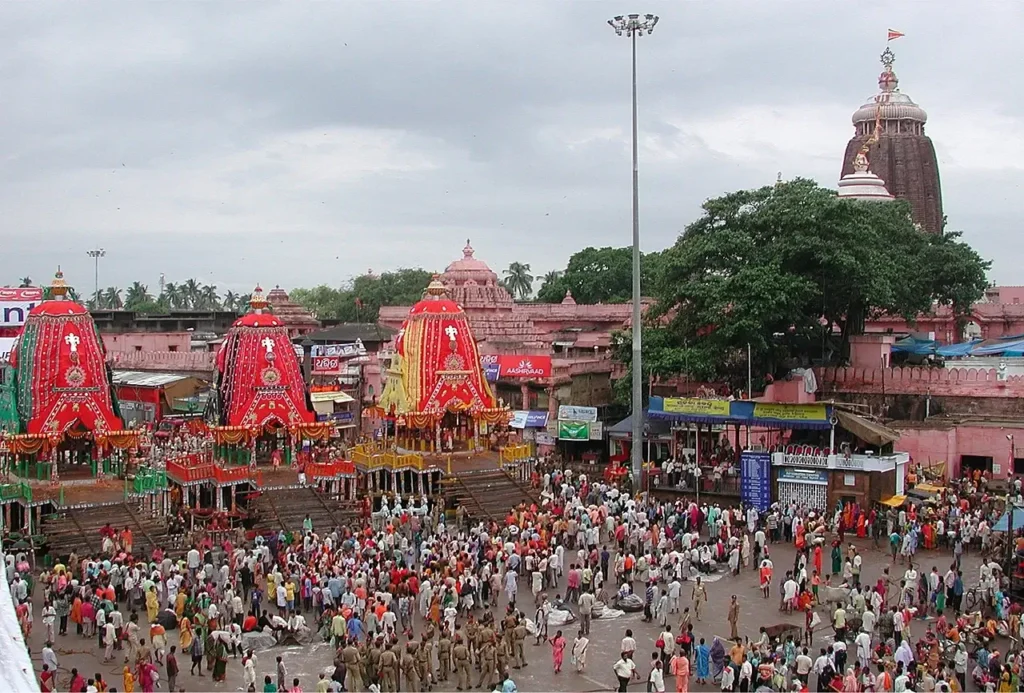
Built by King Indradyumna, the Shree Jagannath Temple in Puri, Odisha, on the eastern coast of India is a major Hindu pilgrimage site dedicated to Lord Jagannath, a form of Lord Vishnu, the “Lord of the Universe”. The temple is one of the Char Dham pilgrimage sites and is renowned for its massive annual Rath Yatra (chariot festival) which honours the three deities – Lord Jagannath, Lord Balabhadra and their sister Subhadra as well as the sacred Mahaprasad which is served to thousands of devotees daily.
The temple is renowned for its annual chariot festival or Ratha Yatra honouring the three principle deities worshipped in the temple namely Lord Jagannath, Lord Balabhadra and their sister Subhadra. The inner sanctum of the temple sanctum contains the deities Sudarshana Chakra, Madanmohan, Sridevi and Vishwadhatri.
The deities in the temple are adorned with different clothing and ornaments according to the season. Their worship predates the construction of the shrine.
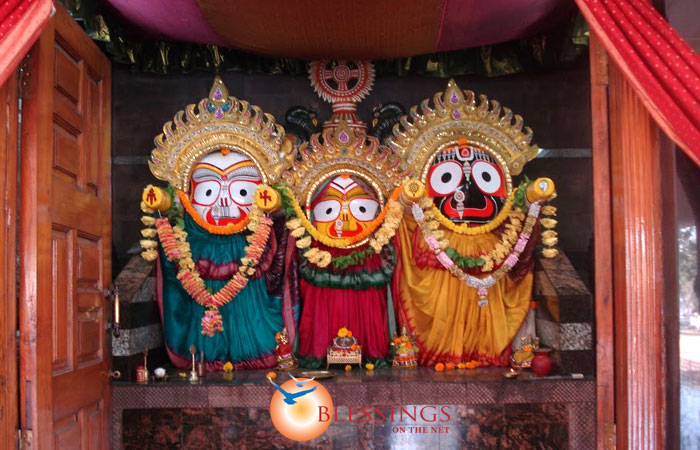
The earliest known reference to Lord Jagannath appears in the Oddiyana Vajrayāna Tantric text by Indrabhuti, which begins with an invocation of the deity. In Sarala Mahabharata, Sarala Das presents Lord Jagannath in multiple forms, emphasising his connection to Krishna. He also described Lord Jagannath as being one with Krishna, Rama, and Buddha, reflecting a synthesis of the different faith and traditions.
During the festival, the three principal deities are pulled on large, elaborately decorated raths, or temple cars. The worship is performed by the Bhil Sabar tribal priests, as well as priests of other communities in the temple.
Unlike the stone or metal icons found in most Hindu temples, the image of Lord Jagannath is carved from margosa wood, which is ceremoniously replaced every 12 or 19 years with an identical and elaborate replica during a month-long ceremony called nabakalebar.
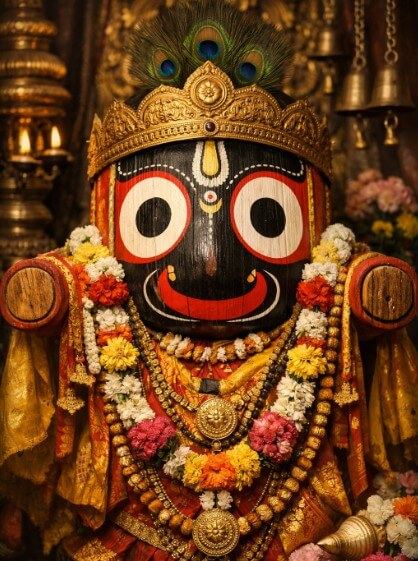
The temple is sacred and holy to all Hindus, especially the followers of Vaishnava traditions.
Many great Vaishnava saints like Chaitanya Mahaprabhu, Ramanujacharya, Madhvacharya, Nimbarkacharya, Vallabhacharya and Ramanandwere were closely associated with the temple.
Sage Ramanuja established the Emar Matha in the south-eastern corner of the temple, while Adi Shankara, also called Adi Shankaracharya an Indian Vedic scholar-monk, philosopher, and teacher of Advaita Vedanta established the Govardhan Math — the seat of one of the four Shankaracharyas. He also wrote influential commentaries on the Brahma sutras and other texts, and in recent times is often revered as the most important Indian philosopher.
It may be mentioned that Chaitanya Mahaprabhu the founder of Gaudiya Vaishnavism was particularly attracted to the deity Jagannath and lived in Puri for many years.
The main temple, one of the 108 Abhimana Kshetrams is revered in the Sri Vaishnava tradition, is traditionally associated with King Indradyumna of Avanti. The present temple complex on the site of the earlier shrines, excluding the main Jagannath temple was rebuilt from the eleventh century onwards by Anantavarman Chodaganga
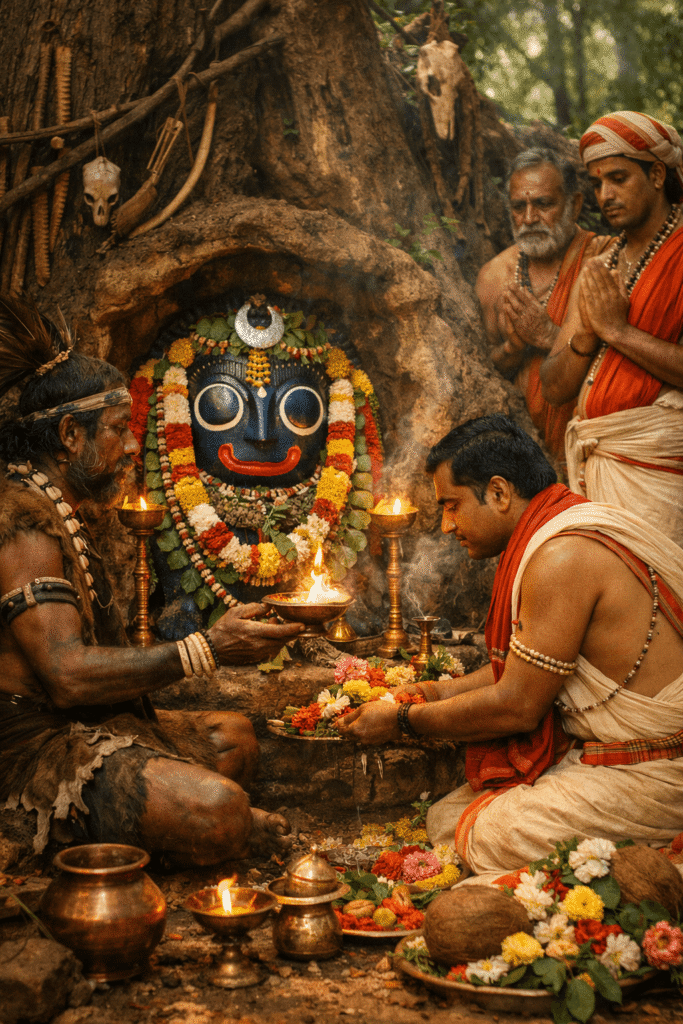
Many of the temple rituals retain elements of the Shabara tantras, which has its roots in tribal beliefs and practices. The local legends link the idols with Nilamadhaba deva worshipped by tribala and the daitapatis (servitors) claim to be descendants of the tribes.
As per local legend Lord Jagannath was worshipped as Nilamadhava by the Savara tribal chief Visvavasu, while the Daitapatis— temple Sevayat or group of hereditary temple servants who manage vital administrative, logistical, and ritual operations in a structured hierarchy are traditionally regarded as descendants of the Savara tribes.
It was supposed to be the tallest monument dedicated to Lord Jagannath in the world measuring 1,000 cubits (457.2 meters) in height.
It has been widely believed that despite being without hands, the deities can watch over the world and be its lord.
(To be continued)