

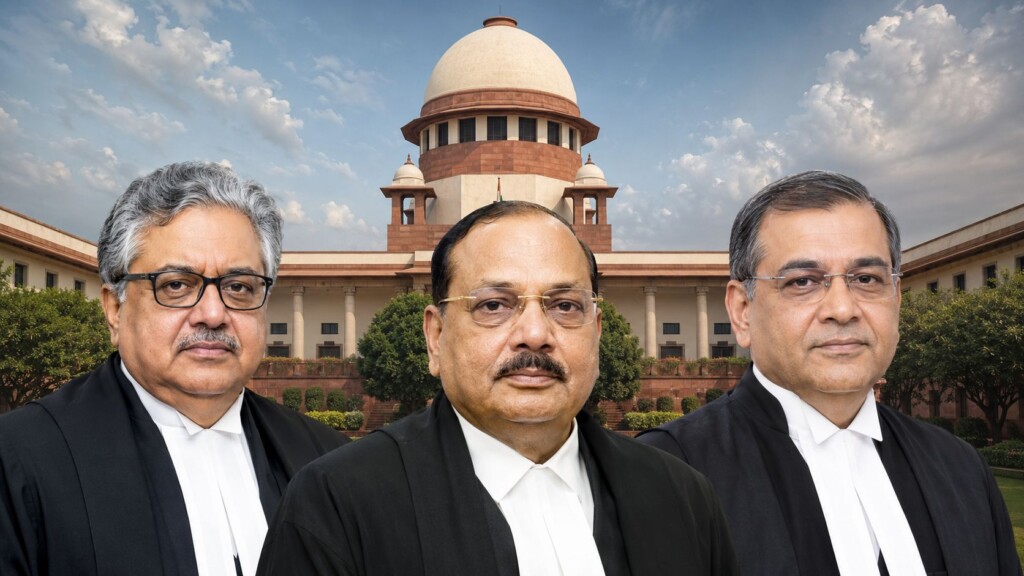
In an extraordinary and unsparing courtroom discourse on February 26, 2026, a Supreme Court Bench led by Chief Justice Surya Kant (alongside Justices Joymalya Bagchi and Vipul M. Pancholi) delivered what is perhaps the most scathing judicial indictment of India’s tribunal system since independence. The Apex Court did not merely lament administrative delays; it laid bare a deep-seated systemic rot, explicitly characterising the country’s quasi-judicial bodies as a chaotic “no-man’s land.” Directing his remarks with absolute candour at Attorney General R. Venkataramani, Chief Justice Surya Kant remarked, “Mr. Attorney General, tribunals are your [the Centre’s] creation, and they have become a headache. They are a headache for you and a liability for us… These tribunals have become a no-man’s land. They are not accountable to anyone.”
The Bench went on to express profound alarm over a complete collapse of institutional accountability and ethical standards, revealing a shocking trend where certain non-judicial, technical members of major tribunals were caught “outsourcing the writing of judgments” to external entities. The Court flagged this practice as a fatal compromise of judicial integrity, noting that letting individuals with zero constitutional accountability secretly author binding legal orders undermines the very foundation of the rule of law. Furthermore, the Bench heavily criticised the executive’s management of these bodies, frowning upon the chaotic practice where technical members routinely step into the role of acting Chairpersons upon the superannuation of judicial heads. The Court labelled the entire apparatus a functional “mess” that has failed its national purpose, calling out a flawed design where members are expected to build specialised subject-matter expertise within rigid, truncated four-year tenures, only to be cast aside or left in bureaucratic limbo.
While these severe oral observations were triggered by the ongoing constitutional gridlock surrounding commercial, telecom, and financial tribunals, nowhere is this institutional malaise, executive apathy, and structural lack of accountability more visibly damaging today than in the Central Administrative Tribunal (CAT). Originally conceived under Article 323A of the Constitution to provide a speedy, inexpensive, and highly efficient alternative forum for government servants, the CAT has instead devolved into a sluggish gridlock of mechanical adjournments – with tragic and irreversible consequences for the very veterans who spent their lifetimes defending the nation’s integrity.
A 22% Casualty Rate: Waiting for Justice Until the End

A poignant example of this institutional decay is currently playing out in the Principal Bench of CAT, New Delhi. Two critical cases concerning the Rectification of Pension, filed by the Forum of Retired IPS Officers (FORIPSO), have been hanging fire since 2018. Compounding this backlog, a third related case filed in 2025 has not yet seen the light of day, stalling at the very threshold of the legal process.
FORIPSO represents 322 veteran police officers spanning 26 States and Union Territories. These are officers who once led police forces, maintained law and order, and guarded the nation’s internal security. Today, they are locked in a battle of attrition with the very system they served.
The human cost of CAT’s systemic delays is staggering:
- The Toll of Time: Out of FORIPSO’s 322 members, 56 officers have passed away, never seeing the final outcome of their cases.
- The Widows Left Behind: There are 14 widows who joined the forum after their husbands demised, and an additional 35 widows who are already over the age of 80. They remain waiting in the wings, hoping for resolution.
- A Grinding Attrition: With 70 total deceased members, FORIPSO’s casualty percentage has risen to almost 22%.
The passage of time is robbing these senior citizens of their legal rights. The forum’s seniormost member, Shri P.A. Rosha (1948 batch, Haryana cadre) – a member of the historic first batch of the Indian Police Service – passed away in January 2023 just weeks shy of his 100th birthday, still waiting for justice. Currently, the forum’s seniormost surviving member is the legendary Shri Julio Ribeiro (1953 batch, Maharashtra cadre), who is now 97 years old. Over 100 other members of the forum are well above the age of 80.
Despite these aging demographics being brought to the notice of the Bench repeatedly, the tribunal remains unmoved, routinely handing out long dates and mechanical adjournments.

This state of affairs stands in stark, dismal contrast to the functioning of the tribunal less than two decades ago. In July 2009, a similar pension-related case was filed by the author of this piece, J.K. Khanna, in his personal capacity before the Principal Bench of CAT, New Delhi, during the tenure of Mr. V.K. Bali as Chairman. Proving that the system is entirely capable of efficiency when driven by leadership, the entire matter was thoroughly adjudicated, argued, and decided within just five months, culminating in a landmark victory judgment in December 2009.
The secret to that efficiency was accountability. Under Chairman Bali, the tribunal maintained a strict policy: never allow more than two adjournments in any case. Because the Bench was disciplined, advocates remained on their toes, thoroughly prepared, and deeply aware that dates would not be given lightly.
Today, that culture of discipline has been replaced by procedural chaos. Cases that have been ripe for final arguments for years are derailed by the routine, administrative shuffling of benches. When a bench changes mid-way, part-heard matters are completely undone, forcing elderly litigants and their counsel to argue the entire case afresh before a new set of members.
The Mockery of the Statutory Mandate
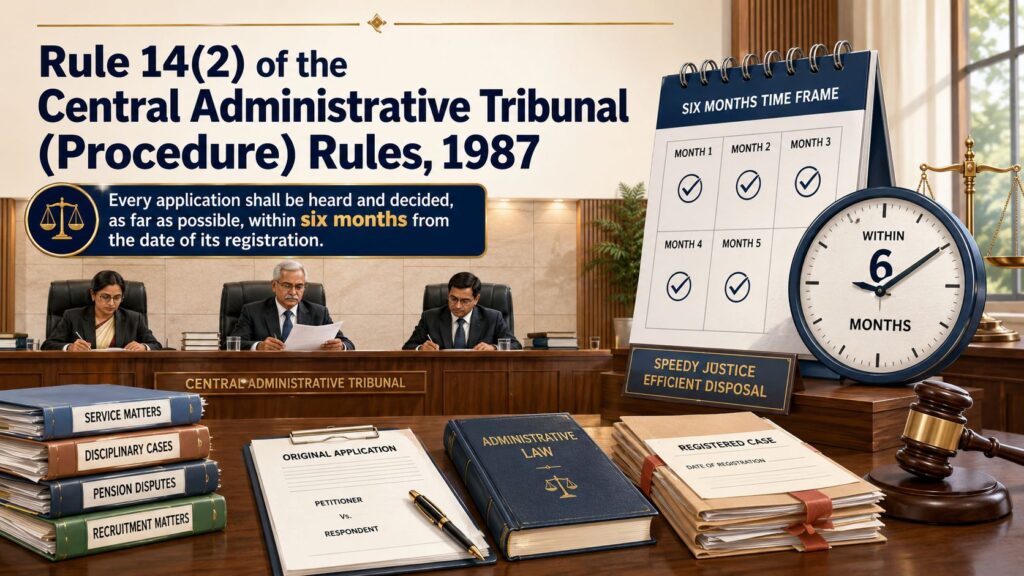
What makes this delay a profound institutional failure is that it flies in the face of the tribunal’s own governing rules. While benches frequently treat delays as a standard norm, Rule 14(2) of the Central Administrative Tribunal (Procedure) Rules, 1987 explicitly mandates:
“Every application shall be heard and decided, as far as possible, within six months from the date of its registration.”
To ensure this timeline is met, Rule 14(3) equips the Bench with the muscle to enforce discipline, granting it the explicit power to decline adjournments and limit the time for oral arguments.
Today, the phrase “as far as possible” in Rule 14(2) – which was legally intended to accommodate extraordinary, complex constitutional gridlocks – has been twisted into a convenient escape hatch to justify routine, administrative lethargy. For a simple matter of pension rectification, a delay stretching across years is not an administrative challenge; it is a direct violation of the spirit of the statutory rules.
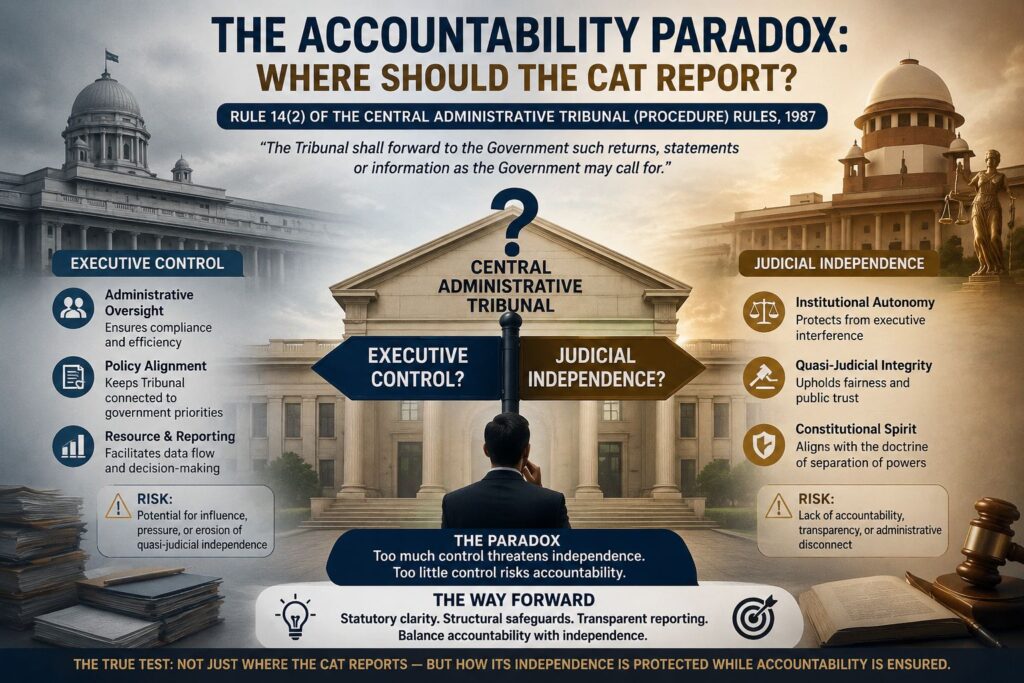
When the Supreme Court lamented the lack of accountability in tribunals, it exposed a fundamental constitutional dilemma. To whom should the CAT be accountable?
It must absolutely not be made accountable to the Executive. The CAT is a judicial body in all respects rather than a mere quasi-judicial body, adjudicating complex service matters and exercising powers of judicial review. Binding it to an executive parent ministry creates a direct conflict of interest, especially since the State is the primary litigator before it.
Equally, making the CAT administratively accountable to individual High Courts presents a severe structural anomaly. The Chairman of the CAT is traditionally a retired High Court Justice/ Chief Justice. Subjecting a tribunal headed by a jurist of such seniority to the administrative oversight of a High Court creates an untenable institutional hierarchy.
Therefore, to preserve its dignity and ensure uncompromised judicial independence, the CAT must be made structurally and administratively accountable directly to the Supreme Court of India.
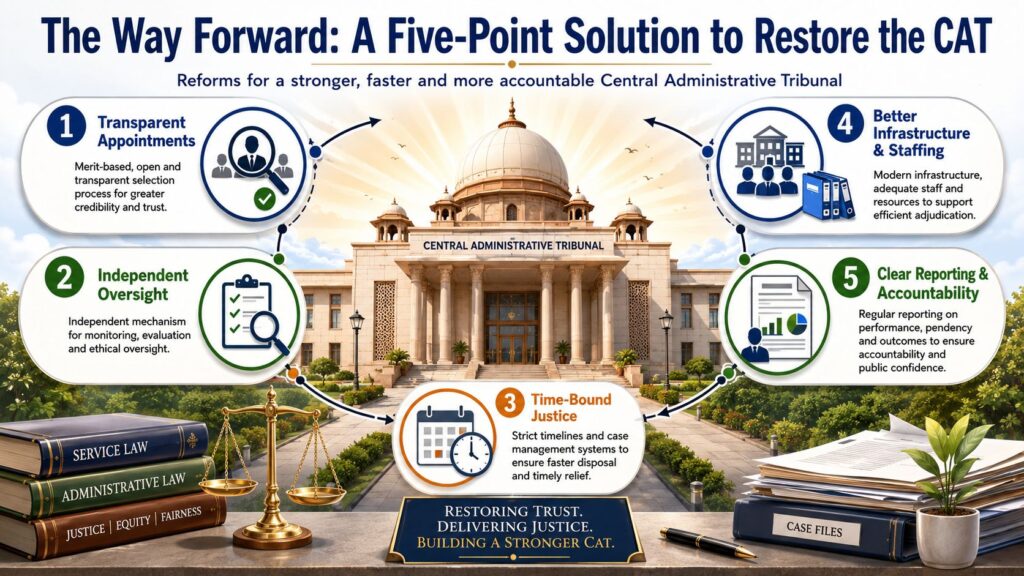
If the Central Administrative Tribunal is to salvage its institutional credibility and fulfil its statutory purpose, it must urgently implement structural and administrative reforms:
Enforce the “Maximum Two Adjournments” Rule
The administrative example set by former Chairman V.K. Bali must be institutionalised across all CAT benches in India. A strict cap of two adjournments per case would eliminate casual litigation strategies, force prompt arguments, and clear the massive backlog.
Establish Bench Continuity for Part-Heard Cases
Benches must not be changed in a routine or mechanical manner. To prevent systemic waste of judicial time, any bench that has part-heard a matter must stay seized of that specific case until its final disposal and judgment.
Adhere Religiously to the Six-Month Timeline
The six-month disposal mandate under Rule 14(2) of the 1987 Rules must be treated as a sacrosanct operational requirement rather than a flexible guideline. Administrative audits under the Supreme Court’s supervision should flag benches that routinely breach this threshold.
Mandatory Fast-Tracking for Senior Citizens
The tribunal must formally prioritize matters involving senior and super-senior citizens. When litigants are in their 80s and 90s, delayed justice is cleanly denied justice. Their cases must be fast-tracked automatically so they can enjoy the fruits of their legal remedies during their lifetime.
Anchor Accountability Directly to the Supreme Court
The administrative oversight, funding, and performance auditing of the CAT must be placed directly under the aegis of the Supreme Court of India. This completely insulates the tribunal from executive interference while respecting the senior judicial status of its leadership.
Conclusion:

The Supreme Court’s warning that tribunals are turning into an unaccountable “no-man’s land” is a wake-up call. For the octogenarian and nonagenarian veterans of the Indian Police Service waiting at the gates of the CAT, statutory reform cannot arrive a day too soon. The tribunal must fix its administrative machinery, realign its lines of accountability to the nation, and honour its own statutory timelines before time runs out for the very people seeking its protection.


Eloquent and impeccable article.
Irrefutable facts and logic.
Institutional ills identified and remedies well- thought and clearly spelt out.
Extraordinary endeavour of Shri Khanna in the common and worthy cause of senior citizens and pensioners continues relentlessly, earning everyone’s respect and gratitude.
Hopefully Hon’ble Supreme Court takes note.
Eloquent and impeccable article from Shri Khanna sir with irrefutable facts and logic.
Institutional ills have been identified and remedies well-thought and clearly spelt out.
Shri Khanna’s extraordinary endeavour in championing the common cause of senior citizens and pensioners continues relentlessly, earning everyone’s respect and gratitude.
Hopefully, the Hon’ble Supreme Court takes note.