

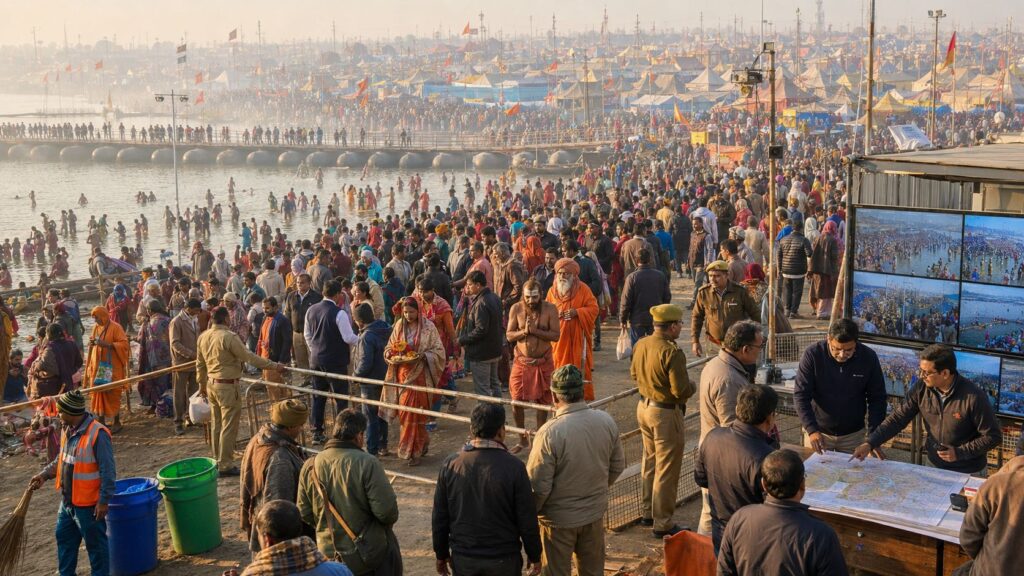
Civilisations do not survive merely on political power, economic strength, or police forces. They endure because a people remember who they are, revere their institutions, and respect the traditions that connect them to their past. When a modern secular State uses its administrative and legal machinery to humiliate, discredit, and target religious leaders, it threatens the very survival of that civilisational inheritance.
The relationship between the Indian State and Hindu society has hit a breaking point. This crisis is laid bare in our recent civil society fact-finding report, “Abuse of State Power Against Jyotirmath Sankaracharya Ji: A Civil Society Fact-Finding Report on Prayagraj Magh Mela 2026.” Alongside my colleagues on the investigative committee—Professor Madhu Kishwar (Founder of Manushi) and Smt. Ritu Rathaur (prominent social worker)—we uncovered a deeply disturbing sequence of events.
What happened during the 2026 Magh Mela in Prayagraj was not a routine administrative hiccup. It was a coordinated, state-backed assault on the dignity of the highest religious office of Sanatana Dharma, followed by a malicious manipulation of the criminal justice system. It reveals a broken system where a supposedly “secular” State seeks to dominate and control Hindu institutions through bureaucratic and political commands.
The Desecration of Mauni Amavasya
The Magh Mela and Kumbh Mela at Prayagraj are not events created by the government. They are among the oldest continuous religious gatherings in human history, thriving long before the modern Indian State or medieval empires even existed. The State’s role is strictly limited to facilitation—managing public order, safety, roads, and sanitation—while fully respecting the religious hierarchy and traditions that give the gathering its meaning.
Central to this tradition is the ceremonial palki (palanquin) procession of the Sankaracharyas. Originating with Adi Sankaracharya over a thousand years ago, the palki is not a personal luxury or an individual privilege. It is a symbol of the office. It signifies that the Sankaracharya Ji travels not as a private citizen, but as the living representative of an enduring Hindu religious institution.
On January 18, 2026, the sacred day of Mauni Amavasya, Jagadguru Sankaracharya Swami Avimukteshwaranand Saraswati Ji of Jyotirmath left his camp (shivir) in the Mela area toward the Triveni Sangam for the holy Ganga bath. The procession was fully planned and approved by the Mela administration. A designated police team led the movement from the front, even wearing yellow scarves provided by the Sankaracharya Ji’s entourage to identify themselves as part of the escort.
Yet, after the procession had moved peacefully under police escort for nearly two kilometers, senior administrative and police officials—including the Prayagraj District Magistrate Manish Kumar Varma, Mela Administrator Rishi Raj, and Commissioner of Police Jogendra Kumar—abruptly blocked the path. They rudely ordered the Sankaracharya Ji to get out of his palki and walk on foot.
The excuse they gave was absurd and factually false: they claimed motor vehicles were banned past that point. A palki is obviously not a motor vehicle. When the Sankaracharya Ji refused to comply with this insulting order and his disciples protested, the police resorted to unprovoked, brutal physical force.
Peaceful devotees and young Ved Vidyarthis (Batuks) were assaulted. In a deeply sacrilegious act, police officers dragged these young Batuks by their shikhas (sacred tufts of hair), beat them, and locked them up.
This violence completely disrupted the sacred procession. The palki, with the Sankaracharya Ji still inside, was forcibly taken back to his camp by police officers in plain clothes. The highest spiritual authority of Sanatana Dharma was prevented from performing his sacred ritual bath (Divya Snan) on Mauni Amavasya.
Grieved by the assault on his students, the Sankaracharya Ji began a gruelling ten-day protest, sitting on the bare road outside his camp until January 28, 2026. The state government expressed no remorse, offered no apology, and took no corrective measures. Instead, it escalated its hostility.
Fake Excuses and Double Standards
Our committee thoroughly examined and dismantled the excuses made by the authorities after the incident. The officials claimed they stopped the procession for “crowd control” and to prevent a “stampede.” However, the evidence we gathered reveals this was a weak, afterthought cover-up.
The administration had written, advance knowledge of the timing and scale of the procession, and placed no restrictions at the start. The movement was completely orderly and escorted by the police. There was no panic or crowd congestion until the police themselves suddenly blocked the path, creating artificial chaos and tension.
Furthermore, our investigation highlighted a glaring double standard. While the traditional palki of the Sankaracharya Ji was blocked under the pretext of a vehicle ban, other religious figures closely aligned with the political establishment were allegedly allowed to drive directly to the bathing areas in motorised vehicles.
Legally, the police can only use force to disperse an unlawful assembly, make a lawful arrest against physical resistance, or prevent an imminent crime. None of these conditions existed. The procession was peaceful and legally permitted. Having spent decades in law enforcement, it is clear to me that the police action was entirely illegal, constituting offenses like wrongful restraint, assault, and maliciously outraging religious feelings.
The Weaponisation of Criminal Law: The POCSO Perversion
The state intimidation did not end with the assault on the entourage and the prevention of the Sankaracharya Ji’s Divya Snan. In fact, it was right there on the banks of the Ganga that the groundwork for a subsequent, fabricated POCSO narrative was simultaneously laid. As the Sankaracharya Ji’s steadfast roadside protest intensified and public outrage mounted, the machinery of the State was weaponised into a ruthless counter-offensive aimed at the total moral assassination and public delegitimisation of both the spiritual leader and the Peetham itself.
The tool for this attack was a complainant named Ashutosh Pandey. Our investigation revealed that Pandey is a registered history-sheeter with a long criminal record at the Kandhal Police Station in Shamli district. He is also openly associated with certain public figures who had publicly clashed with the Jyotirmath Sankaracharya Ji.
The timeline of the legal cases reveals a calculated escalation. On the evening of January 18, Pandey first filed a complaint claiming that the Jyotirmath Sankaracharya Ji and his disciples had attempted to murder and strangulate him near the camp. The police did not register a case because the area was under heavy CCTV surveillance, and the footage instantly proved his story was completely made up.
When the attempted murder narrative failed to gain traction, the complainant pivoted to a far more damaging accusation. He approached the local police with a terrifying new claim, alleging that minor Veda Vidyarthis associated with the Sankaracharya Ji’s Gurukulam were being subjected to sexual exploitation. However, when the local police did not register a First Information Report (FIR), he moved the Special POCSO Court.
When the court asked for a report, the very same police department that had initially declined to register the FIR did a complete U-turn. They submitted a report claiming the offenses were valid, which forced the court to order the registration of a formal POCSO case.
The handling of this case violated every legal safeguard of the POCSO framework. The alleged minor victims were never brought forward by their parents; they were kept under the direct control of a known criminal with connections to public figures and a personal vendetta against the Jyotirmath Sankaracharya Ji.
The malicious nature of the case was fully exposed when it reached the Allahabad High Court. The State of Uttar Pradesh did not act fairly; its legal team fiercely opposed the Sankaracharya Ji’s bail. On March 25, 2026, the High Court granted anticipatory bail to the Sankaracharya Ji, issuing a stinging critique of the prosecution. The Court noted massive contradictions in the statements of the alleged victims, a deep and unexplained delay in filing the complaint, and severe procedural violations. Crucially, verified school records proved that the alleged victims were not even students of the Sankaracharya Ji’s Gurukulam, completely collapsing the government’s case.
The Price of Independence
Why would a state government go to such extremes to humiliate and vilify a revered spiritual leader? Our committee connected these events to a clear political motive.
In the period leading up to the 2026 Mela, the Sankaracharya Ji had consistently and publicly criticised the anti-Hindu policies of the ruling establishment. He had opposed involving non-Hindus in the construction of the Ram Temple in Ayodhya, pointing out violations of traditional scriptures. He had protested the mass demolition of ancient heritage temples and the destruction of the sacred geography for the Kashi Vishwanath Corridor project in Varanasi. He had led a national campaign demanding a total ban on cow slaughter, and he had fiercely criticised the increasing state control over Hindu temples and Hindu religious affairs.
Because the ruling political establishment and its parent organisation, the RSS, demand absolute ideological submission from everyone, the independent, uncompromising voice of the Jyotirmath Sankaracharya Ji had become an unbearable challenge. He had to be silenced and discredited.
The Tyranny of Secular Overreach
The structural core of our findings examines the profound crisis at the heart of modern Indian secularism. The events at Prayagraj expose a grotesque double standard in how the State deploys its regulatory power.
Following the incident on January 18, the Mela administration issued formal notices requiring the Jyotirmath Sankaracharya Ji to “prove” his legitimacy and status. This is an astonishing display of secular governmental arrogance. In a secular democracy, a government has absolutely no authority to determine who is or is not a Sankaracharya Ji. The monastic succession to the Jyotirmath seat is governed by an ancient, well-laid-out procedure. Swami Avimukteshwaranand Ji’s succession was explicitly noted by the Supreme Court of India in September 2022 and recognised in official central government publications.
The impropriety becomes obvious when contrasted with the secular world. Just as the legitimacy of a Prime Minister or a Chief Minister is not questioned once constitutional procedure is followed and the oath administered, the secular State has no authority to question who is a Sankaracharya Ji.
Furthermore, Chief Minister Yogi Adityanath publicly questioned the Jyotirmath Sankaracharya Ji’s title on the floor of the State Assembly and made derogatory remarks aimed at him. It must be noted that Yogi Adityanath himself occupies the position of the Mahant of the Gorakhnath Peeth—a position he attained through the exact same traditional process of monastic succession. By attacking the succession of the Jyotirmath, the Chief Minister undermines the very institutional logic that legitimises his own religious office.
This asymmetry represents an outright distortion of secular governance. An intricate web of laws, like the United Provinces Melas Act and the Uttar Pradesh Prayagraj Mela Authority Act, has institutionalised complete state control over Hindu religious life. No comparable regime of invasive state control exists for the mosques, waqfs, or churches of Islam or Christianity. Their internal hierarchies are protected, their financial revenues remain untouched by the secular state, and their religious leaders are never subjected to the humiliation of having a local bureaucrat demand proof of their religious legitimacy.
When it comes to Hinduism, the secular State behaves like an active, hostile manager. Massive spiritual congregations like the Magh Mela have been stripped of their Hindu character and converted into government-managed events. In these forums, traditional Hindu religious leaders are systematically marginalised, while secular bureaucrats and politicians take center stage.
The Path to Restoring Secularism
The findings of our committee demonstrate that the current system has deeply wounded Hindu society and introduced dangerous conflict. To rectify this civilisational wrong, we have proposed a clear framework of immediate and long-term structural reforms.
First, the State government must take immediate corrective measures to heal this self-inflicted wound. Chief Minister Yogi Adityanath must open a direct, respectful dialogue with the Jyotirmath Sankaracharya Ji to resolve these issues. The administrative and police officials responsible for the blockade, the assault on devotees, and the sacrilegious dragging of the students must offer an unconditional public apology. Furthermore, given the documented threats to the Jyotirmath Sankaracharya Ji’s life, the State must provide high-level, continuous security for his person.
Second, for a long-term structural solution, the State must enact a comprehensive new law—the Uttar Pradesh Hindu Dharma Parishad Act—to create an autonomous apex body comprised exclusively of traditional Hindu religious authorities, spiritual heads, and traditional scholars. This body must be chaired by the Sankaracharya Ji of Jyotirmath.
This proposed law would restore true secularism by strictly separating government and religion. It removes the State’s power to control Hindu institutions and establishes a clear division of authority. Under this law, the Hindu Dharma Parishad will oversee all religious and spiritual matters—including temple management, ritual protocols, and major festivals. By contrast, the secular state machinery will focus entirely on its legitimate, non-religious duties, such as infrastructure, public amenities, law and order, public safety, sanitation, and public health.
The choice of the Sankaracharya of Jyotirmath to lead this body is rooted in history. The lineage traces directly back to Adi Sankaracharya, providing an unbroken, pan-Hindu revered link to the defence of Sanatana Dharma. As a leader who operates above localised or sectarian divisions, the Jyotirmath Sankaracharya Ji serves as a stabilising figure for all traditions, ensuring that religious governance remains completely insulated from political transitions and electoral shifts.
A Moment for National Reflection
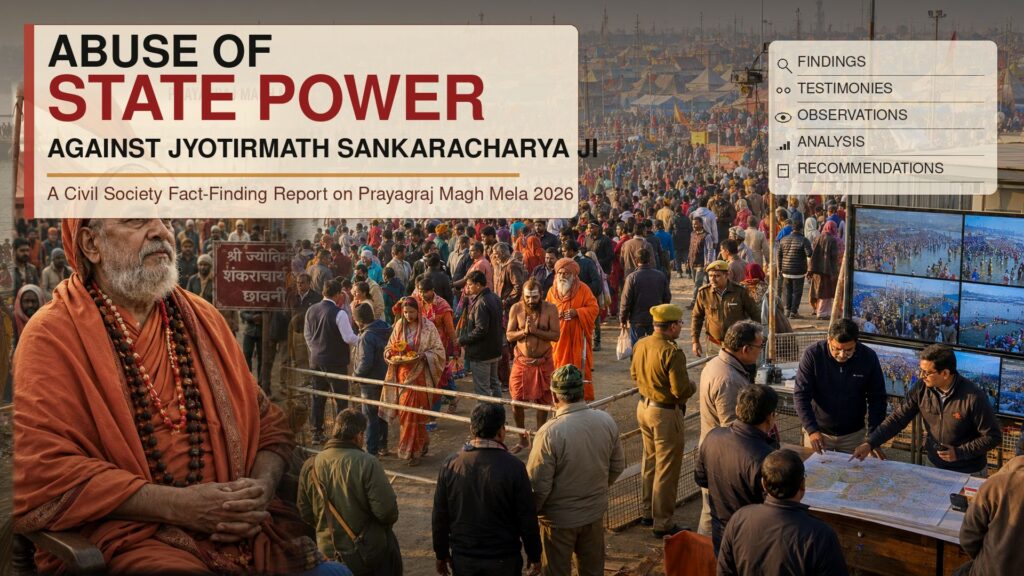
Our Fact-Finding Report, released at the sacred city of Kashi—the intellectual and spiritual heart of Sanatana Dharma—is a historic document. Written with the analytical precision of a seasoned criminal investigation and the deep commitment of public intellectuals, it leaves no room for doubt.
The events of the 2026 Magh Mela were a flashpoint that revealed a deeper disease. The modern Indian State has developed an unhealthy appetite for controlling the one major religion that lacks a centralised, political structure. In doing so, it has turned its immense regulatory power against the very saints who have preserved Hindu traditions through centuries of debilitating foreign invasions and rule.
This is not a political issue to be viewed through the narrow lens of party politics. It is a foundational civilisational question. If India is to remain a true secular constitutional democracy, its government must learn administrative restraint. A secular State must protect religious freedom; it must never attempt to run religion. The recommendations laid out by our Committee offer a clear, legally sound path toward restoring true secularism and preventing avoidable conflicts.
The full report can be accessed and downloaded at maghmela2026factfinding.com/report-english.pdf.