

Global Materials Science: The Credible Track
Graphene and 2D-material thermal camouflage
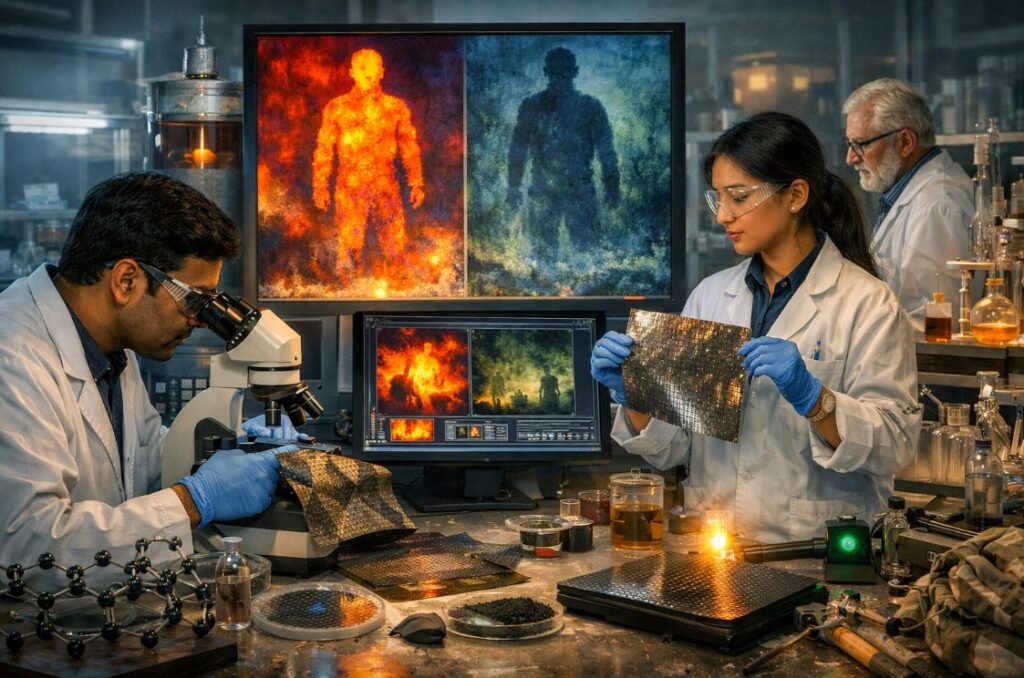
The most physically grounded line of global research concerns multilayer graphene and graphene-like nanomaterials for infrared signature control. The mechanism is electrolytic gating: applying a voltage bias drives intercalation of ionic liquids into the graphene layers, which tunes the material’s infrared emissivity. Because the effect is electrically controlled, a treated surface can lower its apparent temperature to track a changing background in something close to real time, a genuinely adaptive route to defeating thermal imagers, as distinct from static IR-suppressant paints. The open problem across every group working this is scale-up: producing metre-scale, durable, field-survivable panels from what is currently thin-film laboratory work.
China: claims requiring careful sourcing

Two separate Chinese claims are circulating and are worth distinguishing by evidentiary weight. The first, dubbed “Chimera” in Chinese state media, is a bio-inspired metasurface said to draw on chameleon pigment modulation, glass-frog transparency, and bearded-dragon thermoregulation, adapting across five terrain types and multiple spectral bands. The second is a more recent claim of an AI-steered metalens for drones, in which onboard sensors read incoming radar frequency and angle and an AI system adjusts the metamaterial surface accordingly. Both originate from Chinese research institutions and state media reporting via outlets such as the South China Morning Post, and neither has independent third-party verification of field performance.
What is independently verifiable is the manufacturing base underneath these claims: the State Key Laboratory of Metamaterial Electromagnetic Modulation Technology at the Guangqi Advanced Institute of Technology in Shenzhen has been mass-producing metamaterial plate stock since 2011, with reported links to J-20 and J-35 signature-reduction programmes. That production-scale capability is the more consequential fact for planners; the invisibility-cloak framing layered on top of it in domestic media is better read as strategic signalling.
Western comparators
BAE Systems’ Adaptiv remains the most mature fielded-adjacent adaptive thermal system outside China or India: hexagonal, Peltier-effect tiles that reprogram a vehicle’s thermal signature in real time, demonstrated altering a tank’s thermal profile to resemble a car or blend into ambient background heat. On the optical side, Canada’s HyperStealth continues to promote Quantum Stealth, a lenticular-lens material said to bend light around a target without a power source; the company reports demonstrations to US and Canadian military and counter-terrorism units. These claims are company-sourced rather than independently tested, and the binding constraint industry-wide remains manufacturing scale-up rather than underlying physics.
Comparative Snapshot Assessment
| Program / Claim | Origin | Approach | Status / Caveat |
| Sigma 4.0 / CPGS 4.0 | DRDO, Defence Laboratory Jodhpur (India) | AI-assisted software generating terrain-matched patterns across visual, IR, thermal and radar bands | Formally handed to Army’s CME Pune, Dec 2025, with a multispectral tank mock-up for validation. Fielded training tool, not yet a deployed uniform pattern. |
| Multilayer graphene emissivity control | Academic / multiple labs (China, EU, US) | Voltage-gated ionic intercalation tunes IR emissivity to match background temperature | Strong physical basis; lab and thin-film stage; scale-up to vehicle-sized panels unresolved. |
| Chimera metasurface | Chinese state media / research claim | Bio-inspired (chameleon, glass frog, bearded dragon) adaptive metasurface across five terrain types | Experimental demonstration reported via SCMP; independent verification absent. |
| AI-adjusted metalens (drones) | Chinese research claim | Sensors read radar frequency/angle; AI steers metamaterial structure in real time | Unverified; consistent with China’s broader metamaterial manufacturing base (Guangqi/Shenzhen). |
| Adaptiv | BAE Systems (Sweden/UK) | Peltier-effect hexagonal tiles reprogram thermal signature in real time | Most mature fielded-adjacent adaptive thermal system in the West; demonstrated on vehicles. |
| Quantum Stealth | HyperStealth Biotechnology (Canada) | Lenticular lens array bends light around target; no power source | Company-sourced claims; reported demonstrations to US/Canadian military; manufacturing scale-up remains the binding constraint. |
Two things are true simultaneously. First, India’s indigenous programme has produced a real, traceable milestone a formal technology handover into an operational training command that is more concrete than most of what is being publicised abroad. Second, the loudest global claims, chiefly Chinese, remain in the realm of announced capability rather than demonstrated field performance, and deserve to be reported with that distinction preserved rather than flattened into a generic “invisibility cloak” narrative.
For India, the near-term opportunity is less about chasing metamaterial cloaking and more about consolidating the multispectral-software and materials-textile threads already in hand, Sigma 4.0 on the software side as mentioned above, DMSRDE’s stealth-textile and composite work on the materials side into a genuinely integrated multispectral signature-management doctrine, using the CME Pune tank mock-up as the validation platform going forward.
The Way Forward: Five Things India Needs to Get Right

First, move multispectral from the lab to the line faster. DMSRDE’s technology-transfer record over the past two years is genuinely encouraging, but the gap between a validated prototype and a soldier actually wearing or deploying it in the field needs to keep shrinking. A formal, funded fast-track pathway not just ad hoc ToT agreements for multispectral materials specifically would help convert India’s research lead into fielded capability before adversaries close the gap.
Second, build a domestic metamaterials and smart-textile supply chain, not just a procurement pipeline. The most advanced camouflage technologies like plasmonic films, electrochromic fabrics, radiative-cooling coatings depend on specialised inputs: rare-earth-adjacent materials, precision nano-fabrication, and electronic control layers for active systems. India’s broader push for self-reliance in critical minerals and electronics components needs to explicitly account for this niche but strategically important demand, rather than treating camouflage materials as a downstream textile problem disconnected from the broader Atmanirbhar Bharat materials push.
Third, get private industry further up the value chain, deliberately. A similar deliberate push, joint DRDO-industry development programmes specifically targeted at multispectral textiles and metamaterial coatings, with export potential built in from day one would let companies beyond MKU make that same jump, rather than leaving frontier materials development as a government-only activity.
Fourth, treat camouflage as a software and data problem, not just a material one. CPGS 4.0 is a genuine step forward, but the broader trend globally is toward AI-assisted camouflage design that models how specific enemy sensor platforms — a particular drone’s camera, a specific satellite’s resolution — actually perceive a target, then optimises the pattern or coating against that specific threat rather than a generic “jungle” or “desert” profile. India’s strength in software and AI talent is an underused asset here; camouflage R&D should be drawing on it as actively as materials science.
Fifth, build the testing and certification infrastructure to match the ambition. Much of India’s camouflage validation work still depends on a handful of DRDO facilities. As the technology gets more complex — multispectral, adaptive, sensor-specific — testing needs to keep pace, ideally with expanded facilities that can certify performance against the realistic sensor threats Indian forces actually face on the northern and western borders, rather than generic laboratory conditions.
The Bottom Line
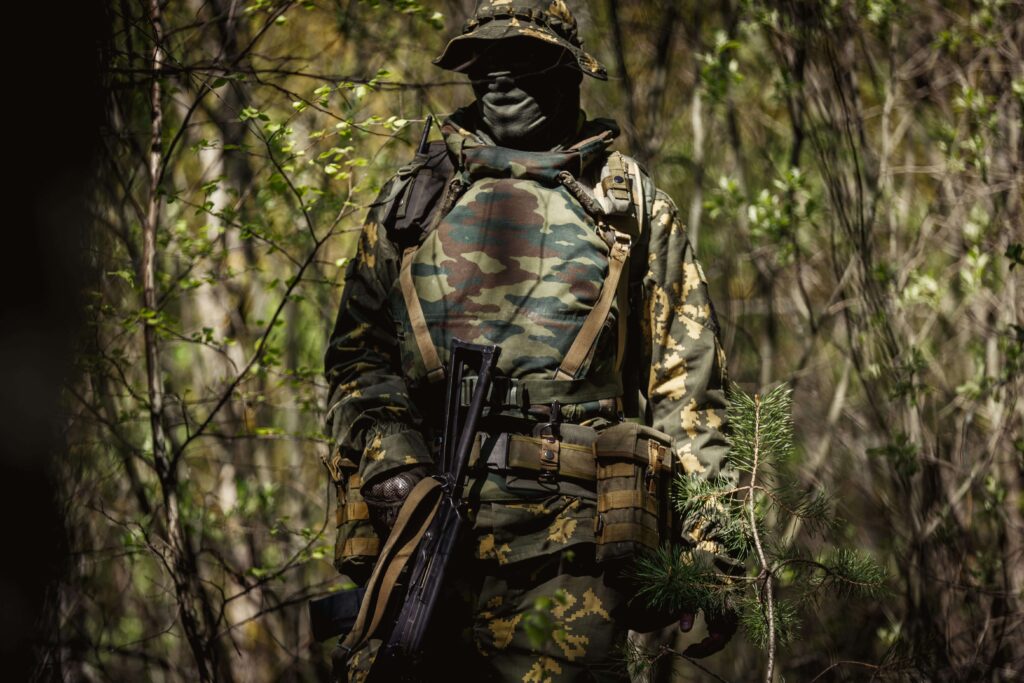
Camouflage has quietly become one of the clearest examples of how modern warfare has changed the value of being unseen. It used to be a uniform colour. It is now a materials-science and software discipline worth billions of dollars globally and growing fastest exactly where the technology is hardest multispectral and adaptive systems that can fool a drone’s thermal camera and a satellite’s radar at the same time.
Doctrine is ahead of procurement
Where India arguably leads is institutional intent rather than fielded inventory. The decision to hand the Army’s Corps of Military Engineering its own in-house camouflage-design and validation toolkit, rather than leaving pattern development to ad hoc requests routed through DRDO, signals a doctrinal recognition that signature management deserves the same standing institutional infrastructure as, say, artillery targeting or air defence a discipline with its own software, its own testing protocols and its own dedicated personnel rather than an afterthought handled by whichever unit happens to be deploying. The harder question is whether procurement volume and budget allocation are catching up to that doctrinal seriousness at the same pace. Multispectral nets and personnel camouflage equipment exist and are in limited service, but moving them from pilot quantities to standard issue across the Army’s full order of battle the kind of scale at which unit economics genuinely improve and domestic supply chains become self-sustaining is the harder, less glamorous step that usually determines whether a promising indigenous technology becomes a strategic asset or stays a laboratory showcase.
India’s position in this race is better than most outside observers assume a serious, productive research lab in DMSRDE, a private manufacturing base with real scale, and growth rates in the highest-value segment that outpace the global average. What India needs now is less a research breakthrough and more an execution discipline: turning validated lab technology into fielded systems faster, building the domestic supply chain for the materials that make adaptive camouflage possible, and pulling private industry further up the technology curve.
Nations that once raced for bigger guns and faster missiles are now racing for something quieter: the right to remain unseen. In that race, invisibility itself has become a weapon, and India cannot afford to be the one left exposed.
(Concluded)