

India’s Position: Real Capability, Real Gaps
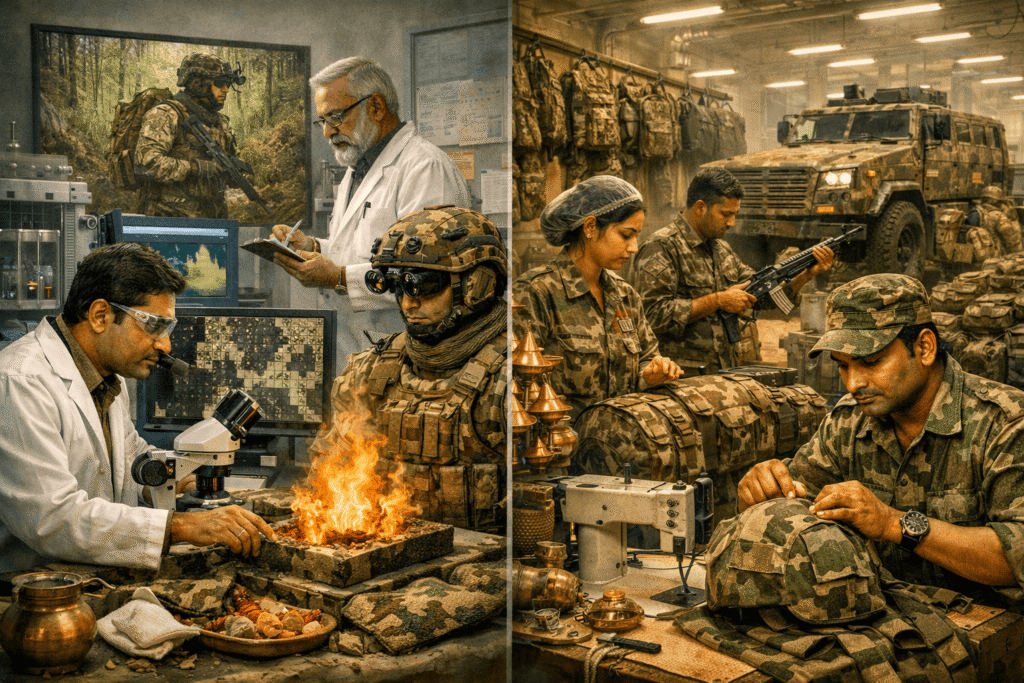
India’s camouflage story runs on two parallel tracks a genuinely strong public-sector research base, and a private manufacturing sector that has scaled impressively but still concentrates mostly at the lower-technology end of the value chain.
The research engine: DMSRDE, Kanpur
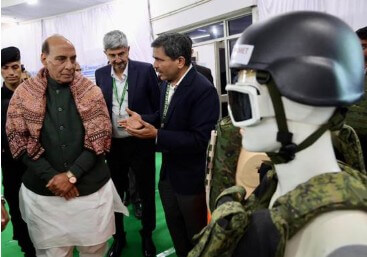
The institutional heart of India’s camouflage R&D is DRDO’s Defence Materials and Stores Research and Development Establishment in Kanpur, which works across functional polymers, composites, stealth materials and camouflage textiles essentially the materials-science backbone for everything from personal concealment kit to vehicle signature reduction. DMSRDE’s output has been concrete rather than theoretical: its Multispectral Personnel Camouflage Equipment a suit, poncho and screen system is designed specifically to protect soldiers operating across green-belt, jungle, desert and semi-desert terrain against detection. The lab has also developed synthetic multispectral camouflage netting and transferred the technology to industry for production scale-up.
More recently, DRDO handed over its fourth-generation Camouflage Pattern Generation Software and a complete Multispectral Signature Tank Mock-up to the Army’s Corps of Military Engineering in Pune , giving Indian forces an in-house capability to design, test and validate camouflage and deception schemes across visible, infrared and radar bands rather than relying on imported tools or trial-and-error in the field. During an official visit to DMSRDE in mid-2025, the government specifically credited the lab’s stealth and camouflage work for its role in Operation Sindoor, and noted that DMSRDE has led all DRDO establishments in technology-transfer agreements with industry over the past two years, a meaningful signal that the lab-to-factory pipeline, often the weak link in Indian defence R&D, is actually functioning here.
The industrial base: scaling fast, still catching up on the frontier

On the manufacturing side, India’s private sector has built real depth. MKU Limited, the Kanpur-headquartered company that began as a lock-maker before pivoting into defence kit during the 1999 Kargil War, has grown into a genuinely global player protecting over three million soldiers and 3,000-plus platforms across 230 forces in more than 100 countries, with manufacturing and R&D operations spanning India and Germany. While MKU’s headline strength is ballistic protection and electro-optics, its scale and vertical integration place it among the natural candidates to lead India’s push into next-generation multispectral textiles as that segment matures.
Below MKU sit a cluster of dedicated camouflage-textile manufacturers companies like Mahavir Spinfab, which produces NIR-compliant, flame-resistant camouflage fabrics and multi-spectral camouflage netting for both Indian and export markets alongside a long tail of smaller textile producers in Bhilwara, Surat and Ludhiana supplying combat-uniform fabric at the commodity end of the market. This gives India real volume manufacturing capacity, anchored in Uttar Pradesh’s defence corridor, but the genuinely cutting-edge materials — metamaterial coatings, electrochromic films, adaptive textiles remain concentrated in DRDO’s labs and a handful of pilot programmes rather than scaled private production.
The Indigenous Net Industry
India’s camouflage-net sector is best understood as two tiers. The first is a broad, cost-competitive base of small and medium manufacturers anchored in Faridabad, Meerut and a long tail of more than three hundred suppliers on trade portals that makes the world’s least expensive nets at USD 15–30 per square metre: G.D.S. International of Meerut (export shares reported at forty to sixty per cent), Raksha Supreme Camouflage of Faridabad (ISO 9001:2015), Sonu Sports, the paints-and-nets vendor trading as Sterlite Camotech, and Hyper Stealth Technologies Private Limited, an Indian affiliate established in 2016 that makes multi-spectral nets under licence. This base gives India genuine volume and price competitiveness, but most of it has historically supplied visual- and near-infrared-grade product rather than the demanding multispectral specifications that now define the frontier.
The second tier is thin but consequential, and it is here that the indigenous story turns. Motley Exim Co, the Delhi-headquartered specialty-coatings and multispectral-concealment manufacturer behind the CAMPRO product family, occupies the leading edge of the Indian private sector by published specification. CAMPRO multispectral netting carries a NABL-certified microwave attenuation of at least twelve decibels in the S₂₁ scattering parameter across the 2 to18 GHz band twice the six-decibel floor prescribed for the country in IS 16290:2014 and in the Ministry of Defence net specification. A sub-2-GHz extension of the same line, operating across 0.3–2 GHz, addresses the anti-synthetic-aperture-radar requirement that no other Indian manufacturer presently catalogues. The company also produces three-dimensional knitted camouflage fabric, infrared-reflective and radar-absorbent coatings, and radar-transparent netting variants for specific applications, and a sister company within the same group has won and completed an awarded problem statement under the Defence India Start-up Challenge, a record of execution still uncommon in the segment.

Pic: PIB
The significance is precise. India’s commodity-net strength has never been in doubt; what is new is that a private Indian firm now publishes multispectral specifications that meet or exceed the global mainstream, with an anti-SAR capability ahead of the rest of the domestic field, independently certified rather than merely claimed. Indigenous capability at the frontier is no longer hypothetical, it is on the test certificate. The binding constraint for a manufacturer of this profile is not invention but scale: the volume of qualified production capacity it can hold against the irregular cadence of Ministry of Defence demand.
The contrast with the legacy incumbent sharpens the point. Entremonde Polycoaters of Mumbai was, until recent cycles, the principal supplier of multispectral nets to the Army under the IS 16290:2014 specification, at the six-decibel floor. In December 2024, CRISIL revised the firm’s rating outlook to Negative, citing single-product concentration approaching eighty per cent of revenue, an order book of about ₹6.4 crore, and FY25 revenue near ₹58 crore against a FY23 peak of ₹306 crore. The Ministry’s sixty-forty supply split was designed precisely to open the base beyond such a single point of dependence and the qualified second vendor it invites is exactly the niche a specification-leader like Motley Exim is positioned to fill. The public anchor behind both, the DMSRDE laboratory at Kanpur, continues to develop indigenous multispectral nets, intumescent fire-retardant coatings and protective textiles as the research backbone of the field.
The Indian competitive landscape in camouflage nets and concealment.
| Player | Lead product | Key specification | Position |
| Motley Exim Co (Delhi) | CAMPRO multispectral nets + coatings | ≥12 dB S₂₁, 2–18 GHz (NABL); 0.3–2 GHz anti-SAR extension | Capability leader by published spec |
| Entremonde Polycoaters (Mumbai) | Multispectral camouflage nets | ≥6 dB (IS 16290:2014 floor) | Declining incumbent (CRISIL Negative, Dec 2024) |
| SME net base (Faridabad / Meerut + 300+ suppliers) | Basic-to-mid nets, ghillie, thermal-invisible | Visual / NIR; IS 16290 at the floor | Cost-competitive volume layer (USD 15–30/m²) |
| DMSRDE–DRDO, Kanpur | Indigenous multispectral nets, protective textiles | DRDO-internal qualification | R&D anchor of the indigenous base |
Where the gap actually sits
India’s honest position, then, is this: strong fundamental research, credible netting and personnel-camouflage products already in service, a manufacturing base capable of scaling whatever the labs hand it, but a still-thin presence in the highest-value adaptive and multispectral materials segment that is currently growing roughly four times faster than the rest of the market globally. Forecasts specifically peg India’s adaptive camouflage materials segment at a robust 14.6 percent compound annual growth rate, second only to China’s 15.8 percent among major economies — a clear signal that both investors and policy planners see this as a priority growth area, even if the base it’s growing from remains modest in absolute dollar terms.
The Next Problem: Camouflage Against an AI That Never Blinks

Every advance described above was built to defeat a sensor an eye, a camera, a thermal imager, a radar dish. The emerging challenge is different in kind: defeating not the sensor but the algorithm interpreting what the sensor sees. Computer-vision systems trained on millions of images can now pick out a camouflaged vehicle or a dug-in position from subtle statistical patterns a slightly-too-regular shadow, a texture that doesn’t quite match the surrounding terrain’s noise profile that a human eye would never consciously register. Battlefield trials incorporating drone-based and AI-assisted detection have already shown that patterns optimised purely for human perception, however effective they were against the naked eye, can still be flagged reliably by a trained model scanning the same footage frame by frame.
A detection algorithm can be retrained in weeks once a countermeasure becomes known, whereas a uniform pattern used to stay in service for a decade or more.
This is forcing camouflage design to become adversarial in the literal machine-learning sense — patterns and coatings tested not just against human observers and raw sensor physics but against the specific detection models an adversary is likely to field, then refined to defeat those models specifically. For India, this is precisely the kind of problem where the country’s deep software and AI talent pool already a recognised national strength should be pulled directly into camouflage R&D rather than left as a parallel track pursued only by computer-vision researchers with no connection to DMSRDE’s materials work. The countries that integrate these two disciplines fastest, materials science and adversarial AI, will likely set the next generation of camouflage standards the same way the US and China currently lead on multispectral materials.
(To be continued)