

Need for a United Nations mandated Hormuj Peacekeeping Force (HPKF) or Hormuz–Bab el-Mandeb Peacekeeping Force (HBPKF)
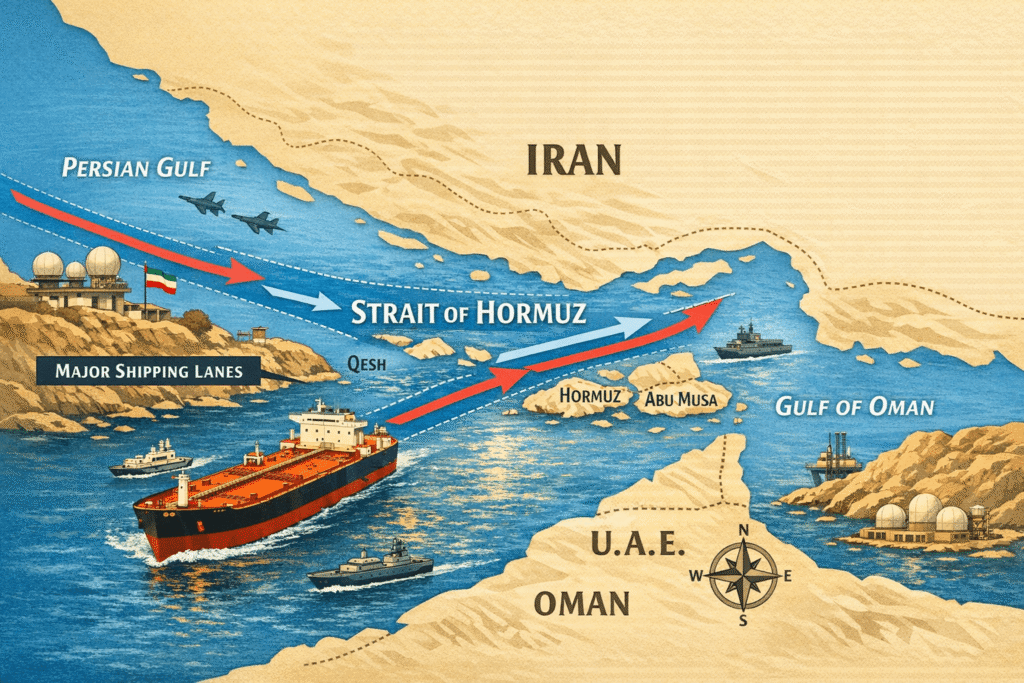
The Strait of Hormuz and the Bab el-Mandeb Strait are among the world’s most critical maritime chokepoints. Together, they form the strategic gateways linking the energy rich Gulf region with global markets through the Arabian Sea, the Red Sea and the Suez Canal. Any disruption in these sea lanes has immediate repercussions for international trade, energy security, shipping costs and geopolitical stability. The 107 days war between US – Israel and Iran has led to blocking of Strait of Hormuj and total disruption of international trade passing through the region.
US and Iran have just announced an agreement in the form of a 14-point MoU towards a full-fledged peace deal for West Asia to be negotiated later over a 60-day period. However, the script of the MoU has not been revealed as yet and there are conflicting versions emanating from US and Iran, as expected. This MoU is to be signed on 19 June and will signal reopening of Strait of Hormuj and withdrawal of the US naval blockade.
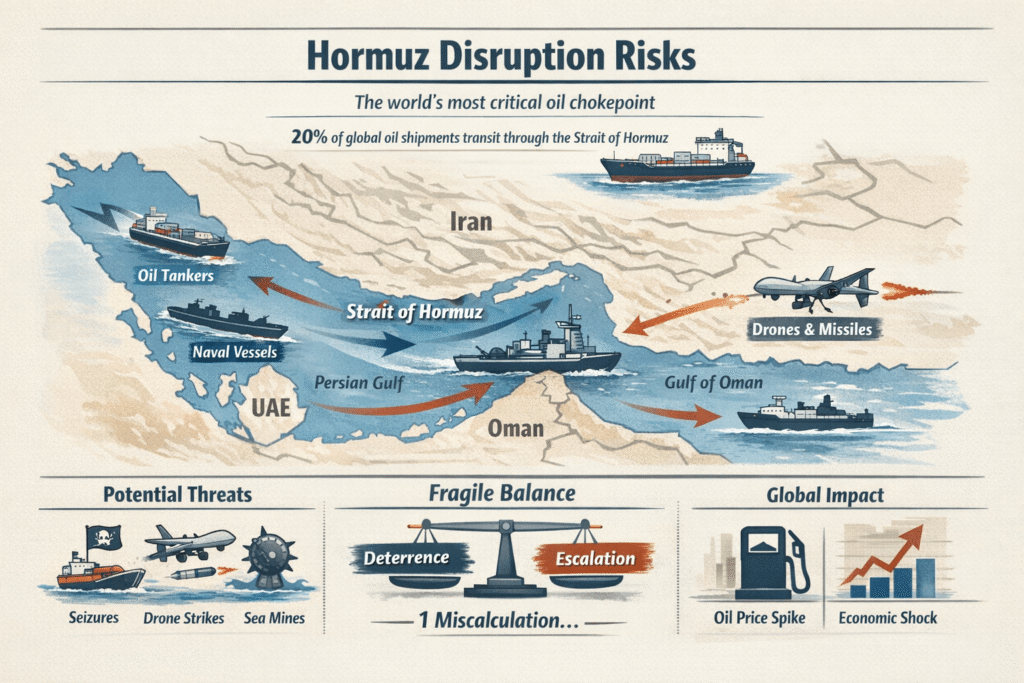
While the world sighs in relief over the prospect of peace and resumption of international trade through the waterways, it may not be an enduring fix as of now. The fragile and uncertain truce emerging between the United States and Iran, coupled with the continuing tensions involving Israel and various regional actors, will continue to highlight the vulnerability of these vital waterways. While the Strait of Hormuz may remain open in the short term, the possibility of renewed confrontation cannot be ruled out. It is a given now that whenever tensions rise again in the Gulf, the threat of mine warfare, missile attacks, drone strikes and maritime harassment will resurface.
In this context, the international community should seriously consider the creation of a United Nations mandated Hormuj Peacekeeping Force (HPKF) or even a combined Hormuz–Bab el-Mandeb Peacekeeping Force (HBPKF), tasked with ensuring the permanent security and freedom of navigation of these globally important Sea Lanes of Communication (SLOCs).
The Strategic Importance of the Chokepoints
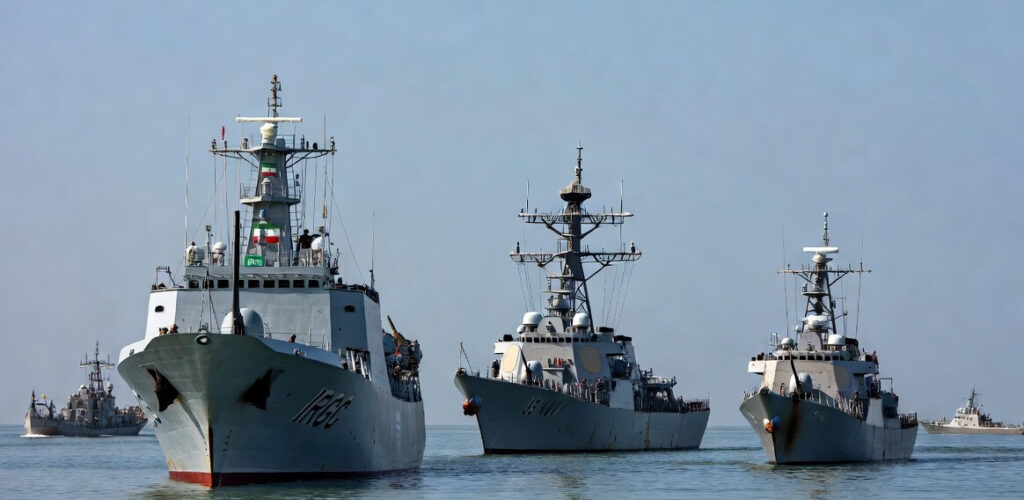
The Strait of Hormuz is arguably the most important energy chokepoint in the world. A significant proportion of global oil exports and liquefied natural gas shipments transit through this narrow waterway connecting the Persian Gulf to the Arabian Sea. Any interruption can trigger immediate spikes in energy prices and destabilize financial markets.
Similarly, the Bab el-Mandeb Strait serves as the gateway between the Red Sea and the Gulf of Aden. It is a crucial link in the Europe-Asia maritime trade route via the Suez Canal. Recent attacks on commercial shipping in the Red Sea have demonstrated how vulnerable this corridor remains to both state and non-state actors.
Together, these waterways constitute a strategic maritime system upon which much of the global economy depends. Their security is therefore not merely a regional concern but an international imperative.
The Limitations of Existing Security Arrangements
Present maritime security arrangements in the region are fragmented and heavily dependent on individual national naval deployments. The United States Navy, European naval missions, regional Gulf navies, and various multinational task forces all operate in overlapping areas. While these efforts have provided a degree of deterrence, they are often perceived through the prism of geopolitical rivalry.
Iran, for instance, views many of these deployments as instruments of strategic pressure rather than neutral guarantors of navigation. Conversely, Gulf states and Israel remain concerned about Iran’s capacity to disrupt shipping through mines, anti-ship missiles, fast attack craft and proxy forces.
As long as maritime security is associated with competing geopolitical blocs, it will remain vulnerable to regional crises. What is needed is a more neutral and internationally legitimate framework.
The Case for a UN-Mandated Peacekeeping Force
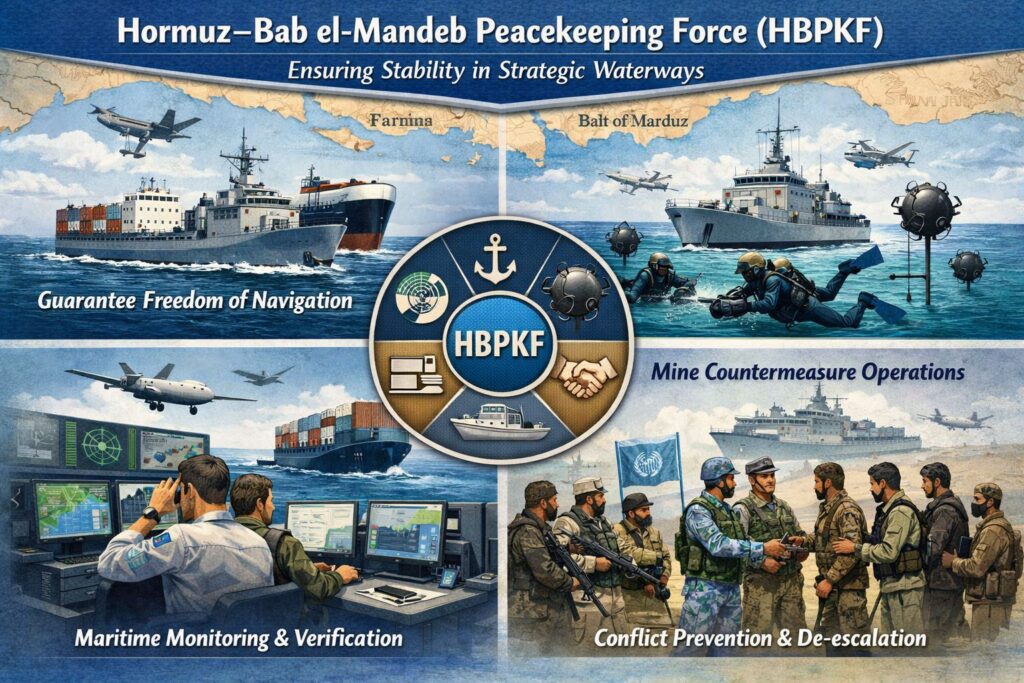
A United Nations mandated maritime peacekeeping force could provide such a framework. Unlike unilateral or alliance based naval deployments, a UN force would derive its legitimacy from international law and collective security principles. The proposed Hormuz–Bab el-Mandeb Peacekeeping Force (HBPKF) would have four primary missions:
Guaranteeing Freedom of Navigation – The force would ensure uninterrupted passage of commercial shipping through both straits in accordance with international maritime law.
Mine Countermeasure Operations – One of the greatest threats to maritime traffic is the deployment of naval mines. Specialized multinational mine-sweeping units would clear existing mines and maintain continuous surveillance against future mining activities.
Maritime Monitoring and Verification – Advanced surveillance systems, maritime patrol aircraft, drones and naval vessels would monitor the waterways and investigate incidents in an impartial manner.
Conflict Prevention and De-escalation – The force would serve as a buffer between rival naval forces, reducing the risk of accidental escalation and providing communication channels during crises.
Proposed Structure and Composition
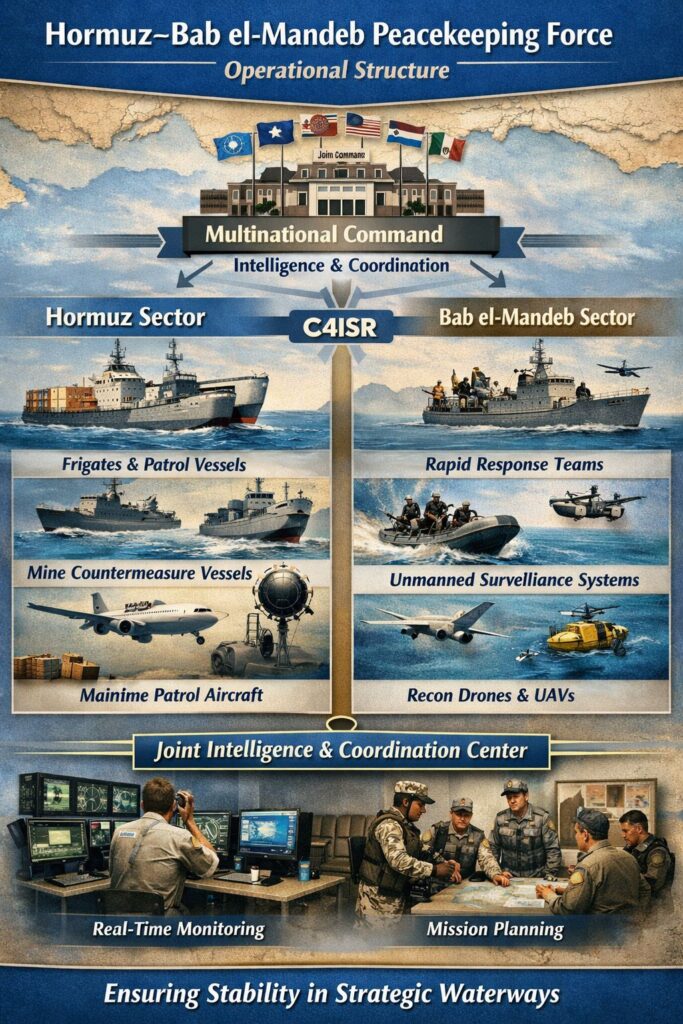
The HBPKF should be composed of naval units contributed by both major maritime powers and neutral states. Countries such as India, Indonesia, Brazil, Japan, Singapore, South Africa and certain European nations could provide substantial contributions while maintaining broad international credibility.
Permanent members of the UN Security Council would inevitably play a role, but operational command should remain under a clearly defined UN mandate to preserve neutrality. The force could include:
- Mine countermeasure vessels.
- Frigates and offshore patrol vessels.
- Maritime patrol aircraft.
- Unmanned surveillance systems.
- Rapid response boarding teams.
- Joint intelligence and coordination centers
Core Components
| Asset Type | Role in HBPKF Operations |
|---|---|
| Mine Countermeasure Vessels | Detect and neutralize naval mines to secure shipping lanes. |
| Frigates and Offshore Patrol Vessels | Provide escort, deterrence, and rapid maritime response. |
| Maritime Patrol Aircraft | Conduct long-range surveillance, anti-submarine warfare, and reconnaissance. |
| Unmanned Surveillance Systems | Offer persistent monitoring through drones and autonomous underwater vehicles. |
| Rapid Response Boarding Teams | Intercept and inspect vessels suspected of violations or illicit activity. |
| Joint Intelligence and Coordination Centers | Fuse data from all assets for real-time decision-making and multinational coordination. |
Forward operating bases could be established at mutually agreed locations near both chokepoints, supported by regional cooperation arrangements.
Benefits for Regional and Global Stability
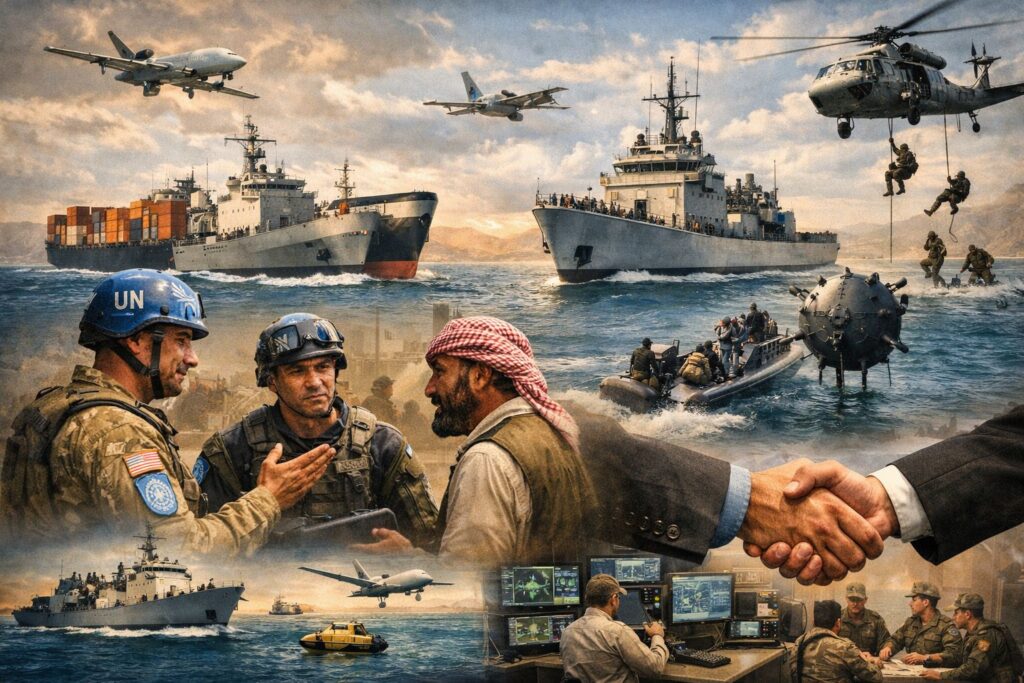
The advantages of such a force would extend well beyond maritime security.
First, it would reduce the ability of any single state to threaten global commerce by closing or disrupting critical waterways.
Second, it would reassure energy importing nations in Asia, Europe and Africa that supply chains remain protected regardless of regional political tensions.
Third, it would lower insurance premiums and shipping costs that rise sharply during periods of instability.
Fourth, it would create a confidence building mechanism among regional rivals by replacing unilateral military responses with collective international oversight.
For countries such as India, China, Japan, and South Korea which depend heavily on Gulf energy supplies, the establishment of a neutral maritime security regime would be particularly beneficial.
Challenges and Obstacles
Despite its advantages, the proposal is likely to face significant political hurdles.
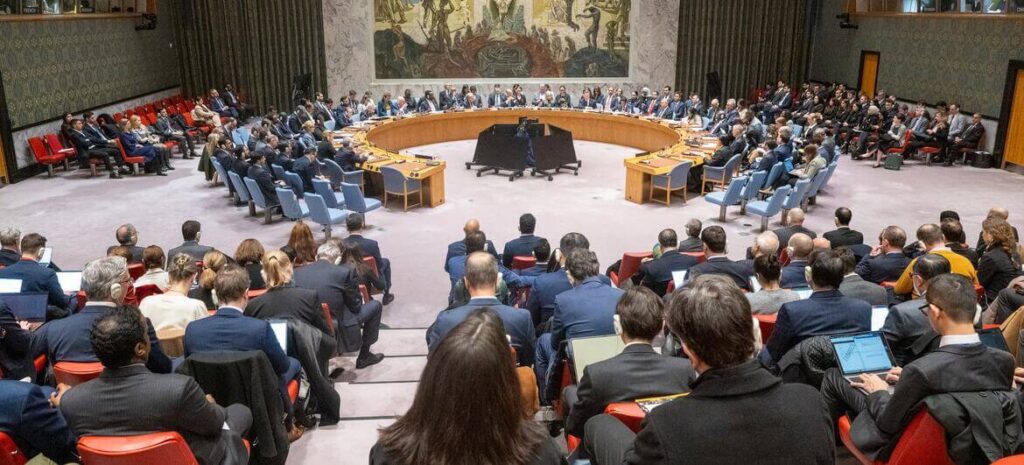
The first challenge would be obtaining agreement within the UN Security Council. Major powers often have competing strategic interests in the region, making consensus difficult.
The second challenge concerns sovereignty. Iran may view an international force operating near its territorial waters as an infringement on national sovereignty. Similar concerns could arise among other littoral states.
The third challenge involves rules of engagement. A peacekeeping force can only succeed if it possesses sufficient authority to deter violations while maintaining strict neutrality.
Finally, financing such an operation would require substantial international commitment. However, the economic costs of maintaining the force would likely be far lower than the costs associated with a prolonged closure of either chokepoint.
A Vision for the Future
The world has long accepted international oversight of strategic waterways and maritime operations where global interests are at stake. Given the crisis affecting the Strait of Hormuz and possibly in the Bab el-Mandeb, in future, the time may have come to explore a new model of collective maritime security.
A UN mandated Hormuz–Bab el-Mandeb Peacekeeping Force (HBPKF) would neither eliminate geopolitical rivalries, nor would it resolve the underlying conflicts between Iran and US – Israel as also with other regional actors. However, it could ensure that these disputes do not endanger the global economy by threatening freedom of navigation.
In an era where economic interdependence has become a defining feature of international relations, protecting the world’s most vital maritime arteries should be viewed not as a regional responsibility but as a collective global obligation. The creation of a permanent UN maritime peacekeeping mechanism for these chokepoints may therefore represent an innovative and necessary step toward a more stable international order.