

At 17,618 feet above sea level, where oxygen is scarce and pacing errors are costly, NDRF DIG completes one of the most punishing endurance races on earth.
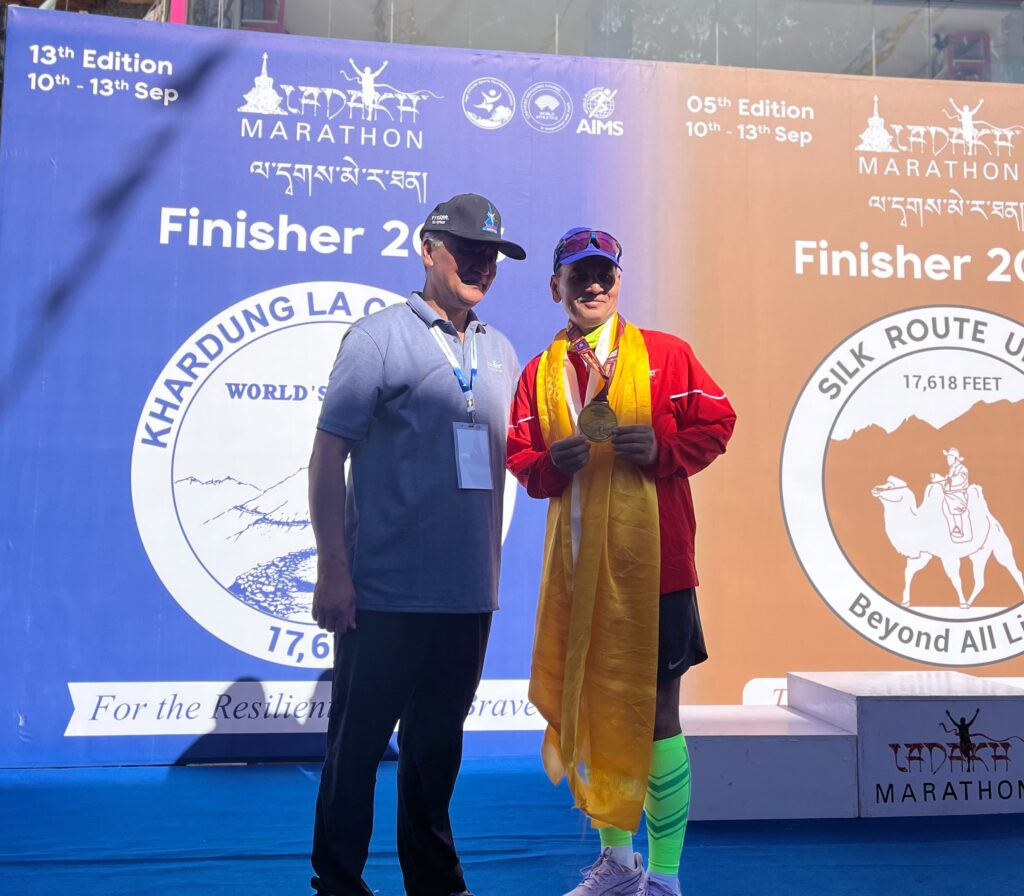
At three in the morning, in the pitch darkness of high-altitude Ladakh, Mohsen Shahedi began to run.
The road ahead climbed steadily out of Khardung village toward Khardung La. It was cold enough for runners to begin wrapped in heavy thermal layers. The air was thin, the finish line sat 72 kilometres away, and the first 32 kilometres went almost entirely uphill.
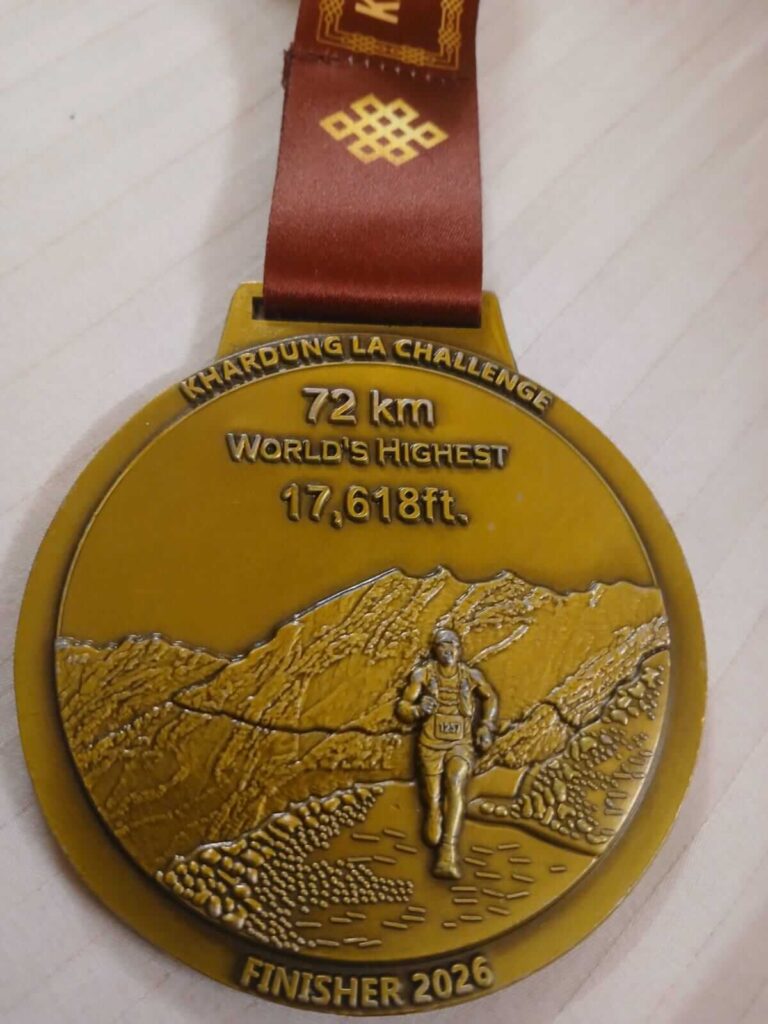
By the time the course reached Khardung La, it stood at approximately 17,618 feet. At that height, every breath delivers roughly half the effective oxygen to the body compared to sea level. Running becomes slower, recovery harder, and small errors in pacing exponentially more expensive. Nearly 60 kilometres of the Khardung La Challenge are staged above 4,000 metres, requiring mandatory acclimatization simply to reach the starting line safely.
Shahedi knew precisely what awaited him. He ran anyway.
The Deputy Inspector General of the National Disaster Response Force (NDRF) completed the Khardung La Challenge—widely recognized as one of the world’s most demanding ultra-distance races. For many, completing the course would mark the pinnacle of a sporting career; for Shahedi, it felt like the latest instalment in a quarter-century-long argument with the concept of fatigue.
There is a point in any ultra-distance race where excitement evaporates. The starting line is long forgotten, the finish line remains abstract, and the body transitions from feeling fresh to sending persuasive signals that it is time to stop. At Khardung La, that internal conversation unfolds in an uncompromising environment.
Starting at 3,975 metres, the course climbs relentlessly to the pass before dropping toward Leh at roughly 3,500 metres. Runners are held to strict cut-offs: eight hours to reach Khardung La Top and 14 hours total to complete the 72 kilometres. Hydration, calorie intake, layer management, and pacing require continuous calibration as sub-zero morning temperatures yield to intense Himalayan sunlight by noon.
Shahedi points out that managing low oxygen levels at such extreme elevation is compounded by drastic weather shifts—transitioning from freezing temperatures at dawn to scorching heat by midday.
The difficulty is not dramatic; it is incremental. A little less oxygen, a little more lactic acid, another incline, another kilometre. That relentless accumulation is precisely why the discipline suits him.
Long before he became an ultrarunner, Shahedi spent his career in operational settings where composure under pressure was non-negotiable. Joining the Central Reserve Police Force (CRPF) in 1994, he served across Doda, Manipur, Assam, and Srinagar. In 2006, he oversaw security operations at Srinagar International Airport, and later held key tactical responsibilities in Anantnag and Kulgam. In 2022, he was awarded the President’s Police Medal for Distinguished Service.
Yet his entry into long-distance running happened entirely by accident.
Kosovo, July 2000. Shahedi, then a young CRPF Deputy Commandant serving with the United Nations International Police, entered the Danish Battalion’s 100-kilometre Dancon Death March. He had no structured training program or specialized endurance gear; he was simply assigned to participate.
Starting at Olaf Rye Camp in Mitrovica, 197 international personnel set out across undulating terrain toward the Serbian border, navigating dirt tracks turned into thick slush by heavy rain and biting cold winds.
Against the odds, Shahedi and Constable Sunil Kumar did not merely finish—they crossed the line joint first in 13 hours and 15 minutes.
With the finish line in sight and the Indian national flag in hand, those final two hundred metres still felt nearly endless to the exhausted officer. Yet pushed by the sheer thrill of the moment, he pressed through—an experience he credits with permanently reshaping how he viewed his own physical and mental boundaries.
Over the next two decades, Shahedi logged more than 200 marathons and ultra-distance events across India—from road races in Delhi and Mumbai to endurance challenges like The Border 100. Yet numbers alone do not explain why someone maintains this regimen long after the novelty wears off.
For Shahedi, Friday evenings remain the highlight of his week—a signal that the upcoming Saturday and Sunday are reserved entirely for running. The senior commander steps aside; the endurance athlete takes over.
Even after hundreds of starts, pre-race anxiety remains. Experience has not eliminated uncertainty, nor has it guaranteed sound sleep the night before an event. But once the race begins, the internal chatter stops. Shahedi describes entering a state of focused rhythm where physical discomfort recedes into the background. For him, the miles represent far more than a physical test; every run becomes a quiet process of self-discovery.

That philosophy has directly informed his work within the disaster response ecosystem. As an officer in the NDRF, Shahedi has consistently championed physical readiness across his units, leading an NDRF contingent through the grueling disciplines of Ironman 70.3 Goa in 2024.
His point is more pragmatic. First responders and disaster teams routinely operate under extreme physical strain, sleep deprivation, and deteriorating conditions. For Shahedi, endurance training is an intentional rehearsal for those moments—a controlled environment in which to meet and overcome discomfort before an actual crisis demands it.
Which brings the narrative back to the high passes of Ladakh.
Somewhere beyond Khardung La Top, the adrenaline of the start was long gone. At that altitude, rank, decorations, and past achievements offer no physical leverage. The mountain demands only what an individual has left to give.
Shahedi crested the pass and began the long descent toward Leh—a solitary figure moving through an immense landscape, tired, focused, and steady. More than 25 years after a young officer in Kosovo discovered he could keep moving when his body asked to stop, the equation remained unchanged:
There is a road ahead. You are tired. Keep going.