

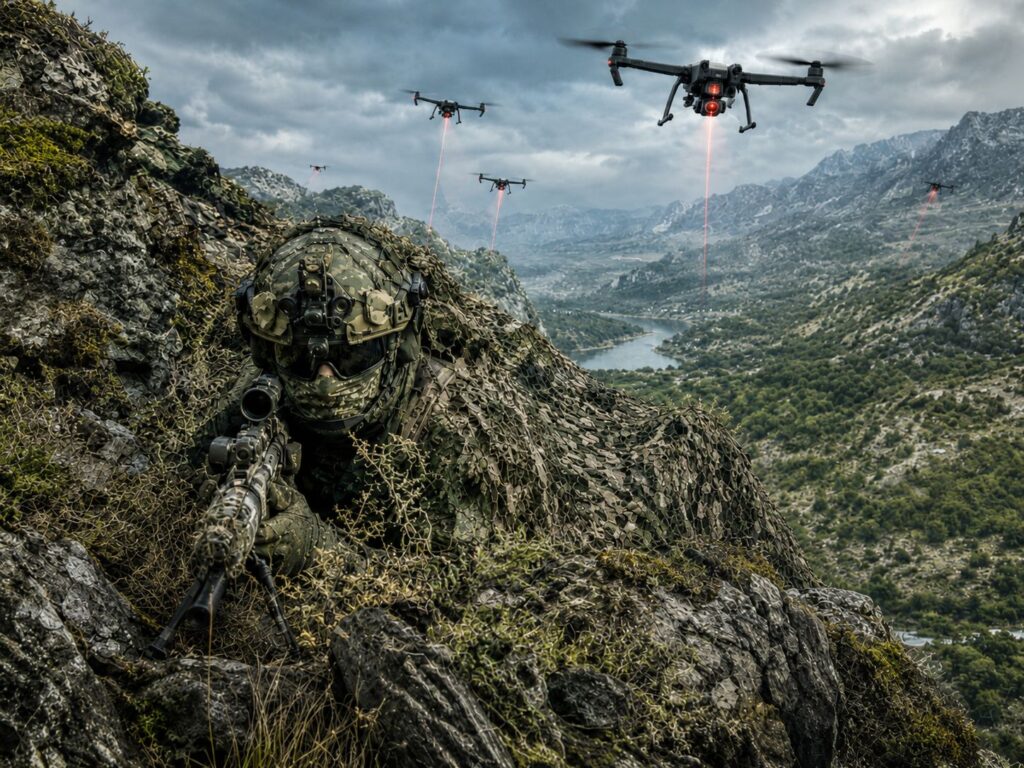
A soldier who cannot be seen cannot be killed. That simple equation, older than gunpowder, has turned into one of the most technologically contested and commercially lucrative corners of the defence industry. As drones, thermal optics and AI-driven sensors strip away the old comfort of distance and darkness, camouflage has stopped being a uniform pattern and become a survival system. Here is where the technology stands, who is winning the race, what it is worth, and where India fits in.
Camouflage is the use of any combination of materials, coloration, or illumination for concealment, either by making animals or objects hard to see, or by disguising them as something else. Examples include the leopard‘s spotted coat, the battledress of a modern soldier, and the leaf-mimic katydid‘s wings. A third approach, motion dazzle, confuses the observer with a conspicuous pattern, making the object visible but momentarily harder to locate. The majority of camouflage methods aim for crypsis, often through a general resemblance to the background, high contrast disruptive coloration, eliminating shadow, and countershading.
The soldier’s oldest insurance policy
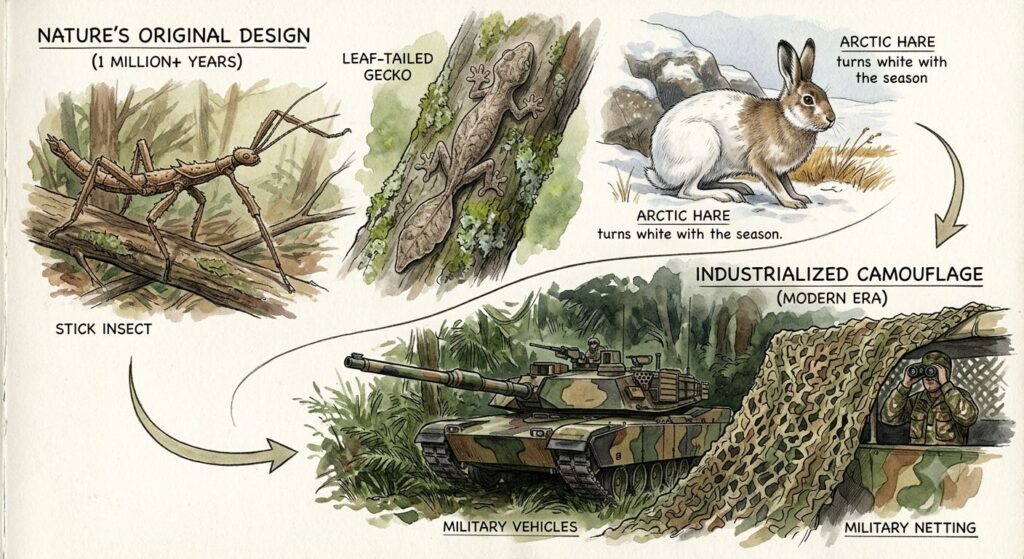
Long before anyone painted a tank or wove a net, nature had already perfected the art of disappearing. A stick insect, a leaf-tailed gecko, an Arctic hare turning white with the season, camouflage in the wild is a million-year-old arms race between predator and prey. The military simply borrowed the idea and industrialised it.
For most of human history this meant little more than dull-coloured cloth. The British Army’s khaki, adopted in colonial India in the 1850s, was the first real step away from the parade-ground scarlet that had made soldiers easy targets the moment rifled muskets extended killing range. By the World Wars, camouflage had become a discipline of its own , dazzle-painted ships meant to confuse a U-boat captain’s eye, and the first proper disruptive-pattern uniforms worn by German and British snipers.
What changed everything was not paint. It was sensors. Once an enemy could see in the dark, see-through cloud cover, or see body heat through a hedge, a pattern designed to fool the human eye stopped being enough. Camouflage had to start fighting machines, not men.
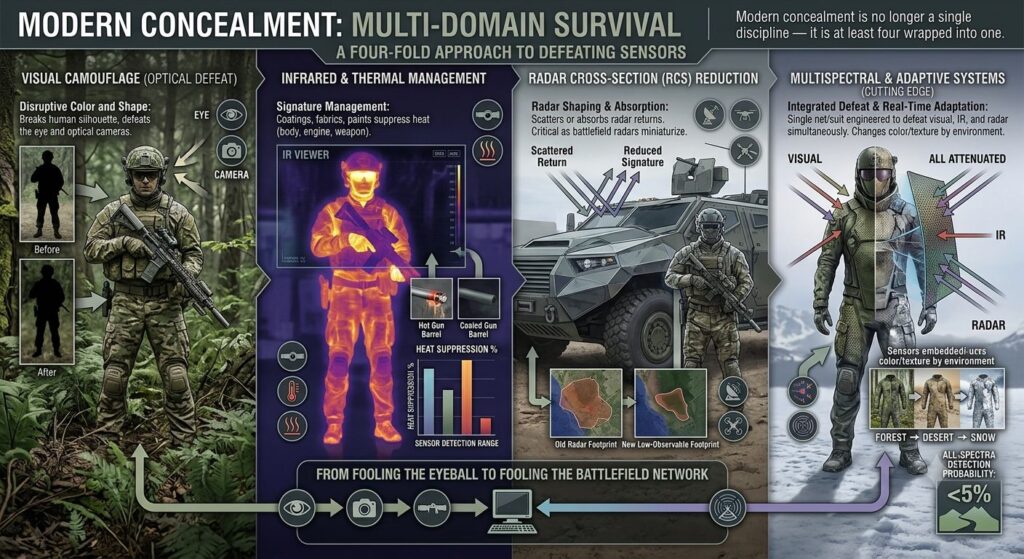
That fight defines the field today. Modern concealment is no longer a single discipline — it is at least four wrapped into one:
- Visual camouflage — disruptive colour and shape, the kind everyone recognises, designed to break up the human silhouette and defeat the eye and ordinary optical cameras.
- Infrared and thermal signature management — coatings, fabrics and paints that suppress or mask the heat a body, engine or gun barrel throws off, since thermal imagers do not care what colour a uniform is.
- Radar cross-section reduction –shaping and materials that scatter or absorb radar returns, traditionally the preserve of aircraft and ships but now creeping into vehicles and even soldier gear as battlefield radars get smaller and cheaper.
- Multispectral and adaptive systems — the cutting edge, where a single net, suit or coating is engineered to defeat visual, infrared and radar detection simultaneously, and in the most advanced cases, to change in real time as the wearer moves from jungle to desert to snow.
Camouflage used to be about fooling an eyeball. Today it has to fool an entire sensor suite — satellite, drone, radar and night-vision scope, all at once.
Why armies treat this as existential, not cosmetic
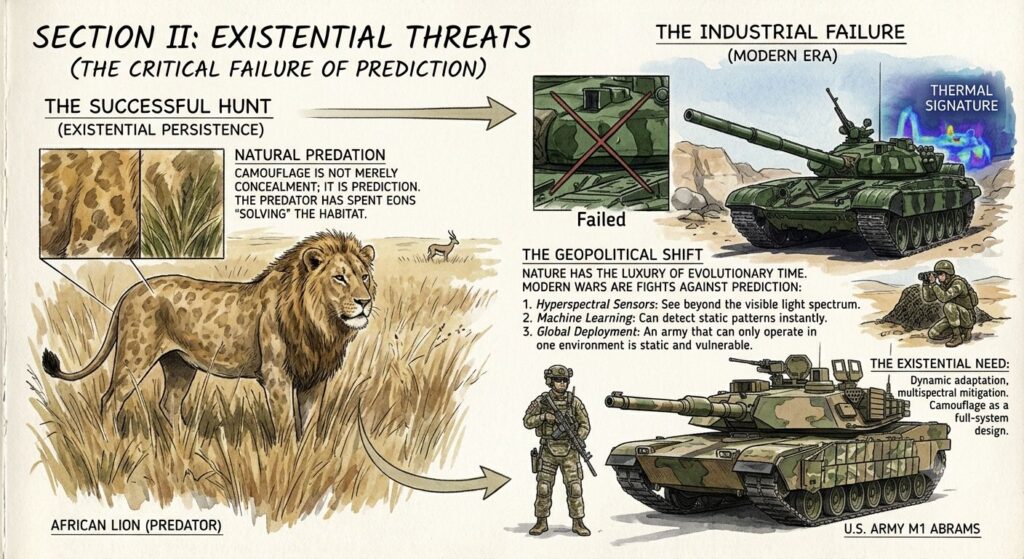
Three recent conflicts have made the argument for camouflage better than any white paper could. In the 2020 Nagorno-Karabakh war, Azerbaijani Bayraktar TB2 drones picked apart Armenian armour and artillery that had no answer to persistent overhead surveillance , vehicles dug in under camouflage nets designed for an earlier era of reconnaissance, not for loitering drones with thermal sensors that could watch a position for hours. The war is now taught in staff colleges as the moment unmanned aerial surveillance tipped from novelty to necessity.
Ukraine since 2022 has hardened that lesson into doctrine. Both sides now operate under what soldiers’ call “the transparent battlefield”, a density of drones, satellite imagery and open-source tracking so thick that traditional concealment, dig-in-and-wait tactics, and even basic vehicle movement have had to be rethought almost from scratch. Units that fail to manage their thermal and visual signature get found, and getting found on this battlefield usually means getting hit within minutes by a loitering munition or artillery cued from a drone feed.
Closer to home, India’s Operation Sindoor in 2025 and the broader pattern of cheap-drone warfare across the Red Sea and West Asia have reinforced the same point for the Indian military establishment: signature management is now inseparable from survivability, whether the threat is a swarm of low-cost quadcopters or a sophisticated stand-off sensor. The Indian Army’s own doctrine writers have been explicit that camouflage and deception sit alongside firepower and mobility as core pillars of modern combat power, not an afterthought bolted on at the end.
The economics back this up starkly. A multispectral camouflage net costing a few hundred dollars protects an asset, a radar, a missile battery, a command posts worth anywhere from hundreds of thousands to tens of millions of dollars. Few investments in defence procurement offer that kind of asymmetric payoff. It is also why camouflage and signature management increasingly sit not in the quartermaster’s stores but in serious R&D budgets, patent filings and dedicated industrial strategies.

Visual patterns are now computed, not drawn
The era of an artist hand-painting blobs on fabric is over. Modern camouflage design relies on computational pattern generation — software that models how the human eye and optical sensors perceive edges, contrast and texture at different ranges, then generates fractal-like, multi-scale patterns optimised for a specific terrain and engagement distance. India’s own DRDO has put real institutional weight behind this: its Camouflage Pattern Generation Software, now in its fourth major version (CPGS 4.0), was handed over to the Army’s Corps of Military Engineering specifically to let units design and validate camouflage patterns and deception schemes across the visible, infrared and radar bands before they ever go into the field.
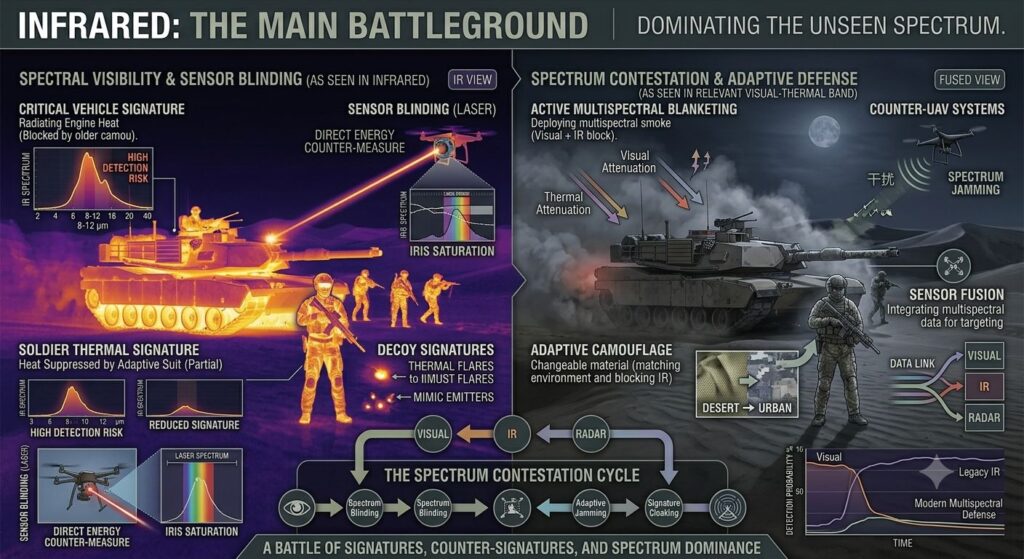
Thermal imaging is now standard-issue down to squad level in most modern militaries, which means infrared concealment has overtaken visual camouflage as the harder, more important problem. The basic physics is unforgiving — anything warmer or cooler than its surroundings radiate a signature, and the laws of thermal radiation mean even small temperature differences show up starkly on a cooled thermal sensor. The fix involves layered approaches: low-emissivity coatings, phase-change materials that buffer temperature swings, and increasingly, “radiative cooling” surfaces that bleed heat away through a specific atmospheric window where thermal sensors are less effective.
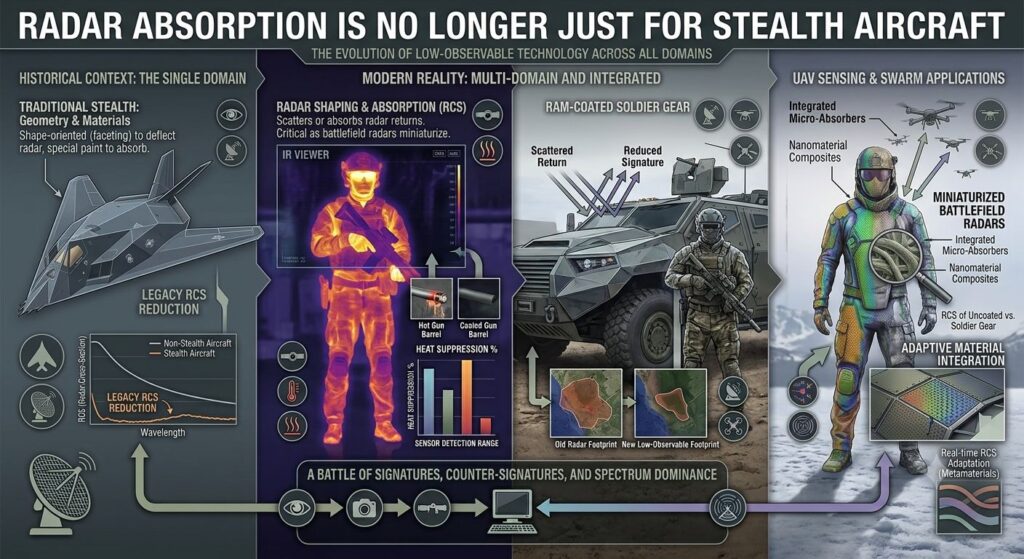
Ground radar and synthetic-aperture radar from satellites or drones are now common enough that radar cross-section reduction has filtered down to vehicles, gun positions, and camouflage netting itself. Modern multi-spectral nets weave radar-absorbent material into the same fabric that handles visual and thermal concealment, so a single system defeats three sensor types rather than needing three separate solutions stacked on top of each other.
The frontier: materials that think
The genuinely futuristic end of the field involves materials engineered at the nanoscale to manipulate light and heat directly rather than just absorbing or scattering them passively. Researchers have demonstrated multilayer photonic structures alternating thin films of materials like zinc sulphide and germanium combined with metal-oxide metasurfaces that simultaneously suppress visible, mid-infrared, laser and microwave signatures while still radiating excess heat away efficiently, solving the old problem where hiding from one sensor made you more visible to another. Separately, flexible plasmonic films using anodised aluminium oxide structures have been shown to deliver close colour-matching in visible light alongside genuine infrared suppression, all on a material thin and pliable enough to actually wear or wrap around a vehicle.
Then there is the “smart textile” layer of the electrochromic and thermochromic fabrics that change colour and infrared emissivity in response to an electrical signal or ambient temperature, effectively letting a uniform or vehicle skin adapt itself to a new environment instead of needing a different printed pattern for jungle, desert and snow. Commercial efforts in this space, including bio-responsive films and chameleon-inspired polymers, are still maturing in terms of switching speed, durability and power draw, but defence planners across the US, Europe and China are funding them seriously precisely because the payoff one suit, every terrain, real-time adaptation would be transformative for an expeditionary force.
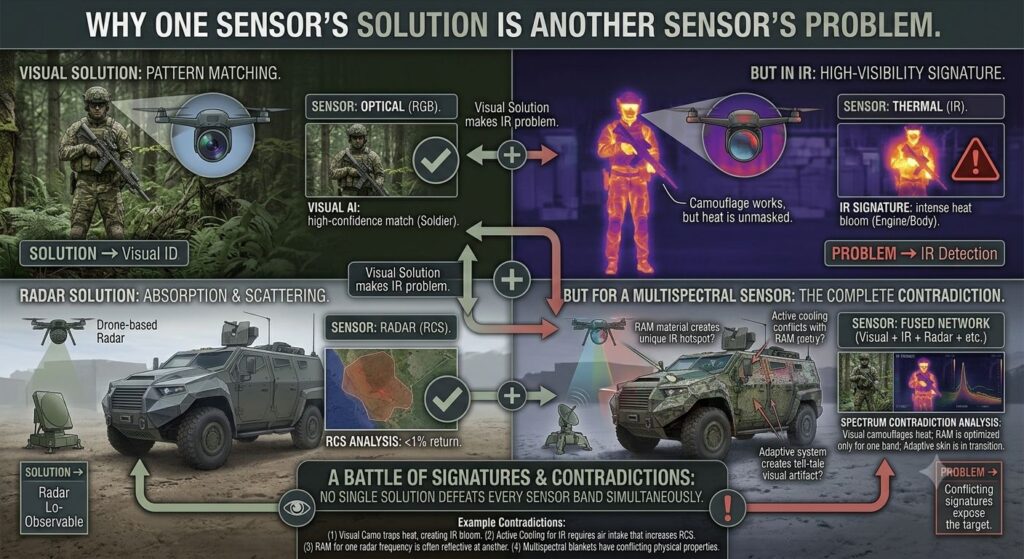
The hardest engineering truth in this field is that camouflage techniques routinely work against each other. A coating that suppresses infrared emission by reflecting heat back toward the body can raise surface temperature and create a sharper edge against a cold background solving one problem while worsening another. A radar-absorbent paint thick enough to cut return signal adds weight and bulk that can make a visual silhouette easier to pick out at close range. This is precisely why true multispectral systems are hard to build and expensive to certify: every layer has to be tested not in isolation but against the full sensor stack a real adversary would actually deploy daylight optics, low-light intensification, thermal imaging and ground or airborne radar, often simultaneously. It also explains why so much of the serious R&D investment globally is going into combined structures, the zinc-sulphide and metal-oxide metasurfaces, the plasmonic films rather than simply stacking three separate single-spectrum products on top of one another, which tends to produce a system that is heavier, more expensive and less effective than an integrated design.
The unglamorous workhorse: netting and decoys
For all the attention adaptive materials attract, camouflage netting remains the unglamorous backbone of battlefield concealment, and for good reason it is cheap, reusable, and scales to cover anything from a single gun position to an entire logistics hub. Modern multispectral netting weaves radar-absorbent fibre and low-emissivity treatments into the same fabric base that handles visual disruption, meaning a single net defeats three sensor types instead of requiring three separate concealment systems layered on top of each other. Decoys and deception measures sit alongside netting as the quieter half of this discipline, inflatable vehicles, simulated radar emissions, false heat signatures designed to draw a sensor’s attention away from the real target entirely rather than simply hiding it. Israel, Russia and increasingly Ukraine have all leaned on decoy tactics during recent conflicts precisely because a convincing fake target can absorb an expensive precision munition that would otherwise hit something real, which makes deception one of the highest-return investments available to a force operating with a smaller budget than its adversary.
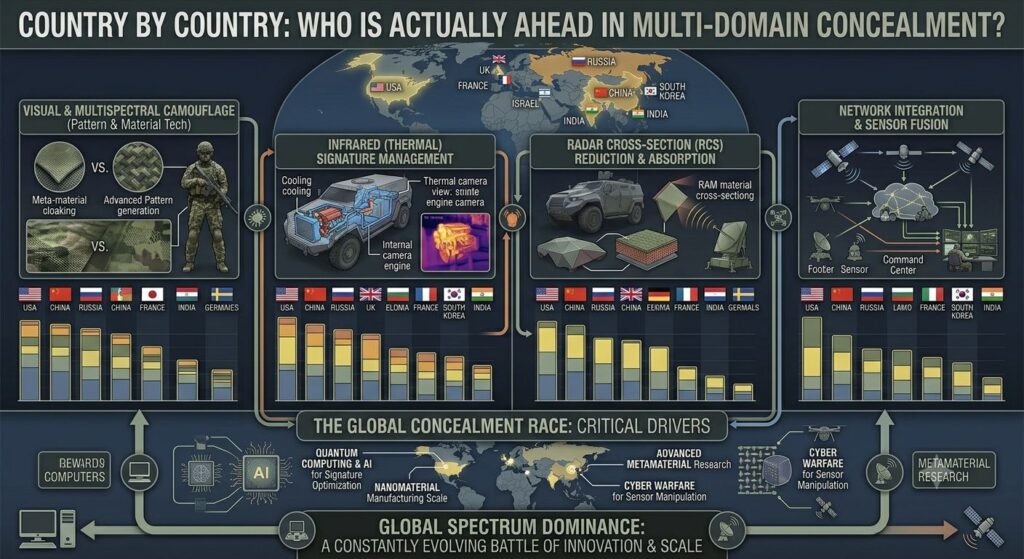
| Country | Signature Pillar | Institutional Model |
| United States | Multispectral nets (ULCANS); OCP pattern; radar-defeat ambitions for uniforms | Natick Soldier Systems Center; decades of continuity |
| China | Unified Type 21 “Xingkong” pattern across all services; advanced metamaterial research | Centralised PLA-wide standardisation |
| Russia | Vehicle/equipment concealment, decoys, dispersal doctrine | Doctrine-led; tested hard in Ukraine |
| Europe (NATO) | Multicam-derived patterns; multispectral netting; biodegradable materials | Rheinmetall, Saab; EU Strategic Compass funding |
| India | MSPCE suit/poncho/screen; synthetic multispectral netting; CPGS 4.0 software | DMSRDE (DRDO) + MKU and textile manufacturers |
United States. The US Army’s adoption of the Operational Camouflage Pattern in 2015, replacing the much-criticised digital Universal Camouflage Pattern, was as much an admission of failure as an upgrade — independent testing had shown the old pattern increased detection distances by 16 to 36 percent compared to better alternatives already on the market. Since then, American effort has shifted decisively toward multispectral systems rather than prettier patterns: the Ultra-Lightweight Camouflage Net System programme, run out of the Natick Soldier Systems Center, is explicitly built to defeat electro-optical sensors and radar simultaneously, and the Army has stated openly that it wants combat uniforms that can also defeat ground-based radar detection. The institutional model is worth noting — a dedicated soldier-systems research centre, decades of continuity, and a willingness to junk an expensive uniform programme when testing proved it didn’t work.
China. The PLA’s 2021 shift to the Type 21 “Xingkong” (Starry Sky) pattern did something the US and most Western militaries haven’t quite managed — it unified camouflage across all services into four standard environmental variants (jungle, desert, Gobi/tundra, urban) rather than letting each branch run its own programme. Beyond uniforms, Chinese research institutions have published some of the most advanced multispectral metamaterial work in the open literature, including plasmonic films and selective-wavelength absorption structures aimed squarely at defeating combined visible-infrared detection. China’s growth in the adaptive camouflage materials segment specifically is currently the fastest of any major market, reflecting the scale of investment its defence-industrial base is willing to commit.
Russia. Russian forces have historically prioritised vehicle and equipment camouflage and concealment doctrine — dispersal, decoys, deception — as much as soldier-level patterns, an emphasis validated rather brutally by the war in Ukraine, where both sides have had to relearn concealment against pervasive drone surveillance in real time. Russian industry continues to push radar-absorbent paints and applique armour with built-in signature reduction for armoured vehicles, though the war has exposed real gaps between doctrine and battlefield execution.
Europe. NATO’s push for interoperability has driven a degree of convergence — many European forces use Multicam-derived or closely related patterns — while companies like Rheinmetall and Saab anchor a strong industrial base in multispectral netting and vehicle signature management. The EU’s broader defence-modernisation push, including the Strategic Compass initiative, has specifically prioritised acquisition of advanced tactical concealment systems, and European firms have leaned into sustainable and biodegradable camouflage materials as a market differentiator.
India. Covered in detail below, but the short version: India has a genuinely capable indigenous R&D base in DRDO’s Defence Materials and Stores Research and Development Establishment, a fast-growing private manufacturing ecosystem, and a market now expanding faster than the global average even as it still leans on legacy patterns and faces the same multispectral catch-up race as everyone outside the top tier.

Camouflage sits inside several overlapping market categories, each tracked separately by industry analysts, which makes the “true” market size a matter of how widely you draw the circle.
| Segment | Current Size | Forecast | CAGR |
| Military camouflage uniforms | USD 1.4 bn (2024) | USD 1.7–2.5 bn by 2030–33 | ~3–5% |
| Camouflage suits & clothing | USD 1.9 bn (2025) | USD ~2.5 bn by 2029 | ~7%+ |
| Camouflage netting | USD 1.5 bn (2025) | USD 2.8 bn by 2034 | ~4.5–7.5% |
| Deployable camouflage systems | USD 2.1–2.2 bn (2025–26) | USD 3.2 bn by 2034 | ~5.8% |
| Adaptive / multispectral materials | USD 260–290 mn (2024–25) | USD 780–880 mn by 2034–35 | ~11.7% |
At the narrowest level, the global military camouflage uniform market — just the printed-pattern combat clothing itself is a mature, low-growth segment: uniforms are a recurring but unglamorous procurement line, growing at roughly 3–5 percent a year.
Widen the lens to camouflage suits and clothing more broadly, including paramilitary, law enforcement and civilian tactical-wear crossover, and growth accelerates to over 7 percent CAGR — reflecting guerrilla and asymmetric conflict trends, urban warfare training demand, and crossover into civilian tactical and outdoor markets.
Camouflage netting, the deployable systems that hide vehicles, artillery and installations, is growing steadily on the back of rising border tensions and the sheer number of assets that now need to be hidden from persistent drone surveillance.
The most strategically interesting segment, though, is the smallest in absolute dollar terms but the fastest growing by far: adaptive and multispectral camouflage materials smart textiles, electrochromic films, metamaterial coatings growing at nearly 12 percent CAGR, more than double the rate of the traditional uniform market. Within this segment, the military and defence application alone already accounts for roughly half of total demand.
Stack these segments together and a reasonable aggregate estimate for the full global camouflage and signature-management ecosystem sits somewhere in the USD 6–8 billion range today, climbing toward USD 10–12 billion within the next decade. North America currently commands the largest single share, at roughly 45 percent of the uniform segment specifically, with Europe close behind at around 30 percent and Asia-Pacific led by China and India flagged consistently by analysts as the fastest-growing region.
The named players reading like a who’s who of global defence and materials science tells its own story: Rheinmetall, Saab, BAE Systems, Raytheon, Lockheed Martin, QinetiQ and Crye Precision sit alongside specialist newcomers like Hyper Stealth Biotechnology and Folium Optics a mix of legacy primes and nimble materials-science startups that mirrors exactly the pattern seen in other frontier defence-tech segments, from drones to directed energy.
What is actually driving the spending
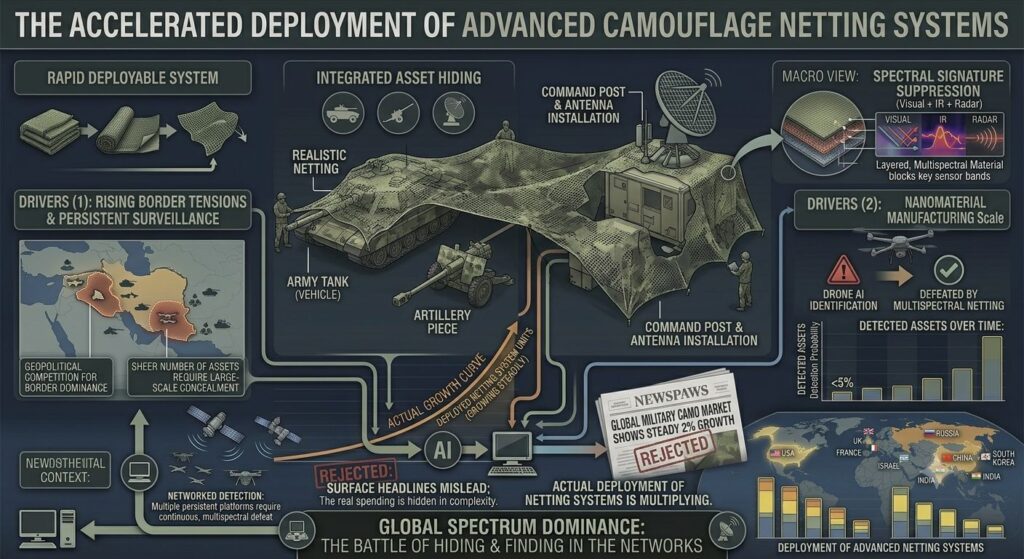
Three forces explain why this market keeps growing even in segments analysts call “mature.” The first is simple replacement cycling uniforms wear out, nets degrade under UV exposure and field use, and every army eventually has to re-buy at scale regardless of whether the underlying technology has changed. The second, and far more interesting, is threat-driven obsolescence: as cheap drones and commercial satellite imagery proliferate, camouflage systems designed even a decade ago are being quietly retired not because they wore out but because they no longer work against sensors that didn’t exist when they were fielded. This is the dynamic pulling money specifically into the multispectral and adaptive segments rather than into traditional uniform printing, and it explains why that smaller segment is growing at nearly four times the rate of the broader market. The third driver is dual-use spillover, investment in nanotechnology, metamaterials and smart textiles for camouflage increasingly serves aerospace stealth, civilian wearables and even architectural coatings, which means defence budgets are no longer the only money chasing the underlying science, and that broader commercial interest is helping bring down costs that used to be prohibitive for anyone but a handful of air forces.
What is actually driving the spending

Three forces explain why this market keeps growing even in segments analysts call “mature.” The first is simple replacement cycling uniforms wear out, nets degrade under UV exposure and field use, and every army eventually has to re-buy at scale regardless of whether the underlying technology has changed. The second, and far more interesting, is threat-driven obsolescence: as cheap drones and commercial satellite imagery proliferate, camouflage systems designed even a decade ago are being quietly retired not because they wore out but because they no longer work against sensors that didn’t exist when they were fielded. This is the dynamic pulling money specifically into the multispectral and adaptive segments rather than into traditional uniform printing, and it explains why that smaller segment is growing at nearly four times the rate of the broader market. The third driver is dual-use spillover, investment in nanotechnology, metamaterials and smart textiles for camouflage increasingly serves aerospace stealth, civilian wearables and even architectural coatings, which means defence budgets are no longer the only money chasing the underlying science, and that broader commercial interest is helping bring down costs that used to be prohibitive for anyone but a handful of air forces.