


Ever since he came to power on November 15, 2012, Xi Jinping seems to be fighting a relentless battle within his own country – to eliminate rivals and ensure absolute loyalty within the People’s Liberation Army (PLA) military and scientists involved in weapon research and testing.
Over the past 13 years ago nearly 100 generals, scientists, and Party officials occupying key positions have been dismissed, sidelined or replaced by loyalists. At least 15 high-ranking military officers and defence-industry executives were removed between July and December 2023 alone.
These purges have reportedly influenced every branch of the PLA including the CMC, five theatre commands (Central, Northern, Eastern, Southern, and Western), four services (Air Force, Army, Navy, and Rocket Force), four support forces, military academies, and People’s Armed Police (PAP) as well as subordinate departments and offices directly or indirectly functioning under them.
The Rocket Force which controls China’s strategic nuclear missiles – seems to have paid the highest price. At least four of its past commanders have been officially purged.
It is pertinent to note that investigations against senior PLA officials take months and sometimes up to a year to complete—as a result many officials currently in service – may retire or will need to be expelled from the CCP in the coming months.
Significantly no one is immune – even retirement does not protect officials from expulsion. Apart from those who are still in service, so far nearly eleven PLA officers were purged after retirement. Seven out of the eleven ousted PLA officers reportedly retired before 2022 but were purged later – after 2022.
The bulk of these changes have occurred in 2025–26 where several top generals and defence scientists were shunted out and made to resign or unceremoniously shown the door.
In 2025 itself, at least 15 generals were officially purged. Nine of them were expelled from the Chinese Communist Party (CCP) and six dismissed. This apart, many general officers are still under investigation. At least 46 general officers suddenly disappeared or were missing at various ceremonial occasions in 2025. For instance, 14 generals and 5 lieutenant generals were conspicuous by their absence at the CCP’s fourth plenum in October 2025.
Some recent examples of such kind include:
| Name & Position | Year | Action taken | Implications |
| Liu Guozhi – Senior PLA scientist, nuclear test site commander, and expert in high‑power microwave weapons. | Mar 2026 | His name was abruptly removed from the Chinese Academy of Sciences website | His fate reflects how even highly capable professionals like him—are vulnerable if perceived as insufficiently loyal. By removing him, Xi has signalled that no one is indispensable—not even senior scientists at the heart of China’s nuclear weapons program. |
| Wu Manqing, Zhao Xiangeng, and Wei Yiyin— three senior defence scientists were quietly removed from the official roster of the Chinese Academy of Engineering (CAE). Wu Manqing was a specialist in radar and electronic warfare systems. Zhao Xiangeng was a nuclear weapons scientist, deeply involved in China’s warhead program while Wei Yiyin was a key figure in missile development & aerospace defence projects. | Mar 2026 | Disappeared after the U.S. nuclear warhead stockpile report | These men represented the pinnacle of China’s defence R&D in nuclear weapons, radar, and missile systems. Their removal signals a deliberate sidelining of independent technical voices. The removal of Wu Manqing, Zhao Xiangeng, and Wei Yiyin is not an isolated event—it fits into a broader pattern of Xi Jinping’s internal war against independent minds. By reshaping the CAE and PLA’s scientific leadership, Xi is ensuring absolute loyalty but at the cost of technical depth and strategic flexibility. |
| Zhang Youxia –Vice Chairman of the Central Military Commission (serving directly under Xi Jinping) and one of the few serving generals with real combat experience. | Jan 2026 | One of China’s senior most generals, he was placed under investigation for “serious violations of discipline and law,” marking the most dramatic purge in Xi’s campaign against the PLA elite. | Reports suggest allegations of selling nuclear secrets to the U.S., though these claims remain unverified and politically sensitive. His removal shocked observers because he was once Xi’s most trusted military ally. |
| Admiral Dong Jun – a People’s Liberation Army Navy (PLAN) (shangjiang) was appointed as the 14th Defence Minister and replaced Li Shangfu (who disappeared from public view and was later dismissed in Oct 2023). Dong was the first defence minister with a naval background. His elevation was called the “biggest surprise of 2023” but an even bigger shocking news broke out when he himself was removed from office in early 2026 | 2026 | Dong was reportedly under investigation for corruption | He was the third consecutive Chinese defence minister to be ousted after corruption allegations. |
| Gen He Weidong –the second-highest ranking PLA officer after President Xi Jinping and seven other senior Generals were abruply removed. The disgraced officers included: He Hongjun – executive deputy director of the CMC’s political work department Wang Xiubin – executive deputy director of the CMC’s joint operations command centre Lin Xiangyang – Eastern Theatre commander Qin Shutong – the Army’s political commissar Yuan Huazhi – the Navy’s political commissar Wang Chunning – Armed Police Force commander. | Late 2025 | “Serious violations of discipline and law” – the official charge, often a euphemism for corruption linked to procurement, weapons development, and misuse of funds or political disloyalty | Created vacancies in strategic missile command, undermining continuity. Analysts believe the purge was less about corruption and more about eliminating independent power centres within the PLA.Most of them were three-star generals and were responsible for China’s nuclear arsenal, missile forces, and strategic operations with decades of service and technical expertise in advanced weapons systems. |
| Wang Houbin — a PLA navy officer brought in to clean up the PLA Rocket Force (PLARF) was himselfshown the door. In 2023, then three-star Gen Wang, replaced Gen Li Yuchao. Wang’s appointment was seen as a bold move—transferring a naval officer to lead China’s strategic missile command. | October 2025 | On 17 Oct 2025, China’s Ministry of Defence announced that Wang and eight other senior officers were being expelled for “serious violations of Party discipline” | Wang Houbin was the second consecutive Rocket Force commander to be removed. His expulsion—signals deep instability within the Rocket Force and military hierarchy. His short tenure and abrupt dismissal reflects Xi’s fear of factionalism, insubordination, or potential coup within elite military circles. |
| Admiral Miao Hua — PLA’s top political officer on the CMC, which meant he was central to ideological control, loyalty enforcement, and senior personnel management inside the military. | 2024- 2025 | Penalised for “serious violations of discipline”. He and others were suspected of “serious duty-related crimes involving an extremely large amount of money.” In Chinese political language, this usually means graft, bribery, or abuse of office. | He was suspended and investigated in Nov 2024, removed from the CMC in June 2025, and then expelled in Oct 2025 |
| Minister of National Defence Wei Fenghe — a retired PLA general (shang jiang) as well as former commander of the Rocket Force previously called the Second Artillery Corps was investigated by the CMC’s disciplinary inspection department for charges of corruption. | 2023- 2024 | Wei was accused of accepting large amounts of money for using his power to obtain benefits for others. In June 2024, he was expelled from Chinese Communist Party (CCP) for disciplinary and law violations andstripped of the rank of general | The fact that three consecutive defence ministers have been implicated in investigations highlights a persistent “political contamination” within the military that Xi has vowed to eliminate. |
| General Zhang Lin, Gao Daguang and other officers responsible for procurement and distribution of fuel, ammunition, and transport for PLA’s military operations | 2024 | Inflated contracts, kickbacks, and mismanagement of fuel, ammunition, and transport procurement. | Highlighted systemic corruption in supply chains. Accelerated purges in logistics branches- removing senior officers and replacing them with loyal cadres. |
| Five out of seven members of China’s Central Military Commission (CMC) were removed. The CMC is chaired by Xi himself, and its members are the ultimate decision‑makers for the PLA’s nuclear, missile, and conventional forces. | 2023 | Charges of “serious violations of discipline and law”. An extraordinary development, as the CMC is chaired by Xi Jinping and is the apex military authority in China. | One of the most extraordinary developments in Xi Jinping’s campaign to reshape the PLA, it led to concentration of power in Xi’s hands |
| Li Shangfu — removed as defence minister and state councillor and stripped of the rank of general | 2023 -2024 | He was removed from the CMC in Oct 2023 and later expelled from the Party in June 2024 due to alleged kickbacks in procurement of equipment in the PLA unit he commanded from 2017 to 2022. | Li Shangfu was not removed over policy failure or diplomacy; he fell because the procurement system he once controlled became a corruption target in Xi Jinping’s widening purge of the PLA. |
| Multiple Rocket Force generals were removed, replaced, expelled, or investigated | 2023–onwards | Rocket Force was one of the hardest-hit branches. | |
| Li Yuchao — PLA Rocket Force commander was removed. Deputy commander Liu Guangbin and former deputy commander Zhang Zhenzhong were also caught up in the probe. | 2023- 2024 | He was effectively replaced in July 2023 and expelled from the Party in July 2024 for “serious violations of discipline and law”. | Li Yuchao’s removal was the first major signal of instability within the Rocket Force, setting off a chain of purges that later included Wang Houbin and other senior generals in China’s most sensitive military branch. |
| Xu Zhongbo, a senior PLA general, served as the Political Commissar of China’s Rocket Force (2020 – 2023) when he was abruptly removed and replaced by Xu Xisheng – an outsider from the Southern Theatre Command political system. | July 2023 | Xu Zhongbo’s removal coincided with the dismissal of Rocket Force Commander Li Yuchao and several deputies. Reports suggest the purge was linked to corruption investigations and concerns about loyalty within the Rocket Force. | Xu’s removal, created a vacuum at the top of China’s most sensitive military branch. As the Political Commissar of PLA Rocket Force (2020–2023), he was responsible for discipline, ideological control, and political loyalty within the branch. |
| Fang Fenghui, Chief of the CMC Joint Staff Department and one of the PLA’s top operational officers. Reports suggest he embezzled billions, sold military products worth 4.7 billion yuan, and built a nuclear explosion-proof mansion. | 2017- 2019 | He was sidelined in 2017, expelled from the Communist Party and stripped of rank in 2018, and sentenced to life imprisonment for bribery and corruption in 2019 | His conviction showed corruption was not confined to lower ranks but had reached the top of China’s defence establishment. |
| Zhang Yang – Director of the CMC Political Work Department, the arm responsible for political control, ideology, and loyalty inside the PLA. | 2017 | On August 28, 2017, CMC decided to investigate him, but he committed suicide on Nov 23, 2017, while under investigation. He was posthumously expelled from the CCP. | Zhang’s case revealed that corruption was entrenched even at the very top of the PLA. The suicide of such a senior officer shocked the PLA and created fear psychosis among the officer corps. |
| One of the top military leaders in China and Vice Chairman of the Central Military Commission (CMC) — Guo Boxiong, was sentenced to life imprisonment for taking bribe. | 2015- 2016 | He was investigated in 2015 for corruption, expelled from the CCP and stripped of the rank. He was sentenced to life imprisonment in July 2016, for taking bribe in exchange for promotions and favours. | Guo Boxiong’s imprisonment was a watershed moment in Xi Jinping’s anti-corruption campaign and set the precedent for subsequent purges in PLA leadership. |
| Xu Caihou – Vice Chairman of the Central Military Commission (2004–2012), was one of the first senior officers jailed for graft. | 2014-2015 | Xu was accused of taking massive bribes in exchange for promotions, reportedly filling his home with cash, jewels, and luxury items. He was investigated for corruption in 2014, expelled from the CCP, and stripped of the rank but died of cancer in March 2015 before his trial could conclude. | His case revealed how patronage networks had hollowed out the PLA’s meritocracy, undermining professionalism. By targeting Xu, Xi demonstrated that even the most senior military leaders were not untouchable. |
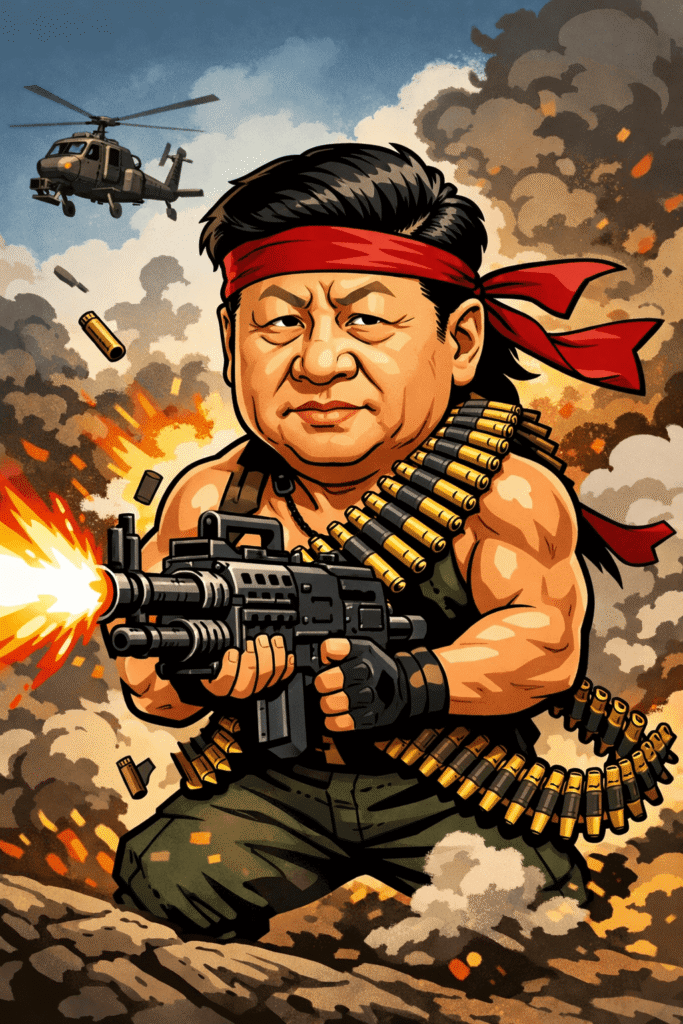
Xi Jinping’s three‑pronged objective behind this has been to cement power, enforce absolute loyalty, and impose ideological discipline by systematically removing and replacing potentially rogue elements with trusted loyalists—before they can disrupt the military chain of command or the Communist Party hierarchy.
Behind all this is Xi’s doctrine – where obedience is rewarded and dissent is punished —even when it means sidelining the most capable professionals in sensitive branches like the Rocket Force, which manages China’s strategic missile arsenal.
As of now loyalty outweighs competence at every level of China’s military hierarchy.
The message is loud and clear – technical expertise alone is of no use without loyalty and reliability. Xi can tolerate mediocrity and hypocrisy but doesn’t want independent-minded opinion leaders who are branded as corrupt or disloyal and disgracefully booted out- before they can do any real damage within the military chain of command or party hierarchy.