

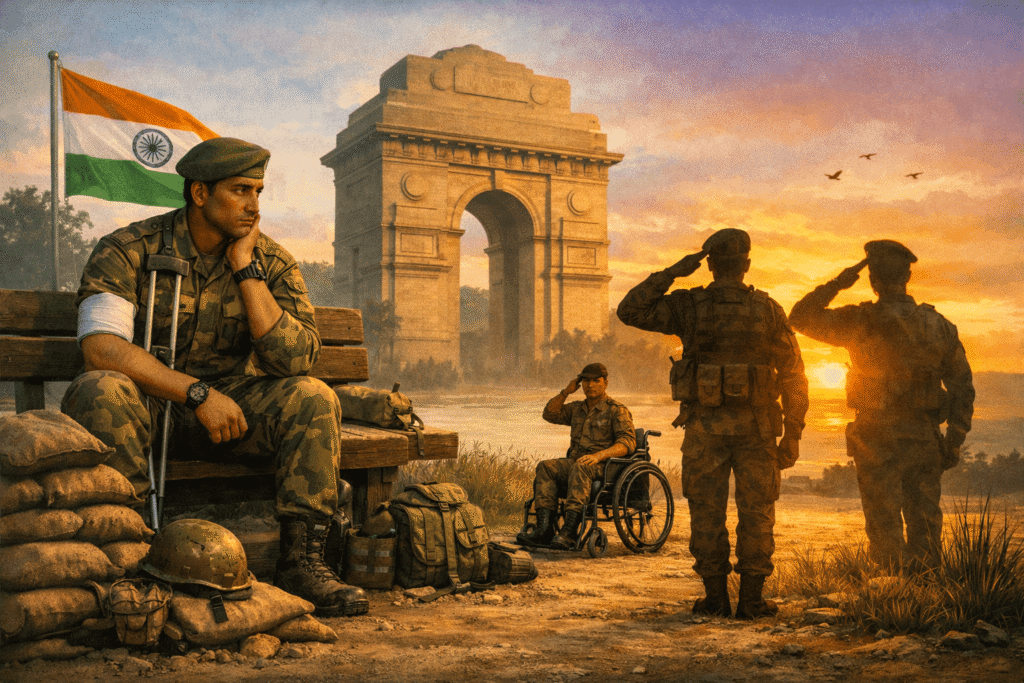
India’s pension system is complex, divided between defense services, paramilitary forces, and civilian employees. Disability pensions add another layer of complexity. For decades, disability pensions have been a moral commitment, a recognition that those who risk their lives for the nation deserve lifelong support if injured in service. In India, disability pensions for soldiers remain a critical support system.
What is Disability Pension and Who is Eligible?
Disability Pension comprises two elements:
- Service Element: Equivalent to the retiring/service pension based on qualifying service and rank (50% of reckonable emoluments for full qualifying service).
- Disability Element: Proportional to the percentage of disability (30% of reckonable emoluments for 100% disability in non-battle cases; scaled down proportionally). No disability element is payable below 20% disability.
Eligibility
(Regulation 173, Pension Regulations for the Army/Navy/Air Force, 1961, and parallel rules):
- The individual must be invalided out (or “deemed invalided” in certain low medical category discharges for PBORs) with disability assessed at 20% or more.
- The disability must be attributable to or aggravated by military service.
Updated rules under:
- Entitlement Rules for Casualty Pension and Disability Compensation Awards, 2023 (ER 2023)
- Guide to Medical Officers (GMO) 2023
apply to cases after 21 September 2023.
Personnel retained in service with attributable/aggravated disability now receive Impairment Relief (formerly Disability Element) in addition to service pension, or Capitalised Impairment Relief as a lump sum option via Retention cum Impairment Assessment Board (RIAB).
For those invalided earlier, the 1961 Regulations read with 1982/2008 Entitlement Rules continue to govern, with benefit of doubt always extended to the soldier.
Medical Boards: the gateway to entitlement
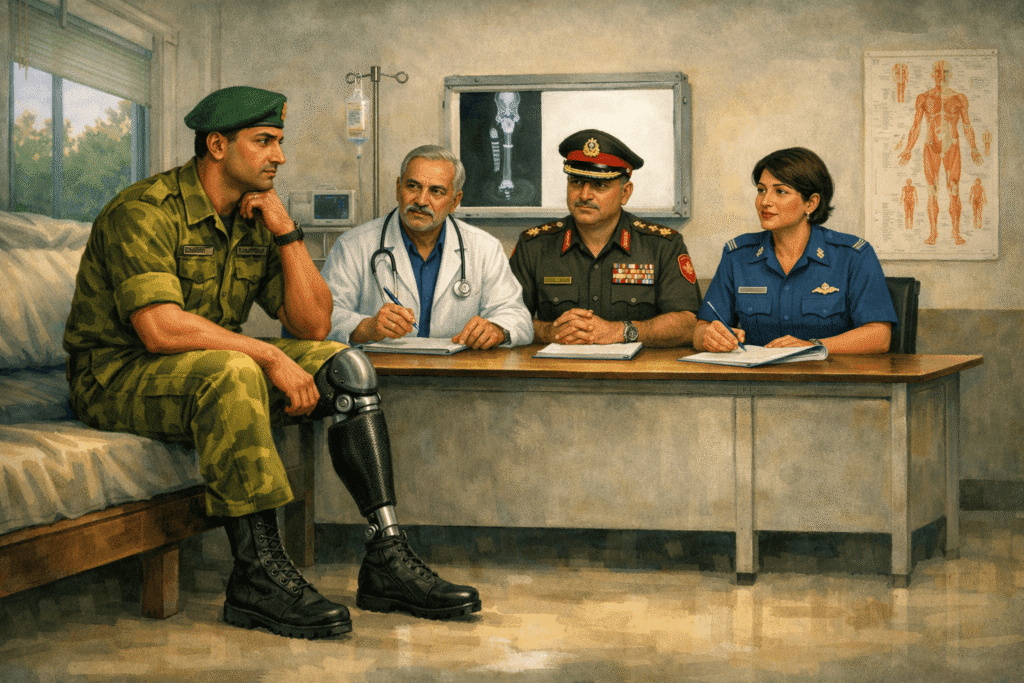
Medical Boards are the gateway to entitlement. Key types under GMO-2023:
- Classification/Reclassification Medical Board (AFMSF-15): Initial/temporary low medical category.
- Invaliding Medical Board (IMB) / Release Medical Board (RMB) (AFMSF-16): Determines invalidment, attributability/aggravation, and disability %.
- Retention cum Impairment Assessment Board (RIAB): For retention with impairment relief.
- Appeal/Review/Re-assessment/Post-Discharge Medical Boards: For challenges or worsening conditions.
Critical Rule
Boards must give reasoned opinions.
A bare “NANA” (Neither Attributable Nor Aggravated) without specific reasons linking (or not linking) the disability to service is unsustainable and can be set aside by courts.
Evidence includes:
- Service history
- Injury reports
- Courts of Inquiry
- Specialist opinions
- Field/high-altitude postings
Presumption in Favour of Soldier

If no disease/disability was recorded at enrolment (AFMSF-15 at entry), it is:
- Presumed to have arisen during service, and
- Presumed attributable/aggravated,
unless the authorities rebut it with cogent, evidence-based reasons (benefit of doubt to the soldier).
GMO-2023 provides objective criteria (e.g., hypertension in high-altitude areas ≥3 months, certain psychiatric disorders in operational zones, etc.). Lifestyle diseases are rarely attributable unless specific service causation is proven.
The Law: Attributable vs. Aggravated Disabilities
- Attributable: Direct causal connection to military service (e.g., injury in training/operations).
- Aggravated: Pre-existing condition (even undetected) worsened by service stresses (exertion, climate, isolation).
ER 2023 and Appendix II to older regulations mandate this determination. Natural progression without acceleration by service does not qualify. However, courts liberally interpret “causal connection, however remote.”
How Disability is Calculated:

Disability percentage is assessed by the Medical Board for “loss of earning capacity.”
For pension computation, broadbanding/rounding-off applies (MoD letter dated 31.01.2001, as amended):
| Percentage Assessed by Medical Board | Percentage Reckoned for Disability Element |
| Up to 50% | 50% |
| More than 50% up to 75% | 75% |
| More than 75% up to 100% | 100% |
This policy was initially limited to invalided cases post-01.01.1996 but was extended by the Supreme Court to all cases of attributable/aggravated disability (even normal retirement/discharge).
It significantly boosts the pension amount (e.g., 30% becomes 50%).
Note:
Broadbanding applies only to the disability element, not service element. Impairment Relief follows the same principle.
Important Judgments (With Citations)

Courts have consistently protected soldiers’ rights:
- Dharamvir Singh v. Union of India (2013) 7 SCC 316 and Bijender Singh v. Union of India (2025 INSC 549): Strong presumption of service connection if disability not recorded at enrolment. Onus on Government to rebut with reasons.
Dharamvir Singh (2013)
An Army Naik invalidated out after 13 years’ service with hypertension (diagnosed during service, assessed at 30%) claimed disability pension; Release Medical Board (RMB) deemed it constitutional/essential hypertension with “no contributory effect of service,” but without noting it at entry or providing evidence of pre-existence. The Court clarified Policy Entitlement Rules (Rule 5 presumes fitness at entry; Rule 9 mandates benefit of doubt to personnel; Rule 14 presumes attributability/aggravation for post-entry diseases unless proven otherwise by employer); unreasoned RMB opinions insufficient to rebut presumption onus on Union to show disease was congenital, hereditary, or pre-existing via entry medical records or scientific evidence.
Result :Pension granted as service-related (disability + service elements) with arrears.
Bijender Singh (2025)
Ex-L/Nk invalidated out with <20% “generalized tonic-clonic seizure” (old); Invaliding Medical Board noted it non-pre-existing (could not have been detected at entry), but Armed Forces Tribunal (AFT) denied pension citing <20% threshold under Pension Regulations 1961/2008. Building on Dharamvir, Sukhvinder Singh (2014), and Rajbir Singh (2015), the Court reiterated strict employer onus to disprove service link (Rules 5/9/14); abolished rigid 20% bar for invalidment cases, mandating “broad banding” to 50% minimum for pension (per 2001/2008 policy letters); AFT erred in ignoring board’s own admission of post-entry origin and service aggravation presumption.
Result : Directed 50% disability pension for life from January 1, 1996, with arrears and interest.
- Union of India v. Rajbir Singh (2015) 12 SCC 264 and Sukhvinder Singh v. Union of India (2014) 14 SCC 364: Undetected disability presumed service-related; benefit of doubt to soldier. Both affirm liberal interpretation of beneficial pension rules: presumption of fitness at entry, service causation for unnoted post-entry disabilities, employer onus to disprove (Rules 5/9/14), and mandatory reasoned opinions from boards
Sukhvinder Singh (2014)
A recruit enrolled in 2001 was invalided out after ~5 months with 6-10% hearing impairment (right ear), linked to an assault or slap during training; no pre-enlistment note of the condition existed. The Court presumed sound health at entry per Entitlement Rules Rule 5 (1982), deeming post-entry deterioration attributable to service absent rebuttal; invalidation despite <20% disability entitled him to service element pension under Regulation 173/183 (Pension Regulations 1961). Benefit of doubt favors claimants liberally (Rule 9), with no provision for discharging those <20% without pension or re-enrollment options.
Rajbir Singh (2015):
Union challenged Armed Forces Tribunal orders granting disability pensions to multiple ex-servicemen (e.g., epilepsy, hypertension, schizophrenia at 20%+) solely on Medical Board opinions denying attributability. Upholding Dharamvir Singh (2013) 7 SCC 316 and Sukhvinder, the Court ruled Medical Boards must provide reasons if deeming diseases pre-existing/undetectable; presumption of service origin holds if unnoted at enlistment (Rules 5/14), rebuttable only by evidence showing congenital/hereditary nature. Pensions due for ≥20% disabilities; boards’ unreasoned conclusions insufficient.

K.J.S. Buttar v. Union of India (2011) 11 SCC 429
Landmark on rounding-off; discriminatory denial to pre-1996 retirees struck down under Article 14. Ex-Captain Buttar, invalided out in 1979 after a gunshot injury during live ammunition training (50% disability assessed as attributable to service), sought: war injury pension from January 1, 1996; disability upgrade to 75%; full 10 years’ service element (not 2 years); and revised rates post-Fifth Pay Commission. Union resisted, citing his pre-1996 invalidment.
The Core issue that was decided : Restrictions limiting benefits (e.g., 75% disability upgrade under para 7.2, war injury pension under para 10.1 for Category E(f)(ii)) to post-1996 cases violate Article 14, as they create arbitrary cut-off dates among equals; these are liberalizations of existing schemes, not new ones. Full commissioned service (10 years) counts for pension, per C.S. Sidhu (2010) 4 SCC 563.
Union of India v. Ram Avtar (2014 SCC OnLine SC 1761)
Extended broadbanding to personnel retiring on completion of tenure (not only invalided). Disability pension is a valuable right, not largesse.
Supreme Court in Union of India v. SGT Girish Kumar & Ors. (2026 INSC 149, decided February 2026)
Latest and path-breaking.
Arrears of broad-banded disability pension cannot be restricted to three years before filing application in AFT.
- Full arrears payable from 01.01.1996 (or 01.01.2006 as applicable) or date of entitlement, with 6% interest.
- The Court rejected limitation arguments, noting the Union’s own 2014 and 2016 policy letters acknowledged arrears from those dates without curbs; restricting them violates Article 300A (property rights).
- Disability pensions, as deferred compensation for service-related impairments, must be paid from when due, not curtailed selectively.
- Reiterated: “Disability pension is recognition of sacrifice, not charity.”
Recent High Court/ AFT Trend (2025–2026):
These judgments are binding and have been applied across AFT benches.
Special Impact on Short Service Commissioned (SSC) Officers and PMR Officers
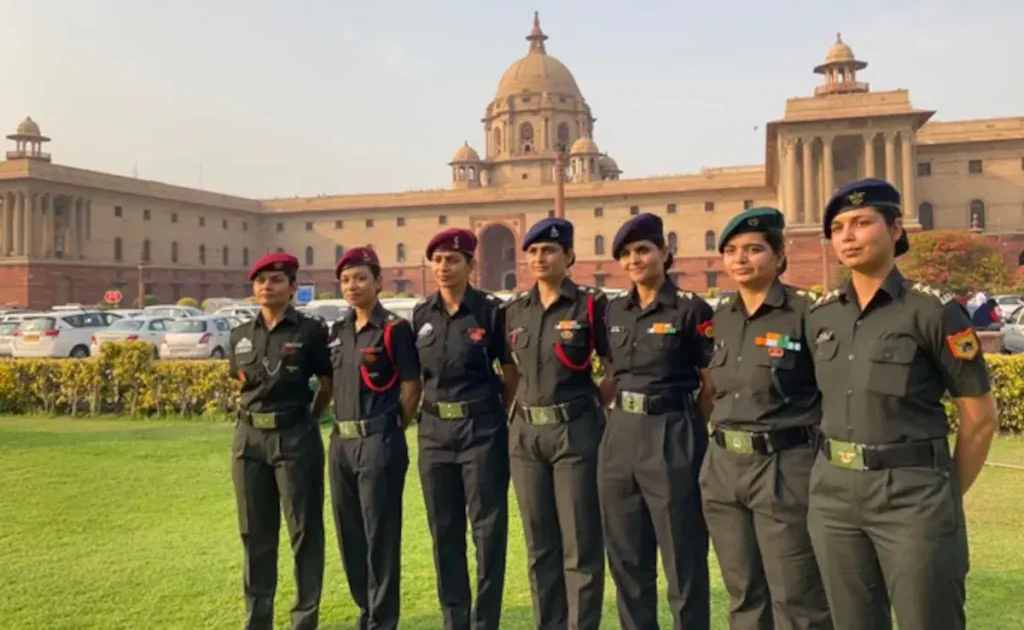
SSC Officers
They serve fixed tenure (usually 10–14 years) and normally have no statutory pension (minimum 20 years qualifying service required for regular pension).
However, if invalided or released with attributable/aggravated disability ≥20%, they are entitled to full:
- Disability Pension
- Service element for completed service
- Disability element with broadbanding
Courts (including AFT applying K.J.S. Buttar) treat SSC completion as akin to invalidment in disability cases.
Recent Supreme Court directions (March 2026) in PC denial cases have further strengthened pro-rata pensionary benefits for eligible SSC officers. Impairment Relief is also admissible if retained.
PMR Officers
Regulation 50 of Pension Regulations bars disability pension for voluntary retirement.
However:
- If the officer was due for retirement and sought PMR (e.g., for higher commutation), or
- If disability is clearly attributable/aggravated,
courts/AFT have granted relief in several cases, striking down discriminatory application.
The proviso to Regulation 50 protects those seeking PMR near tenure end.
Unreasoned denial is challengeable. SSC/PMR cases require strong medical evidence and timely AFT approach.
What Should Soldiers Do If Disability is Not Recognised (But They Feel It Is Attributable)?

DOs
- Immediately collect all medical documents, service records, and RMB/IMB proceedings.
- File a detailed representation to the competent authority (Record Office/PCDA).
- Apply for:
- Appeal Medical Board (AMB)
- Review Medical Board
- Maintain a diary of all correspondence.
- Consult a veteran advocate early and file Original Application (OA) in the nearest AFT Bench within limitation (generally 6 years from cause of action, but AFT is liberal).
- Preserve evidence of service stressors (field postings, high altitude, operations).
DON’Ts
- Do not accept a vague “NANA” opinion without challenging it.
- Never delay limitation issues can arise (though 2026 SC ruling helps on arrears).
- Do not rely solely on unit advice; get independent legal opinion.
- Avoid submitting incomplete documents or emotional appeals without legal citations.
- Do not ignore post-discharge worsening apply for Post-Discharge Medical Board within 7 years if SHAPE-I at retirement.
Practical Insight
Success rate is high when armed with reasoned challenge and judgments.
Conclusion

Disability pension is your hard-earned right.
Medical Boards must follow due process; unreasoned opinions will not stand judicial scrutiny. Broadbanding, presumptions, and latest rulings especially the February 2026 Supreme Court judgment on full arrears have significantly strengthened your position.
SSC and PMR officers are not left out specific entitlements exist and have been judicially upheld.

