


Counterfeit liquor trade is no longer a back‑alley menace. FICCI CASCADE estimates illicit alcoholic beverages now account for over 30 percent of India’s market, worth more than ₹60,000 crore. This is not a handful of cheats; it is a systemic failure. Excise departments remain focused on revenue collection rather than consumer safety, while protection frameworks still treat liquor as a “sin tax” commodity instead of a product with serious health risks.
In an exclusive interview Consumer policy expert Bejon Misra touches upon the true extent of the problem, the loopholes that make refilling so easy, and the practical, low‑cost safeguards that could protect consumers. At its core lies a blunt question: are we ready to treat liquor safety as a matter of public health, not just excise duty?
How big is the problem of refilled or diluted premium liquor, and what does it reveal about our excise duty taxes and consumer protection processes and systems?
The problem is much bigger than the occasional raid you see in the news. We now have regular cases where licensed vends are caught refilling premium bottles with unsafe, cheap or watered-down alcohol. In Noida, for instance, excise officials recently seized adulterated whisky in bottles of Ballantine’s, Black Label, Red Label and Jameson, all with fake QR codes. In Nagpur, police under “Operation Thunder” found 1,200 litres of watered-down premium alcohol, 4,500 empty branded bottles, fake caps and sealing machines – a full-scale counterfeiting and dilution factory.
If you step back and add FICCI’s estimate that illicit alcoholic beverages now account for over 30% of the Indian market, worth more than ₹60,000 crore, you realise we are not dealing with a few small-time cheats. It reveals two most uncomfortable truths: excise departments are still designed primarily to chase revenue, not protect consumers, and our consumer-protection mechanism has not yet fully entered the liquor space in a pro-active manner, which is still treated as a “sin tax” commodity rather than a product with serious health and safety risks.
What practical, low-cost anti-counterfeiting and supply-chain measures should liquor companies adopt in India?
The good news is you don’t need science fiction to fix a large part of the problem. This is no rocket science. There are several low-cost measures that are already working in some states and can be scaled in every State and Union Territories of the country.
First, unique method is, non-reusable closures – caps that clearly break or deform if opened – make refilling extremely expensive and much harder to hide. Second, every bottle should carry a serialized QR code linked to a central database, which consumers can verify on a simple app. Rajasthan’s excise department has already launched a citizen app where buyers scan the hologram/QR to see brand, batch, MRP and manufacturer details on their phone. Third, states like Kerala are moving to high-security excise labels using currency-grade features to make copying far more difficult.
For companies, that means working with states to standardize these systems, integrating them into their own ERP, and backing them with random mystery audits at vends and bars. These are not expensive technologies anymore – they just require the will to treat counterfeiting as a core business risk, not a minor nuisance.
Why is it still so easy for vends and gangs to refill branded bottles and sell them at full MRP?
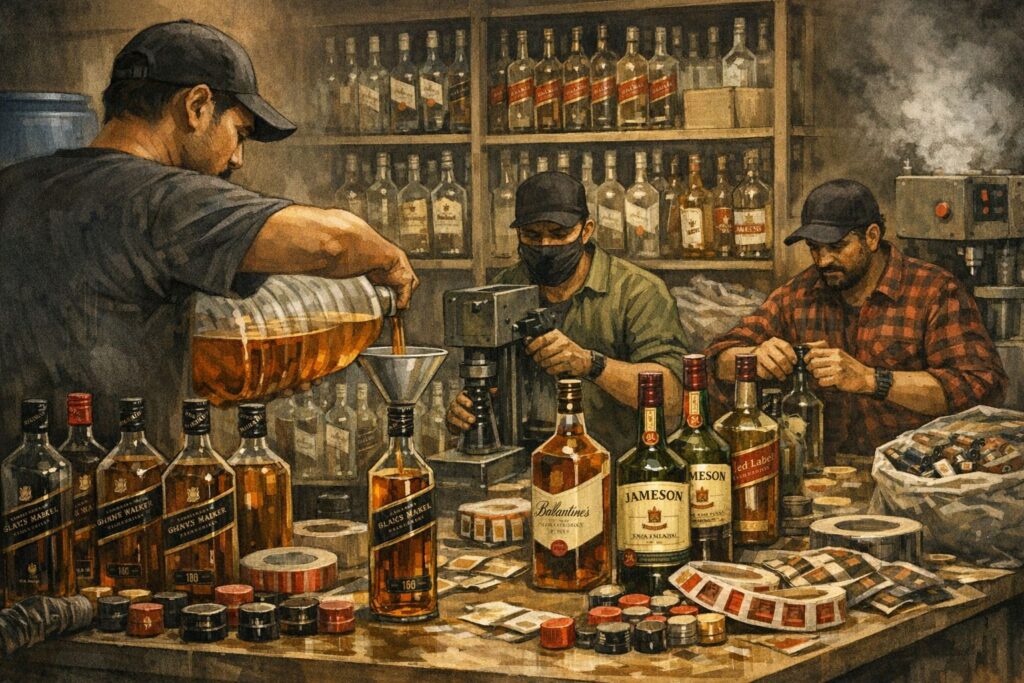
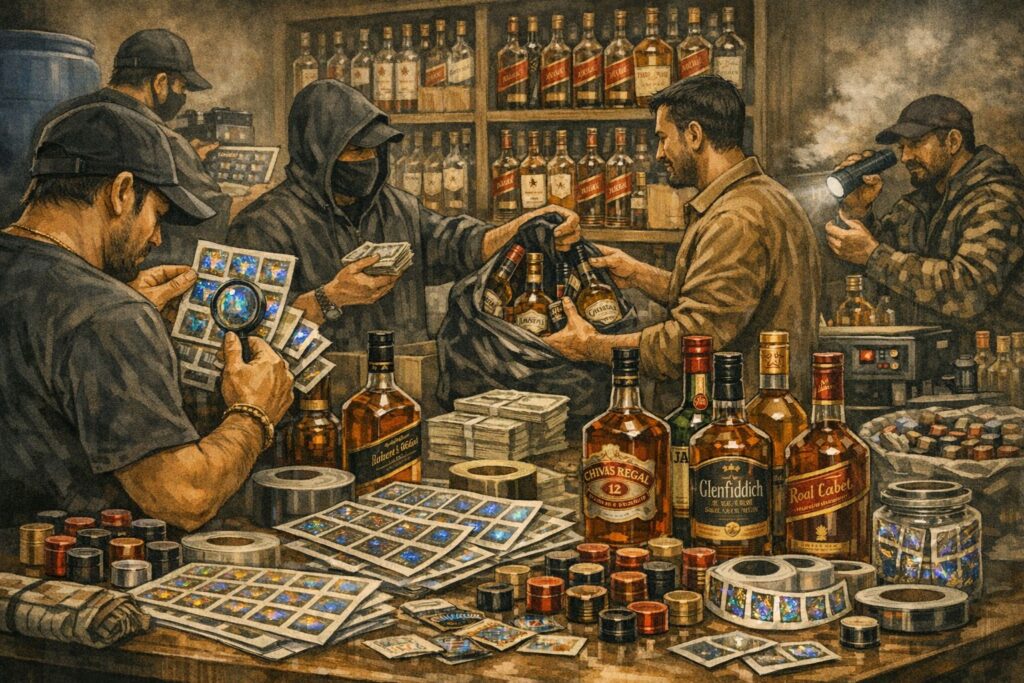
Because the entire ecosystem makes it easy. Empty bottles of top brands are freely available from bars, hotels and scrap dealers – there is a thriving secondary market for empties. Grey-market vendors supply counterfeit caps, excise labels and even fake QR codes, as we saw in the Noida and Lucknow rackets.
On top of that, the enforcement focus is still on paper, not product. Inspectors check registers, quotas and licences; they don’t always open random bottles, test contents or verify QR codes on the spot. Supply-chain controls are also porous – Nagpur’s adulteration racket was diverting bottles in transit, diluting them by up to 40% with water, then pushing them back into the system.
So the answer is simple: refilling is easy because bottle-by-bottle traceability is weak, bottle empties are treated as harmless scrap, and the risk of getting caught – compared to the margins – is still very low.
How widespread is counterfeit “imported” and IMFL liquor, and why are fake caps, labels and holograms so hard to catch?
If you use FICCI CASCADE’s numbers as a rough guide, illicit alcoholic beverages – which include smuggled, tax-evaded and counterfeit products – have more than doubled in value in five years, to about ₹66,000 crore. A good slice of that is counterfeit “imported” and IMFL riding on the aspirational demand for premium brands.
Recent raids keep uncovering the same pattern: in Noida, fake premium whisky in bottles of Ballantine’s, Black Label, Red Label, Jameson; in Ghaziabad, a gang operating from a licensed shop with hundreds of empty bottles of Royal Stag, McDowell’s, Blender’s Pride and fake packaging; in Telangana, an entire printing unit making counterfeit excise holograms and brand labels for multiple states was caught red-handed.
Fake caps and labels are hard to catch because the printing technology is cheap and sophisticated, and many states still rely on visual inspection by overstretched staff. Without machine-readable security features and routine scanning, a fake hologram looks “real enough” under a shop light. The counterfeiters only need to fool you for a few seconds at the shelf.
What are the most common adulteration methods in alcohol, and what health risks do they carry?

Broadly, I would put adulteration into three brackets.
One, simple dilution – adding water to genuine liquor. This cheats you economically but usually doesn’t kill you, unless contaminated water is used, which could be a health hazard.
Two, use of industrial or denatured alcohol, particularly methanol, to fortify or completely replace drinkable alcohol in illicit liquor. Studies show methanol is highly toxic: it is metabolized to formic acid, causing metabolic acidosis, optic nerve damage, blindness and often death, even in relatively small doses. This is what we see in hooch tragedies where dozens die overnight.
Three, non-food grade colours and flavours – from industrial dyes to contaminated flavouring agents – used to mimic the look and smell of branded spirits. Reviews of adulterated liquor have also found contaminants like fusel oils, metals and other by-products when purification is poor.
So the health risks range from stomach upset and liver strain in mild cases to irreversible blindness, brain damage and multi-organ failure in the worst methanol poisonings. It is not just a revenue crime; it is a serious public-health hazard.
After repeated methanol hooch deaths from Punjab to Kallakurichi, is illicit liquor now a chronic public-health crisis?
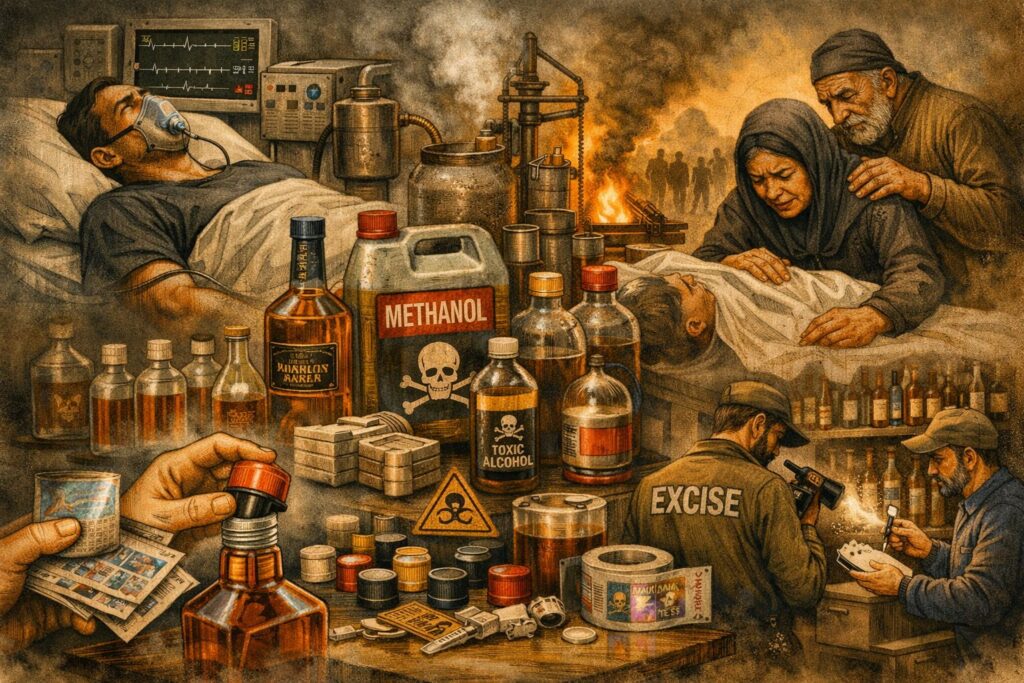
In my view, a loud YES – and we should stop pretending it is a series of isolated accidents. In Punjab alone, media investigations show over 170 deaths from spurious liquor in the last five years, most linked to methanol-based hooch. We had 121 deaths in the 2020 Punjab tragedy, 42 deaths in the 2022 Gujarat incident, and at least 65 deaths in the 2024 Kallakurichi tragedy in Tamil Nadu, where illegally brewed liquor was laced with methanol.
These are not small numbers. International experts now describe methanol poisoning from illicit alcohol as a recurring, under-reported crisis across many countries, including India. When you see the same pattern – poor communities, prohibition or high taxes, local networks using industrial chemicals as “shortcuts” – you are looking at a structural public-health failure.
So yes, illicit liquor in India today is a chronic crisis, not a one-off law-and-order problem. It needs the same seriousness we reserve for epidemics.
Do we need much tougher laws and penalties for alcohol adulteration, or mainly better enforcement of existing rules?
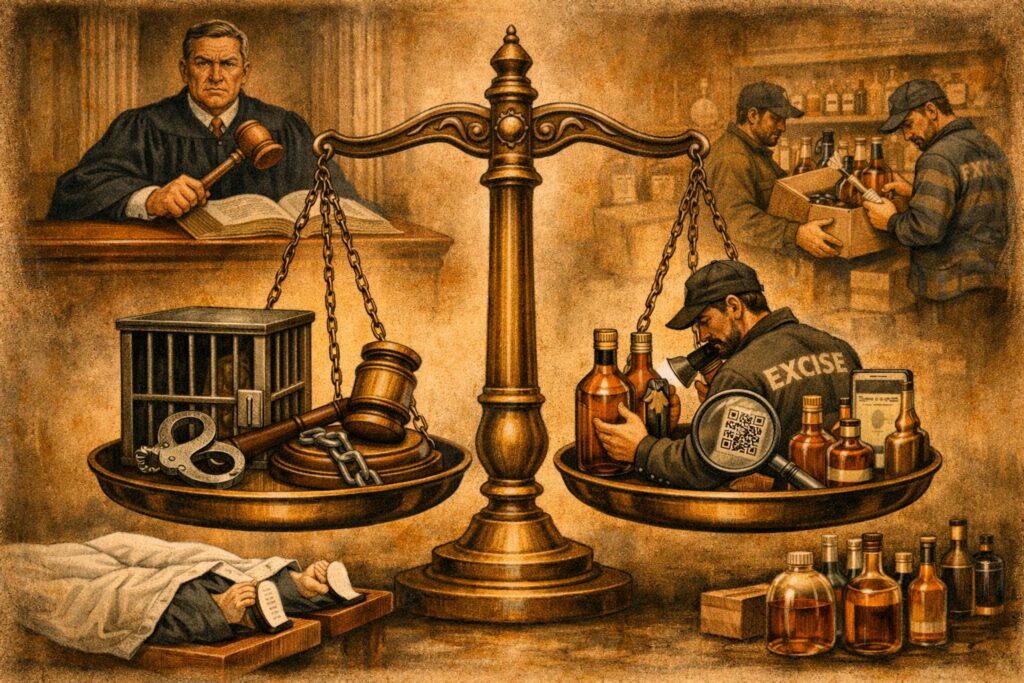
We need both, but I would start by admitting that even our existing powers are not being fully used. Under food safety and excise laws, authorities can already suspend licences, seize stock, and in serious cases prosecute offenders. After the 2020 Punjab tragedy, for example, there were calls for the death penalty for those guilty of spurious liquor deaths.
The deeper problem is that enforcement is often sporadic and reactive – after a tragedy or a media expose. There is also a conflict of interest: excise departments are judged on revenue targets, not on lives saved. So they naturally prioritise collection over disruption.
That said, I do think penalties must be deterrent and sharpened to reflect the reality that adulteration can kill. In my view, it should not less than death penalty on criminals caught counterfeiting and manufacturing spurious liquor. That means the punishment must be linked to the seriousness of the crime adopted by the manufacturing companies, mandatory jail terms for repeat offenders, and personal liability for those who run refilling and hooch networks. But any new law must be backed by independent investigation, fast-track courts, whistle-blower protection and transparent reporting, or it will remain a paper tiger.
How can consumers protect themselves, and what simple, pro-consumer steps should be taken by the regulators?
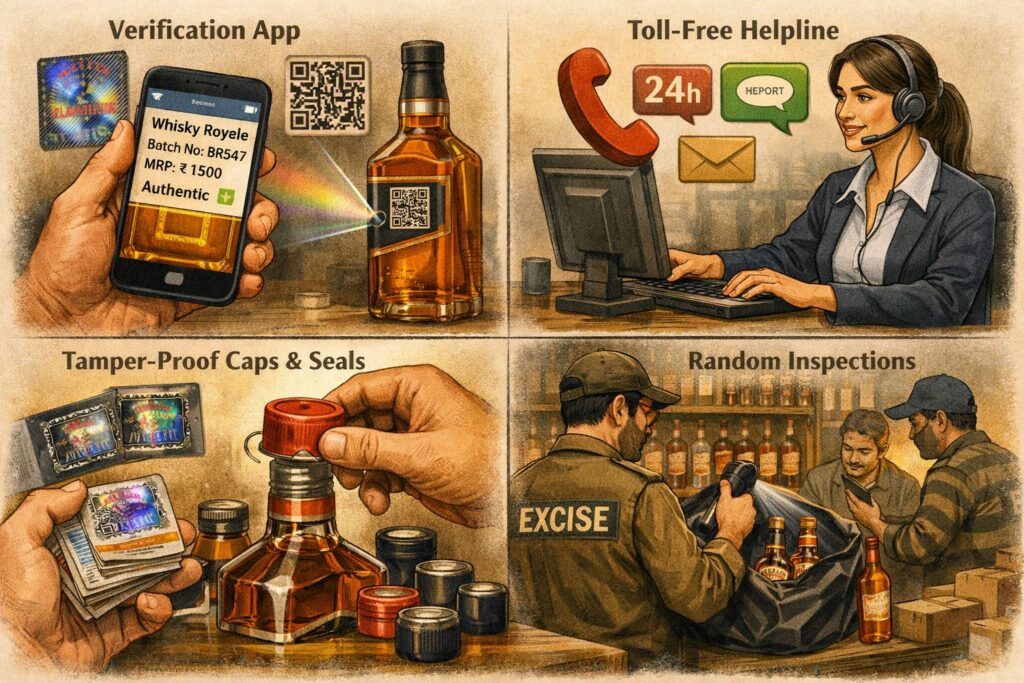
Consumers cannot become forensic labs, but there are a few practical safeguards. Buy only from licensed shops and reputable hotels, insist on sealed bottles, and be wary of unbelievable “discounts” on very premium brands. In bars, it is safer when you see the bottle opened in front of you and the tracking and tracing mechanism is in place at the user-end; if something tastes or smells clearly off, stop drinking and report the matter to the police or dial 100 and complain. Most importantly, never touch country liquor or “special” bottles sold in unmarked containers, especially in prohibition or border areas – that is where methanol tragedies usually originate.
On the regulatory side, there are some simple pro-consumer steps. Every state should offer every citizen with a verification app – like Rajasthan’s – so people can scan QR codes and verify bottles in seconds. There should be a single, well-publicised toll-free number and WhatsApp line for reporting suspicious liquor or overcharging, with an obligation on authorities to respond. States must mandate tamper-evident closures and secure, non-copyable excise labels, and publish the names of vends and hotels caught with duplicate or adulterated stock.
Most of all, we need a mindset shift: treat the liquor consumer as a citizen with rights, not just a taxpayer with a bottle. Once you accept that, pro-consumer measure become common sense, not charity. Always raise your voice as a consumer on your rights. JAGO GRAHAK JAGO