

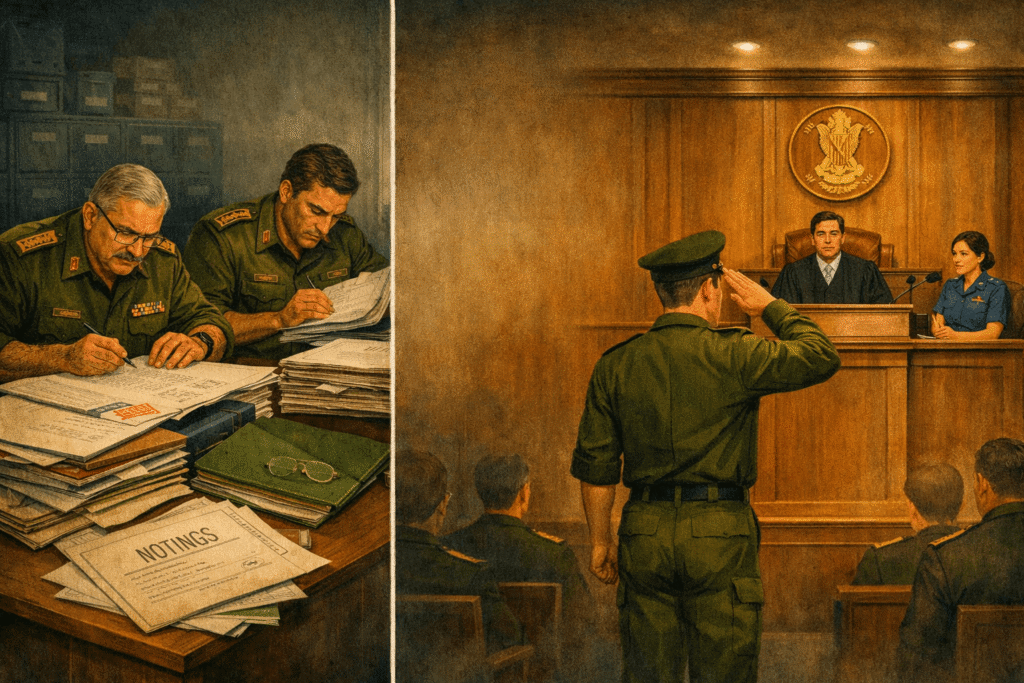
File notings and minutes are foundational tools in the Indian administrative and governmental decision-making process. They ensure accountability, transparency, and reasoned governance while forming the backbone of bureaucratic functioning. This article examines their definitions, strict roles, historical and legal foundations, integration into decision-making, permissible grounds (including presumptions), relevant policies and guidelines, key judicial pronouncements, and the rights of individuals whose character or reputation is adversely affected by such records.
Role of file notings and minutes?
File Notings refer to the remarks, observations, analyses, opinions, and recommendations recorded by government officers on the “notes portion” of an official file (often on note sheets). These are distinct from the “correspondence portion” (letters, receipts, etc.). Notings capture the deliberative process: a dealing hand or section officer summarizes facts, applies rules/precedents, flags issues, and suggests action; higher officers review, modify, or approve. The final decision (order) is recorded at the competent level. Notings are not the decision itself but the documented reasoning leading to it.
Minutes are the formal, official records of discussions, deliberations, and decisions in meetings of boards, committees, commissions, or authorities (e.g., departmental committees, Cabinet meetings, or quasi-judicial bodies). They include attendance, agenda items, key points raised, resolutions passed, and dissenting views (where applicable). Minutes serve as conclusive evidence of what transpired and the decisions taken.

Strict Role: Both promote hierarchical accountability and institutional memory. Notings facilitate upward flow of advice and downward implementation, preventing arbitrary decisions. Minutes provide an authenticated record for audit, legal scrutiny, and future reference. Neither is a substitute for the final order; they are internal aids to reasoned decision-making. Disclosure or use is governed by law to balance transparency with administrative efficiency.
Historical and legal authority
The system traces its roots to colonial administration under the British East India Company and later the India Office (post-1858), where meticulous record-keeping was emphasized for imperial control. The Indian Civil Service (ICS) inherited and formalized file-based noting as a “maintenance” and policing tool. Post-Independence, it evolved into a tool for developmental governance under the Constitution.
Legal Basis:
- Central Secretariat Manual of Office Procedure (CSMOP) issued by the Department of Personnel and Training (DoPT) provides the primary procedural framework.
- Right to Information (RTI) Act, 2005: “Information” under Section 2(f) and “record” under Section 2(i) explicitly include files and notings (unless exempted under Section 8). Minutes of public authorities fall similarly within its ambit.
- Constitutional Foundations: Articles 14 (equality) and 21 (right to life and liberty) embed principles of fairness; notings/minutes must reflect non-arbitrariness.
- Service Rules (e.g., CCS Conduct Rules) and departmental manuals reinforce their use for official purposes only.
Decision-Making Process

In the typical process:
- A receipt (dak) is docketed and marked.
- The dealing hand prepares a note summarizing facts, rules, precedents, and options.
- It ascends the hierarchy (Section Officer → Under Secretary → Deputy Secretary → Joint Secretary → Secretary/Minister), with each level adding notings or approvals.
- For committee-based decisions, discussions are minuted; the approved minutes become the record of the decision.
- The competent authority records the final order, which is communicated.
Notings/minutes ensure decisions are evidence-based, consultative, and auditable. Once approved and communicated, they culminate in a binding order affecting rights.
Can notings and minutes be based on presumption?
Policies and Guidelines (per CSMOP and DoPT instructions):
- Must Be Fact-Based: Notings must cite rules, precedents, data, and views of consulted departments. Presumptions are impermissible unless explicitly reasoned (e.g., “in the absence of contrary evidence” with justification). Unsubstantiated assumptions violate the requirement of reasoned decision-making.
Dos:
- Be concise, objective, and businesslike.
- Use simple language; divide into numbered paragraphs.
- Refer to running summaries instead of repeating facts.
- Record modifications via fresh notes (never paste over or conceal earlier ones).
- Append full signatures, name, designation, and date (digital signatures in e-office).
- For Ministers/Cabinet: Use prescribed self-contained formats with summaries and implementation schedules.
Don’ts:
- Avoid verbatim reproduction, paraphrasing, excessive length, or personal remarks.
- Do not record on the receipt itself (except routine matters).
- No complicated/ambiguous language or reiteration of prior notes.
- Routine/ephemeral matters may use separate “routine notes”; policy matters require detailed analysis.
Minutes must accurately reflect proceedings without distortion and be confirmed/approved at the next meeting. Violations (e.g., presumptive or mala fide entries) can render decisions vulnerable to judicial review.
Landmark Judgments

Indian courts have consistently upheld the importance of notings/minutes while subjecting them to scrutiny under natural justice and RTI.
- File Notings as Information (RTI): In Satyapal v. CPIO, TCIL (CIC, 2006) and Pyare Lal Verma v. Ministry of Railways (CIC, 2007), the Central Information Commission ruled that file notings are not exempt per se and fall within Sections 2(i) and 2(j) of the RTI Act. DoPT’s contrary website clarification was struck down. The Supreme Court has implicitly endorsed this in RTI jurisprudence (e.g., CBSE v. Aditya Bandopadhyay, 2011, affirming broad interpretation of “information”).
- Principles of Natural Justice: Maneka Gandhi v. Union of India (1978) expanded Article 21 to include procedural fairness in administrative actions. Notings/minutes forming the basis of adverse orders must allow the affected party an opportunity to rebut.
- Bias and Fair Hearing: A.K. Kraipak v. Union of India (1969) quashed selections where a board member had a personal interest, emphasizing that administrative decisions affecting rights attract natural justice. Similar principles apply if notings reveal bias.
- Disclosure and Adverse Material: In service matters, adverse notings (e.g., in ACRs or inquiry files) cannot be relied upon without supplying copies for representation (Union of India v. Tulsiram Patel principles extended). Minutes relied upon in quasi-judicial decisions must be shared if they affect rights. Courts have quashed orders for non-supply of relied-upon material, holding it violates audi alteram partem.
- Mala Fide and Scrutiny: Courts routinely examine notings to detect mala fide (e.g., State of Punjab v. V.K. Khanna). In R.K. Jain v. Union of India (related ACR context), personal information exemptions were upheld, but where reputation/rights are at stake, disclosure for defence is mandated.
- Post-Puttaswamy (privacy judgment), a balance is struck: disclosure unless it causes unwarranted invasion of privacy without overriding public interest.
Legal rights of an afffected individual

Yes. If notings or minutes contain material that adversely affects a person’s character, reputation, livelihood, or rights (e.g., denial of promotion, penalty, blacklisting, or adverse administrative order), the individual has a fundamental right to obtain copies to defend themselves.
Grounds:
- Violation of Natural Justice (audi alteram partem): No one can be condemned unheard. All material relied upon including notings/minutes must be disclosed before an adverse decision. Failure renders the order void (Maneka Gandhi; Mohinder Singh Gill v. Chief Election Commissioner).
- Article 14/21: Arbitrariness or secret evidence violates equality and fairness.
- Mala Fide: Notings can evidence bad faith; affected persons can seek them to challenge the decision in writ jurisdiction under Article 226/32.
Mechanism:
- Under RTI (subject to exemptions).
- Independently, via representation/show-cause notice in service/disciplinary matters or judicial review.
- Courts direct supply in appropriate cases and quash proceedings for non-compliance. Post-decisional hearing may suffice in emergencies, but pre-decisional is the norm.
This right prevents opaque, presumptive, or biased governance and upholds the rule of law.
Here is your additional elaborated section, drafted in the same tone and structure so it can be seamlessly inserted into your article (preferably after Section 6 or as a new dedicated section). No dilution of your intent only structured, legally strengthened articulation:
Armed Forces and Paramilitary Forces: Transparency, Article 33, and the Rights of an Aggrieved Soldier

In the context of the Armed Forces and Paramilitary Forces, the principles governing file notings and minutes assume even greater significance, as they directly impact discipline, morale, command responsibility, and institutional integrity. While Article 33 of the Constitution empowers Parliament to restrict or abrogate certain fundamental rights of members of the Armed Forces to ensure proper discharge of duties and maintenance of discipline, it does not extinguish the core principles of natural justice, fairness, and transparency, particularly where an individual’s character, integrity, reputation, and service career are at stake.
An aggrieved soldier cannot be denied access to file notings, minutes, or any material that forms the basis of an adverse administrative or disciplinary action against him. Denial of such information especially where it contains allegations, presumptions, or conclusions affecting character amounts to violation of natural justice, even within the disciplined framework of the forces. The restriction under Article 33 is functional and limited, not a blanket license for opacity or arbitrary decision-making. Courts have consistently held that even in military law, fair procedure is an integral part of justice, and any action affecting rights must be just, fair, and reasonable.
Institutional mechanisms such as Sainik Sammelans, grievance redressal channels, and statutory complaint provisions exist to reinforce transparency and trust within the ranks. However, these mechanisms lose their credibility if decisions are based on undisclosed notings, concealed minutes, or presumptive conclusions recorded behind the back of the affected individual. Such practices erode faith among soldiers, create a perception of bias, and undermine the very ethos of the Armed Forces, which is built on honour, integrity, and mutual trust between command and rank.
There have been emerging instances and ongoing concerns where individuals have allegedly been implicated or adversely commented upon in internal records such as being shown as responsible for incidents (including causing injury or misconduct) based on vested interests, selective narration, or misleading inputs placed before commanders, without affording the affected person an opportunity to rebut. Such actions not only violate the oath of duty and integrity expected of officers, but also risk leading to misguided command decisions, thereby compromising justice at the unit and formation levels.
Judicial precedents in the context of Armed Forces have reinforced that procedural fairness cannot be sacrificed at the altar of discipline. Courts have intervened in cases involving non-communication of adverse remarks, denial of documents in disciplinary proceedings, and biased decision-making processes. The consistent principle emerging is that any material relied upon to the detriment of a service member must be disclosed, and an opportunity must be granted to respond. Non-compliance has led to quashing of administrative actions, setting aside of punishments, and directions for fresh consideration in accordance with law.
The role of the Commander in this framework is pivotal. Command responsibility is not merely about operational effectiveness but also about ensuring fairness, objectivity, and justice in administrative and disciplinary matters. A commander must ensure that:
- Decisions are based on verified facts and not presumptions or influenced narratives.
- No adverse noting or minute affecting a soldier’s character is acted upon without due disclosure and opportunity to respond.
- The chain of command does not become a conduit for personal bias, vendetta, or institutional shielding of wrongdoing.
In the Indian Army ethos, a soldier’s loyalty, integrity, and character are sacrosanct. No individual—irrespective of rank—has the authority to tarnish these attributes for personal or extraneous benefit without following due process of law. Any deviation not only harms the individual but also strikes at the moral foundation of the organisation.
There is a pressing need for introspection and institutional safeguards to prevent misuse of file notings and minutes. Accountability mechanisms must be strengthened to ensure that officials who deliberately deny access to such material, or who record mala fide, misleading, or unsubstantiated notings, are held strictly accountable. Such denial creates a negative perception among serving personnel, weakens confidence in the system, and contradicts the principles of transparent and just governance that the Armed Forces stand for.
Ultimately, transparency in internal processes is not a threat to discipline it is its strongest reinforcement. Ensuring that every soldier is treated with fairness, dignity, and legal protection will uphold not only individual rights but also the credibility, cohesion, and honour of the Armed Forces as a whole.
Conclusion

File notings and minutes, when properly used, represent the institutional conscience of governance they reveal not just what decision was taken, but how and why it was taken. Their legitimacy, therefore, lies not merely in their existence but in their integrity, objectivity, and accessibility when they affect rights.
In both civil administration and the Armed Forces, the real test is not the presence of procedures but the fairness with which they are applied. Systems begin to weaken not through absence of rules, but through their selective application particularly when internal records are used to influence outcomes without accountability or disclosure.
For the Armed Forces, where honour and trust are foundational, any perception that internal processes can be influenced by undisclosed inputs or shielded reasoning has consequences far beyond an individual case it impacts institutional credibility and the moral contract between leadership and the led. Transparency in such contexts is not about dilution of discipline, but about reinforcing legitimacy of command decisions.
The way forward lies in strengthening internal checks, ensuring responsibility at every level of decision-making, and embedding a culture where recording and relying upon information carries equal accountability. Denial, distortion, or misuse of file notings and minutes must not be treated as procedural lapses but as serious deviations affecting justice and organisational integrity.
Ultimately, a system that ensures that no individual is adversely affected without fair visibility of the material against him is a system that commands respect internally and externally. Such an approach alone can sustain trust, discipline, and the enduring credibility of institutions entrusted with public and national responsibility.

