


India’s ambitious Great Nicobar Project has emerged as one of the most consequential strategic infrastructure initiatives in the Indian Ocean Region in recent decades. Located at the southernmost edge of the Andaman and Nicobar archipelago, Great Nicobar Island sits close to the Malacca Strait — one of the world’s busiest maritime chokepoints through which nearly one-third of global trade and a substantial proportion of China’s energy imports transit. In geopolitical terms, the island is no longer viewed merely as a remote territory; it is increasingly seen as a potential maritime pivot for India’s Indo-Pacific strategy.
The proposed mega-development project includes an International Container Transshipment Terminal (ICTT) at Galathea Bay, a greenfield international airport, power infrastructure, military-support facilities and a planned township. The project, estimated at over ₹80,000 crore, is envisioned as a long-term strategic and economic hub.
Yet the project has simultaneously triggered one of the sharpest debates in India between strategic imperatives and environmental preservation. Conservationists warn that the island’s fragile ecology, endemic biodiversity and indigenous tribal communities may face irreversible consequences. The debate over Great Nicobar therefore represents a larger national dilemma: how should India balance national security, economic growth and ecological responsibility in an increasingly contested Indo-Pacific environment?
The Geography Behind the Strategy
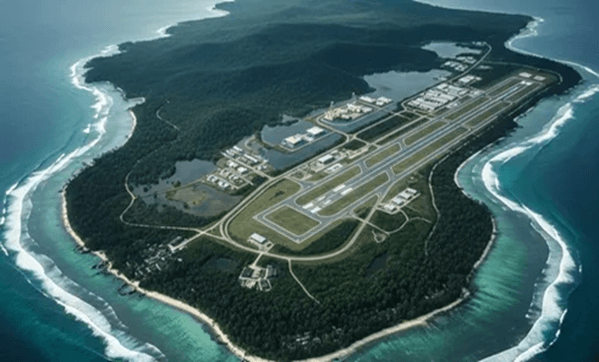
Great Nicobar’s importance stems fundamentally from geography. The island lies barely 40 nautical miles from the Malacca Strait, connecting the Indian Ocean to the Pacific Ocean. Any country with a sustained logistical, naval and surveillance presence in this region acquires substantial strategic leverage. Great Nicobar position near the Six Degree Channel- the primary trade route exiting the Malacca Strait’s northern funnel- is a genuine operational advantage.
For India, this location has become even more significant in the context of China’s expanding maritime footprint in the Indian Ocean. Beijing’s “String of Pearls” strategy, its presence in Gwadar, Hambantota and Djibouti, and the growing deployment of Chinese naval assets in the eastern Indian Ocean have heightened Indian concerns regarding maritime encirclement. The BRI counterpoint is also serious and should not be taken lightly.
The Great Nicobar Project is therefore not merely a commercial venture; it is part of a broader geopolitical calculus. By developing advanced port and aviation infrastructure in the island chain, India seeks to strengthen maritime domain awareness, enhance naval reach and establish logistical superiority in the Bay of Bengal and eastern Indian Ocean.
As India’s Ministry of Ports, Shipping and Waterways has argued, the project aims to reduce India’s dependence on foreign transshipment hubs such as Colombo, Singapore and Port Klang. At present, a substantial share of Indian cargo is transhipped through foreign ports, increasing costs and strategic vulnerability.
The proposed ICTT is expected to handle massive container traffic and potentially compete with regional maritime hubs over time. Strategically, this would give India an indigenous transshipment capability near vital sea lanes.
The Military Dimension
While officially framed as an economic and infrastructure initiative, the defence implications of the project are unmistakable.
The Andaman and Nicobar Command already serve as India’s only tri-service theatre command. Enhanced infrastructure in Great Nicobar would significantly improve India’s ability to support long-range maritime surveillance aircraft, drones, naval deployments and rapid military mobilisation.
The proposed international airport, for instance, can have clear dual-use utility. In peacetime, it may support civilian and commercial traffic; during conflict, it could facilitate strategic airlift, force projection and maritime reconnaissance operations.
The island also offers India a stronger forward-operating position to monitor Chinese naval movements entering the Indian Ocean through the Malacca Strait. This fits into the larger Indo-Pacific strategic architecture in which India is increasingly partnering with the Quad countries — particularly the United States, Japan and Australia — to maintain balance in the region.
Strategic analysts frequently refer to China’s “Malacca Dilemma” — Beijing’s dependence on the strait for energy imports. A strengthened Indian maritime presence near this chokepoint creates deterrence value in any future regional confrontation.
Why INS Baaz Alone Is Not Considered Sufficient
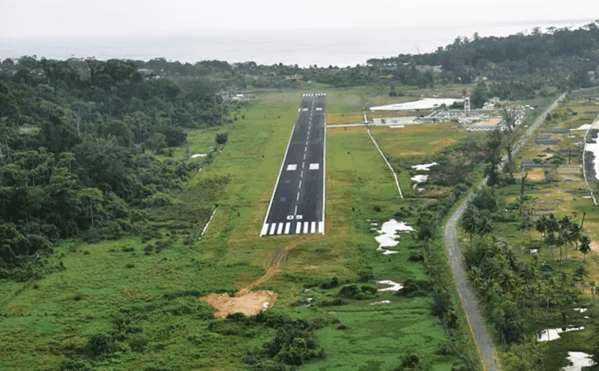
INS Baaz, India’s southernmost Naval based station located at Campbell Bay on Great Nicobar Island already gives India a significant strategic foothold in the eastern Indian Ocean. Located near the Malacca Strait, it enables maritime surveillance, reconnaissance operations and limited force projection. Since its commissioning in 2012, INS Baaz has been viewed as India’s “unsinkable aircraft carrier” in the Bay of Bengal. It allows monitoring of shipping movements entering and exiting the Malacca Strait and supports the operations of the Andaman and Nicobar Command.
However, the argument within Indian strategic circles is that INS Baaz represents only a military outpost — not a full-spectrum strategic ecosystem. The Great Nicobar Project is intended to create an integrated civilian-military-maritime hub with far greater logistical depth and economic sustainability.
One major limitation of INS Baaz is infrastructure scale. The existing airstrip and facilities support surveillance aircraft and limited military operations, but they are insufficient for sustained high-volume naval logistics, large transport aircraft operations, major cargo handling or long-duration force sustainment during a crisis. In a prolonged Indo-Pacific confrontation, especially involving China’s expanding naval deployments, India would require far larger storage, fuel, repair, replenishment and mobility infrastructure.
The proposed Great Nicobar development seeks to create precisely that strategic depth. A transshipment port, dual-use airport, logistics parks, warehousing and expanded connectivity would enable continuous naval and commercial activity rather than isolated military presence. Modern maritime competition increasingly revolves around logistics and sustainment rather than simply deploying platforms.
Another reason is economic viability. Purely military installations in remote island territories are extremely expensive to sustain. Strategic planners increasingly favour dual-use infrastructure where civilian economic activity subsidises and justifies long-term military presence. The Great Nicobar Project therefore attempts to merge strategic and economic objectives. Commercial shipping, trade and aviation activity would generate revenue, employment and connectivity while simultaneously supporting defence infrastructure.
This approach reflects a broader global trend. China’s facilities in places such as Djibouti began with commercial-port logic before evolving into strategic military nodes. Similarly, the United States often integrates civilian and military maritime infrastructure across the Indo-Pacific.
There is also a geopolitical signalling dimension. INS Baaz gives India surveillance capability, but a major transshipment hub and large-scale infrastructure project signals permanent strategic intent. It demonstrates that India intends not merely to observe Indo-Pacific dynamics but to shape them.
Supporters of the project further argue that China’s maritime expansion has altered the scale of competition. Chinese naval deployments in the Indian Ocean are becoming more frequent, supported by overseas logistics facilities and commercial ports across the region. In that context, a modest forward air station is viewed as inadequate for the future strategic environment.
At the same time, critics argue that India could have upgraded INS Baaz incrementally without pursuing a massive ecologically disruptive mega-project. According to this perspective, expanding runway capacity, surveillance systems, hardened shelters and naval berthing infrastructure would have delivered most strategic benefits at far lower ecological cost. They contend that the present project goes well beyond strategic necessity into large-scale commercial urbanisation.
This is where the real debate lies. The issue is not whether Great Nicobar has strategic value — almost all sides acknowledge that it does. The disagreement concerns scale and model. One school sees the project as essential for transforming India into a serious Indo-Pacific maritime power. The other believes India risks overbuilding in one of the world’s most fragile ecological zones when a calibrated military expansion around INS Baaz may have sufficed.
In essence, INS Baaz is a forward military eye and ear. The Great Nicobar Project aims to transform the island into a permanent strategic nerve centre combining commerce, logistics, maritime infrastructure and military reach.
Vizhinjam and the Great Nicobar Vision
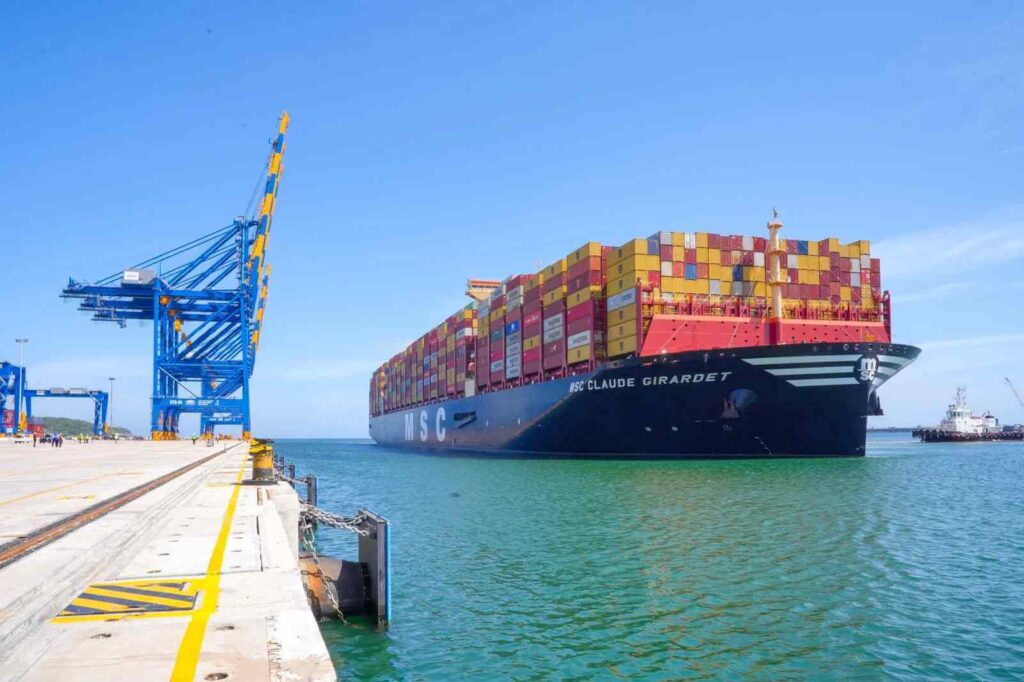
The success and strategic logic behind the Vizhinjam International Seaport project are increasingly being viewed as an important conceptual model for the development of Great Nicobar. Vizhinjam demonstrated that India can create a deep-water transshipment hub capable of competing with established regional maritime centres such as Singapore and Colombo. Located close to major international east-west shipping lanes, Vizhinjam natural draft depth, minimal deviation distance for cargo vessels and strategic location transformed it into a critical component of India’s maritime ambitions.
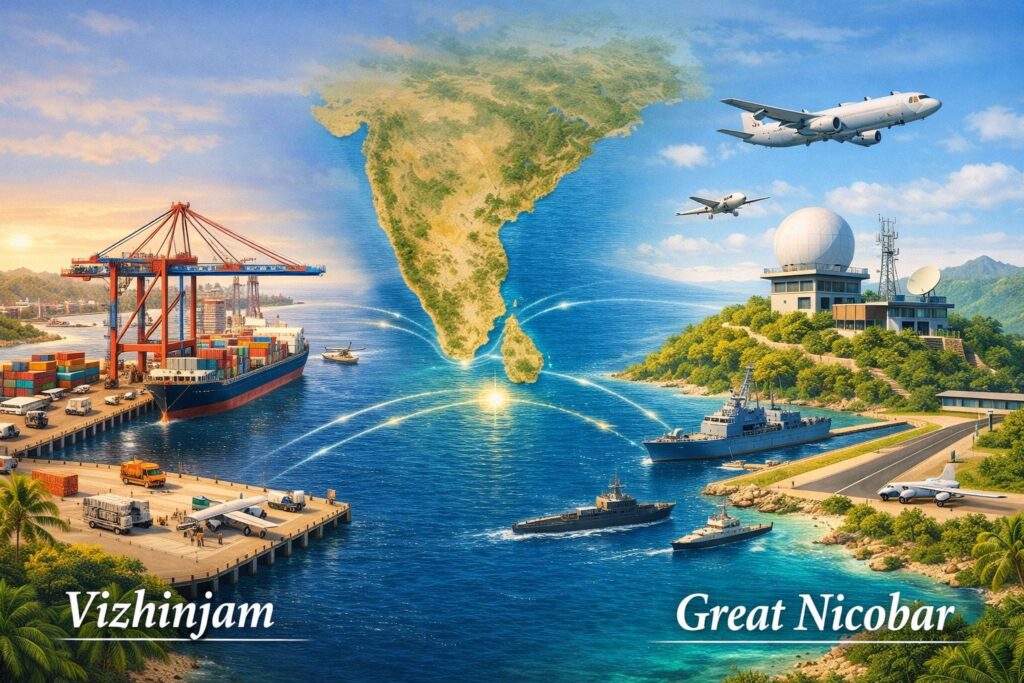
Policymakers now see Great Nicobar through a similar lens — not merely as an isolated island infrastructure project, but as a future maritime-economic node integrated into the larger Indo-Pacific shipping architecture. If Vizhinjam represents India’s western maritime gateway in the Arabian Sea, Great Nicobar could emerge as its eastern strategic gateway overlooking the Malacca Strait. Together, they symbolise India’s aspiration to build an indigenous transshipment ecosystem that reduces dependence on foreign ports and strengthens national maritime resilience.
Strategically, the comparison is important because both projects reflect a shift in Indian thinking from traditional port development to maritime geopolitics. The rationale is not simply commercial profitability. Rather, it involves creating strategic logistics hubs that combine economic utility with naval reach, supply-chain security and maritime influence. Great Nicobar’s proposed International Container Transshipment Terminal therefore mirrors Vizhinjam core concept: leveraging geography to create long-term strategic advantage.
Supporters of the Great Nicobar Project argue that Vizhinjam has already validated the feasibility of attracting global shipping traffic to Indian-controlled transshipment facilities. The operationalisation of Vizhinjam has strengthened confidence within strategic and maritime circles that India can successfully challenge the dominance of Colombo and Singapore in container handling. This experience provides institutional lessons in port management, private sector participation, connectivity planning and maritime logistics that can shape Great Nicobar’s future development.
However, there are important differences. Vizhinjam is located on the mainland with relatively developed supporting infrastructure, whereas Great Nicobar remains ecologically fragile, geographically isolated and logistically complex. Critics therefore argue that applying the Vizhinjam model directly to Great Nicobar without accounting for environmental vulnerability could prove problematic. While Vizhinjam primarily triggered commercial and political debates, Great Nicobar carries much larger ecological, tribal and seismic concerns.
Nevertheless, within India’s broader Indo-Pacific strategy, the linkage between Vizhinjam and Great Nicobar is increasingly evident. One strengthens India’s western maritime flank near the Arabian Sea and Gulf routes, while the other seeks to secure India’s eastern maritime frontier close to Southeast Asia and the Pacific. Together, they represent the emergence of a more assertive Indian maritime doctrine — one that seeks not only to defend sea lanes, but also to shape them.
Economic Rationale and Maritime Ambitions
India’s maritime ambitions form another major rationale behind the project. Despite being a major trading nation, India has historically lagged in container transshipment infrastructure. Ports like Colombo and Singapore handle a large percentage of Indian cargo because Indian ports often lack the draft depth and large-scale transshipment capability needed for ultra-large container vessels.
The Great Nicobar transshipment hub seeks to address this structural gap. The project also aligns with India’s SAGAR doctrine — “Security and Growth for All in the Region” — which envisions India as a leading maritime power in the Indian Ocean.
Supporters argue that the island could eventually evolve into a logistics, shipping and trade ecosystem connecting South Asia with Southeast Asia. Some policymakers even compare its long-term vision to Singapore’s transformation into a maritime-commercial powerhouse.
The National Green Tribunal, while upholding environmental clearance in 2026, explicitly acknowledged the “strategic importance” of the project.
The Ecological Reality

However, the strategic logic collides directly with ecological realities. Great Nicobar is not an empty landmass awaiting development. It is among India’s richest biodiversity zones and forms part of a UNESCO-recognised biosphere reserve. Dense tropical rainforests, mangroves, coral ecosystems and rare wildlife species make the island ecologically unique.
Environmental groups estimate that nearly one million trees could be felled during implementation. The island is home to endangered species such as the giant leatherback sea turtle, Nicobar megapode and several endemic flora and fauna species found nowhere else in the world. Galathea Bay, where the transshipment terminal is planned, is one of the most important nesting sites for the leatherback turtle in the Indian Ocean.
Scientists have also warned about the island’s seismic vulnerability. Great Nicobar lies in a highly earthquake-prone region and was severely affected during the 2004 Indian Ocean tsunami. Critics argue that large-scale urbanisation and heavy infrastructure in such a fragile seismic zone could generate long-term environmental risks.
A major concern involves habitat fragmentation. Roads, urban zones and industrial infrastructure may irreversibly alter ecological continuity across the island.
Tribal Concerns and Indigenous Rights

Another contentious issue concerns indigenous communities, particularly the Shompen tribe — one of India’s most isolated Particularly Vulnerable Tribal Groups (PVTGs).
The Shompen live largely in forest interiors and have minimal interaction with the outside world. Anthropologists and rights activists fear that increased external contact could expose them to diseases, social disruption and displacement pressures.
International academics and conservation groups have described the project as potentially catastrophic for tribal survival. The government, however, maintains that no displacement of tribal communities is planned and that tribal reserve protections will remain intact. Official statements emphasise that the project incorporates safeguards and compensatory measures.
Nonetheless, critics argue that indirect impacts — migration, demographic shifts, ecological degradation and increased outsider presence — may fundamentally alter tribal life even without formal displacement.
Why Objections Are Being Raised
The objections to the project emerge from multiple dimensions rather than from a single ideological standpoint.
Environmentalists argue that the environmental impact assessment process was inadequate for such a sensitive ecosystem. They question whether compensatory afforestation elsewhere can genuinely replace ancient tropical rainforest ecosystems unique to Great Nicobar.
Strategic sceptics also question the economic viability of the transshipment terminal. Competing hubs like Singapore, Colombo and increasingly Vizhinjam already possess established shipping ecosystems, deep connectivity and operational maturity. Some analysts worry that Great Nicobar could become an expensive strategic asset with uncertain commercial returns.
Others raise concerns regarding excessive urbanisation. Critics argue that a limited strategic naval-air infrastructure footprint may have been sufficient, whereas the scale of township and industrial expansion appears disproportionate.
The debate has also acquired political overtones, with opposition parties accusing the government of bypassing ecological caution in pursuit of large-scale infrastructure symbolism.
The Government’s Defence
The government’s position is that India cannot indefinitely delay strategic infrastructure due to maximalist environmental objections.
Official documents argue that only a small percentage of the island’s forest area will be directly diverted and that extensive mitigation measures are planned, including compensatory afforestation and strict environmental compliance mechanisms.
Supporters further contend that major powers across the world have developed strategically critical islands and maritime hubs despite environmental sensitivities. In their view, India cannot afford strategic paralysis in an era of intensifying Indo-Pacific competition.
There is also an argument that sustainable engineering and phased development can reduce ecological damage while still enabling strategic gains.
The Larger Strategic Debate
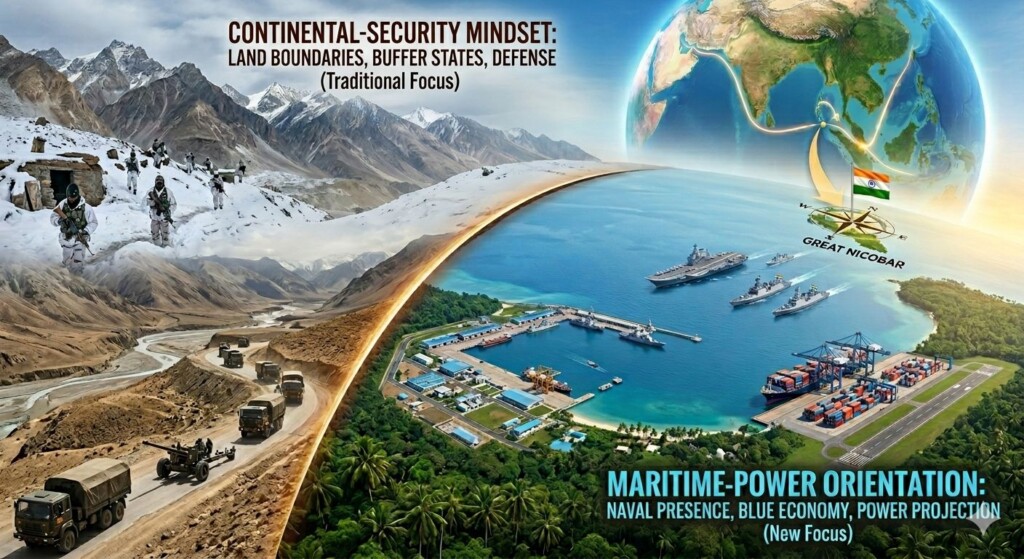
The Great Nicobar debate ultimately reflects India’s transition from a continental-security mindset to a maritime-power orientation.
For decades, India’s strategic focus remained concentrated on land borders with Pakistan and China. Today, however, the Indian Ocean has become central to global geopolitics. Sea lanes, logistics chains, underwater surveillance, submarine movements and maritime trade are increasingly shaping national power.
Great Nicobar symbolises India’s attempt to adapt to this changing geopolitical reality. Yet it also exposes the challenge of pursuing strategic modernisation in ecologically fragile zones. Unlike mainland infrastructure, island ecosystems possess limited regenerative capacity. Once damaged, restoration becomes extraordinarily difficult.
The central question therefore is not whether India should strengthen Great Nicobar, but how it should do so. If executed with transparency, ecological discipline, limited-footprint infrastructure and robust tribal protections, the project could emerge as a landmark in India’s maritime rise. If pursued through unchecked expansionism and weak environmental governance, it risks becoming a case study in irreversible ecological loss.
As one commentator observed in recent discussions surrounding the project, “strategy without restraint is just another Hambantota.”