

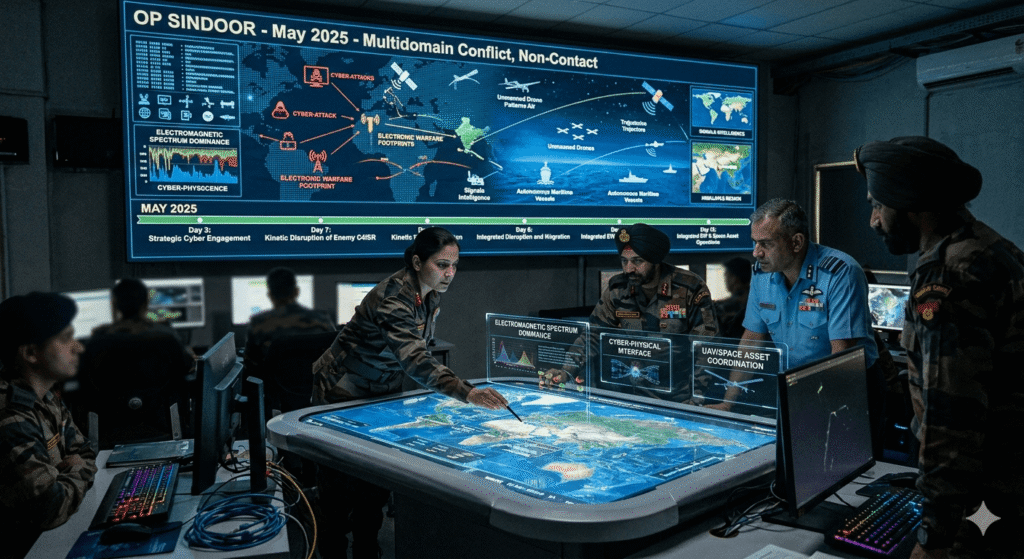
The world has moved into an era that military strategists call “hyperwar” condition where the decision-action cycle compresses to minutes, multi-domain operations run simultaneously across land, sea, air, cyber, space and the electromagnetic spectrum, and the side that processes information and delivers effects fastest tends to prevail. India’s adversaries China, evolved core concepts driving the People’s Liberation Army (PLA) restructuring under the 2015 Deepening National Defense and Military Reform are informatized warfare and intelligentized warfare.
This sweeping modernization transformed the PLA from a legacy, land-centric mass army into a technologically integrated joint force optimized for multi-domain operations.
On the morning of May 7, 2025, Indian Air Force jets conducted coordinated strikes against nine terror infrastructure sites across Pakistan and Pakistan-occupied Kashmir under Operation Sindoor. The operation, executed with surgical precision using domestically developed and integrated munitions, marked a decisive moment, not merely in the operational sense, but as proof that the long, frustrating journey from Indian laboratories to weapons platforms had finally, in select instances, begun to close. Yet the operation also exposed the still-considerable gaps between what India’s military industrial ecosystem produces and the armed forces actually need when conflict arrives without announcement.
The Inheritance: What DRDO Built and What It Did Not
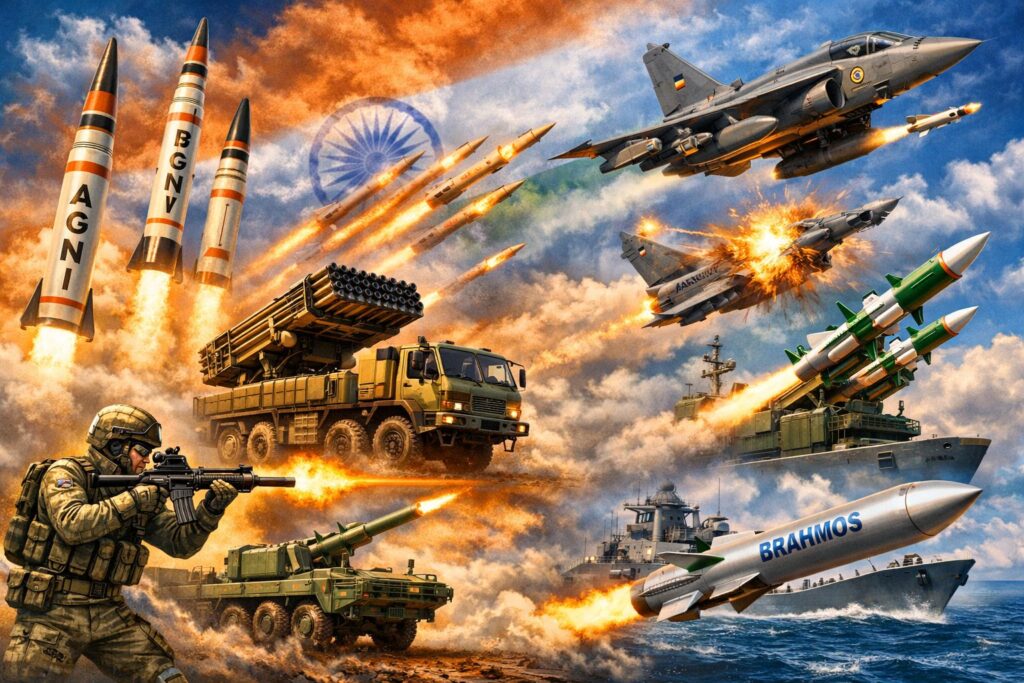
The Defence Research and Development Organisation, established by merging several colonial era units functioning under the then military structure with the Defence Science Organisation, in 1958, occupies a peculiar position in Indian strategic history. It has produced genuine achievements: the Agni series of ballistic missiles, the Pinaka multi-barrel rocket system, the Akash air defence system, the BRAHMOS supersonic cruise missile (developed in partnership with Russia), and the LCA Tejas a four-plus generation fighter that, after a 35-year gestation, is now in squadron service. These are not trivial accomplishments. Building a credible ballistic missile deterrent from scratch, as India did through the Integrated Guided Missile Development Programme launched in 1983, required deep engineering competence and institutional persistence across political cycles.
But the balance sheet has persistent liabilities. DRDO runs 46 laboratories with roughly 20,000 employees, including around 7,500 scientists. Its annual budget for 2026-27 stood at approximately ₹29,100.25 crore, a figure that sounds substantial until measured against peers. China’s defence R&D spending, embedded within a military-civil fusion architecture that blurs the line between commercial and weapons research, is estimated at over ten times India’s figure. More critically, driven by the ministry’s policy framework, the structural separation between DRDO labs and the manufacturing ecosystem has historically meant that knowledge generated in research settings took years, sometimes decades, to arrive in serviceable form at the frontline.
The Tejas story is instructive. The LCA programme definition phase began in August 1983, the Aeronautical Development Agency ADA, a society under DRDO was registered on 16 July 1984, it commenced functioning in mid-1985, the programme definition phase report was submitted in 1988, decision to initially go only for 2 Tech Demonstration aircraft taken in 1990 but funds were released in mid-1993. Maiden flight was held in less than 8 years on the 4th January 2001 despite post Pokhran-II US sanctions. The Initial Operational Clearance was granted on 20 December 2013. Final Operational Clearance meaning the aircraft was truly combat-ready came in February 2019. Thirty-six years from conception to combat viability. In that time, the technology that made Tejas state-of-the-art when its requirements were written had cycled through multiple generational shifts. Several such advancements were incorporated. Nevertheless, the aircraft India eventually deployed was not the aircraft India had originally imagined; it was, in several aspects, already a generation behind the frontier
This is not a story of scientific failure. It is a story of institutional architecture misaligned with the tempo at which military technology is imperatively required to move under current and emerging scenarios.
Hyperwar Defined: Why the Old Architecture Fails

The term “hyperwar” was popularized in strategic literature around 2017 by retired US Marine General John Allen and tech entrepreneur Amir Husain, who argued that artificial intelligence would compress the observe-orient-decide-act (OODA) loop to such a degree that human decision-making would be the primary bottleneck in combat. Since then, the concept has been stress-tested against real conflicts the Nagorno-Karabakh war of 2020, where Azerbaijani drone swarms dismantled Armenian armour in hours, and the Russia-Ukraine conflict, where Starlink-linked drone operators were adjusting targeting algorithms in near-real-time.
The defining characteristics of hyperwar are: speed of decision compressed by machine autonomy; saturation of sensors producing data faster than human analysts can process; multi-domain simultaneity requiring effects to be sequenced across physical and virtual domains within the same operational window; and precision at scale, where even a mid-power military can achieve effects previously requiring superpower resources, provided it commands the right technology stack.
India’s military industrial ecosystem including the defence R&D architecture and the way it interacts with rest of the systems were built for a different era, where the timeline from concept to deployment was measured in decades, where the vendor was almost always a foreign OEM, where absorption of technology was the primary ambition rather than origination, and where the relationship between the laboratory and the fighting force was mediated by a procurement bureaucracy designed to minimise financial risk, not operational risk. The apparatus that worked imperfectly but adequately for equipping a conscript-era army with licensed rifles and imported tanks is simply not calibrated for the development cycles that hyperwar demands.
Consider the contrast: in 2022, Ukraine’s army integrated commercial Starlink satellite communications, commercially sourced drone hardware, and AI-assisted targeting into operational doctrine within weeks of hostilities beginning. India’s process for inducting even a minor modification to an existing weapons platform, under the standard Defence Acquisition Procedure, involves a multi-stage trial sequence, inter-services consultation, financial concurrence, and Cabinet Committee on Security approval beyond certain thresholds — a sequence that routinely exceeds three years. DAP 2020 introduced reforms to this process, including fast-track procurement provisions and an Indigenously Designed, Developed and Manufactured category, but the cultural inertia of the system has diluted many of these provisions in practice.
The iDEX: What Competitive Innovation Looks Like

In 2018, the Ministry of Defence launched the Innovations for Defence Excellence programme — iDEX as an attempt to connect the defence establishment with startups and small enterprises outside the traditional DRDO-DPSUs-OFB triad. The model was conceptually sound: open challenges posted by the armed services, rapid grant funding of up to Rs 1.5 crore initially (later raised to Rs 10 crore and beyond for larger challenges), and a commitment to prototype within a defined timeline.
The results were unevenly distributed but occasionally spectacular. By 2024, iDEX had engaged over 350 startups and awarded contracts across more than 300 challenges spanning electronic warfare, drone systems, AI-enabled surveillance, lightweight armour, and quantum communication. Several products have moved from prototype to trial evaluation with the armed forces. The DRDO-iDEX partnership for the Dedicated Freight Corridor of defence technology — where a startup builds, DRDO certifies, and the Service uses and is maturing, however slowly.
What iDEX demonstrated is that the problem of innovation velocity in Indian defence is not one of scientific capability but of institutional channelings. Young engineers at firms like Ideaforge, Sagar Defence, and NewSpace Research and Raphe mPhibr were producing militarily relevant products faster than the traditional system could absorb them. The drone ecosystem that emerged around iDEX challenges has been among the most productive. India now has indigenous rotary-wing and fixed-wing unmanned aerial vehicles in trial or operational use across the Army, Navy, Air Force, and Coast Guard, with a significant proportion traceable to startups rather than DRDO.
The Technology Development Fund (TDF) is a flagship Ministry of Defence scheme executed by the DRDO to drive indigenous defense manufacturing. It bridges the gap between the Armed Forces and private innovators by funding up to $600,000 (INR 50 crore) and covering up to 90% of total project costs. The TDF supports the realization of advanced defence systems through several targeted mechanisms and strategic implementations
Operation Sindoor in May 2025 provided a test. Reports indicated that alongside imported systems, certain indigenous drone platforms and electronic warfare tools some developed through iDEX-connected firms— were operationally employed. Whether this constitutes the beginning of a genuine lab-to-lethality pipeline or a fortunate coincidence of timing is a question the defence establishment will need to answer honestly.
Technology Stack That Actually Matters
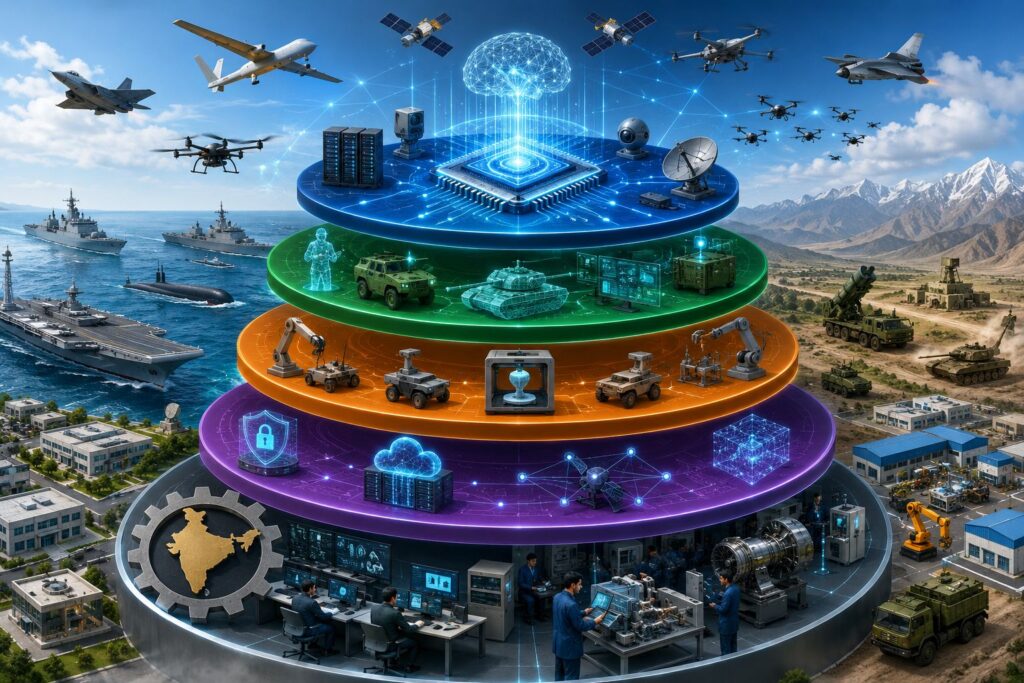
Rewiring India’s military industrial ecosystem for hyperwar requires clarity about which technologies sit at the center of the coming competitive space. Four clusters deserve primary attention.
- Autonomous Systems and Swarm Robotics
The 2020 Nagorno-Karabakh conflict demonstrated relatively inexpensive loitering munitions. Azerbaijan deployed the Israeli Harop and Turkish Bayraktar TB2 which could destroy sophisticated armoured formations at acceptable cost exchange ratios. China has publicly demonstrated swarm drone concepts involving hundreds of coordinated unmanned aerial vehicles, and its military doctrine has incorporated unmanned systems into every domain. India’s current unmanned systems programme, spread across DRDO, private firms, and imports, lacks the integrating doctrine and investment scale needed to field swarms as a coherent force multiplier.

The iDEX Prime category was partly designed to address this, offering larger funding envelopes for startups working on complex systems. But the transition from a demonstration-scale swarm of twenty drones to an operationally viable swarm of two hundred requires systems engineering, investments and risks at levels that only a handful of Indian firms currently possess. Dedicated investment in this area, with clear acquisition roadmaps, is the missing ingredient.
- Electronic Warfare and the Electromagnetic Spectrum
Control of the electromagnetic spectrum through jamming, spoofing, direction-finding, and cyber-electromagnetic integration has become as consequential as fires in modern conflict. Russia-Ukraine war highlighted this: both sides have invested enormous effort in GPS jamming and counter-jamming, with tactical outcomes that directly shaped ground maneuver. India’s Kargil review pointed to electromagnetic vulnerabilities two decades ago. Progress made at DRDO’s Electronic Warfare complexes at Bengaluru and Hyderabad has produced systems including the Samyukta EW platform, now operational with the Army but the speed at which electronic warfare technology evolves means any static programme is perpetually at risk of obsolescence.
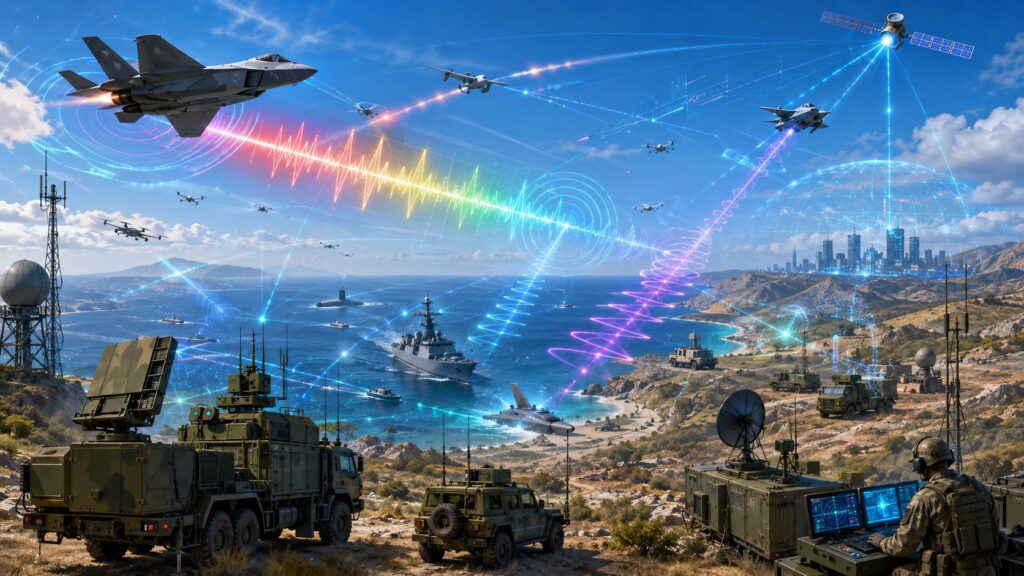
The critical requirement here is a modular, software-defined EW architecture that can be updated in the field as adversary emissions change what the US military calls an “open systems architecture” approach. Several Indian industries, including Bharat Electronics Limited’s newer divisions as well as startups, are working in this space, but a coordinating framework that pulls these efforts toward a common architecture is absent.
- Artificial Intelligence for Intelligence, Surveillance and Reconnaissance
The volume of sensor data generated in modern operations from synthetic aperture radar, electro-optical satellites, signals intelligence platforms, and tactical sensors has outpaced the human analyst’s ability to process it. AI systems capable of fusing multi-source intelligence, identifying targets, tracking movements, and generating courses of action in real time speed are now a structural component of effective military operations.

India has committed to AI in defence at the policy level. The Defence AI Council was established in 2022, and the Defence AI Project Agency (DAIPA) has been tasked with implementing an AI roadmap. DRDO has active projects in AI-assisted radar signal processing, autonomous navigation, and predictive maintenance. But the intersection between India’s commercial AI talent among the deepest in the world and its Defence AI programme remains critically underdeveloped. The separation between a thriving AI sector in Bengaluru, Hyderabad and Chennai and the classified programmes in DRDO is structural: security requirements, salary differentials, cultural mismatch, and the absence of a cleared commercial ecosystem all contribute.
Israel’s model where Unit 8200 veterans founded companies like Palantir competitors that then fed intelligence-grade algorithms back into defence contracts provides a reference. India lacks an equivalent revolving door between defence intelligence and commercial AI. Building one requires changes to security clearance infrastructure, to government pay scales for AI researchers in defence, and to procurement rules that currently disadvantage small software firms bidding against large systems integrators.
- Directed Energy and Space-Based Capabilities
Directed energy weapons, high-energy lasers, and high-power microwave systems are moving from laboratory to deployment faster than anticipated. The United States Navy has fielded laser systems on surface combatants; Israel’s Iron Beam laser air defence system demonstrated operational performance in 2024. China has been investing heavily in directed energy, with assessments suggesting deployable ground-based laser systems capable of blinding or damaging satellites at low Earth orbit.
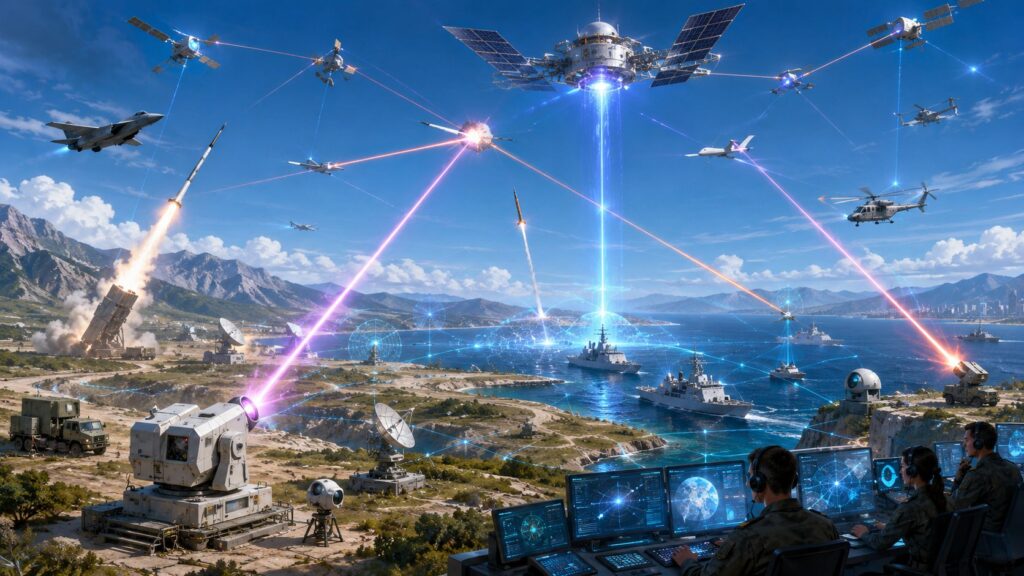
India’s directed energy programme under DRDO has been operational for more than two decades, but investment levels have constrained progress. The Centre for High Energy Systems and Sciences (CHESS) at Hyderabad has produced research-grade results; the gap between those results and a deployable weapon system still remains substantial. Space-based capabilities present a related challenge.
India’s military space programme, managed through the Defence Space Agency established in 2019, is developing ISR satellites, communications systems, and hardening measures against adversarial counter-space threats. However, the intersection between India’s strong commercial space sector ISRO’s NewSpace India and a growing ecosystem of private launch and satellite firms and military space requirements is still being worked out institutionally. Another area that needs urgent attention is space robotics, especially orbital robotics, with reference to military applications. ISRO has made some progress in the areas relevant to its own domains, but the pace is far from being desirable in the context of hyperwars.
(To be continued)