


Not long ago, “stealth” was the holy grail of military engineering. Nations spent hundreds of billions of dollars developing aircraft and submarines that could slip past adversary defences undetected. The Lockheed F-117, the B-2 Spirit bomber, and the nuclear-powered submarines of the world’s major powers embodied this doctrine of invisibility. Now, the very physics that governs how particles behave at the subatomic scale is threatening to make stealth obsolete.
Quantum technology encompassing quantum computing, quantum sensing, and quantum communications is rapidly emerging as the defining military technology of the 21st century. Unlike previous technological revolutions, quantum technology does not merely improve existing capabilities; it changes the fundamental rules of what is detectable, what is computable, and what is communicable. A quantum sensor does not just detect submarines, better it can, in principle, make oceans “transparent.” A quantum computer does not just calculate faster but it can break the encryption that protects every modern military secret.
The stakes could not be higher. The U.S. Defence Science Board has concluded that quantum sensing, quantum computers, and quantum communications represent the three most promising quantum applications for the Department of Defense. The 2025 Worldwide Threat Assessment by the Defence Intelligence Agency notes that China and Russia are aggressively expanding quantum communication networks while developing quantum magnetometers, gravimeters, and inertial navigation systems explicitly designed to find, track, and target previously invisible weapons. For India — sandwiched between two nuclear-armed, quantum-investing neighbours in China and Pakistan (the latter with close Chinese technological cooperation) — this revolution is not a distant concern. It is an urgent strategic imperative.
This article tells that story: what quantum technology means for warfare, how the world is responding, and what India must do to remain strategically relevant in the quantum age.
Quantum Toolkit: What Military Planners Need to Understand
Before examining the geopolitical landscape, it is worth understanding what quantum technology actually offers the military. The term “quantum” covers a broad and often misunderstood spectrum of technologies, each with distinct military implications.
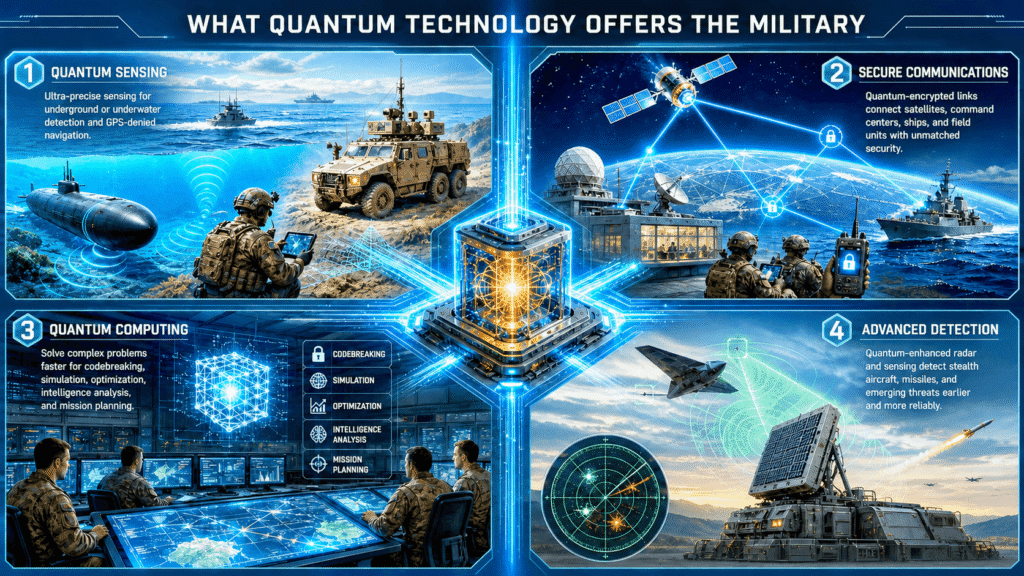
Quantum Computing
At its core, a quantum computer uses qubits (quantum bits) that can exist in a superposition of 0 and 1 simultaneously, unlike classical binary bits which are always either one or the other. Combined with quantum entanglement, this allows quantum computers to explore enormous solution spaces in parallel, making them exponentially faster than classical computers for specific classes of problems. As the National Academies of Sciences put it, quantum computers are “the only known model for computing that could offer exponential speedup over today’s computers”.
The most alarming military implication of quantum computing is its capacity for crypto analysis. The widely used RSA and elliptic-curve encryption algorithms that protect military communications, financial systems, and government data are theoretically breakable by a sufficiently powerful quantum computer running ‘Shor’s’ algorithm. Experts call this milestone “Q-Day,” and while a true cryptographically relevant quantum computer (CRQC) may still be a decade or more away, the threat is already live through what intelligence agencies call “harvest-now, decrypt-later” attacks, adversaries collecting encrypted data today, intending to decrypt it later once quantum capability matures. The U.S. Department of Defence assessed as recently as July 2025 that quantum computers capable of breaking current encryption are at least ten years away but this horizon is shortening.
In August 2024, the U.S. National Institute of Standards and Technology (NIST) released its first three finalized post-quantum cryptographic (PQC) standards: FIPS 203 (ML-KEM), FIPS 204 (ML-DSA), and FIPS 205 (SLH-DSA), derived from CRYSTALS-Kyber, CRYSTALS-Dilithium, and SPHINCS+ respectively. The U.S. National Security Agency has announced it expects national security systems to complete their transition to quantum-resistant algorithms by 2035. This is not a theoretical exercise — it is a race against the quantum clock.
Beyond decryption, quantum computers promise revolutionary capabilities in logistics optimization, materials simulation for advanced weapons, AI-driven battlefield analysis, and drug discovery relevant to biological warfare defence. Notably, Google demonstrated in 2024 that its error-corrected logical qubit became more reliable as more physical qubits were added — a critical indicator that scalable, fault-tolerant quantum computation may be achievable.
Quantum Sensing

If quantum computing threatens data security, quantum sensing threatens physical concealment. Quantum sensors exploit the extreme sensitivity of quantum states to tiny environmental perturbations. A quantum magnetometer can detect the minute changes in Earth’s magnetic field caused by a submarine’s steel hull or the passage of a vehicle through a tunnel. Quantum gravimeters can map density anomalies beneath the seabed to reveal underwater vessels or underground facilities. Cold-atom inertial sensors and atomic clocks can provide GPS-independent navigation capable of guiding missiles or submarines accurately even when satellite signals are jammed or spoofed, a critical vulnerability in today’s GPS-dependent military.
The 2025 CSIS analysis warns starkly: the first country to operationalize quantum sensing technologies for defence purposes will eliminate the comparative advantage of submarines and stealth aircraft, reshaping nuclear deterrence and conventional warfighting alike. For a world whose entire deterrence architecture is built around the invulnerability of submarine-launched ballistic missiles, this is a seismic shift. China has reportedly tested drone-mounted quantum magnetometers designed to track undersea movements from the air; the UK Royal Navy has trialed quantum magnetometers for detecting small submerged objects; and U.S. scientists have explored GPS-free navigation kits based on atom interferometry.
Quantum sensing also has important implications for electronic warfare. Quantum radiofrequency sensors can detect faint or stealthy missile signals even in jammed environments, enabling passive and resilient monitoring. Quantum-enhanced optical techniques can improve intelligence, surveillance, and reconnaissance (ISR) capabilities without emitting any detectable electromagnetic radiation — meaning sensors that cannot be detected, cannot be jammed, and cannot be spoofed.
Quantum Communications
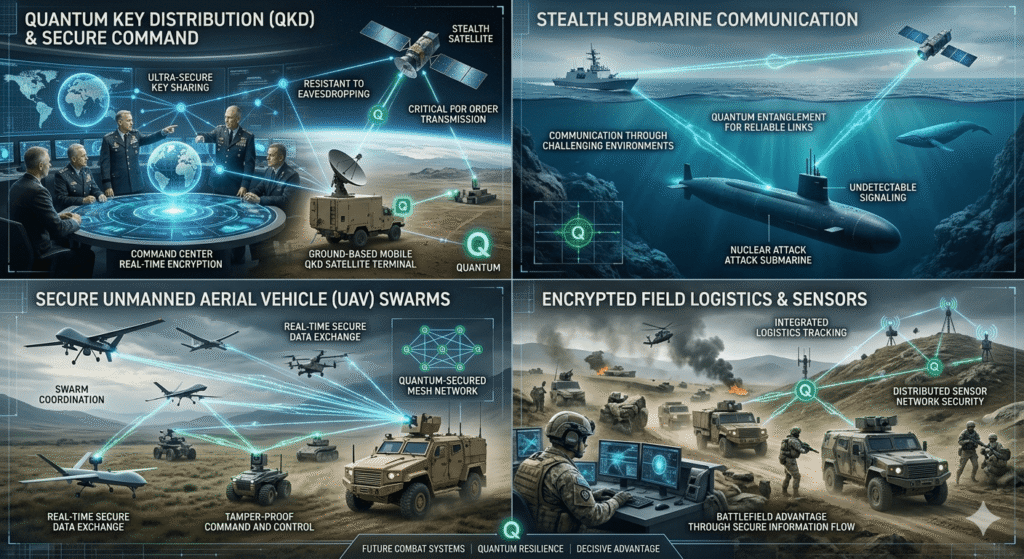
Quantum communication exploits the principle of quantum entanglement to create theoretically unbreakable channels. In Quantum Key Distribution (QKD), any attempt to intercept a quantum-encoded transmission disturbs the quantum state of the photons, immediately alerting both sender and receiver to the interception. Unlike classical encryption — which is theoretically vulnerable to a sufficiently powerful computer — quantum encryption provides information-theoretic security against any adversary, regardless of computational power.
For military planners, quantum communications can make battlefield command links, nuclear command-and-control channels, and intelligence transmissions immune to interception providing a decisive advantage in any conflict. In 2025, China became the first country to deploy quantum communications by satellite, an exceedingly difficult technical feat given the fragility of quantum states over long distances. China’s quantum communication network now stretches over 10,000 kilometers, incorporating 145 backbone nodes, 20 metropolitan networks, and six ground stations connected to quantum satellites, covering 17 provinces and 80 cities.
The Global Quantum Arms Race: State of Play
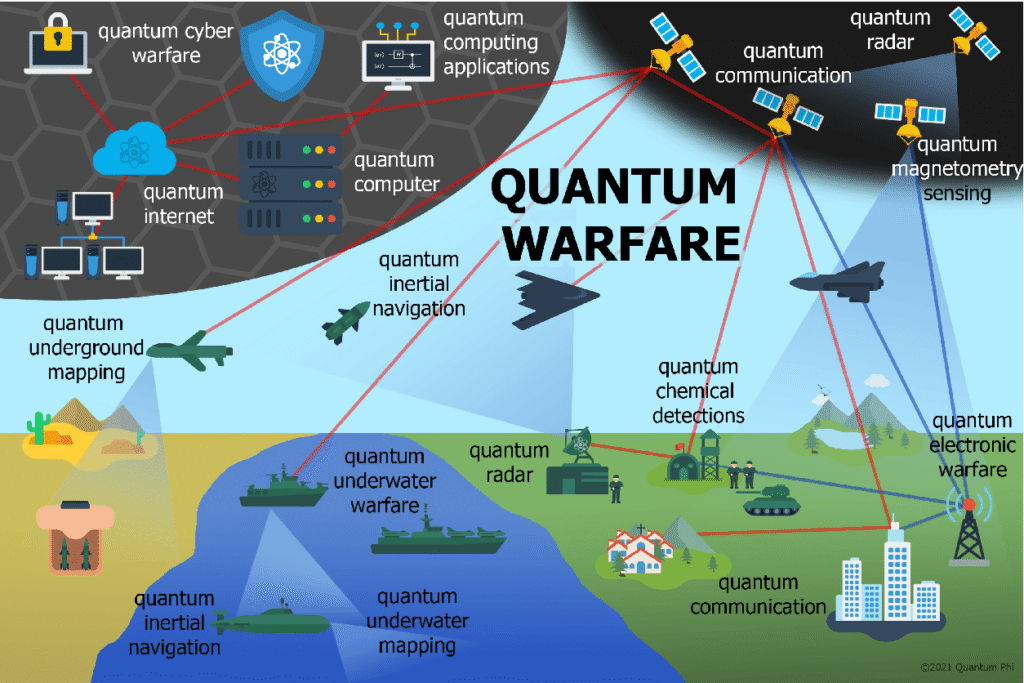
The quantum arms race is real, it is accelerating, and it is reshaping the balance of power in ways that will define the next century of geopolitics.
United States: The Strategic Awakening
The United States has historically led in quantum research, home to Google, IBM, Quantinuum, and other commercial quantum computing giants. In September 2024, Quantinuum announced plans to deliver a fully fault-tolerant quantum computer capable of executing millions of operations on hundreds of logical qubits, with IBM and Google similarly targeting industrial-scale quantum computing by 2029.
On the policy front, the Biden administration’s 2022 National Security Memorandum NSM-10 directed federal agencies to begin the multi-year process of migrating vulnerable cryptographic systems to quantum-resistant alternatives, with NSA targeting completion by 2035. In 2025, the Pentagon elevated quantum technology to one of its six Critical Technology Areas under the category “Quantum and Battlefield Information Dominance,” focusing on jamming-resistant communications, quantum navigation, and quantum ISR. “Our adversaries are moving fast, but we will move faster,” declared Emil Michael, U.S. Under Secretary of War for Research and Engineering.
The Department of Defence’s Research, Development, Testing and Evaluation budget for 2025 totaled over $179 billion — up from $141 billion the prior year — with significant but classified quantum allocations. The U.S.-China Economic and Security Review Commission’s 2025 annual report argued that “whoever leads in quantum (and artificial intelligence) will control the encryption of the digital economy” and urged Congress to establish a “quantum first” goal targeting advantage in cryptography, drug discovery, and materials science by 2030.
China: The Determined Challenger
China has made quantum technology a central pillar of national strategy. Under the 14th Five-Year Plan (2021-2025), quantum information ranked as the second highest-priority emerging technology field — above semiconductors, below only artificial intelligence. Beijing has invested approximately $15 billion in quantum research and development, with a far larger state-backed fund of approximately $140 billion (1 trillion renminbi) planned to accelerate hard technologies including quantum systems ahead of Q-Day.
The results are substantial. Since 2022, China has published more quantum-related research papers annually than any other country. Its quantum communication network exceeding 10,000 kilometers is the world’s most extensive ground-and-satellite quantum infrastructure, positioning China far ahead of any other nation in scaling quantum encryption. In 2025, China became the first country to deploy operational quantum satellite communications, enabling theoretically unbreakable military and government links.
China’s military dimension is equally significant. The 2025 Defence Intelligence Agency report highlights that Chinese investments in quantum magnetometers and gravimeters are aimed directly at developing the ability to track American submarines and target stealth aircraft. A March 2025 Chinese think-tank report noted that the U.S. operates nuclear attack submarines, guided-missile submarines, and strategic bombers with increasing intensity in the Indo-Pacific — and Beijing’s quantum sensing programme is designed specifically to counter this. China has also reportedly placed its 72-qubit ‘Origin Quantum’ computer in its national supercomputer network, though U.S. export controls placed Origin Quantum on the entity list for support of Chinese military efforts.
Russia: The Asymmetric Bet
Russia’s quantum programme is largely state-driven and opaque, focused on military and intelligence applications. The 2025 Worldwide Threat Assessment notes Russia is investing in quantum communication networks and quantum navigation particularly to counter GPS-dependent U.S. and NATO systems and mitigate vulnerabilities exposed in electronic warfare. Russia is also building quantum navigation systems designed to operate independently of GNSS a direct response to battlefield experience in Ukraine where GPS jamming and spoofing have proven effective. Given Russia’s conventional weaknesses, quantum technology represents Moscow’s long-term bid for strategic equilibrium.
Europe: Research Strength, Deployment Gap
Europe punches above its weight in quantum research but below its weight in deployment. The EU’s Quantum Flagship programme is a €1 billion initiative funding research institutions and startups across quantum sensors, networks, and computers. The UK has committed £2.5 billion over ten years under its National Quantum Strategy. The Royal Navy has carried quantum magnetometers for submarine detection, and British researchers have demonstrated gravity sensors for detecting underground voids and tunnels. Germany, France, the Netherlands, and Nordic countries have added quantum technologies to dual-use export control lists.
However, Europe’s research excellence has not translated into deployed military capability — a gap that China is exploiting to dominate the quantum communications space. The European Quantum Communication Infrastructure (EuroQCI) initiative is attempting to address this but was only launched recently, and commercial momentum for quantum communications in Europe remains limited compared to the state-directed Chinese model.
Other Notable Players
Israel has quietly built significant quantum capability, with $380 million dedicated to quantum cryptography, sensing, and advanced algorithm development. Its integration of quantum technologies with its existing cyber and intelligence architecture makes it a global outlier in translating investment into operational capability. Canada has invested heavily through a National Quantum Strategy (2023) and a dedicated military Quantum Science and Technology Strategy. Japan, alarmed by China’s rapid progress, has significantly accelerated quantum investments, making it a natural partner for both the United States and India. The PNT (Positioning, Navigation, and Timing) quantum market alone was projected as $200 million, driven by military demand for GPS-independent navigation systems.
India’s Quantum Journey: From Vision to Strategic Reality

The National Quantum Mission: A Foundational Step
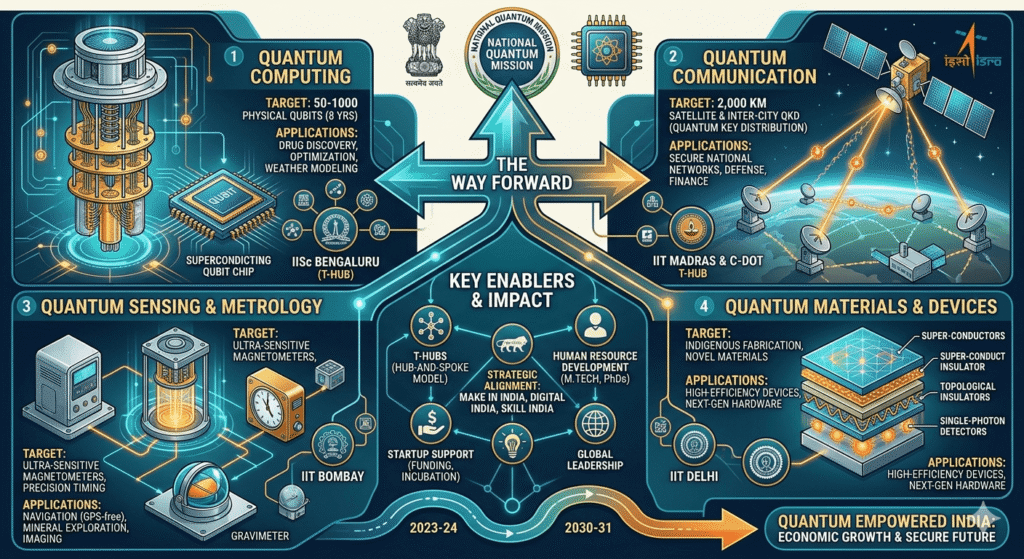
On April 19, 2023, the Union Cabinet chaired by Prime Minister Narendra Modi approved the National Quantum Mission (NQM) with a total budgetary outlay of ₹6,003.65 crore (approximately $730 million) spanning 2023-24 to 2030-31. This placed India in a select club of seven nations alongside the United States, China, Austria, Finland, France, and Canada with dedicated national quantum missions. The mission aims to make India one of the leading nations in Quantum Technologies and Applications (QTA), accelerating scientific and industrial R&D while supporting national priorities under Digital India, Make in India, and Atmanirbhar Bharat.
The NQM’s objectives span the full quantum spectrum. On computing, the mission targets developing intermediate-scale quantum computers with 50-1,000 physical qubits within eight years, across superconducting and photonic platforms. On communications, it aims to establish satellite-based secure QKD between ground stations over 2,000 kilometers within India, extend long-distance QKD links to partner countries, and build a multi-node quantum network with quantum memories. On sensing and metrology, NQM prioritises high-sensitivity magnetometers in atomic systems and atomic clocks for precision timing, communications, and navigation.
The institutional response has been encouraging. NQM’s January 2024 Call for Proposals attracted 384 submissions from academic and research institutions across 43 institutions in 17 states and two Union Territories, involving 152 researchers. Four Technology Hubs were established in late 2024 to anchor implementation. The MeitY 2025 whitepaper “Transitioning to Quantum Cyber Readiness” has called on strategic sectors to identify vulnerable data and begin migration planning by acknowledging that India faces massive quantum security exposure with 1.4 billion citizens’ Aadhaar biometric data and UPI processing approximately ₹45 billion in daily transactions potentially at risk.
DRDO: Taking the Lead on Defence Applications
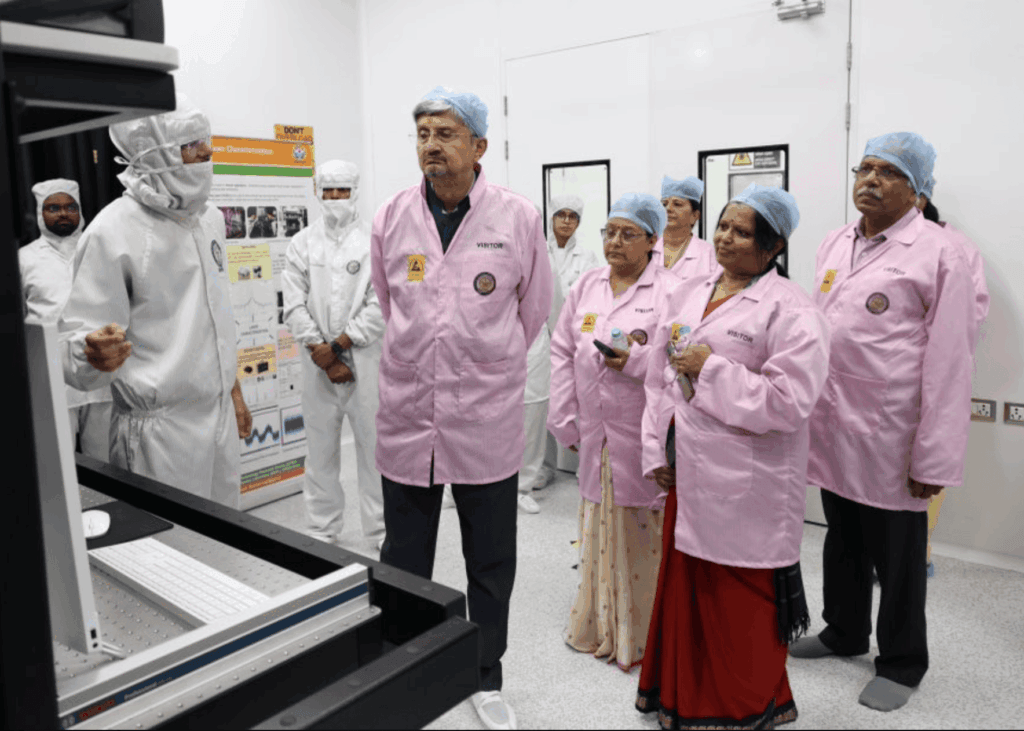
The Defence Research and Development Organisation (DRDO) has emerged as the principal driver of India’s quantum defence ecosystem, translating national mission objectives into concrete strategic capabilities.
On May 27, 2025, DRDO inaugurated the Quantum Technology Research Centre (QTRC) at Metcalfe House, Delhi — India’s first dedicated facility for defence quantum research, led by Dr. Samir V. Kamat, Secretary, Defence R&D and Chairman DRDO. The Centre houses state-of-the-art experimental setups for quantum key distribution, quantum lasers, single-photon sources, alkali vapor cell characterization, and atomic clock development. Research is led by DRDO’s Scientific Analysis Group (SAG) and Solid-State Physics Laboratory (SSPL), which is developing ultra-small atomic clocks using coherent population trapping and atomic magnetometers for high-sensitivity magnetic field detection capabilities with direct applications in navigation, anti-submarine warfare, and underground facility detection.
On the cryptography front, DRDO is designing and testing quantum-resilient security schemes, quantum-safe symmetric and asymmetric key cryptographic algorithms, and quantum-secure key management frameworks. The Society for Electronic Transactions and Security (SETS) has implemented PQC algorithms for Fast Identity Online (FIDO) authentication tokens and IoT security. The Centre for Development of Telematics (C-DoT) has developed Quantum Key Distribution systems, post-quantum cryptographic solutions, and quantum-secure video IP phones, already deployable for protecting sensitive government and military communications.
India’s most significant recent milestone came in June 2025 when DRDO and IIT Delhi jointly demonstrated quantum entanglement-based free-space secure communication over a distance exceeding one kilometer at the DRDO-Industry-Academia Centre of Excellence located on IIT Delhi campus. The experiment transmitted quantum-entangled photons through a free-space channel a critical proof-of-concept for future city-to-city and satellite-based quantum networks. Unlike traditional QKD systems, entanglement-based communication ensures security even if hardware is compromised, since any interception immediately and irreversibly alters the entangled quantum states. This builds on earlier milestones: India’s first intercity quantum communication link between Vindhyachal and Prayagraj in 2022, and a 100-km fiber-based QKD demonstration in 2024. India has now demonstrated QKD over 500+ km (announced at ESTIC 2025) and targets a 2,000-km QKD network under NQM.
ISRO is developing QKD satellites as part of NQM to enable secure satellite-to-ground quantum communications, directly mirroring China’s Micius satellite programme and positioning India for operationally relevant quantum-secure space communications within the decade.
India’s Strategic Context: The Quantum Threat Next Door
India’s quantum imperative is not abstract, it is defined by two specific adversary realities. On the northern front, China’s development of quantum magnetometers and seabed sensors directly threatens the survivability of India’s naval assets, including INS Arihant and the emerging SSBN fleet that underpins India’s nuclear second-strike capability. If Beijing operationalizes quantum submarine detection before India develops effective counter-measures or deploys quantum-secure navigation, India’s nuclear deterrence posture and by extension, its strategic autonomy could be fundamentally compromised.
On the cyber front, the “harvest-now, decrypt-later” threat means India’s classified military communications, nuclear command-and-control signals, and intelligence transmissions may already be subject to adversary collection for future quantum decryption. Unlike kinetic attacks, this threat leaves no visible footprint making it simultaneously the most dangerous and most underappreciated quantum threat India faces today.
Way Forward for India: A Strategic Roadmap
India’s response to the quantum challenge must be multi-dimensional, sustained, and strategically savvy. The following eight-point roadmap charts a pragmatic path from mission to military advantage.
First, India must dramatically scale its financial commitment. The current NQM budget of $730 million over eight years, while a meaningful start is inadequate given China’s $15 billion investment and planned $140 billion fund. India should target a minimum of ₹25,000 crore ($3 billion) over the NQM period, with a dedicated classified defence quantum allocation routed through DRDO and the Strategic Forces Command. The political architecture of Atmanirbhar Bharat provides the ideological framework for this; what is needed is the fiscal will to back it.
Second, India must establish quantum as a national security priority equal to nuclear and space. India’s nuclear and space programmes succeeded because they had sustained highest level political patronage, protected institutional structures, and ring-fenced funding. Quantum deserves identical treatment. A dedicated Quantum Technology Board under the National Security Adviser — integrating DST, DRDO, ISRO, MeitY, and the three-armed forces is required to provide coordination and strategic direction that currently risks being fragmented across ministries.
Third, the migration to quantum-resistant cryptography for defence systems must be accelerated with urgency. The harvest-now, decrypt-later threat means India’s classified military and nuclear communications may already be under collection by adversaries. India should immediately audit sensitive communications infrastructure, prioritize migration to NIST-aligned PQC standards (FIPS 203, 204, 205) or indigenously developed equivalents, and mandate quantum-safe encryption for all new defense procurement cycles. This is the single most time-critical quantum action India can take and it must begin today.
Fourth, India should invest aggressively in quantum sensing for immediate and asymmetric advantage. While India cannot match China’s quantum computing investment overnight, quantum sensing offers a pathway to high-value military capability at comparatively lower cost and on a faster timeline. DRDO should fast-track indigenous development of quantum magnetometers and gravimeters for anti-submarine warfare (ASW), border surveillance, and underground facility detection — directly applicable on both the northern and western fronts. The SSPL’s existing work on atomic magnetometers provides a technical foundation that must be urgently scaled from laboratory demonstration to field-deployable systems.
Fifth, building a quantum satellite constellation should be treated as a national security mission, not merely a research exercise. ISRO’s QKD satellite programme should receive the same prioritization as NAVIC or the RISAT surveillance satellites. India should target deploying its first operationally capable QKD satellite by 2028, enabling quantum-secure communication between military headquarters, field commands, and naval vessels — independent of terrestrial infrastructure vulnerable to attack or interception.
Sixth, India must forge a quantum technology alliance under the Quad framework. The iCET (initiative on Critical and Emerging Technology) framework, launched between India and the United States in 2023, provides the diplomatic foundation for co-development of quantum hardware, sharing of research, and establishment of common standards for quantum-secure interoperability. Japan, alarmed by China’s trajectory and significantly scaling its own quantum investments, is a natural partner. Australia, a member of both the Quad and AUKUS, brings additional research capability. A formal Quad Quantum Pact analogous to how the Five Eyes coordinate signals intelligence would dramatically accelerate India’s capabilities while reducing development costs.
Seventh, India must build its quantum workforce pipeline at scale. NQM’s engagement of 152 researchers from 43 institutions is a creditable start but far below what is needed. India should establish at least five dedicated quantum research centers of excellence at IITs and IISc, introduce quantum engineering as a distinct undergraduate discipline, and create a quantum fellowship programme that retains Indian talent domestically rather than losing it to Silicon Valley or European laboratories. The pipeline of quantum-trained engineers, physicists, and cryptographers will be India’s most durable strategic advantage — one that no adversary can easily replicate or counter.
Eighth, India must cultivate a dual-use quantum startup ecosystem. Unlike China, where quantum innovation is state-dominated and commercially constrained with only two Chinese companies appearing in the 2025 list of the world’s top 80 quantum computing companies. India has the advantage of a vibrant, globally connected startup culture. Companies like QNu Labs are already active in commercial quantum-safe communications. The government should establish a Quantum Startup Accelerator with DRDO, ISRO, and the armed services as anchor customers developing dual-use technologies which can be commercialized. This is precisely the innovation model that has given the United States its depth advantage over China in quantum.
Conclusion: India at the Quantum Crossroads

The arc of military history is clear. Every transformative technology gunpowder, the steam engine, radar, nuclear fission, the internet has restructured power relations among nations. Quantum technology is the next such transformation, and unlike its predecessors, it does not merely amplify existing military advantages; it upends the very foundations of stealth, secrecy, and deterrence.
India stands at a crossroads. the National Quantum Mission is real, DRDO’s Quantum Technology Research Centre is operational, and the joint DRDO-IIT Delhi breakthrough in quantum entanglement-based communication is genuinely significant. But recognition alone is not strategy. The geopolitical clock is ticking: China is deploying quantum communications by satellite, testing quantum submarine detectors, and mobilizing up to $140 billion for hard technologies. India’s ballistic missile submarines and stealth platforms, the backbone of its nuclear deterrence are at strategic risk if quantum sensing matures in Beijing before quantum counter-measures mature in New Delhi’s.
The good news is that India is not starting from zero. It has world-class physics institutes at IISc, IITs, TIFR, and IUCAA; a dynamic technology sector with global reach; and strategic partnerships with quantum leaders including the United States and Japan. What it needs is the combination of sustained investment, political will, institutional coherence, and strategic urgency that transformed India from a marginal nuclear power in the 1970s to a credible one by 1998.
In the coming decades, the most dangerous adversaries will not necessarily be those with the largest armies or the most advanced stealth platforms. They will be those who have mastered the strange, counterintuitive, and profoundly powerful world of quantum physics. India’s security — and sovereignty — in the 21st century depends on its willingness to enter, and compete in, that world.

