

This investigation paints a striking picture of how Pakistan has restructured its military architecture for speed rather than sheer weight of power. Let us break down the key elements and implications:
Pakistan’s New Architecture
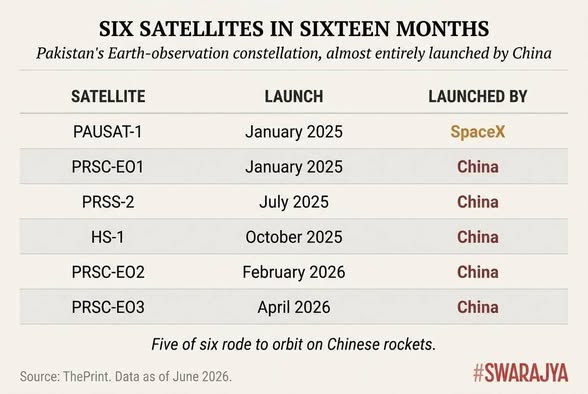
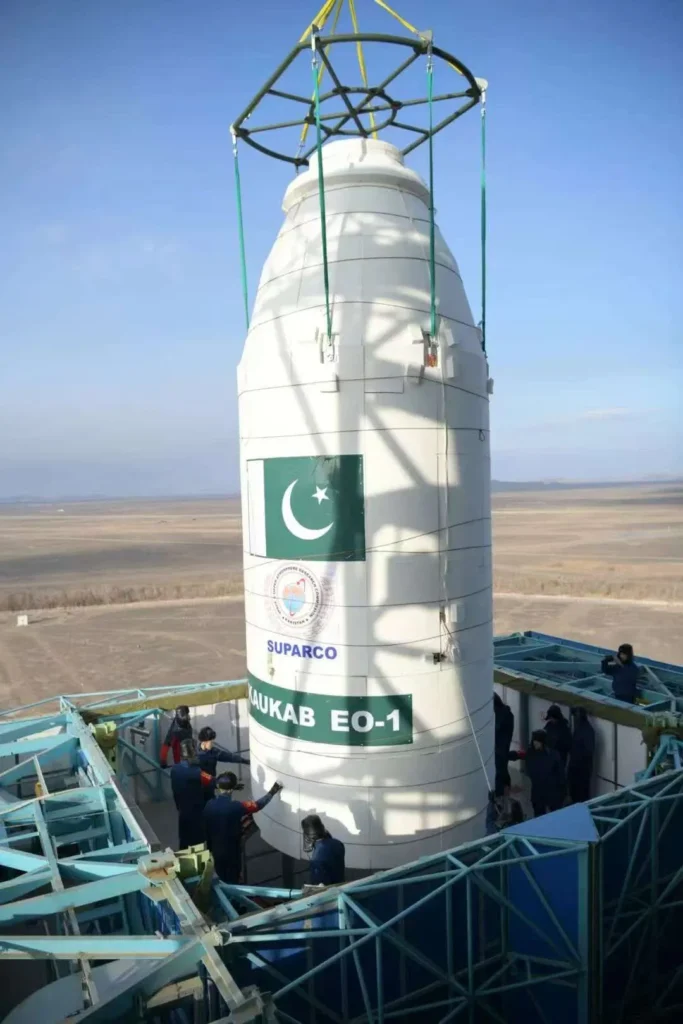
Satellite Constellation: Six Earth-observation satellites launched in just 16 months, mostly on Chinese rockets. Their orbits are optimized not for global coverage but for rapid revisit over India and Kashmir — a deliberate choice to prioritize surveillance of one adversary.
Chinese Integration: Beyond launch services, China provides BeiDou navigation access and intelligence sharing. Pakistan’s “eyes” and “reference grid” are now effectively Chinese, nesting its sovereign layer inside Beijing’s larger system.
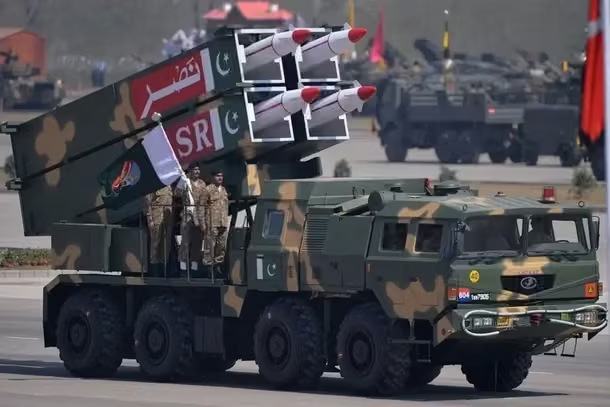
Army Rocket Force Command (ARFC): Formed in 2025 to unify conventional strike assets — guided rockets, cruise missiles, and drone swarms. This solves the problem of nuclear-reserved Babur missiles by creating a conventional strike force that can act early without triggering nuclear escalation fears.
Command Reform: The 27th Constitutional Amendment created the Chief of Defence Forces, concentrating authority in one office. This collapses decision layers, enabling faster authorisation of strikes.
Strategic Logic

Velocity over Mass: Brigadier Anil Raman’s point is crucial — crises in South Asia are decided in hours, not weeks. Pakistan’s reforms compress the sensor-to-shooter chain into hours, while India’s cycle still runs on days.
Firebreak/Fuse Dynamic: By separating nuclear and conventional arsenals, Pakistan lowers the threshold for missile use. Conventional launches are legible as non-nuclear, making them more usable in early crisis stages.
Narrative Control: In the 2025 Sindoor conflict, India’s military strikes came too late to shape Washington’s diplomatic narrative. Pakistan’s reforms aim to ensure its version of events dominates before India can act.
India’s Dilemma

Fragmented Strike Assets: India’s precision strike options remain scattered across services, consuming 24–48 hours to coordinate — time in which short wars are decided.
Integrated Rocket Force Proposal: First floated in 2021 by General Bipin Rawat, still unresolved. Institutional resistance, especially from the Air Force, has stalled progress.
Risk of Marginalisation: If Pakistan can strike, signal restraint, and de-escalate before India’s machine is ready, India’s superior power risks being sidelined in the decisive diplomatic window.
In essence, Pakistan has built a sensor-decision-shooter chain designed for speed, precision, and narrative advantage. India’s challenge is not lack of capability but lack of integration and tempo.
Here’s the full analysis given in crunch points with explanations for easier assimilation.
Pakistan’s Satellite Leap
Rapid Launches: Six Earth-observation satellites launched between Jan 2025–Jun 2026, compared to only nine in the previous six decades. Explanation: This sudden acceleration shows a deliberate military push, not just scientific progress.
Orbit Choice: PRSC-EO3 uses a 38° inclined orbit instead of the usual Sun-synchronous orbit.
Explanation: This sacrifices global coverage to maximize surveillance over India and Kashmir — a targeted military decision.
Chinese Role: Five of six satellites launched on Chinese rockets.
Explanation: Pakistan’s space surveillance is deeply integrated with China’s infrastructure, giving it both independence and Chinese backing.
Pak Army Rocket Force Command (ARFC)
Formation: Established in Aug 2025 to unify conventional strike assets — guided rockets, cruise missiles, and drone swarms.
Explanation: This centralization allows faster, coordinated strikes without bureaucratic delays.
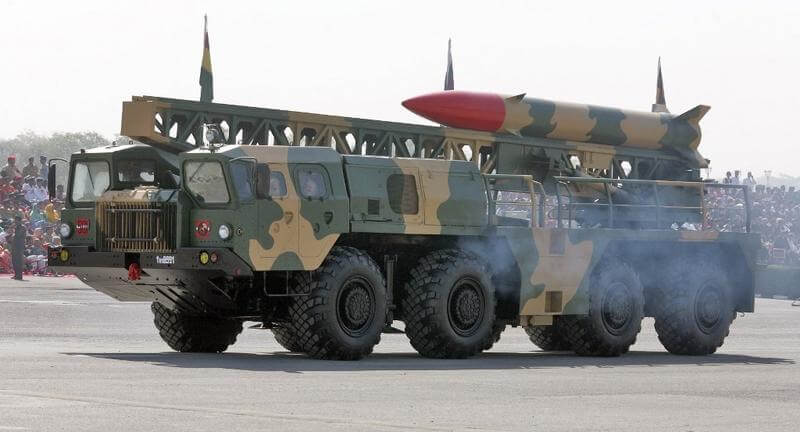
Fatah Arsenal: Includes Fatah-1/2 guided rockets and Fatah-4 cruise missile (750 km range, 5 m accuracy).
Explanation: These weapons are designed for precision strikes against Indian air defences and infrastructure.
Conventional vs Nuclear Separation: Nuclear missiles remain under a separate National Strategic Command.
Explanation: This separation lowers the threshold for conventional missile use, since launches are clearly non-nuclear.
Command Reform
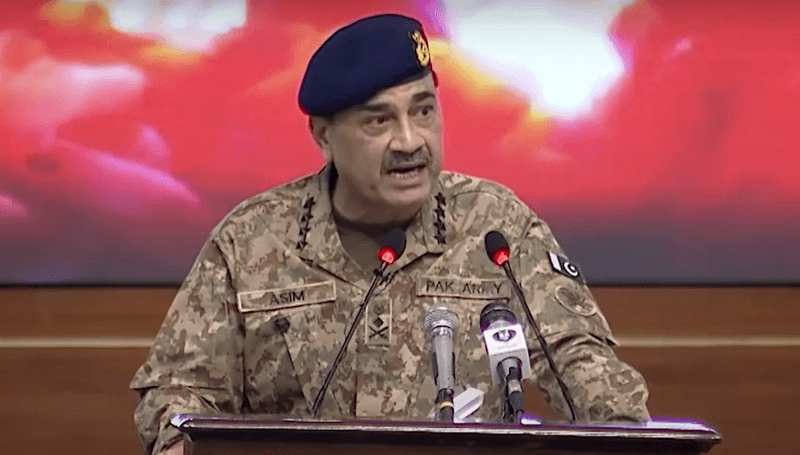
27th Constitutional Amendment (Nov 2025): Created the Chief of Defence Forces (CDF), abolishing the Chairman Joint Chiefs.
Explanation: Authority is concentrated in one office, currently held by Field Marshal Asim Munir, enabling rapid decision-making.
Effect: Target selection, escalation control, and execution orders flow through a single chain.
Explanation: This reduces delays and ensures Pakistan can act within hours in a crisis.
Strategic Logic: Speed Over Strength

Velocity Matters: Brigadier Anil Raman argues crises are decided in hours, not weeks.
Explanation: The side that acts first shapes the diplomatic narrative before external powers intervene.
Sindoor 2025 Example: India took nearly two weeks to authorize BrahMos strikes, by which time Pakistan had already influenced Washington’s view.
Explanation: India’s military competence was undermined by slow decision cycles.
India’s Challenges
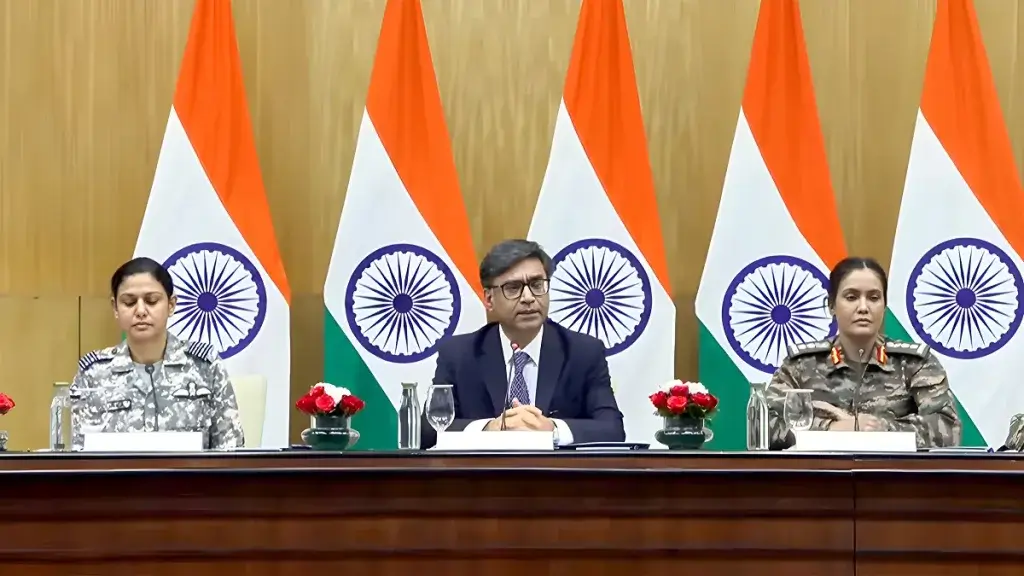
Fragmented Assets: Precision strike options are scattered across the Army, Navy, and Air Force.
Explanation: Coordinating them consumes 24–48 hours — too slow for short wars.
Integrated Rocket Force Proposal: Suggested in 2021 by General Bipin Rawat, still unresolved.
Explanation: Institutional resistance, especially from the Air Force, has stalled progress.
Risk: Pakistan’s compressed sensor-to-shooter chain could marginalize India’s superior power by acting faster.
Explanation: India may win battles but lose crises if it cannot match Pakistan’s tempo.
The Big Picture
Pakistan’s Architecture: Satellites (sensor) + ARFC (shooter) + CDF (decision) = a complete chain rebuilt in 12 months.
India’s Situation: Still debating organizational reforms while adversaries have already operationalized them.
Core Lesson: In modern South Asian crises, speed and narrative control outweigh raw military strength.