

Industry 6.0 does not simply add new tools… it overturns fundamental assumptions about how factories are designed, decisions are made, and value is created
— ScienceDirect
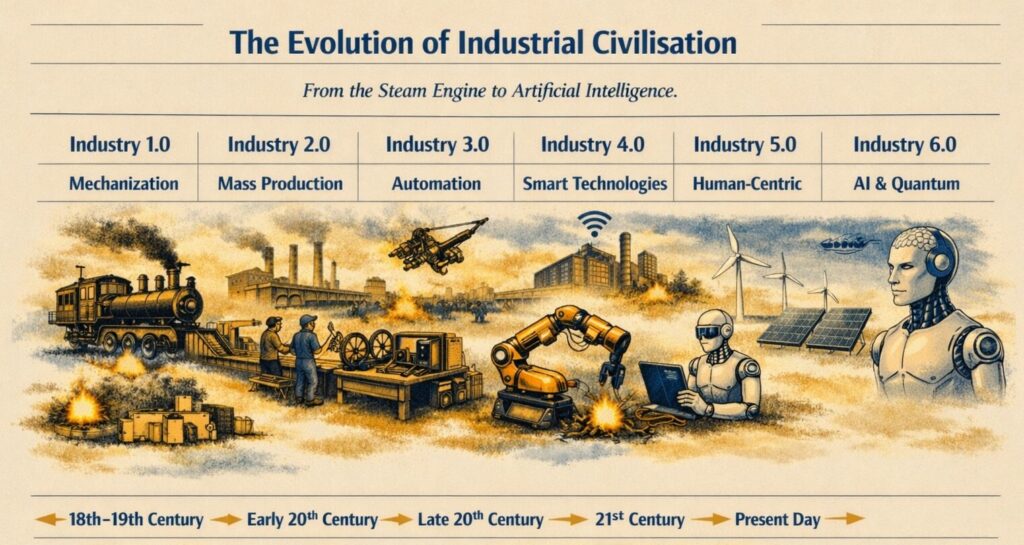
The evolution of industrial civilisation has been marked by significant transformations over time, influencing work practices, energy utilisation, and information dissemination. Currently, nations are experiencing the fourth industrial revolution, with a progression toward the fifth and sixth phases. This transition is reshaping manufacturing processes, quality assurance, and military capabilities. It involves not merely the introduction of new tools, but a comprehensive re-evaluation of the industrial system to enhance intelligence and connectivity.
To understand the essence of the contemporary military-industrial complex (MIC), it is essential to examine the intersection of technical capability, mass production, and stringent standards. These three foundational elements— technology, industry, and quality —are interconnected, forming a feedback loop that shapes a nation’s strategic advantage.

Technology: In the military context, technology refers to the practical application of scientific knowledge to achieve tactical or strategic superiority. It encompasses not only hardware (such as stealth coatings) but also the expertise, processes, and software necessary to address complex battlefield challenges.
Industry: Industry involves a systematic process of manufacturing and production. Within the MIC, this includes the infrastructure—factories, shipyards, and workforce—that converts raw materials and technological designs into tangible assets on a large scale.
Quality: Quality pertains to the level of excellence and adherence to the specifications. In the military context, quality equates to “mission reliability,” ensuring that a missile launches as intended and that armour meets the required density to withstand specific kinetic threats.
MIC relies on the synergy of the above three components, if any of them falters, the entire defence system becomes susceptible. This relationship is often perceived as a cycle of R&D, production, and sustainment:
– Technology propels industry: Innovations (such as 3D printing or stealth technology) compel industries to upgrade their facilities and train their workforce.
– Industry relies on Quality: for instance, to manufacture 1,000 fighter jets, industry must implement ” total quality management ” to ensure that each unit is identical and operational.
– Quality influences technology: Field data on defects, failures, and wear and tear are relayed to engineers to develop superior materials (technology).
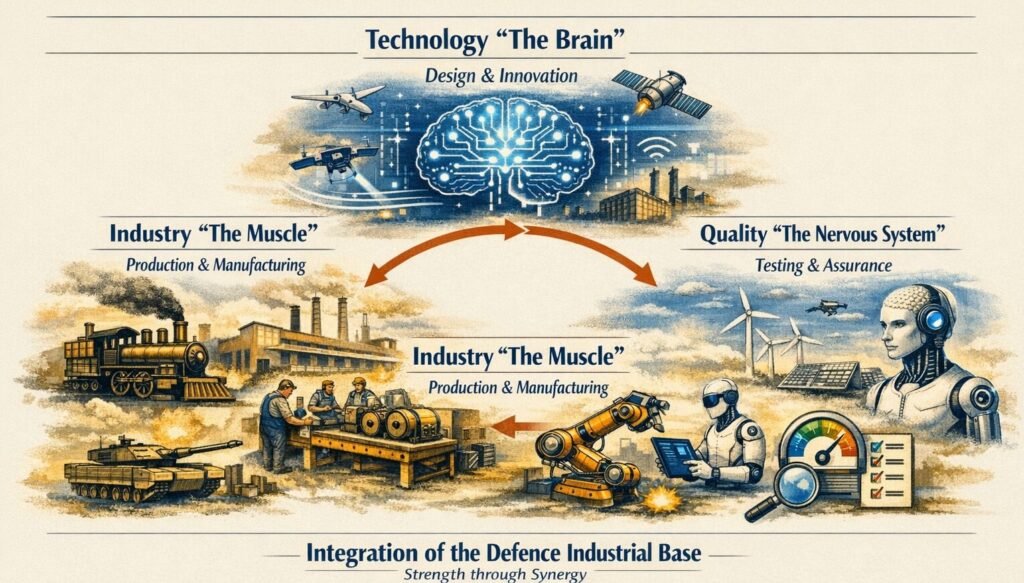
In the current landscape, particularly for an emerging power, the integration of these three elements is often referred to as defence industrial base (DIB) self-reliance, where technology serves as the ” brain ” (design), industry as the ” muscle ” (production), and quality as the ” nervous system “. An advanced MIC is characterised by cutting-edge technology, rapid industrial production, and quality that ensures reliability at critical moments.
Industry 4.0 emphasises the utilisation of extensive data to revolutionise manufacturing and related sectors, integrating big data, human resources, processes, services, and systems. This phase of the Industrial Revolution prioritises connectivity, automation, machine learning, and real-time data utilisation. Historically, Industry 1.0 harnessed water and steam, Industry 2.0 employed mass production and electricity, and Industry 3.0 utilised computers and basic automation. Industry 4.0 amalgamates physical production with advanced digital technology, establishing a highly interconnected system.

The technical foundation of Industry 4.0 is the cyber-physical system (CPS), which comprises “smart machines” equipped with modern control systems, software, and Internet connectivity via the Internet of Things (IoT). Industry 4.0 enables these systems to autonomously make decisions, leveraging data to enhance efficiency and transform manufacturing processes while real-time communication between machines and humans facilitates decentralised decision-making. Industry 4.0 is highlighted by Additive Manufacturing, Augmented Reality, IoT, Cloud Computing, and Cybersecurity, which collectively augment human creativity rather than supersede it. Business proprietors can exercise enhanced control and understanding of their operations by utilising instantaneous data to boost productivity and growth.
To meet Industry 4.0 standards, certain quality rules called Quality 4.0 have to be followed. This focuses on future quality and excellence in Industry 4.0. Compliance with these standards entails more than merely incorporating sensors; it necessitates the creation of a “digital thread” that ensures data accuracy and transparency throughout the entire process.

Industry 4.0 necessitates a paradigm shift from ‘post-occurrence problem’ resolution to proactive prevention. Traditional methodologies, which relied on manual inspections and sampling, are prone to errors. In contrast, Quality 4.0 employs comprehensive automation and utilises technologies such as computer vision and sensors to conduct exhaustive inspections. The objective is to achieve defect-free production from the outset by leveraging artificial intelligence (AI) to pre-emptively address potential defects. This approach requires robust digital infrastructure, including digital platforms that monitor, track, and control the entire production process from raw materials to finished goods via remote serverscloud-based manufacturing execution systems (MES) and enterprise resource planning (ERP) systems, to effectively manage the substantial data influx from smart factories. High-speed Internet connectivity, such as 5G, is essential for the seamless operation of these systems.
AI plays a pivotal role in Industry 4.0 by transforming data into actionable insights and facilitating a transition from reactive to preventive maintenance strategies. AI has revolutionised maintenance practices by analysing sensor data to identify issues before machinery failure occurs, thereby enabling condition-based maintenance and minimising downtime and catastrophic failures. Corporations such as BMW and General Electric utilise AI to monitor machinery, including robotic arms and engines, for potential malfunctions. The efficacy of AI in maintenance is evaluated using metrics such as mean time between failures (MTBF) and mean time to repair (MTTR), with the aim of increasing MTBF and reducing MTTR through automated alerts and diagnostics. Furthermore, AI enhances quality control by employing computer vision and deep learning to detect defects that may escape human inspection, thereby ensuring product reliability. AI also optimises production and supply chain management by facilitating real-time decision-making and adjusting schedules based on resource availability and priorities. Additionally, AI aids in supply chain management by forecasting demand and reducing costs.
Industry 4.0 and the Military-Industrial Complex

Industry 4.0 is fundamentally transforming the operations of military-industrial complexes (MIC). This transformation represents a significant rethinking of manufacturing processes, within the defence sector, Industry 4.0, enhances national security by facilitating faster, more cost-effective, and reliable production processes.
Digital engineering has become indispensable for defence departments and contractors who now employ digital twins, which are detailed virtual replicas of real systems. These digital twins enable real-time monitoring and testing, thereby mitigating risks throughout the design, production, and maintenance phases of weapon systems.
Additive manufacturing (AM), commonly known as 3D printing, is pivotal in addressing future military requirements. It enables on-demand production of parts, even beyond traditional maintenance facilities. This capability is crucial for military readiness, as it allows for the rapid replacement of parts in the field and alleviates supply chain challenges. In conflict zones such as Ukraine, AM has emerged as a network for producing weapons and components.
Contemporary military reform incorporates “informationization” across all equipment, transitioning from basic mechanical weaponry to sophisticated digital networks. Digital input optimises equipment for diverse environments, such as extreme temperatures, through rapid modelling and simulation.
Armament Transformation

Industry 4.0 is ushering in the development of superior weaponry. armed forces are witnessing the emergence of new weapons systems that are characterised by increased precision, reduced weight, and enhanced adaptability.
The integration of artificial intelligence and precision manufacturing techniques has led to the creation of smart munitions and missile components with exceptional accuracy. Advanced materials contribute to weight reduction without compromising strength. The U.S. Army’s Rapid Additively Manufactured Ballistics Ordnance project (RAMBO) project has demonstrated the capability to rapidly print complex weapons and tailor them to specific operational needs.
Industry 4.0 accelerates the advancement of unmanned aerial vehicles and drones, with modular systems that allow for the reconfiguration of drones for various missions by altering their components. The coordination of these drones into swarms utilising real-time data provides a significant tactical advantage on the battlefield.
Enhancing weaponry extends beyond merely increasing power; it encompasses ensuring rapid deployment and minimising the interval between research and operational use. Artificial intelligence (AI) plays a pivotal role in ensuring defect-free weapon production, which is a critical factor given that errors can result in loss of life.
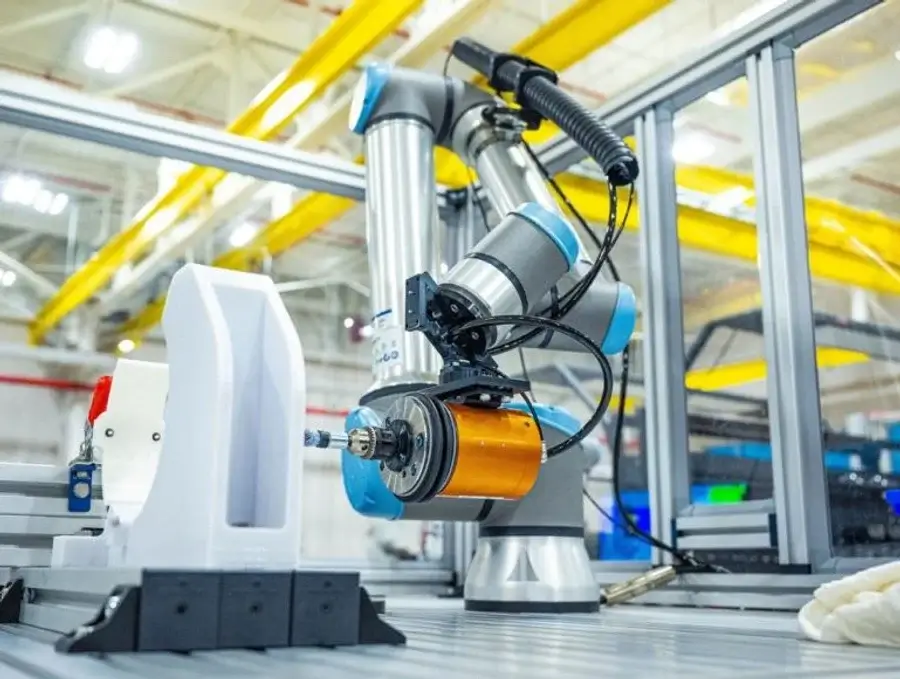
Prominent defence contractors, such as Lockheed Martin, BAE Systems, and General Dynamics, are actively embracing Industry 4.0 technologies. Notable initiatives include Lockheed Martin’s “1LMX” program, which establishes a “Digital Tapestry” and leverages 5G technology to enhance connectivity on factory floors.
Our customers face threats that require us to deliver innovation at scale and with greater agility than ever before to address their toughest challenges
– Chandra Marshall, Vice President and General Manager, Lockheed Martin Radar and Sensor Systems
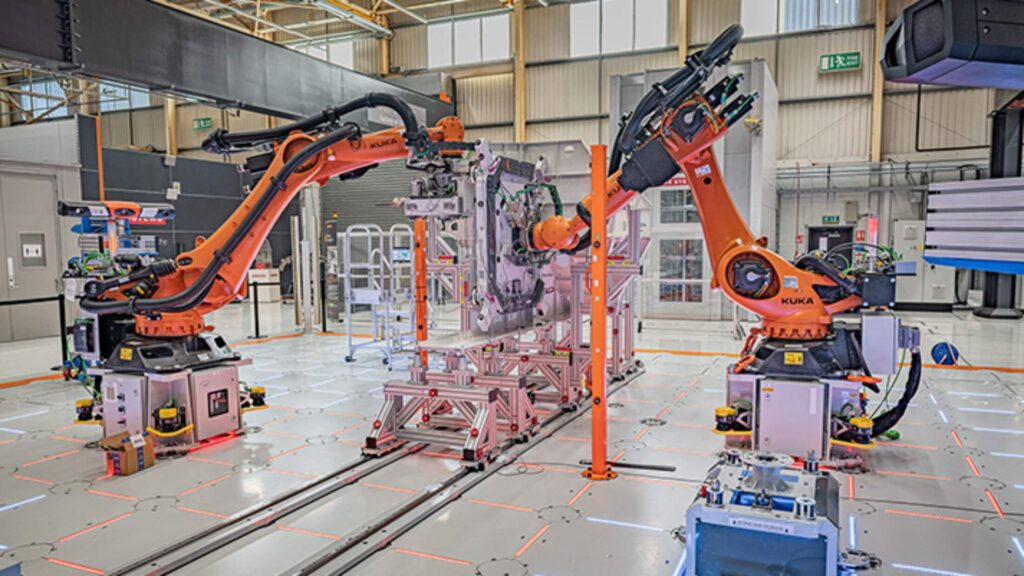
BAE Systems employs virtual reality (VR) and 3D printing within its “Factory of the Future” to advance munitions and combat aircraft production. Northrop Grumman is committed to digital transformation in advanced manufacturing technology. FN Herstal utilizes additive manufacturing (3D printing) for weapon production. Beretta is recognized for its innovative 4.0 business models, incorporating automated, high-tech manufacturing processes. General Dynamics implements smart factory technology to produce sophisticated weapon systems. Raytheon (RTX) emphasizes digital factory architecture and smart manufacturing. Huntington Ingalls Industries is developing advanced laser weapons and employing high-tech shipbuilding techniques. Kratos Defense engages in high-tech, AI-powered system testing. Savage Arms is noted for adapting its manufacturing processes to contemporary digital standards. KelTec employs advanced techniques to create distinctive, modern firearm designs. Heckler & Koch is investing in the expansion of high-tech manufacturing, particularly at its facilities. Boeing utilizes advanced technologies for both military and commercial products. Ruger prioritizes “innovation” within the firearms industry. Capewell integrates modern technologies for aerial delivery systems. Tonasco employs Industrial Internet of Things (IIoT) sensors, AI, and robotics for precision manufacturing. SteelAsia implements AI-supported platforms to optimize production. These companies are primarily motivated by the imperative for increased speed, efficiency, and the production of superior, high-tech products.
Strategic landscape of 2026-India

In the strategic landscape of 2026, the Indian Ocean has emerged as a key arena for autonomous naval competition. While India has made considerable progress in indigenous development through the iDEX and ADITI initiatives, it faces a sophisticated ” grey zone ” challenge from China and an evolving unmanned threat from Pakistan.
The “Industry” pillar underscores the most pronounced disparity within the regional military–industrial complex (MIC). China leads the region in scaling efforts, having effectively integrated civilian survey vessels, such as the Xiang Yang Hong series, into its military ISR network. Its industry is currently experimenting with ” drone motherships ” capable of deploying swarms of small AI drones collectively. India counters China’s mass production with agility, the Indian Navy has signed over 540 iDEX contracts, the transition to “mission-speed” manufacturing, exemplified by Sagar Defence’s new facility, aims to produce a new vessel or drone every six weeks, focusing on high-attrition, low-cost assets. Pakistan’s naval industry is linked to China, this year, the first of eight Hangor-class (Type 039A) submarines will enter service, four of these are being constructed in Karachi, marking a significant technology transfer that enhances Pakistan’s local industrial “Quality.”
In 2026, “Quality” extends beyond build strength to include mission hardening in contested environments. India emphasises TRL-9 (technology readiness level) and indigenous content, modern Indian platforms, such as the Arighat, and new UUVs are achieving 90% indigenisation, mitigating ” quality ” risks associated with foreign supply chains. Although China has a “first mover” advantage, some of their UUVs, such as the HSU-001, are noted for limited endurance, their strategy focuses on quantity over the longevity of individual assets, relying on the ability to overwhelm defences.
Analysts describe the proliferation of these low-cost drones as “destabilizing,” their expendable nature lowers the threshold for their use, increasing the risk of a ” grey zone ” incident escalating into a conventional conflict.
India is currently adopting a “Target-Poor” defence strategy, by deploying thousands of small, indigenous autonomous systems (Technology), rapidly manufactured by local startups (Industry), and tested to withstand the harsh sea environment (Quality), the navy aims to render the Indian Ocean too “noisy” and “risky” for adversary submarines to remain concealed.
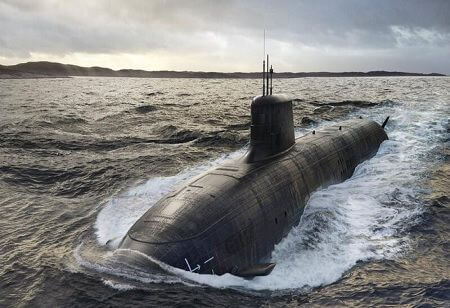
The Indian S5 class submarine is being designed to resolve the “stealth vs. communication” paradox of traditional submarines. In partnership with Sagar Defence Engineering (SDE), the DRDO is developing Unmanned Launchable Underwater Aerial Vehicles (ULUVs), these are launched from the S5’s torpedo tubes while submerged, ascend to the surface, and transition into flight to provide real-time intelligence, surveillance, and reconnaissance (ISR) over 20 km away. As per some reports the S5 is expected to deploy Underwater Drone Swarms to function as a “protective screen.” These small drones can distract enemy sonar or identify “shadowing” hunter-killer submarines (SSNs) without the S5 disclosing its own position.
The industrial requirements of the S5 class significantly surpass those of the Arihant-class, The Bhabha Atomic Research Centre (BARC) has developed a new 190–200 MW pressurised water reactor for the S5, effectively doubling the power output of the Arihant’s 83 MW system. This advancement enables the S5 to maintain high speeds (exceeding 24 knots) while supporting advanced artificial intelligence and sonar systems. To facilitate the construction of these submarines, the Shipbuilding Centre (SBC) in Visakhapatnam has undergone substantial dry-dock expansions. This industrial development ensures that India can maintain a “Continuous At-Sea Deterrence” (CASD), with at least one S5 consistently on patrol.
For a platform likely to be equipped with K-6 MIRV-capable missiles (with a range of 8,000–10,000 km), the “Quality” standards are stringent. Unlike earlier models that required frequent refuelling, the S5 is designed for 10-year deployment cycles before necessitating a core reload. This necessitates manufacturing quality in the reactor and cooling systems that is comparable to the finest Western “boomers” (such as the US Ohio or Columbia classes). The S5 utilises advanced pump-jet propulsors instead of traditional propellers and incorporates anechoic coatings. This enables the S5 to become a “ghost,” disappearing into the deep trenches of the Indian Ocean. The inclusion of the third vessel, INS Aridhaman, into the fleet this year, would serve as the final “bridge” in quality and technology before the commencement of full-scale production of the S5 “behemoths” in the coming years.
AI in Weapon Quality

AI systems are now employed to detect even minutest cracks and defects in critical military components, such as turbine blades, these systems surpass human capabilities by maintaining prolonged focus, thereby ensuring that all components adhere to stringent standards.
In the production of complex materials for armour and weaponry, AI monitors variables in real-time, such as temperature and humidity, and by analysing historical data, AI identifies patterns that may lead to defects, enabling the cessation of production before flawed components are manufactured, thus ensuring consistent material quality.
Emerging manufacturing techniques, such as 3D printing, encounter challenges owing to their reliance on destructive testing. AI facilitates non-destructive testing by employing sensors and analytical methods to evaluate components without causing damage, thereby meeting military standards.
Looking forward, the focus is on advanced AI capable of autonomously operating and eventually performing tasks surpassing human capabilities. In near future AI could achieve objectives with minimal supervision, possessing the ability to plan, act, and adapt to achieve the desired outcomes.
Artificial general intelligence (AGI)

Artificial general intelligence (AGI) has the potential to perform nearly any task that humans can, in the military context, AGI could revolutionise warfare and manufacturing processes.
-AGI has the potential to transform intricate technical discoveries into actionable military insights at a remarkable speed, thereby reducing the time required for scientific advancements from decades to mere years.
-AGI can manage extensive operations by integrating data from satellites, drones, and terrestrial sensors to construct a real-time operational overview.
Industry 5.0 and 6.0
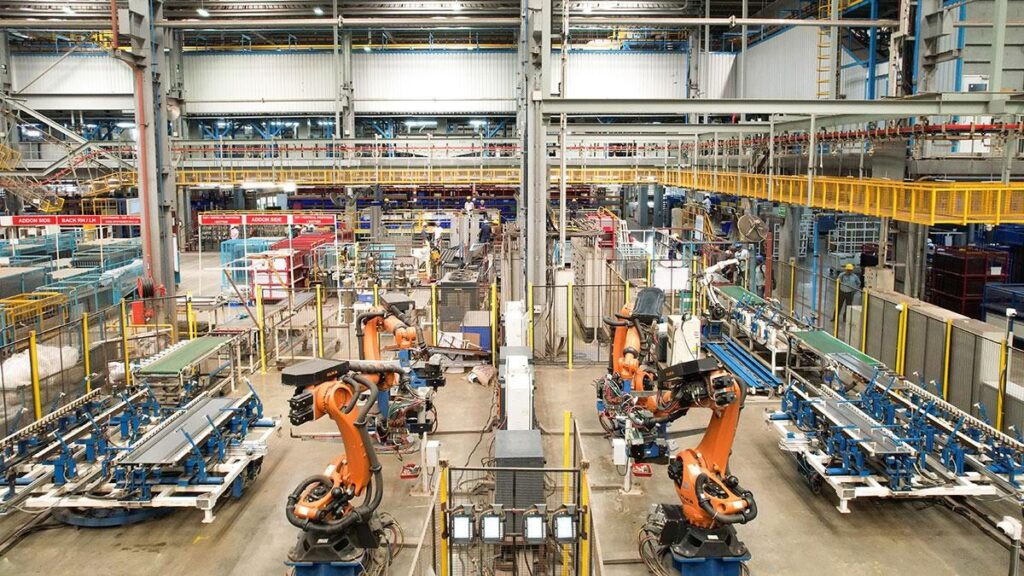
Industry 5.0 and 6.0 represent the subsequent phases following industry 4.0, emphasising enhanced collaboration between humans and machines. Industry 5.0 focuses on the collaboration between humans and advanced technologies, including AI-driven robots (co-bots), to optimise work processes. This phase reintroduces the “human touch” in manufacturing, prioritising personalisation, sustainability, and resilience. The objective is to leverage technology to assist humans, thereby generating social value alongside economic growth.
Industry 6.0 is anticipated to mark a significant advancement toward self-regulating industrial systems. It encompasses the following:
-The distinction between human decision-making and automated actions becomes increasingly indistinct using brain–computer interfaces and neurotechnology.
-Systems are designed not only to endure stress but also to improve because of it.
-Quantum computing facilitates complex decision-making, while nanotechnology enables manufacturing at a microscopic scale.
Quality 5.0 and 6.0: From Proactive to Self-Healing
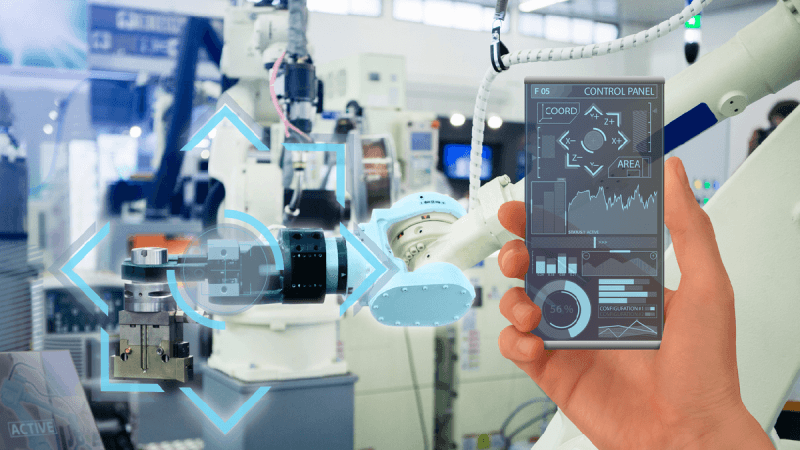
Quality management evolves in tandem with industrial revolutions, transitioning from predictive measures in quality 4.0 to future collaborative and cognitive standards.
Quality 5.0 builds upon industry 4.0 by integrating AI with human expertise in quality management. It emphasises the following:
-AI not only forecasts but also mitigates quality failures through corrective measures.
-Real-time data exchange among plants, suppliers, and customers ensures global compliance and traceability.
-Quality leaders assume the role of “navigators,” utilising AI to drive excellence.
Quality 6.0 represents the next evolution for intelligent systems. It involves the following:
-Systems possess the capability to comprehend defects and adjust production processes accordingly.
-Materials are engineered to detect and repair their own deficiencies.
-Quantum computing is employed to verify the integrity of complex systems in real-time, managing substantial data volumes.
Challenges of Industry 4.0/ 5.0/ 6.0:
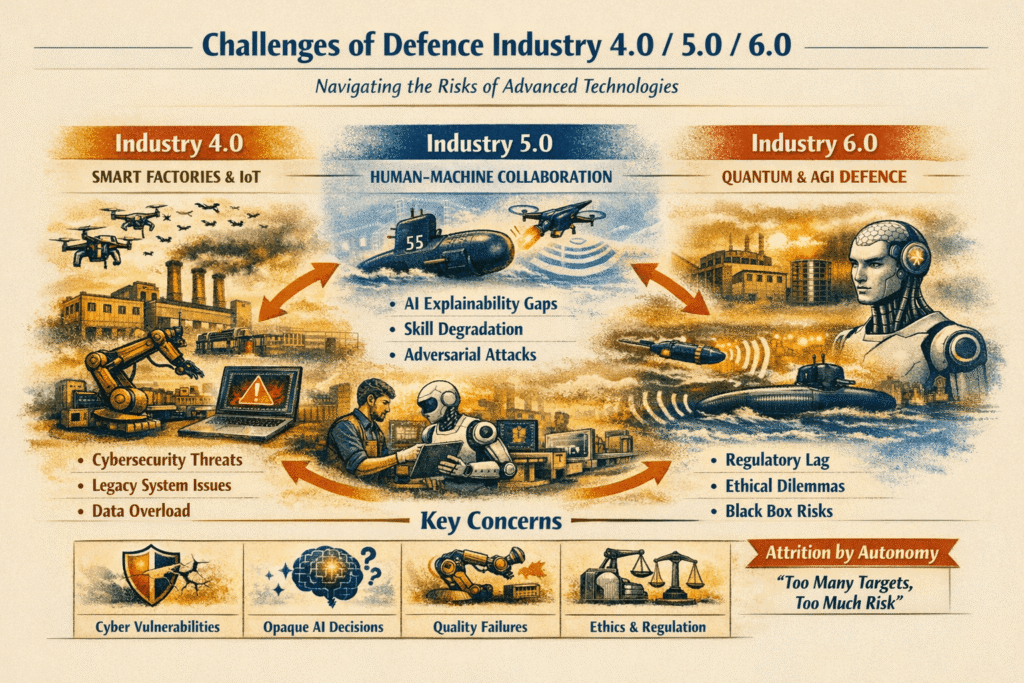
While these industrial revolutions hold significant promise, they also face the following challenges in ensuring the safety, security, and ethical deployment of autonomous systems.
Cybersecurity and Network Reliability: As industrial systems become increasingly interconnected, they are rendered more susceptible to cyberattacks. The advent of Industry 5.0 and 6.0, which utilise 5G/6G networks, introduces potential vulnerabilities. A cyberattack or network failure could result in significant disruptions to critical systems.
The “Black Box” Problem and Explainability: AI models often present challenges in terms of interpretability. In sectors such as manufacturing and defence, this opacity undermines trust in AI systems. It is imperative to establish clear guidelines to prevent AI from making biased or unchecked decisions.
Data Integrity and the “Garbage In, Garbage Out” Trap: AI systems are contingent upon high-quality data. Poor data quality can lead to AI system failures that may not be immediately apparent. Historically, human oversight could detect errors early; however, in the current context, minor data inaccuracies can precipitate substantial issues.
Pitfalls of Quality 4.0/ 5.0/ 6.0:

Transitioning to automated quality management systems entails certain risks. In the context of Quality 5.0, there is a risk that individuals may lose essential skills due to excessive reliance on AI. It is crucial to maintain human competencies to address potential AI failures.
Quality 4.0 and 5.0 systems employing computer vision are vulnerable to adversarial attacks, in which minor alterations to images can deceive the system. In the context of weapon production, such a vulnerability could allow defective components to pass inspection, leading to failures.
As Quality 6.0 progresses, regulatory frameworks may struggle to keep pace with technological advancements. This poses challenges to effective governance, potentially compromising safety in critical domains.
Conclusion:

The transition from Industry 4.0 to 6.0 signifies the evolution toward more intelligent and integrated systems. For the military-industrial complex, this transformation is essential to maintain a competitive edge. Weapons systems will become more advanced, exhibiting increased lethality and the capacity to collaborate with autonomous systems.
To realise this vision, it is imperative to address critical issues such as cybersecurity, data integrity, and ethical responsibility. The transition to Quality 6.0 necessitates an emphasis on transparency and the development of systems that prioritise human values within the industry. As artificial general intelligence (AGI) and agentic AI influence the future of manufacturing, success will hinge on the creation of systems that are not only intelligent and efficient but also robust, ethical, and conducive to human oversight.
“Quality 6.0 includes the quality of all stages of the life cycle of a product or service, including development, production, distribution, use, and disposal”. Tereza Smajdorova