

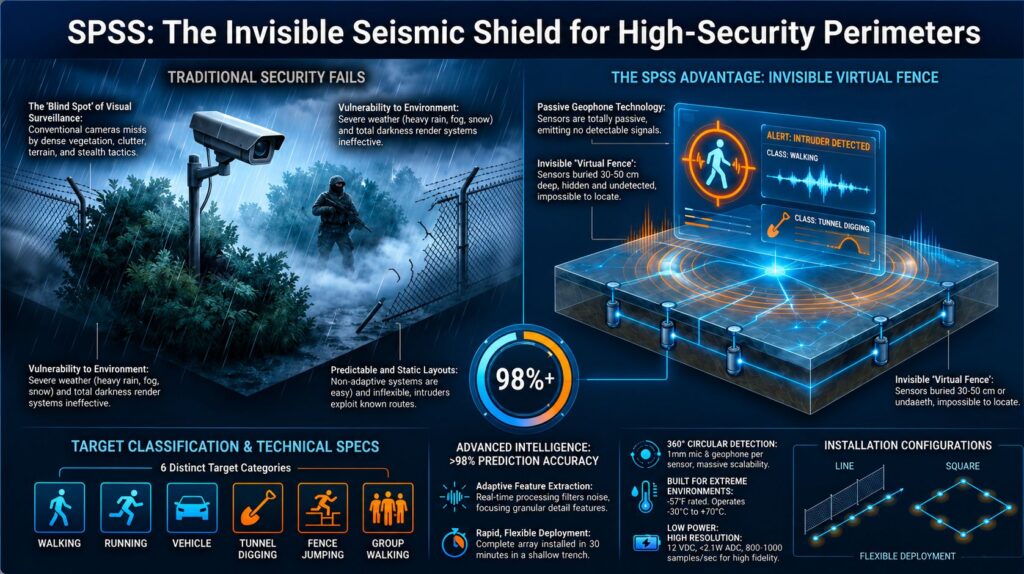
In an era where the protection of critical infrastructure is of paramount importance, maintaining a secure perimeter around permanent and temporary installations is a formidable challenge. Whether in military environments guarding against insurgent threats or in civil environments protecting proprietary operations from physical theft, the earlier an intrusion is detected and assessed, the easier it becomes to deploy effective countermeasures.
Visual surveillance and electronic imaging have long served as the primary modalities for perimeter protection. However, these traditional methods suffer from critical vulnerabilities. The nature of the surrounding terrain, dense vegetation, and adverse weather conditions can effectively negate visual observation. Intruders utilizing stealth and camouflage can frequently bypass these conventional systems undetected.
Currently, a wide variety of perimeter protection systems exist, categorized broadly into fence-line sensors (vibration, taut wire, fibre optic, continuity, micro bending, strain cables, coaxial, magnetic polymer, e-field, capacitance), in-ground sensors (balanced pressure line, ported coax, buried fibre optic), open-area volumetric sensors (infrared, microwave, radar, acoustic), and video motion detectors. While diverse, these non-geophone-based systems share severe disadvantages. Their installation is typically costly and complicated, requiring meticulous advance planning tailored to the specific terrain. More importantly, they are inflexible. Because they cannot be easily re-configured to accommodate changing requirements, they are highly vulnerable; determined intruders can study and learn the installation layout, ultimately finding routes to evade detection and penetrate the security zone.
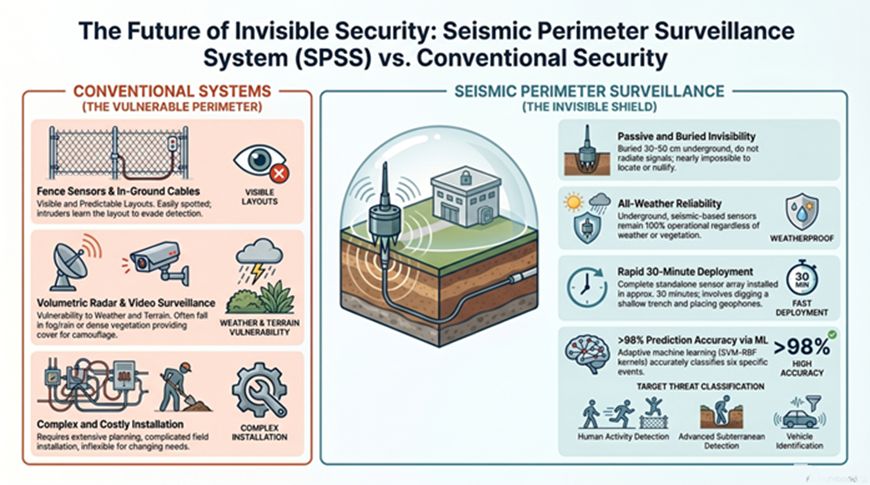
To overcome all these limitations we developed a hidden, flexible, economical, easily deployable and AI based Security System with high intruder detection capabilities.
An AI Security Guard with almost 98% intruder detection accuracy
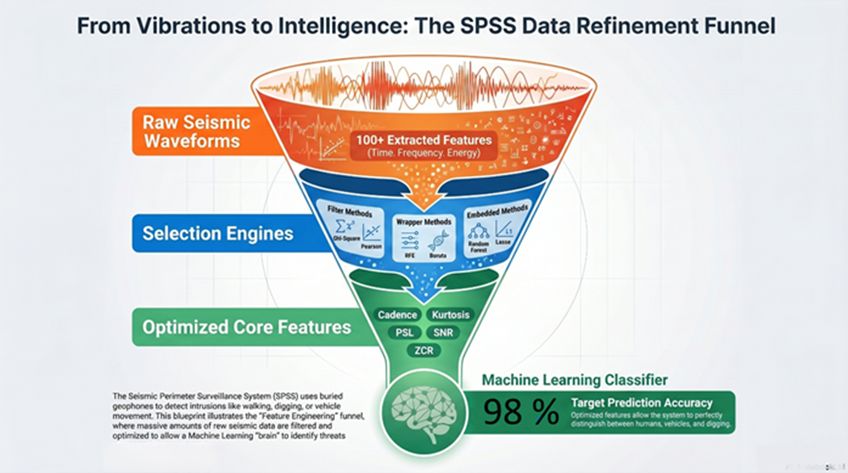
Having a lot of data is good, but processing it instantly requires a highly optimized system. Rigorous selection methods are used to strip away irrelevant “noise” and focus only on the absolute best indicators—to feed into the system’s machine learning “brain”.
Powered by a weighted ensemble of various AI algorithms, the SPSS doesn’t just know something is out there; it knows exactly what it is. During rigorous testing, the system was trained to instantly identify and classify complex threats:
- Person walking / Trespassing
- Person running
- Vehicle movement
- Jumping fence
- Subterranean tunnel digging
In vast testing scenarios, this optimized machine learning model delivered a remarkable overall accuracy rate exceeding 98%, with some threat predictions achieving a flawless 100%.
Steps in Realtime detection / classification and notification of Intruder Alarm
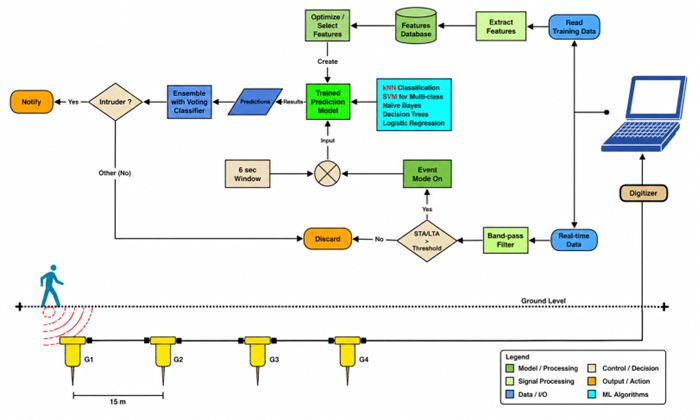
Schematic below shows the flow chart describing the complete process for real time intrusion detection / classification and summarised as –
Geophone Sensors [Acquire Data] → Digitizer [Digitise Data] → Filter [Remove Noise] → STA/LTA [Ratio of Short-term average to Long-term average] → Event Detection [Prediction data]→ Window [Extract 6 seconds data] → Use ML Model → Weighted Ensemble of various ML Models → Intruder Decision [Walk/Run/Vehicle/Fence Jump/Tunnelling] → Notify.
This Next Gen Seismic Perimeter Surveillance System represents a massive leap forward in physical security. By moving away from easily compromised visual sensors and capturing the very vibrations of the earth, this technology ensures that our most critical installations are protected by an intelligent, ever-vigilant shield.
The physical specifications of the SPSS are engineered for harsh, unforgiving environments. It operates reliably in extreme temperatures ranging from -30°C to +70°C and holds an IP67 rating for ingress protection. The system provides a 360-degree circular detection pattern. While most commercially available seismic systems are severely limited by ambient background noise and offer simple classifiers—usually only differentiating between a human walk and a car—this next Gen SPSS represents a generational leap forward. The prototype was trained and tested, to identify and classify six distinct, complex target events: Human Walk, Human Run, Vehicle Movement, Tunnel Digging, Fence Jumping, and Group of Intruders Walking.
The system relies on a network of “geophones”—passive sensors buried just 11 to 20 inches (30 to 50 cm) beneath the earth. Because these sensors emit no detectable signals and are completely hidden underground, it is virtually impossible for intruders to locate them, learn their layout, or digitally jam them to sneak by.
Beyond its invisibility, the SPSS is incredibly tough and agile. It is built to operate flawlessly in extreme environments, functioning perfectly from a freezing -30°C to a blistering +70°C. Most impressively, a complete sensor array can be deployed in a shallow trench and fully operational in just 30 minutes. This extreme flexibility gives security teams a massive tactical advantage for rapid, temporary setups where traditional equipment would fail.
Translating Earth Vibrations into Intelligence
So, how does the system tell the difference between a harmless animal and a coordinated break-in? When physical movement occurs on the surface, it creates low-frequency seismic vibrations. The buried sensors pick up these tiny ripples in the soil and send the high-resolution digital data to a ruggedized laptop for real-time processing.
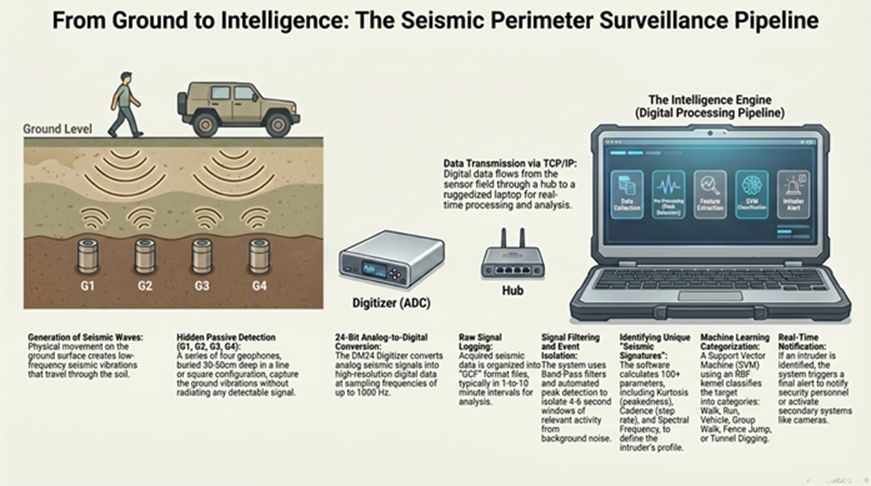
This is where artificial intelligence takes over. Instead of just sounding an alarm for any random noise, the software uses an automated algorithm to isolate 6-second windows of activity and extract specific mathematical “features” from the vibrations. It analyses data points, looking at the rhythm of footsteps (cadence), the dominant pitches (frequency), and energy intensity (amplitude). By filtering out the background noise, the system creates a unique “seismic signature” for whatever is moving above.
Data Acquisition and Pre-Processing
When something moves on the ground, it creates tiny vibrations or “ripples” in the soil.
Sensors: Hidden sensors called “geophones” are buried underground to pick up these vibrations like a high -tech stethoscope on earth.
Digitization: A device called a “digitizer” takes these physical vibrations and turn them into digital data that a computer can read.
Spotting the Action: Instead of watching hours of silence, the computer uses a smart peak detection” tool. It only pays attention when the vibrations get strong enough to indicate something is happening.
Capturing the Moment: When it detects movement, the system “cuts out” a 4 to 6-second clip of that vibration to study it more closely.
Feature Extraction
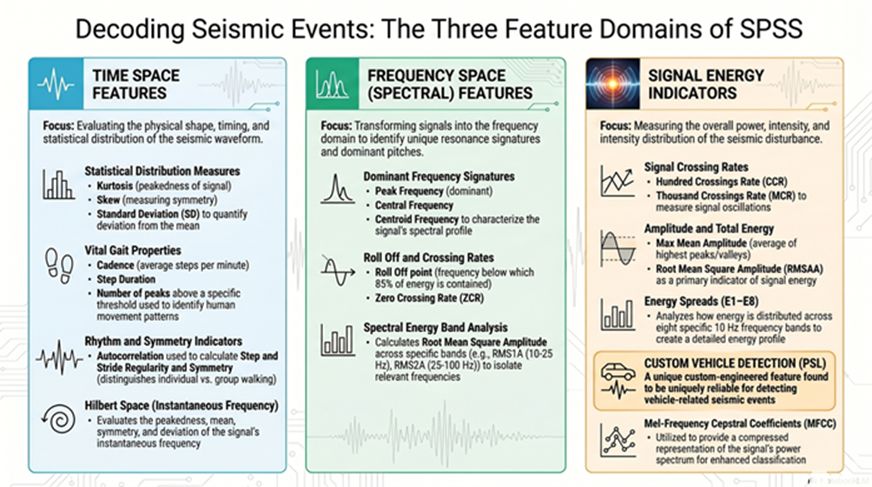
To teach a machine to detect and differentiate various intruder events the software is designed to extract approximately 100 distinct features which act as digital signatures. These features are broadly categorized into three primary domains:
Timing and Rhythm (Time Space Features)- The system looks at the “beat” of the movement—like the steady rhythm of footsteps or how sharp and sudden the vibrations are.
Pitch and Tone (Frequency Space Features)- Just like different musical instruments have different sounds, different movements have different “pitches.” Digging sounds different from walking.
Strength and Energy (Energy based Features)- The system measures how much “power” is in the vibration and how that energy is spread out.
Feature Selection and Optimization
To refine the model, the SPSS development team employed a rigorous feature selection methodology utilizing algorithms from three major categories: Filter-based, Wrapper-based, and Embedded methods to identify the most useful signatures.
The system initially finds over 100 different clues or signatures, but not all of them are useful. Some are just “background noise.” So, we Trim the Fat Using specialized “selection engines,” the system throws away useless or repetitive information by focusing only on the 10 most important clues (like the rhythm of steps or the specific energy of a vehicle), the system can make decisions much faster and more accurately.
The Brain [Decision making and Notification]
These top-tier clues are used to train AI Models and an ensemble of best performing Models form the “brain” for identifying and notifying threats.
The Seismic Perimeter Surveillance System represents a paradigm shift in physical security. By moving away from easily compromised visual and spatial sensors and instead capturing the very vibrations of the earth, the SPSS creates an invisible, unhackable perimeter. Driven by meticulous feature engineering and powered by advanced Machine learning algorithms capable of differentiating between a lone runner, a digging tool, and a group of intruders with over 98% accuracy, this rapidly deployable technology ensures that installations like Military and Tactical Environments, Critical Civil and Commercial Establishments and Challenging Terrains and Weather are secured by a highly intelligent, ever-vigilant technological shield.