

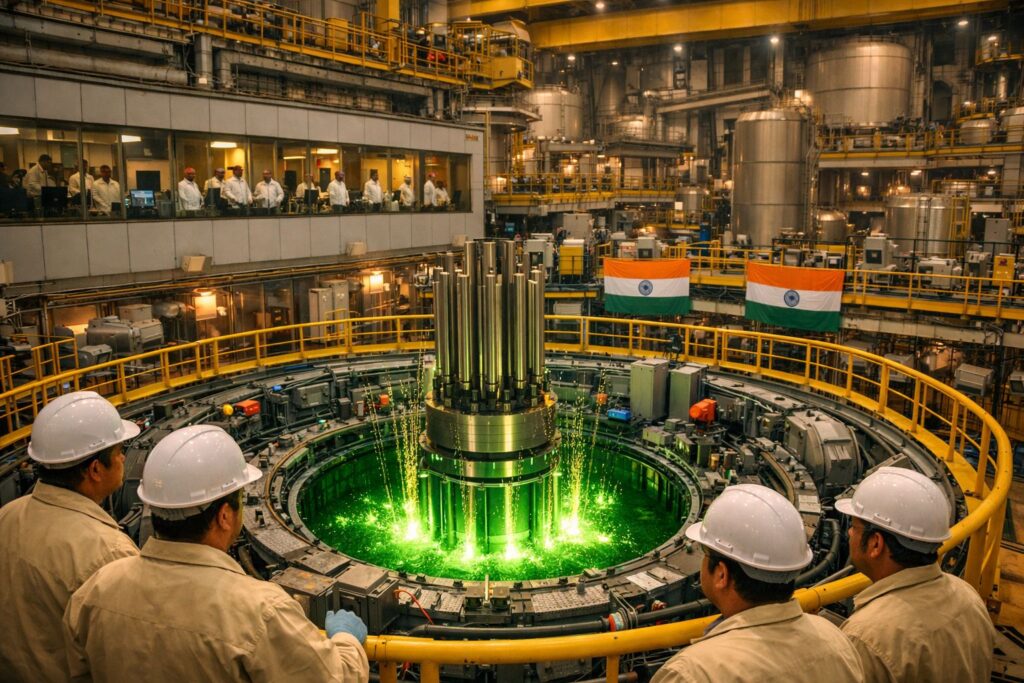
On April 6, 2026, India’s 500 Mwe Prototype Fast Breeder Reactor (PFBR) at Kalpakkam, Tamil Nadu, reached “first criticality”—the initiation of a self-sustaining, controlled nuclear chain reaction. This monumental achievement pushes India into the second stage of its pioneering three-stage nuclear energy program and positions the country as a global leader in advanced breeder reactor technology.
On April 6, 2026, India’s 500 Mwe (Megawatt electric) Prototype Fast Breeder Reactor (PFBR) at Kalpakkam, Tamil Nadu, reached “first criticality”, marking the start of a self-sustaining nuclear fission reaction. This massive indigenous milestone cements India as the second country after Russia operating a commercial-level FBR. While there were experimental reactors in the US, UK, France, and Japan, they were reportedly shut down or decommissioned.
This breakthrough is a cornerstone of India’s long-term energy security and a major step forward in its three-stage nuclear programme. It is a very significant achievement because unlike traditional thermal nuclear reactors, a fast breeder reactor (FBR) generates more fissile material than it consumes. It uses a mixed oxide (MOX) fuel of plutonium and depleted uranium to convert otherwise un-fissionable Uranium-238 into new Plutonium-239.
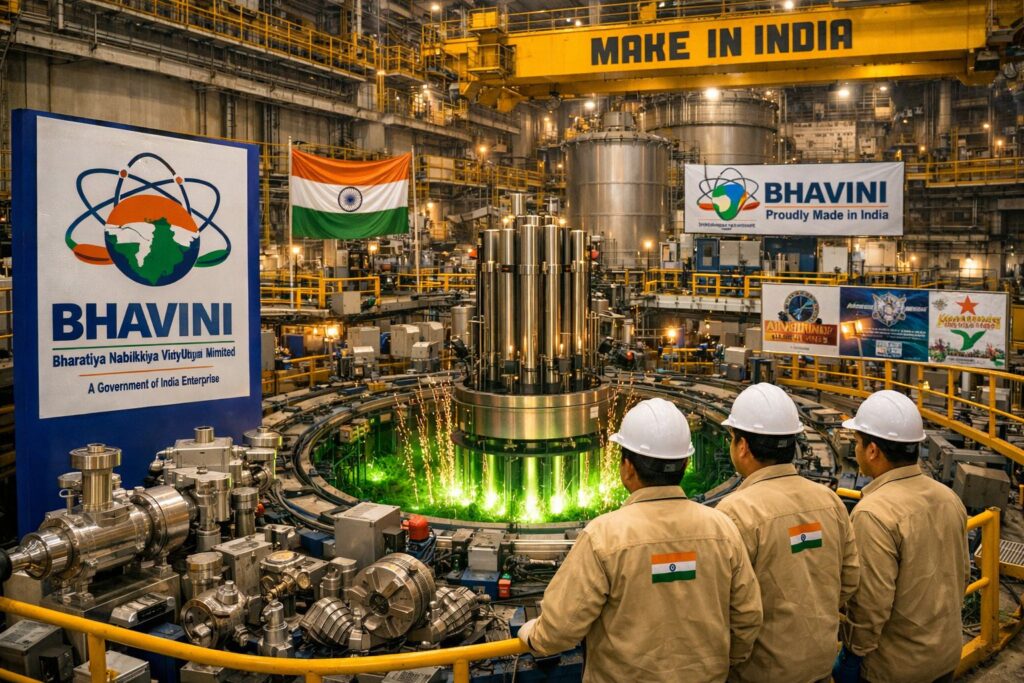
Built completely indigenously by Bharatiya Nabhikiya Vidyut Nigam Limited (BHAVINI), a Government of India enterprise established to construct and operate the country’s advanced nuclear power reactors and designed with the help of over 200 Indian companies, this ₹8,181 crore project is a huge leap for India’s technological self-reliance. Instead of relying on water, the PFBR uniquely utilizes liquid sodium as a coolant, enabling it to operate at high temperatures while maintaining exceptional safety and thermal efficiency. The PFBR is central to stage two of India’s Three-Stage Nuclear Power Programme, designed to use mixed oxide (MOX) fuel (plutonium and uranium) and produces more fissile material than it consumes, paving the way to utilize India’s vast thorium reserves.
India holds only about 1-2% of global uranium reserves but possesses one of the world’s largest thorium reserves (up to 25-30% of the global total). Thorium cannot be used directly as a nuclear fuel; it must first be irradiated in a reactor to convert it into the fissile isotope Uranium-233.
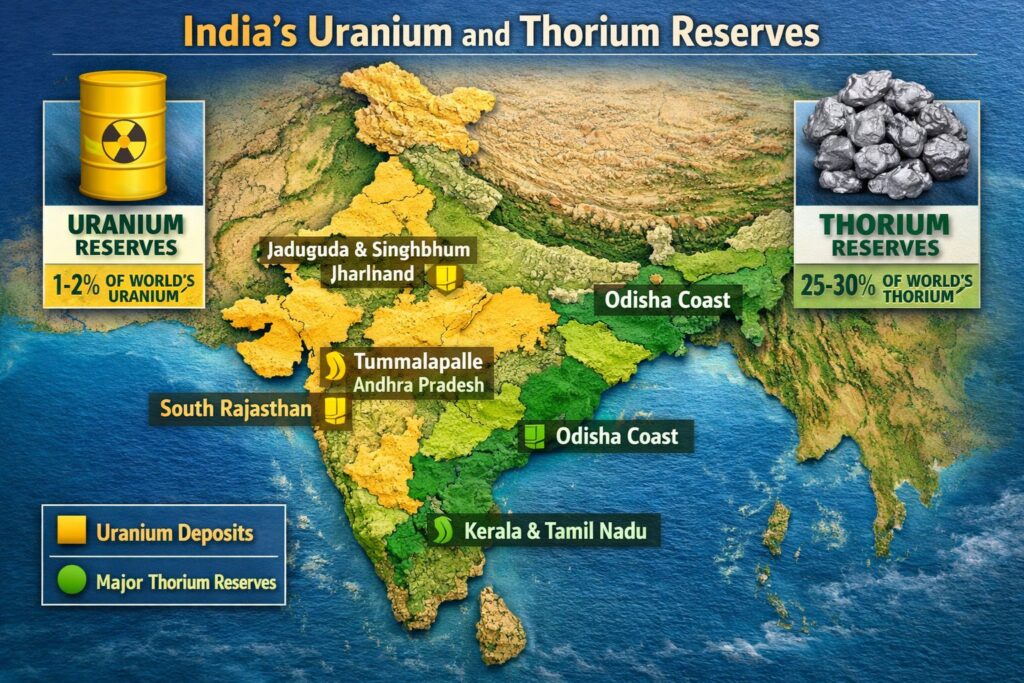
To harness these reserves, the Department of Atomic Energy established an innovative, closed-loop India’s Three-Stage Nuclear Power programme aimed at achieving long-term energy independence:
Stage 1, Pressurised Heavy Water Reactors: Natural uranium is used as fuel to generate power. The spent fuel produces plutonium, which acts as the primary input for the next step.
Stage 2, Fast Breeder Reactors: The plutonium from Stage 1 is used to fuel reactors that generate more fissile material than they consume. These reactors are used to irradiate thorium and convert it into
Stage 3, Thorium-Based Reactors: These reactors will use the bred in Stage 2 to power the nation using the abundant, coastal reserves of thorium.
Completed and produced in March 2024, just thirteen months later, this reactor successfully achieved first criticality—the initiation of a sustained, self-sustaining nuclear chain reaction.
This purely indigenous innovation has been achieved by overcoming decades of complex engineering challenges and geopolitical tech-denial.
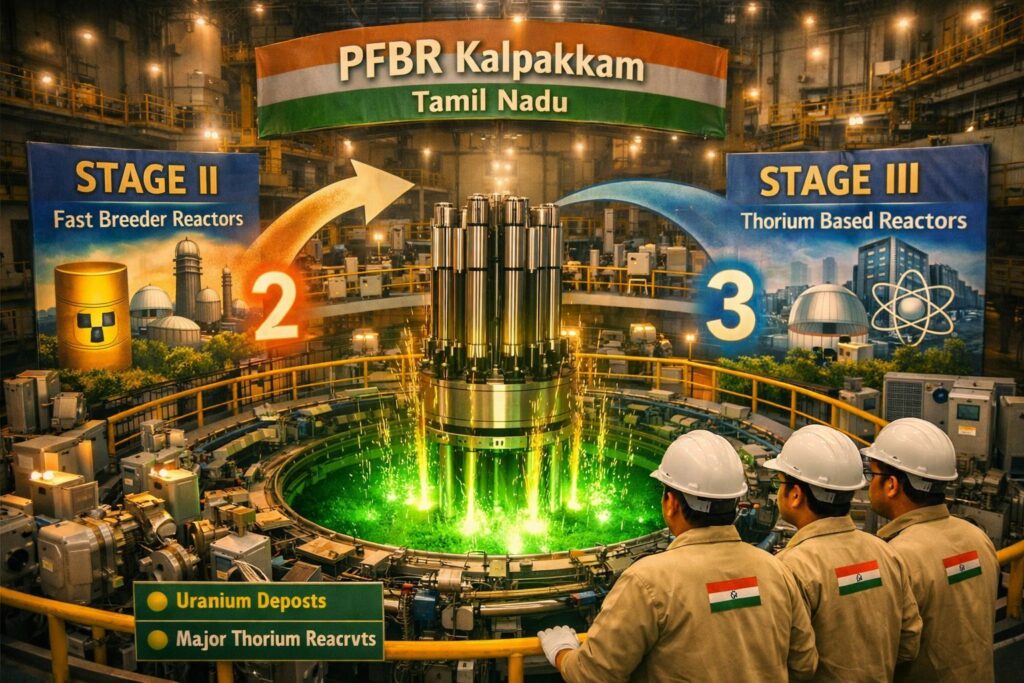
The PFBR at Kalpakkam, Tamil Nadu, marks a major milestone toward transitioning into the second and ultimately third stages of this roadmap. India’s Department of Atomic Energy designed a unique, phased roadmap to bypass its limited domestic uranium reserves and unlock its massive coastal monazite sand deposits (found heavily in Kerala, Tamil Nadu, and Odisha).
Unlike conventional reactors that consume more fuel than they produce, the 500 MWe PFBR is a “breeder”. Using a uranium-plutonium mixed oxide (MOX) fuel core, it is designed to transmute surrounding non-fissile uranium into more plutonium than it burns.
India’s ambition to sustain its power grid for up to 60,000 years relies on its vast, world-leading reserves of Thorium, estimated to exceed 500,000 tonnes. Thorium-based nuclear reactors use a closed fuel cycle process that transforms this abundant element into fissile Uranium-233, creating a practically limitless energy source capable of achieving true national energy independence.
Delivery of power to the people
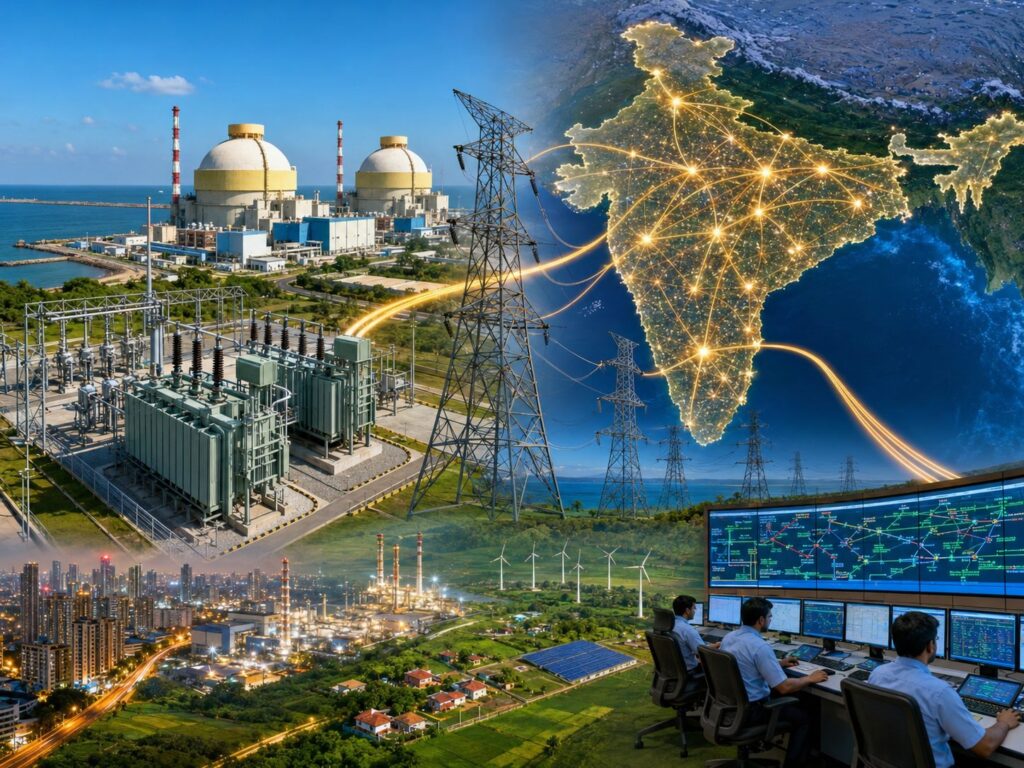
Power generated at the Kalpakkam nuclear complex is delivered across India through the National Grid. The mechanics rely on high-voltage step-up transformers, Inter-State Transmission Systems (ISTS) managed by the Power Grid Corporation of India, and regional load dispatch centres that route the electricity based on national demand.
The delivery process operates involves: (a) Generation and Step-Up: The Madras Atomic Power Station (MAPS) and the PFBR generate electricity at medium voltages (around 15-33 kV). Generator Step-Up (GSU) transformers immediately boost this to extra-high voltages (e.g., 400 kV or 220 kV) to minimize energy loss over long distances. (b) Grid Interconnection: The stepped-up power is fed into the Southern Regional Grid. It is integrated through switchyards at Kalpakkam into high-voltage direct current (HVDC) and high-voltage alternating current (HVAC) transmission lines. (c) National Transmission: Using inter-state “power highways”, power is wheeled across the country. The Power Grid Corporation of India monitors and balances this supply dynamically. If regional power pools experience deficits, grid operators can reroute the Kalpakkam power to different states via the interconnected National Grid. (d) When the electricity reaches its destination state it passes through regional grid substations, where the voltage is stepped down through successive transformers, ultimately reducing it to low-voltage lines (415V/230V) to safely power homes and businesses across the nation.
Nuclear Weapons
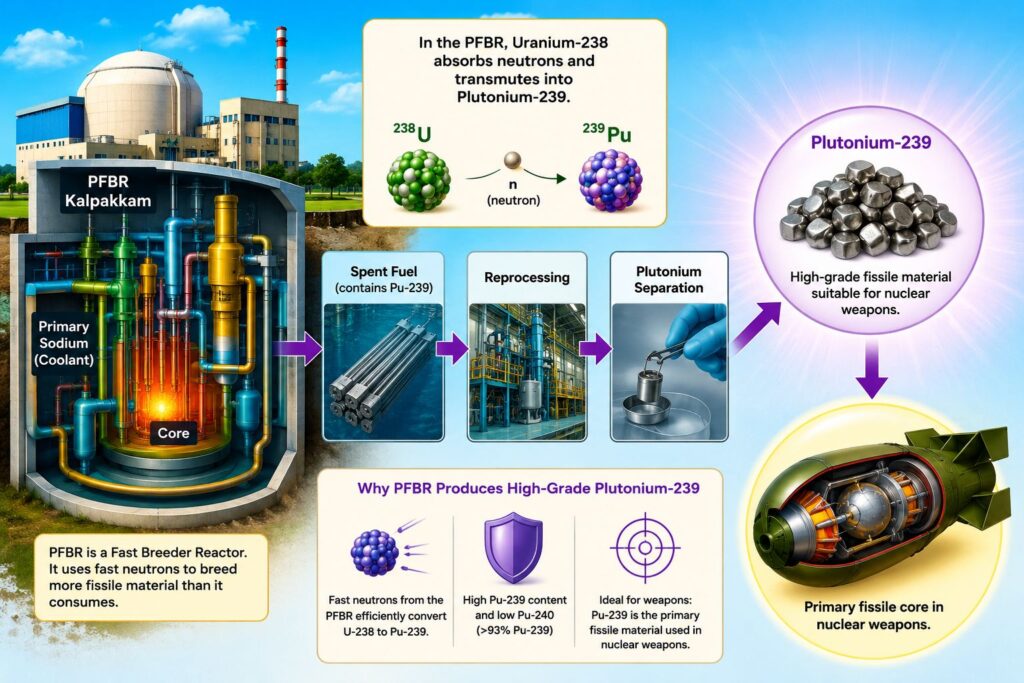
By design and the laws of nuclear physics, the PFBR at Kalpakkam produces high-grade Plutonium-239, which is the primary fissile material used for nuclear weapons. A fast breeder reactor (FBR) uses a core of mixed uranium-plutonium fuel surrounded by a “blanket” of depleted Uranium-238. Fast neutrons generated in the core bombard this blanket, transmuting the uranium into Plutonium-239. While reactors inherently produce different grades of plutonium, the FBR’s operating cycle can be manipulated to yield highly pure, weapons-grade Plutonium-239 by removing the fuel and blanket rods before they are “overexposed” (which creates less-desirable plutonium isotopes). India’s three-stage nuclear program is designed to eventually harness the country’s vast thorium reserves. The PFBR marks Stage 2 of this plan, designed to breed fissile material (like Plutonium-239 and Uranium-233) to power future stages.
Because India maintains a civil-military separation in its nuclear program—and is not a signatory to the Treaty on the Non-Proliferation of nuclear weapons (NPT)—the PFBR operates outside the safeguards of the International Atomic Energy Agency (IAEA). While the PFBR’s stated primary objective is to produce clean baseload electricity and establish a closed fuel cycle for thorium utilization, the facility provides an industrial-scale capability that yields the exact materials required for nuclear weapons.
India: second country in the world, after Russia
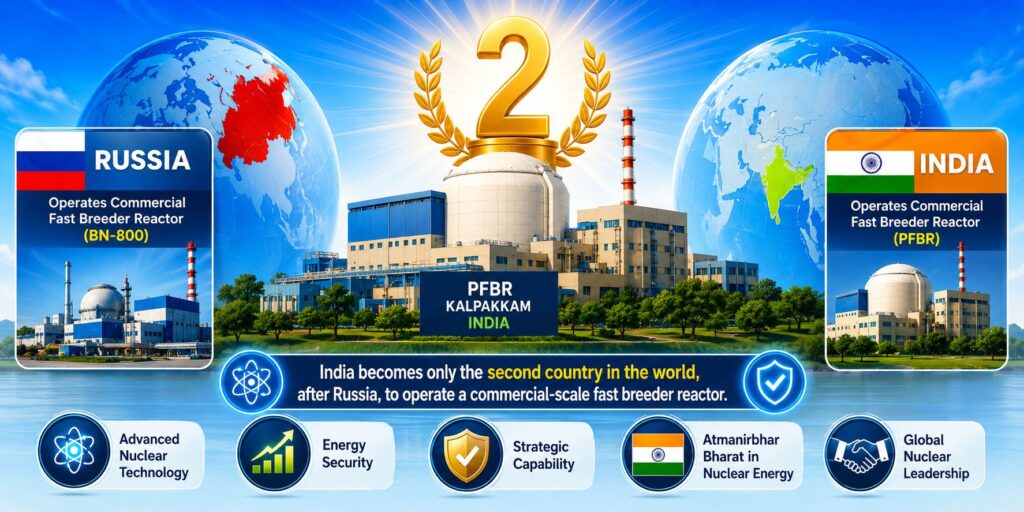
While this is a historic milestone for long-term energy security, it will have no immediate effect on mitigating the current global energy crisis, as the reactor will take months to undergo safety testing, connect to the electrical grid, and reach full commercial power capacity. The real immediate effect is symbolic and strategic-it makes India only the second country in the world, after Russia, to operate a commercial-scale fast breeder reactor, proving the country’s technological capability to manage complex closed-loop nuclear fuel cycles.