


A profound constitutional crisis is quietly escalating within the Indian legal system, directly threatening the separation of powers and the rule of law. It centres on a fundamental question: Can the executive, operating through legislative manoeuvres, retroactively obliterate a right secured by senior citizens after a gruelling 13-year legal battle?
The Forum of Retired IPS Officers (FORIPSO) -comprising veteran public servants, octogenarians, and nonagenarians, including legendary super-senior icons like 97-year-old Julio Ribeiro – has been forced to approach the Supreme Court of India under Article 32 of the Constitution. Our Writ Petition challenges the constitutional validity of Part IV of the Finance Act, 2025, which attempts to resurrect an arbitrary regime of pension disparity previously struck down as unconstitutional.
The Genesis: A Homogeneous Class Divided
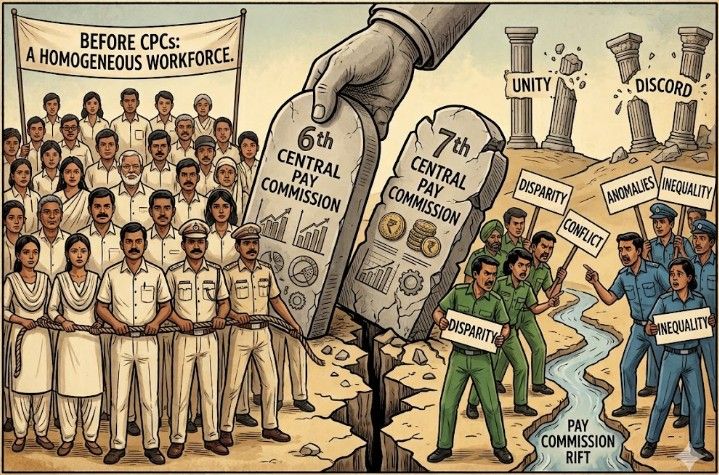
The roots of this conflict trace back to the implementation of the 6th and 7th Central Pay Commissions (CPCs). Historically, up until the 4th CPC, the Government of India treated its pensioners as a single, homogeneous class. This foundational principle was cemented by the Constitution Bench of the Supreme Court in the landmark case of D.S. Nakara v. Union of India (1983) 1 SCC 305, which held that all pensioners form a single class and cannot be arbitrarily fractured using an artificial cutoff date.
Despite this settled law, subsequent Office Memoranda (OMs) introduced a rigid cutoff date, creating a stark disparity between “Pre-2006” and “Post-2006” retirees. Senior officers who dedicated their lives to public service, discovered that their revised pensions were fixed at lower rates than those of their juniors who happened to retire after the cutoff date.
FORIPSO mounted a fierce legal challenge against this discrimination. After a successful battle before the Central Administrative Tribunal (CAT) in 2015, the Delhi High Court, on March 20, 2024, in WP(C) 7350 of 2015, delivered a resounding victory for the pensioners. The High Court ruled that dividing a homogeneous group based solely on the date of retirement violates Article 14 of the Constitution and explicitly commanded: “Arrears in terms of this order will be paid within eight weeks.”
When the Supreme Court subsequently dismissed the Union Government’s Special Leave Petition (SLP) on October 4, 2024, the judgment attained absolute finality.
Contempt Proceedings and Executive’s Sudden Pivot
The eight-week deadline set by the Delhi High Court expired on May 17, 2024, with the Government failing to remit a single rupee. Left with no alternative, FORIPSO moved a Contempt Petition before the Delhi High Court [CONT. CAS(C) 918/2024] to enforce compliance. Parallel contempt petitions were filed by co-litigants, including All India S-30 Pensioners Association [CONT. CAS(C) 43/2025].
For nearly a year, the contemnors dragged their feet. On March 10, 2025, a Single Judge bench of the Delhi High Court took a stringent view of the State’s non-compliance, directing the concerned high-ranking officials to appear in person and explain why they should not be held guilty of contempt and sentenced in accordance with the law.
However, by the next scheduled hearing on April 8, 2025, the tables turned completely. The Additional Solicitor General (ASG) appeared before a changed Bench and dropped a legal bombshell: the Government would not be paying the arrears. The justification? The Parliament had passed the Finance Act, 2025 (notified via Gazette on March 29, 2025). The executive asserted that, by virtue of this new legislation, the High Court’s order dated March 20, 2024, was rendered inapplicable, meaning no contempt had occurred.
Technical Analysis:
The mechanism used by the government to evade judicial enforcement is buried deep within Part IV of the Finance Act, 2025, titled “Validation of Central Civil Services (Pension) Rules and Principles for Expenditure on Pension Liabilities from the Consolidated Fund of India.”
An examination of this amendment reveals profound legal flaws and structural overreach:
- Subordinate Legislation Attempting to Override a Parent Act
The Finance Act, 2025 attempts to retrospectively amend the Central Civil Services (Pension) Rules, 1972 (subsequently replaced by the 2021 Rules and the Extraordinary Pension Rules, 2023).
Critically, these Pension Rules were enacted as subordinate/ delegated legislation under the authority of the All India Services Act, 1951. It is a fundamental canon of administrative law that subordinate legislation must strictly remain within the boundaries set by its parent Act. It cannot go beyond what the parent Act permits, nor can it override it. The primary legislation, enacted directly by Parliament, holds a superior position in the legal hierarchy.
By using an amendment to subordinate rules to override vested pension rights, the validation clause is inherently ultra vires (beyond legal power) and invalid.
- Radical Retrospectivity (Dating Back to 1972)
Section 147 and Section 150 of the Finance Act, 2025 state that the Central Government shall be “deemed to always have had the authority to classify its pensioners” and may maintain distinctions based on the date of retirement.
Shockingly, this amendment has been made effective retrospectively from June 1, 1972 -extending backward more than half a century. While the legislature possesses the competence to alter laws retrospectively to remove a defect pointed out by a court, such alteration must bring the law into alignment with judicial declarations, rather than acting as a blunt tool to defy them.
- A Direct Assault on the Rule of Law
The explicit objective of Part IV is to restore the very pre- and post-2006 retirement distinction that the Delhi High Court and the Supreme Court declared unconstitutional. The rule of law ceases to have meaning if the executive can circumvent an unfavourable, final inter-partes judgment by simply passing an abrogation decree disguised as “validating legislation”.
The Path to the Supreme Court: A Fight for Dignity

Faced with this legislative wall, FORIPSO filed a Writ Petition under Article 32 before the Supreme Court. On November 24, 2025, a double Bench issued notices to the Ministries of Finance, Home Affairs, and Law & Justice, tagging our case with the pending matter of All India S-30 Pensioners Association v. Union of India [WP(C) No. 525 of 2025].
Our petition relies on an unassailable line of constitutional precedents including:
- Madan Mohan Pathak v. Union of India (1978) 2 SCC 50: A seven-judge Bench held that the legislature cannot nullify a binding mandamus issued by a court to pay debts or clear liabilities between parties.
- Chairman, Railway Board v. C.R. Rangadhamaiah (1997) 6 SCC 623: Reconfirmed that pensionary benefits are vested rights under Articles 14 and 16 and cannot be stripped away retroactively.
- All Manipur Pensioners Association v. State of Manipur (2020) 14 SCC 62: Reiterated that no distinction can be made between pre- and post-cutoff date retirees for the purpose of pension revision.
Conclusion: Vested Rights are Not Charity

Pension is not a bounty, a prize, or a charitable handout distributed at the whim of the State; it is deferred wages earned through decades of dedicated service to the nation.
The State has spent 13 years exhausting every judicial avenue available, losing at every single tier. To now use the financial might of a fiscal statute to unilaterally erase those defeats is an impermissible breach of the separation of powers.
Litigants should not have to wait until their fundamental rights are completely destroyed to seek protection; the existence of an imminent, systemic threat to our accrued entitlements warrants immediate judicial intervention. As this case heads to a final hearing, the Supreme Court is tasked with defending more than just the financial security of thousands of elderly officers. It has to decide whether the finality of its own judgments can be quietly legislated away.

