

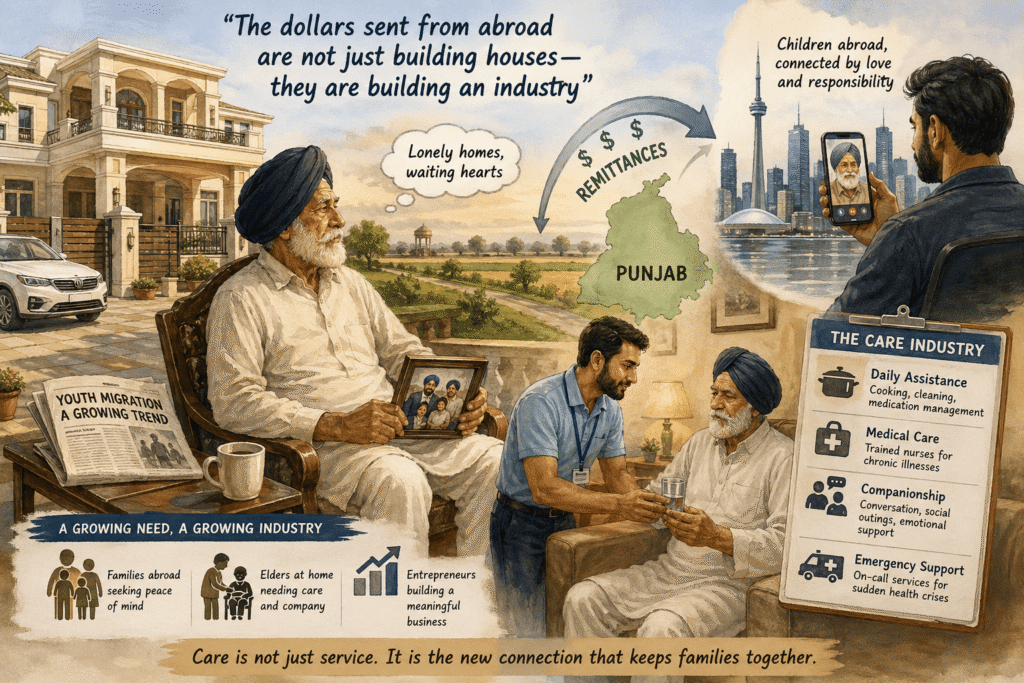
Once the romanticised land of milk and honey, Punjab is now witnessing a painful paradox: one of luxury and loneliness. Punjab’s villages, once the playground for large-scale migration to Canada, the UK, Australia and the US, now seem to be paying the price for prosperity. Remittances from abroad have transformed the rural and urban landscape. Homes have grown bigger, bank balances healthier, fields mechanised and lifestyles modernised.
But progress arrived after the people had departed. Prosperity has created islands of loneliness. Marble-floored mansions and luxury cars are a common sight everywhere, but they are often without the smiles, laughter and energy of the missing youth.
Baldev Singh, a 78-year-old retired schoolteacher from Ludhiana, has everything a man of his age could dream of. He lives in a spacious two-storey home built with the money sent by his sons from Toronto. The family’s prosperity is evident in every corner of the house. His two sons send money regularly, which is enough to pay for whatever he needs.
But in the twilight zone of life, Baldev Singh craves something that all the wealth in the world cannot buy. He has all kinds of comforts money can buy, but no companion. His children’s success abroad has left him financially secure but emotionally drained. He spends most of his time watching television or waiting for a phone call that may or may not come.
Baldev Singh’s story is not unique. Thousands of elderly parents across Punjab’s towns and villages live in similar circumstances—financially secure but emotionally starved.
This has given rise to a new business opportunity: looking after elderly people and providing nursing, caretakers and post-operative care at home.
About a year ago, Baldev’s children subscribed to a home-care service provider offering medication reminders, personal care and emergency help to elderly parents needing daily assistance at home. Twice a day, a young man visits Baldev to help him with his medicines, accompanies him to the gurdwara and even plays cards with him. For his children abroad, the monthly fee is a small price to pay for peace of mind.
Migration and Its Hidden Cost
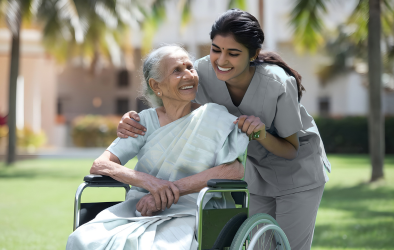
Traditionally, the family was the primary caregiver. Children looked after their ageing parents. Migration disrupted this model. Loneliness has become the hidden cost of prosperity. Parents have been left alone in large houses without anyone to give them company.
Caregiving services—once unheard of in rural Punjab—have proliferated across the state, offering doctor-on-call and 24/7 home nursing services to help with mobility, bathing, feeding and medication. Some of these enterprises are small, while others are professionally managed companies with hundreds of employees.
These services started as a social necessity but have now evolved into a full-fledged industry offering:
• Daily assistance: cooking, cleaning and medication management.
• Medical care: trained nurses for chronic illnesses.
• Companionship: attendants who converse, accompany elders to social functions or simply sit with them.
• Emergency support: on-call services for sudden health crises.
The Economics of Loneliness and the Business Opportunity

This industry is built on a unique economic foundation. The business model behind it is simple: children living abroad are willing to pay for the care of their parents living alone in the towns and villages of Punjab. For them, hiring attendants in Punjab is relatively cheaper and more affordable than Western caregiving costs. For the parents back home, this is their lifeline. For entrepreneurs, loneliness is not just a social issue but a profitable business opportunity.
With thousands of people across Punjab needing similar services, the market is vast and demand is growing from families whose children live abroad.
Take the case of Harbhajan Kaur, an 82-year-old widow who suffers from arthritis and mild dementia. Her daughter, who lives in Melbourne, engaged an agency that provides a nurse who visits her every day to look after her healthcare needs and ensure that she eats her meals. For her daughter abroad, it is “peace of mind in a package”; for Harbhajan, it is the difference between neglect and care.
This has given rise to a number of agencies like Care Punjab, Sehat Saathi, Care Zindagi and MedifyHome, offering 24/7 nurse-on-call and home nursing services for monitoring, medication and daily support. From Ludhiana to Amritsar, caregiving companies are springing up. Their services range from medical support to companionship, from daily assistance to emergency care.
Elder-care services include timely medicines, nebulisation, injections, application of ointment, normal dressing, assistance with feeding, sponge baths or showers, mobility support, exercises, toileting support, diaper or catheter assistance, as well as monitoring of weight, blood pressure and body temperature. The larger promise is not just medical attention, but companionship—caregivers are expected to interact with elderly people, keep them comfortable and reduce the stress of living alone. The price varies according to duration—for example, short-term nursing may cost. The price may vary according to duration, location, medical complexity and whether the family needs a short visit, a trained attendant or full-day nursing support.
For children settled in Canada, the UK, Australia or the US, such services have become a substitute for physical presence. They cannot sit beside their parents every morning, accompany them to the doctor or check whether they have eaten and taken their medicines on time. Home-care agencies try to fill that gap by sending trained attendants or nurses who can monitor health, help with daily routines, provide basic medical support and offer the elderly what money alone cannot provide—a regular human presence inside an otherwise silent home.
This rise of private elder-care services is also a reflection of a deeper social shift in Punjab. As migration empties homes of young adults, elderly parents are increasingly dependent on paid care networks for tasks once performed by family members—medicine reminders, hospital visits, mobility support, hygiene assistance and emotional reassurance. In this sense, home nursing is no longer only a medical service; in Punjab’s NRI belt, it is becoming part of the emotional infrastructure of ageing.
Challenges and Ethical Questions
Yet the rise of this industry raises important questions. Is companionship becoming a commodity? How do families abroad ensure attendants are trustworthy and genuinely caring? Will outsourcing care erode traditional family bonds further?
Critics argue that these services risk reducing elders to “clients” rather than family members. Others counter that professional care ensures dignity and safety, which absent children cannot provide. The debate reflects a larger cultural shift: the outsourcing of emotional labour in a globalised world.
The Future: Tech-Enabled Care
The next frontier is technology. Companies are experimenting with video companionship, where attendants facilitate daily video calls with children abroad. Health-monitoring apps provide real-time updates on elders’ vitals. Some are even exploring AI companionship, with chatbots designed to converse in Punjabi and offer cognitive stimulation.
Imagine an elderly parent in Moga wearing a smartwatch that tracks heart rate, while a nurse visits daily and children abroad receive instant updates. Care becomes a blend of human touch and digital assurance.
Policy Implications
This trend also has policy dimensions. Punjab’s government could regulate caregiving companies to ensure safety and quality. Subsidies for elder care could recognise it as a social necessity. Training programmes for rural youth could create jobs in caregiving, reducing the need for migration in the first place.
Such measures would not only support elders but also generate employment locally, turning caregiving into a sustainable industry.
Conclusion: A New Social Contract
The story of Punjab’s caregiving industry is the story of a new social contract. Migration created prosperity but fractured families. Care enterprises are stitching those fractures, offering companionship where blood ties cannot.
For the elderly, these services are more than business—they are lifelines. For entrepreneurs, they are profitable ventures. And for society, they represent a redefinition of family in the age of globalisation.