

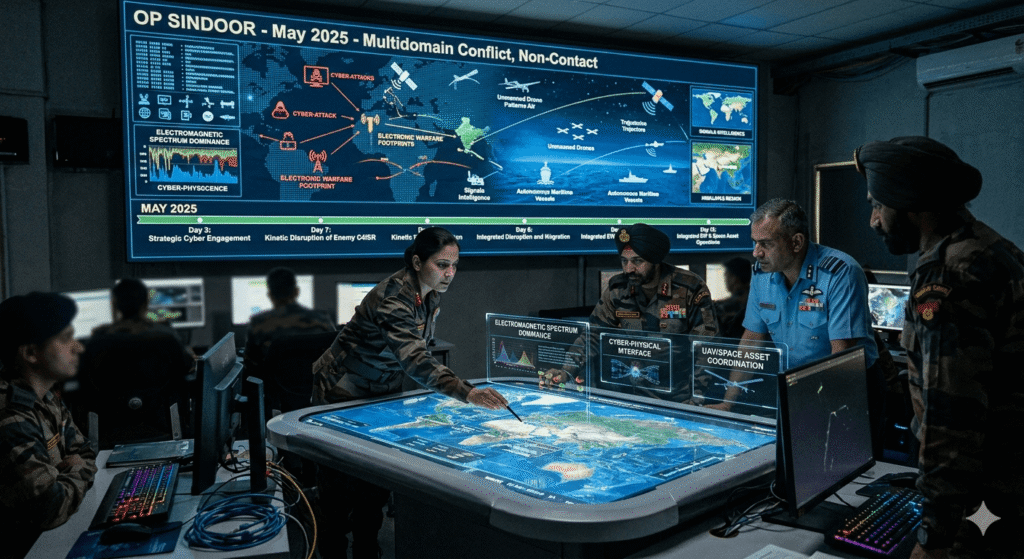
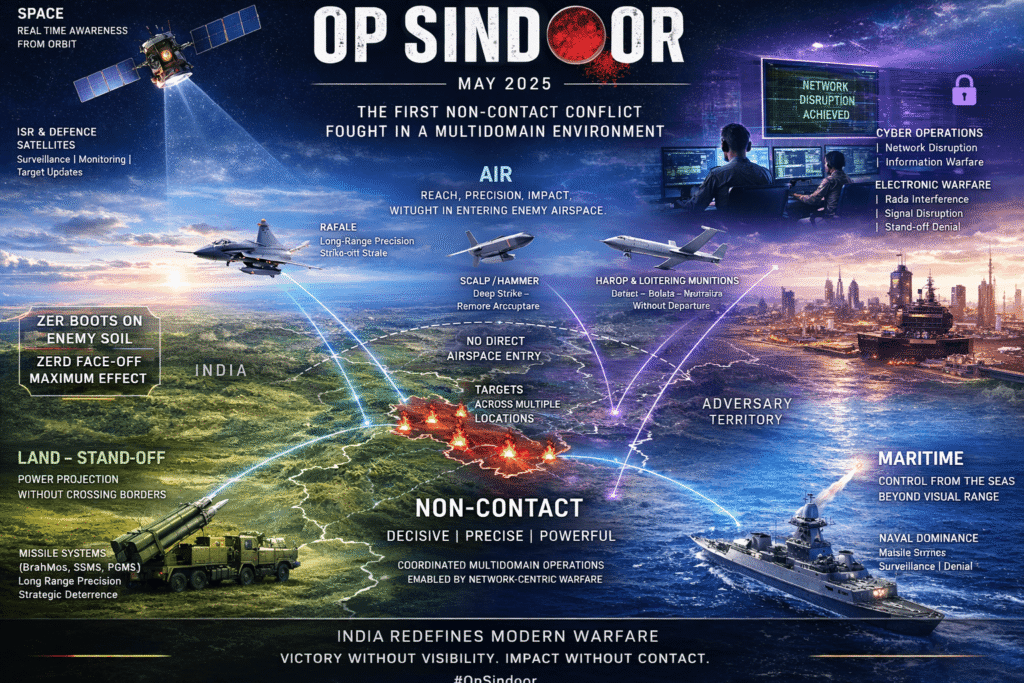
India-Pakistan standoff (Op Sindoor) in May 2025 was the first non-contact conflict fought in multidomain environment which saw intense military engagements between two nuclear-armed neighbours. The conflict demonstrated for the first time multi domain standoff kinetic operations in South Asia, underscoring operational effectiveness of modern military technologies, together with certain vulnerabilities in existing systems, requiring urgent redressal as also revalidation of some existing military doctrines.
On May 7, 2025, India launched coordinated precision missile strikes on nine terrorist launchpads, headquarters, and training centers across both Pakistan and Pakistan Occupied Kashmir (POK) as retribution for Pahalgam attack. Pakistan responded by carrying out artillery, missile and drone attacks across the Line of Control and the International Border targeting military and civil infrastructure including several Indian cities close to the border. Most Pakistani strikes were negated employing S-400 missile systems, backed by indigenous AD and Counter Drone systems. Aerial engagements involved more than 114 aircraft (72 Indian Air Force, 42 Pakistani Air Force) in the largest beyond-visual-range combat, with neither air force crossing the border maintaining “stand-off” at distances exceeding 100 kilometers.
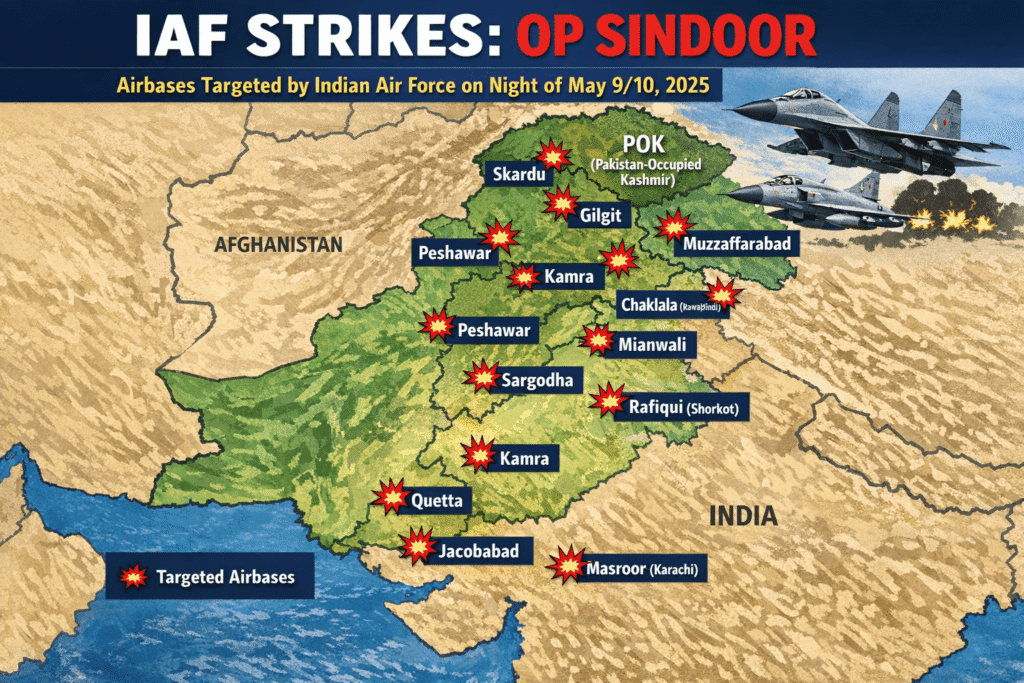
On night of May 9/10, 2025, Indian air force struck, targeting eleven air bases across Pakistan and POK with devastating effect. This was a calibrated attack carried out by first neutralizing PAF’s Chinese supported air defence infrastructure, followed by long-range precision standoff attacks using Brahmos, SCALP, Rampage and Hammer, supported by indigenously designed and developed Integrated Air Command and Control System (IACCS). The aerial duel was intense and unprecedented in scale with BVR combat and standoff ground to air weapons. Scale of damage inflicted and apparent air defence vulnerability forced Pakistan to call for ceasefire on May 10, 2025.
An important and even unexpected aspect of the operations was the extensive use of Chinese military hardware and its performance. Pakistan relied almost entirely on Chinese military equipment, by integrating their advanced systems in live, high-intensity combat: Chengdu J-10C fighter aircraft, PL-15 air-to-air missiles, and HQ-9 air defenses. Making it the first significant contest between high-end Chinese and Western supplied military systems in the subcontinent.
The Chinese strategic support to Pakistan’s was a critical dimension of the conflict. Pakistan received real-time information from China, facilitating rapid tactical decision-making, supported by systems such as two-way BeiDou Navigation system among others providing high degree of locational accuracy. This intelligence support, combined with interoperable equipment and communications, demonstrates the practical military advantage of China-Pakistan strategic alignment, an aspect India cannot overlook in future scenarios.
Critical Lessons for India
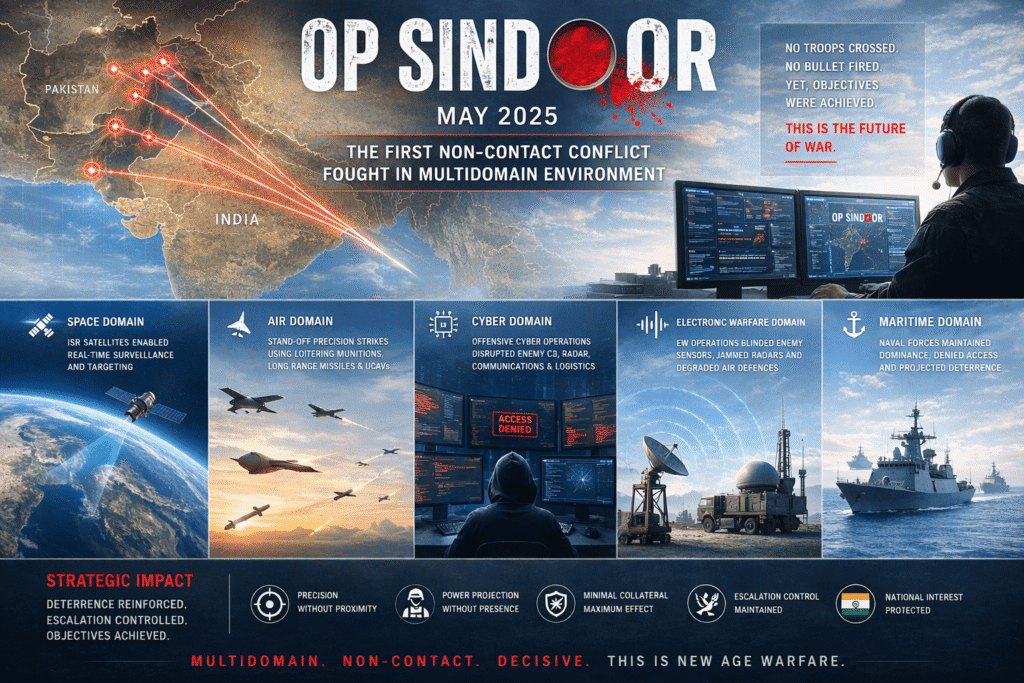
The May 2025 conflict revealed multiple and critical lessons. First, India’s technology integration and rapid decision-making (evidenced by precision strikes using multiple platforms, integrated air defence, and S-400 combat employment within days of conflict initiation) proved effective. This reactive posture is however strategically unsustainable in future standoffs, given the backdrop of across spectrum Sino – Pak collusion and speed of operations. India must transition from responding to threats to shaping operational environment through capability enhancement and proactive military deployments.
Second, the conflict validated India’s emphasis on network-centric warfare and multi-domain integration. Operations requiring simultaneous coordination of air defence systems, fighter aircraft, missile platforms, and electronic warfare systems succeeded only where technological and organizational integration enabled rapid information-sharing and coordinated response.
Third, Chinese military hardware demonstrated competitive effectiveness against Western platforms when properly system integrated and supported by real-time intelligence. This challenges historical assumptions regarding technology gaps and necessitates accelerated Indian development of advanced systems across all military domains.
India’s Defence Modernization Strategy

Comprehensive Modernization Roadmap
The Armed Forces’ defence modernization roadmap, unveiled in 2025, aims to addresses these evolving challenges by systematic technological development across multiple dimensions. The roadmap prioritises:
- Advance Weapon Systems: Development of ultra-fast, highly maneuverable weapon systems including hypersonic glide vehicles, hypersonic air-breathing engines (HEBs), and advanced fourth, fifth, and sixth-generation missiles. These systems must penetrate adversary’s air defence and maintain operational effectiveness in contested environments.
- Autonomous Unmanned Systems: India is pursuing indigenous development of autonomous surface vessels (ASVs), autonomous underwater vehicles (AUVs), and unmanned aerial systems for reconnaissance and combat missions. These systems extend operational reach while minimizing personnel risk.
- Directed Energy Weapons: High-energy lasers and microwave systems are being developed for counter-drone operations, missile defence, and anti-satellite capabilities. These weapons address the critical gap in defending against drone swarms and emerging threats in space domain.
- Spectrum Dominance: Next-generation cyber defence tools, autonomous electronic warfare solutions, and resilient satellite systems need to be prioritised to ensure control of electromagnetic spectrum in contested environments.
- Soldier-Centric Modernization: Integration of AI-powered helmets, smart apparel, real-time health monitoring, exoskeletons, and augmented reality-based battlefield management systems that enhance individual soldier and unit effectiveness.
Technological Sovereignty and Indigenous Development

India’s strategic imperative is to achieve technological sovereignty in critical defence domains. The “Make in India” initiative and Production-Linked Incentive (PLI) scheme are designed to boost domestic defence production and reduce import reliance. However, this objective requires sustained investment, clarity in procurement policies, and private sector participation.
2025 has been declared as the “Year of Reforms” with emphasis to “Strengthen the private sector’s role in promoting defence startups, enhancing indigenization, encourage export-oriented production, and implementing the K Vijay Raghavan Committee’s recommendations on DRDO reforms”. This represents a formal recognition that India’s defence-industrial complex, dominated by government research institutions and public-sector undertakings, must be enthused with greater private-sector dynamism. Recent data validates this approach. Defence exports in Financial Year 2024-25surged to a record high of Rs 23,622 crore, a growth of 12.04% over 2023-24 demonstrating countries growing export capacity.
Indigenous systems including LCA Tejas fighter aircraft, Brahmos cruise missile, Arjun main battle tank, and Brahmos-NG represent significant technological achievements in medium term. However, India faces critical gaps in aero engines, advanced semiconductor manufacturing, composite materials, and AI/ML algorithm development—areas where continued import reliance creates strategic vulnerability.
Critical Gaps and Budget Allocation

Despite comprehensive modernization roadmap, India faces significant implementation challenges. Defence budget allocation has not increased proportionally to meet modernization requirements. This numerical gap translates into developmental lag across multiple technological domains, impairing development plans.
Accelerated modernization requires increased budgetary allocations to meet collusive Sino – Pak threat, and more specifically China and increasingly in maritime domain. India must take cognizance of Chinese military modernization particularly its growing defence budget which saw an 7.2% increase in 2025, bringing the official figure to over $245 billion. Experts, believe the actual expenditure is substantially higher due to unrevealed allocations. Increased budgetary allocations fuels modernization, strengthening dominance across land, sea, air, nuclear, space, and cyber domains. In contrast India’s defence budget has remained constrained at $85 billion, with only 25% availability for modernization.
Realizing these gaps, the defence roadmap recommends “allocation of a larger share of the defence budget to modernization, prioritizing development of critical platforms like the LCA Tejas Mark II and S-400 systems”. Unfortunately, the current procedure driven procurement systems, continues consuming substantial resources for maintaining legacy platforms rather than forward-looking technology-oriented procurements central to credible threat mitigation.
Some of the critical technology gaps include: advanced air defence against drone swarms; quantum-resistant encryption and cyber defence tools; autonomous underwater systems; directed energy weapons; AI-powered command and control systems; satellite-based ISR and early warning systems. Each gap represents years of developmental lag which India can ill afford.
Multi-Domain Defence Doctrine for India

Integrated Operational Concept
India’s multi-domain defence doctrine must transcend traditional service-centric structures and create genuinely integrated operational doctrinal concepts and organisations. The Integrated Theatre Command (ITC) framework provides requisite structural foundation. However, integrated organisations and doctrine need further to be aligned with training, joint procurement, interoperable systems, and coordinated strategic planning extending years into future. This is a complex cycle requiring structural and cognitive reorientation.
NATO’s multi-domain operations framework based on coordinating various activities across multiple military domains and synchronizing them with non-military actions provides a useful reference point. India’s multiple threat scenario requires medium to long term analysis of the nature of future wars backed by analysis of integrating multiple domains in a rapidly changing technology environment. India’s strategic objective must remain deterrence backed by credible offensive capability. Asymmetric warfare is new domain, which must get urgent attention.
Integrated operating concept thus must emphasize high degree of situational awareness across all domains achieved through network-centric information fusion; rapid decision-making enabled by AI-assisted command systems; coordinated effects across domains executed through trained joint teams; resilience through redundant systems and graded degradation under attack; strategic depth enabling sustained operations despite initial adversary advantage.
Space Domain Integration
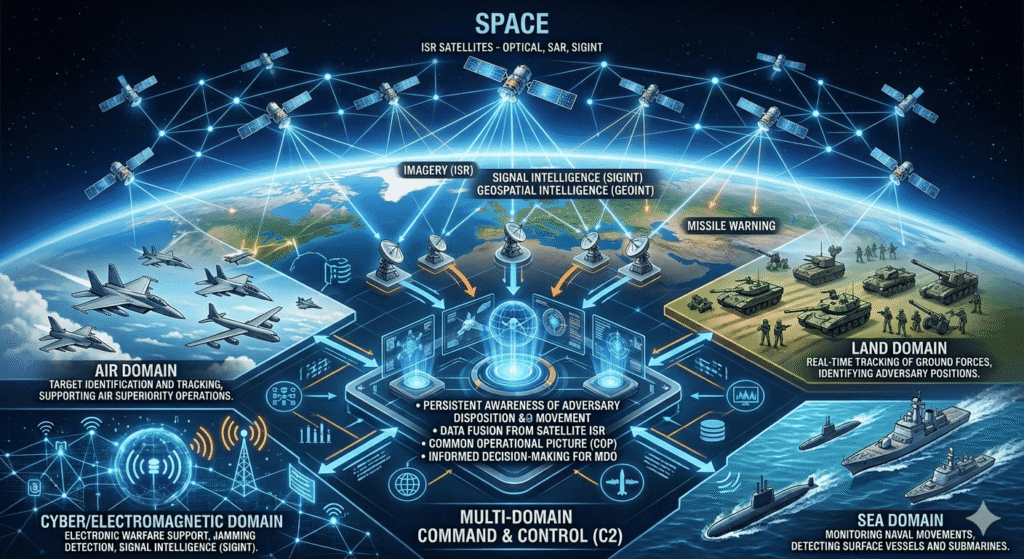
The space domain has emerged as critical enabler of multi-domain operations. Satellite-based intelligence, surveillance, and reconnaissance (ISR) provide persistent awareness of adversary force disposition and movement. Early warning systems detect missile launches and air incursions. Communication satellites enable command and control across dispersed forces. Navigation satellites (NAVIC/GPS) provide positioning for precision weapon guidance. Thus, to prioritize military space requirements is a critical strategic imperative.
Importantly, the space domain is highly contested. China has demonstrated advanced anti-satellite capabilities which include, deliberate satellite destruction tests, employing, non-kinetic means such as satellite jamming and spoofing, cyber-attacks on Indian command and control networks, altering telemetry data injecting false signals among others. India must therefore develop counter-space capabilities including electronic warfare against hostile satellites, kinetic weapons for satellite defence, and space domain awareness systems enabling detection and tracking of adversary space assets. The modernization roadmap’s emphasis on “counter-space capabilities including advancements in electronic warfare (EW) to degrade or neutralize hostile satellites” reflects this requirement.
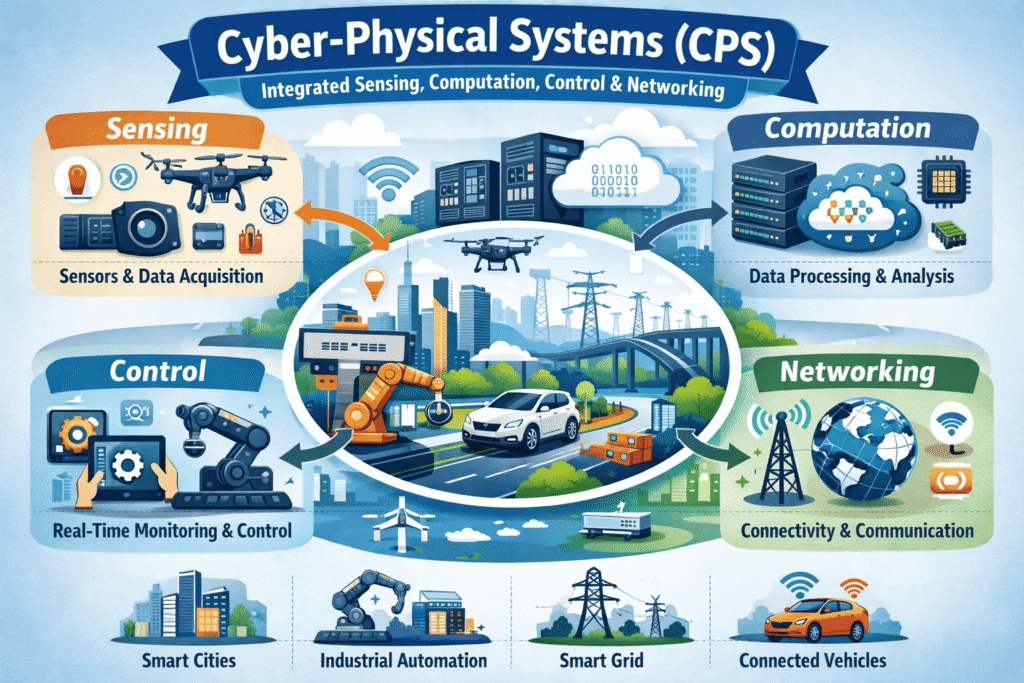
Cyber-Physical Operations Integration

Modern warfare increasingly integrates cyber operations with physical military operations. Cyber-attacks can compromise air defence system software, preventing effective response to subsequent air strikes. Directed electromagnetic pulses might disable communications networks, preventing command center coordination of defensive response. Drone swarms can overwhelm specific sectors while cyber acts can create confusion and intelligence denial in command systems.
Above underscores the need for ‘redundant’ communication systems resilient to electromagnetic and cyber-attack; manual override procedures and manual control capabilities for critical systems; continuous training for personnel to operate effectively during cyber-compromised environments; counter-cyber capabilities enabling rapid response to adversary cyber operations; deception and denial capabilities creating ambiguity regarding adversary cyber successes.
Given the fast-developing inimical cyber environment, the National Security Council Secretariat (NSCS) and Ministry of Defence must coordinate development of integrated cyber-physical defence doctrine. Current arrangements, where cyber defence is primarily responsibility of Ministry of Electronics and Information Technology, is imperfect, creating structural disconnect in military operational planning.
Strategic Recommendations for India
Force Structure and Doctrine
Establish Dedicated Autonomous Systems Command: India should establish dedicated organizational structure responsible for autonomous weapons development, testing, and integration. This Command should function similarly to aerospace forces or special operations commands in other militaries—with autonomous weapons representing new operational domain which requires specialized expertise.
Accelerate Integrated Theatre Command Implementation: The timeline for implementing Integrated Theatre Commands should be accelerated. Differing perceptions obtaining within the military requires political resolution with a clearly defined implementation road map. Developing operational doctrines and achieving some degree of op preparedness require at the minimum of 2-3 years of training. Delayed implementation will only extend vulnerability to deal with multi-domain threats.
Develop Counter-Swarm Doctrine: India needs to develop comprehensive doctrine for defeating drone swarms. This includes immediate counter-drone operations (short-term), directed energy weapons deployment (medium-term), and layered defence architecture (long-term). Doctrine development should begin immediately through exercises and war games involving operational planners and technologists.

Technology Development and Acquisition
Increase Defense Technology Budget: India should increase its defence technology budget by minimum 20 percent over the next five years. This increased investment should be specifically directed toward key emerging technologies: AI and autonomous systems, directed energy weapons, quantum-resistant encryption, space-based ISR and critical infrastructure protection.
Priorities Indigenous Development: India must identify technology areas where indigenous development is strategically feasible and commit long-term resources. Semiconductor manufacturing, composite materials, and advanced software constitute core strategic technologies where India has potential competitive advantage. Subsidizing private-sector development through government contracts can accelerate these capabilities.
Establish Defence Technology Partnerships: India should establish formal technology partnerships with aligned nations (United States, France, Israel, Japan, South Korea, Vietnam, Australia and Russia) specifically focused on emerging defence technologies. These partnerships should include research collaboration, technology transfer agreements, and joint development initiatives and co-production enabling India to access advanced technologies while developing indigenous capabilities.
Critical Infrastructure Protection
Establish National Cyber Defence Command: India must establish dedicated organizational structure responsible for critical infrastructure protection, cyber incident response, and cyber deterrence. This command should have clear authority across all sectors (energy, telecommunications, transportation, water, government) and resources enabling rapid incident response.
Implement Zero-Trust Architecture: India’s critical infrastructure should transition toward Zero-Trust security architecture where all systems and users are verified before granting access, and continuous monitoring replaces static perimeter defence. This architectural change, while technically demanding and expensive, significantly improves defence against advanced persistent threats.
Establish Civil Defence Protocols: Recognizing that cyber warfare is integral with conventional military conflict, India should develop comprehensive civil defence protocols enabling population resilience during extended infrastructure disruption. This includes: (1) backup communication systems; (2) distributed power generation; (3) supply chain redundancy; (4) public information protocols; (5) resource rationing procedures.
Regional Strategic Alignment
Strengthen Quad Collaboration: India needs to push for deepening technological and military collaboration within Quad framework (Australia, India, Japan, United States) specifically focused on emerging defence technologies. Joint exercises (tabletop and physical), intelligence-sharing agreements, and technology development partnerships would strengthen regional security architecture and technological standing while contributing to regional stability.
India-U.S. Defense Technology Cooperation: India’s strategic partnership with United States must move beyond transactional sale of systems and weapons, to technology transfer, co-development and co-production in critical areas including directed energy weapons, advanced ISR, and autonomous systems. Addressing bureaucratic restrictions on technology transfer could accelerate India’s developmental timeline significantly.
Manage China-Pakistan Nexus: India must develop strategic concept and technology capacities to explicitly address emerging Sino-Pakistan technological and operational nexus. This requires understanding the nature and degree of collusion, technological development matching combined capabilities in critical areas rather than addressing threats separately; intelligence collection and analysis specifically focused on technology transfer; diplomatic engagement with third parties regarding responsible military technology transfers.
Organizational and Governance Reforms
Streamline Procurement Process: India’s defense procurement system, reformed through Defence Procurement Manual 2025, requires further streamlining. Decision-making timelines must be compressed to 6-12 months for technology development contracts. Performance-based contracts should replace detailed technical specifications allowing private industry greater flexibility in solution development.
Establish Defence Innovation Commission: A high-level Defence Innovation Commission reporting directly to the Minister of Defence should be established to identify emerging technology opportunities, assess technological gaps, and recommend accelerated development programs. This commission should include military officers, technologists, industry leaders, and policy experts.
Develop a Unified Cyber-Defence Strategy: The National Security Council Secretariat should establish unified cyber defence strategy clarifying inter-agency roles, resource allocation, decision authorities, and escalation procedures. Current arrangement with distributed responsibilities creates ambiguity and delayed response during crises.
Conclusion
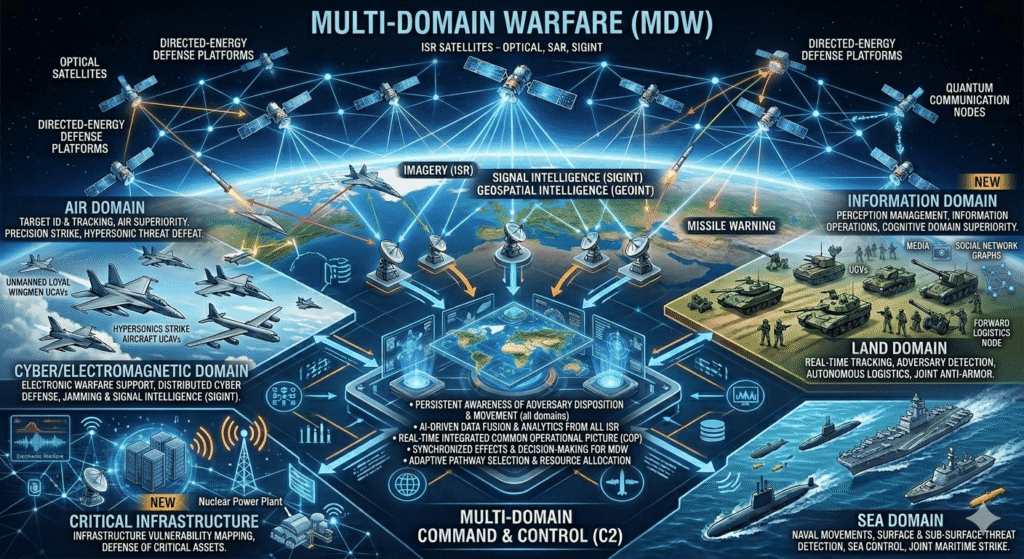
Modern warfare is no longer defined by sequentially campaigns conducted across land, sea, and air domains. The integration of AI, autonomous systems, drone swarms, cyber, and precision strike capabilities has created an operational environment wherein effects are generated simultaneously across multiple domains. Doctrines built around linear escalation and platform-centric dominance are increasingly misaligned from this reality. We are in the age of Algorithmic warfare which is governed by the integration of artificial intelligence, machine learning, and autonomous systems into military planning, operations and decision making. It has shifted the key functions—sensing, orientation, decision, and action from human speed to machine speed. At its core, algorithmic warfare is not a single weapon but a shift in how data becomes combat power.
For India, the challenge is more critical. China and Pakistan are not merely modernising their armed forces; they are also developing interoperable, multi-domain capabilities supported by shared technology ecosystems and real-time intelligence cooperation. China frames AI as central to “intelligentized warfare” and pursues civil-military fusion to accelerate adoption. Israel has publicly discussed AI tools like “Habsora” for target system.
The May 2025 India–Pakistan conflict offered a limited but revealing glimpse of this future battlespace. While India demonstrated credible strengths in precision strike and air defence, the conflict also exposed structural and integration gaps that cannot be addressed through incremental modernization alone.
India’s response therefore has to be systemic rather than reactive. The defence modernization roadmap announced in 2025 provides a strategic direction, however its success will depend on sustained resource commitment, accelerated organizational reform, and most importantly translation of technological acquisition into operational capabilities. Integrated Theatre Commands, resilient cyber-physical defence structures, indigenous technology development, and credible counter-autonomy capabilities must move from concept to implementation in compressed timelines.
Developing autonomous systems is viewed as important for border surveillance, counter-terrorism, and securing sea lanes where India acts as a net security provider. At the same time, DRDO leadership has stressed technological sovereignty, noting that “we can’t afford to depend on AI models from abroad” for defence. The ETAI (Evaluating Trustworthy Artificial Intelligence) framework, released in October 2024, codifies five principles for military AI: reliability, safety, transparency, fairness, and privacy.
India possesses the technological talent, industrial base, and strategic depth necessary to compete effectively in this evolving environment. What remains uncertain is whether institutional processes and budgetary priorities will adapt quickly enough to match the pace of change. The coming decade will be decisive. Failure to integrate emerging technologies into a coherent multi-domain posture will leave India strategically exposed; success will underpin credible deterrence, operational resilience, and long-term strategic autonomy. The opportunity remains, but the window for decisive action is narrowing. Algorithmic warfare will not replace human judgment, but it redefines the environment in which judgment is exercised.

