
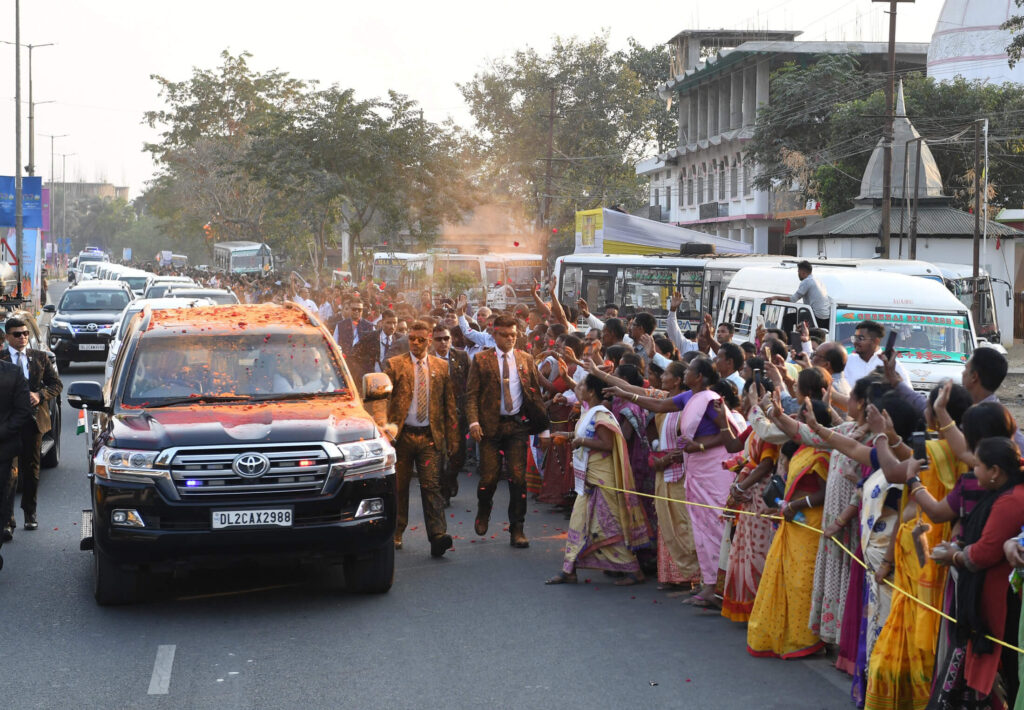
In a democracy, power is meant to belong to the people. Yet in India, after independence, a political class has steadily emerged that captures and concentrates authority, often dominating the governance of society rather than dispersing it. Organised into parties, it frequently seeks not to empower citizens but to normalise a political culture in which power relations are detached from everyday human and social relations. As a strategy, citizens are urged to glorify “national interest” and “national development”—ideas that too often fail to translate into genuine human and social development. In the process, the space for independent “social leaders” is squeezed, even though without social leadership there can be no enduring social progress.
Integral democracy cannot remain confined to political institutions alone. It must privilege people-to-people relationships, not merely leader-to-leader friendships.
Beneath the spectacle of elections lies a quieter disillusionment. Younger generations are increasingly unwilling to accept passive lamentation; they are expressing discontent and resistance, refusing to allow further deterioration. Similar situations have played out across parts of the developing world—Sri Lanka, Bangladesh, Nepal, Madagascar, the Philippines, Peru—where youth-led movements have succeeded in overthrowing rulers but struggled to transform regimes. India’s sheer scale and institutional complexity make such change even harder. Yet revolutions are not the only answer.

What is required is not simply a transfer of hard power from one set of hands to another, but a transformation of power itself—towards a form of soft power grounded in social ethics. Civil society need not wait for permission from those who govern to reclaim democratic control; the instruments already exist within the Constitution:
- Article 19(1)(a) guarantees freedom of speech and expression.
- Article 19(1)(c) protects the right to form associations, enabling citizens to organise for collective action.
- Articles 243 institutionalise local self-governance through Panchayats and Municipalities, empowering citizens to plan and monitor development.
- Articles 32 and 226 empower citizens to seek judicial remedies for violations of their rights.
Building a Culture of Direct Democracy

As Mahatma Gandhi wrote in Hind Swaraj: “Real swaraj will come, not by the acquisition of authority by a few, but by the acquisition of the capacity by all to resist authority when abused.” The path is difficult, but the instruments already exist. Democracy must evolve from a five-year ritual into a daily social practice.
A first step is decentralisation through sincere implementation of the 73rd and 74th Amendments in letter and spirit—devolving not only functions, but also funds and functionaries. Under the 74th Amendment, every municipality must constitute Ward Committees. Yet in most cities, they exist only on paper. In the erstwhile combined state of Andhra Pradesh–Telangana, for instance, G.O. No. 57 (December 2010) constituted Ward Committees involving registered civil-society bodies such as RWAs, with a role in decisions relating to a share of local maintenance resources. Civil society should also be free to conduct independent audits and disseminate findings through traditional and social media.
Several countries—including Japan, Germany, Venezuela, Ecuador, Peru and Latvia—provide for recall, allowing the electorate to remove an elected representative before the end of a term if performance is unsatisfactory, whether at the local or even national level. Civil society could begin by mobilising around one demonstrably corrupt or inefficient local representative and demanding recall; the deterrent effect on others would be immediate. A similar principle should apply to corrupt and inefficient bureaucrats as well, through robust accountability mechanisms. Since we live together as neighbours, we must cultivate social concern as an attitude of mind. Just as we expect Corporate Social Responsibility (CSR) from enterprises, we should expect those in authority to demonstrate Social Responsibility while discharging public duties.
Knowledge is essential to sustain democracy. Constitutional rights—and duties under Article 51A—should be taught in schools, not as slogans but as civic skill.
The way forward towards integral and participatory democracy is to move from form to substance, from representation to participation. The task ahead is not to overthrow the political class, but to overpower its dominance through civic awakening and institutional transformation. This requires dismantling power monopolies that perpetuate dependency and reimagining governance as a shared public responsibility rooted in ethics, cooperation and compassion. Citizens must stop seeing themselves as subjects of welfare schemes; civil society must rebuild the architecture of public accountability. Many such initiatives can—and should—be taken suo motu by citizens and activists, without waiting to be authorised, and even without being exhaustively spelled out in legal texts.