

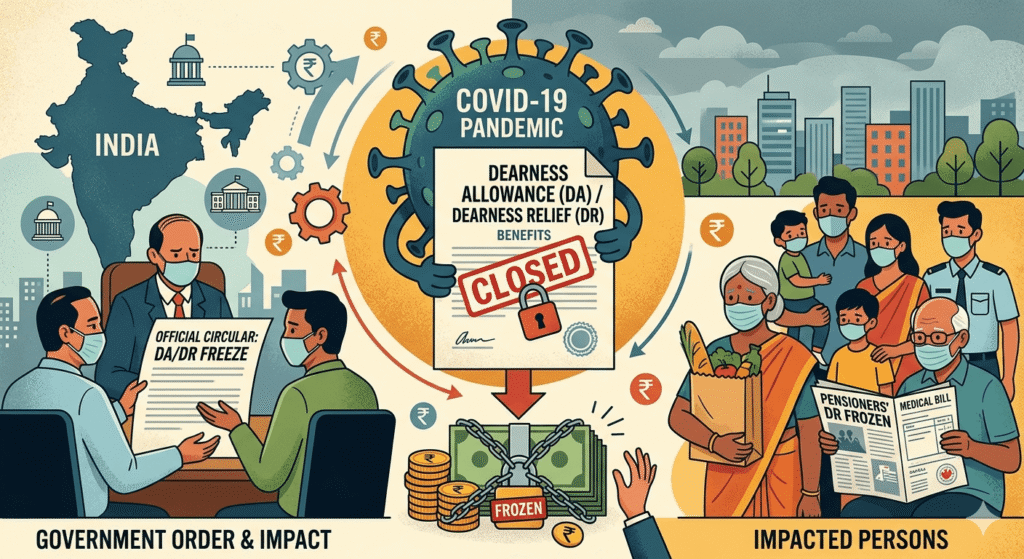
A recent judgment of the Hon’ble Supreme Court of India in State of West Bengal & Anr. vs Confederation of State Government Employees & Ors., 2026 INSC 123 (Judgment dated 05 February 2026) has brought the issue of Dearness Allowance (DA) and Dearness Relief (DR) withheld during the COVID-19 period back into focus.
The judgment lays down important legal principles regarding Dearness Allowance, which may have wider implications for Central Government employees and pensioners whose DA/DR instalments were withheld during the pandemic period.
DA/DR freeze during COVID
The Government of India froze three instalments of DA/DR during the pandemic with effect from:
- 01.01.2020
- 01.07.2020
- 01.01.2021
This was done vide:
- OM No. 1/1/2020-E-II(B) dated 23.04.2020 – Freeze of DA/DR
Later, DA/DR was restored prospectively vide:
- OM No. 1/1/2020-E-II(B) dated 20.07.2021 – Restoration of DA
- OM No. 42/07/2021-P&PW(D) dated 22.07.2021 – Restoration of DR
However, arrears for the period 01.01.2020 to 30.06.2021 (18 months) were not paid, effectively resulting in permanent denial of DA/DR for that period.
Important facts often overlooked
The Government itself acknowledged that DA had accrued during this period:
- OM No. 1(5)/E.V/2020 dated 07.09.2021 directed that DA rates of 21%, 24% and 28% be taken into account for gratuity and leave encashment for employees retiring during the COVID period.
This clearly indicates that:
- DA had accrued
- DA was recognised for retirement benefits
- But cash payment was withheld
This creates an important legal question.
Key principles laid down by the Supreme Court
The Supreme Court held:
- Dearness Allowance is not a bounty or ex-gratia payment.
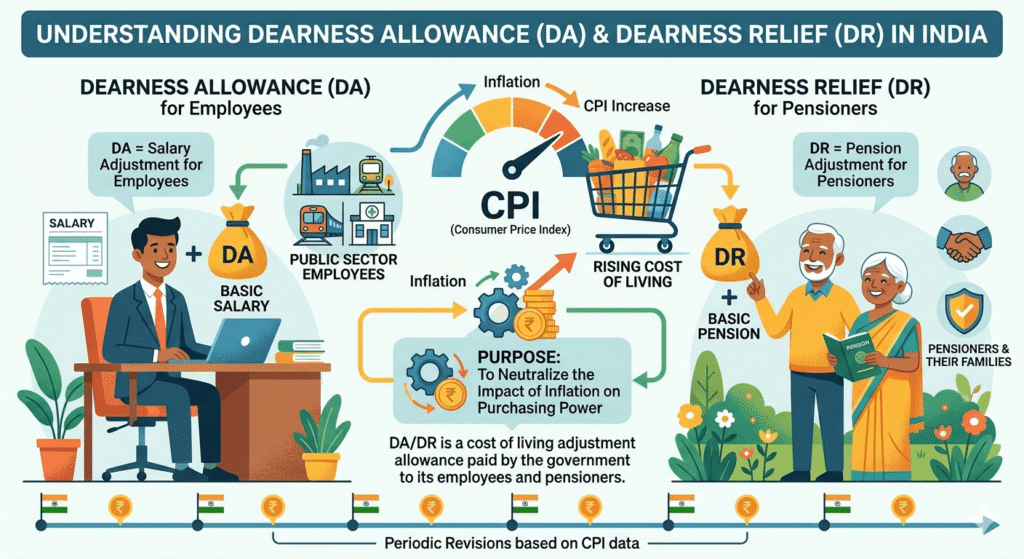
- DA is a mechanism to neutralise inflation.
- Where DA is governed by statutory rules, it becomes a legally enforceable right.
- Executive instructions cannot override statutory rules.
- Wages and allowances are “property” under Article 300A of the Constitution.
- Such entitlement cannot be taken away without authority of law.
- Financial constraints cannot justify permanent denial of accrued entitlement.
- Government, as a model employer, must honour its obligations.
- Even if financial burden is heavy, liability cannot be denied – only payment can be phased.
Why is this issue important
For Central Government employees:
- DA is governed by CCS (Revised Pay) Rules, 2016, framed under Article 309 of the Constitution.
- DA is linked to AICPI-IW index.
- Once the index rises, DA becomes a vested and accrued right.
Therefore, the core issue is:
Can a temporary freeze result in permanent forfeiture of a statutory entitlement?
This is now a legal and policy question, not merely a financial one.
Possible solution
A practical solution could be:
- Release of DA/DR arrears in a phased or structured manner
- This approach has also been recognised by the Supreme Court, which held that while payment may be structured, liability cannot be extinguished.
Conclusion
During the pandemic, employees and pensioners accepted the DA/DR freeze in a spirit of national solidarity, believing it to be a temporary measure. However, non-payment of arrears has effectively converted a temporary deferment into permanent forfeiture.
In view of the Supreme Court judgment dated 05 February 2026, the issue deserves reconsideration at the policy level.
This is not merely a matter of financial burden – it is a matter of:
- Legal entitlement
- Administrative fairness
- Government’s role as a model employer
- Relief to a large number of pensioners, many of whom are senior citizens
A balanced and compassionate decision would resolve a long-standing grievance and reinforce faith in fair governance.


Kudos to Mr Khanna for so succinctly bringing out the injustice meted out to the government employees. Hope the various employees/pensioners association will bring these facts once again to the Govt, now that the Apex Court has reiterated the “rights” position.
Excellent legal analysis on DA and the rights of employees and pensioners to get theDA/DR.
The article covers the issue which is deep inside the ground and such efforts are really required to be initiated. It will help all corners of society. Kudos to the author for bringing such issue on surface
Kudos to Mr. J K Khanna for highlighting an issue that had already been consigned to the annals of history. It’s true that the issue would have remained dormant but for a recent Supreme Court Order . But it goes to the credit of Mr. Khanna to analyse the issue in such great depth and to flag the gross injustice inherent in a temporary freeze of employees’ privilege into a permanent forfeiture .
Very succinct, to-the-point, and measured advocacy of a critical issue on behalf of us all! Kudos, Sir!
Shri JK Khanna deserves praise for presenting the issue of Frozen DA,/DR in such precise, concise and simple analytical style arousing hope in the minds of aged pensioners who had more or less reconciled to their fate forgetting the claim. Hopefully the SC would provide some relief by paying heed to the agony of the elders at this time of unabated price rise.