

Energy lifelines, military brinkmanship, and the world’s most volatile choke point
“Baaziicha-e-atfaal hai duniya mere aage,
– Mirza Ghalib
Hota hai shab-o-roz tamaasha mere aage.”
(The world is but a playground before me, day and night, spectacles unfold before me.)
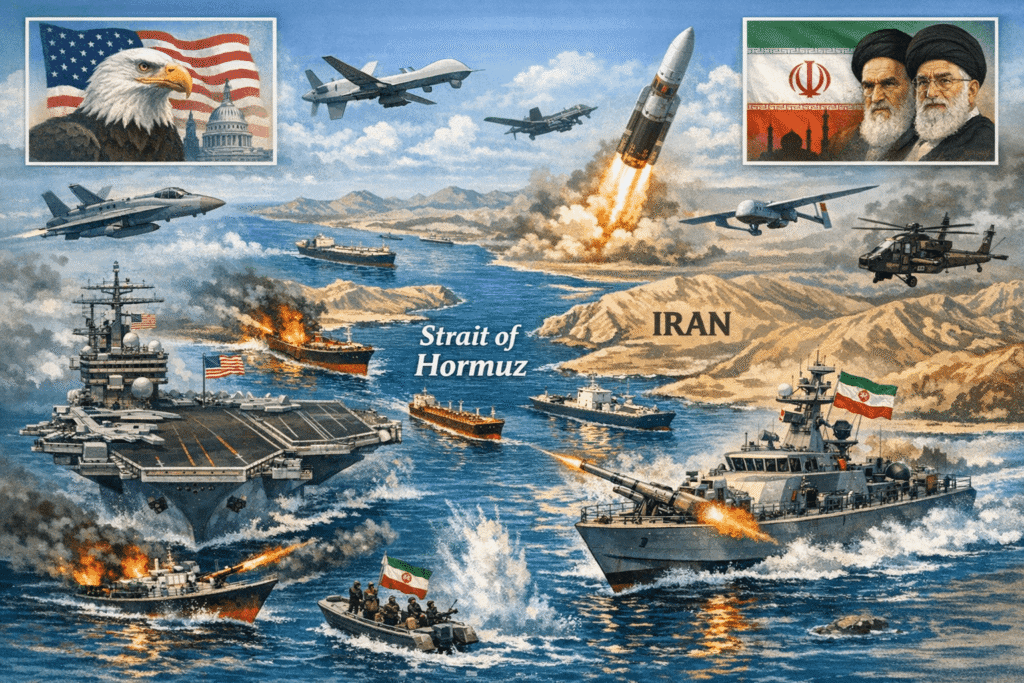
The U.S.-Iran confrontation has reached a critical juncture, with Iran’s persistent closure of the Strait of Hormuz despite internal damage from airstrikes and President Donald Trump’s 48-hour ultimatum to “hit and obliterate” Iran’s power plants if the waterway remains blocked. As of March 23, 2026, no diplomatic off-ramps are visible, elevating risks of broader regional destabilization.
| The Fragile Math of Hormuz |
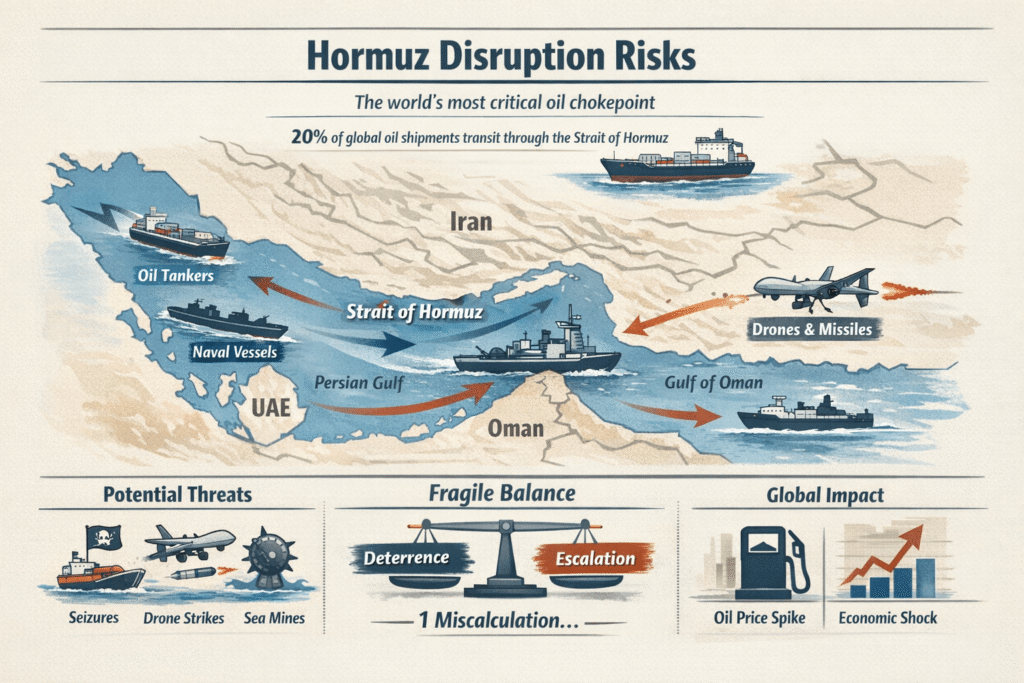
| The Strait of Hormuz is less a shipping lane than a geopolitical fault line. The IRGC’s asymmetric tactics, Israel’s shadow war, and America’s naval presence combine to make it a perpetual powder keg. The “clash” is not hypothetical — it is ongoing, and the fragile math of Hormuz is about whether global powers can prevent a regional flashpoint from igniting into a wider war. Every tanker that passes through Hormuz is part of a delicate equation: deterrence versus escalation. A single miscalculation — a drone strike gone wrong, a naval skirmish, or a cyberattack on port infrastructure — could spike global energy prices overnight. Gulf monarchies, India, China, and Europe all remain hostage to this fragile balance, knowing their energy security hinges on Hormuz staying open. |
Escalation Dynamics
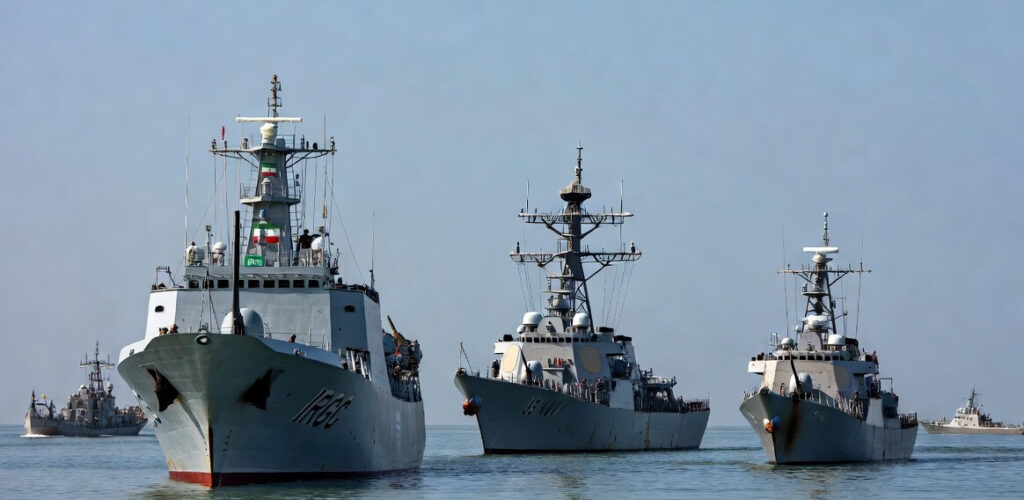
Iran’s IRGC confirmed the Strait’s closure on March 2, 2026, alongside “Operation True Promise 4” strikes on U.S. bases in Bahrain, Saudi Arabia, UAE, Kuwait, and Iraq. Trump stated on Truth Social: “If Iran doesn’t FULLY OPEN… the Strait of Hormuz, within 48 HOURS… the United States of America will hit and obliterate their various POWER PLANTS, STARTING WITH THE BIGGEST ONE FIRST!” Iran’s Parliament Speaker Mohammad Baqer Qalibaf warned that any such attack would trigger “irreversible” destruction of U.S.-linked “critical infrastructure, energy infrastructure, and oil facilities” across the region.
| IRGC’s Role in the Gulf |
| The Islamic Revolutionary Guard Corps (IRGC) Navy has long positioned itself as the guardian of Iran’s sovereignty in the Strait of Hormuz. Its asymmetric tactics — fast attack boats, drones, mines, and missile batteries — are designed to offset U.S. naval superiority. Recent incidents of ship seizures and drone harassment highlight the IRGC’s ability to keep the strait perpetually unstable. |
Parallel tensions intensify with Israel-Hezbollah clashes in Lebanon involving cluster munitions on Israeli sites and IDF strikes wounding soldiers. U.S.-Israeli operations have targeted over 90 Iranian sites, including Kharg Island’s oil hub spared “for reasons of decency,” as Gulf states face IRGC drone and missile crossfire.
Probability Assessment
Probabilities are estimated from escalatory rhetoric, proxy actions, regime resilience, oil sensitivities, and mediation scarcity within the 72-hour post-ultimatum window as of March 23, 2026.
Most Likely Pathway: Regional Multi-Front Conflagration (45%)
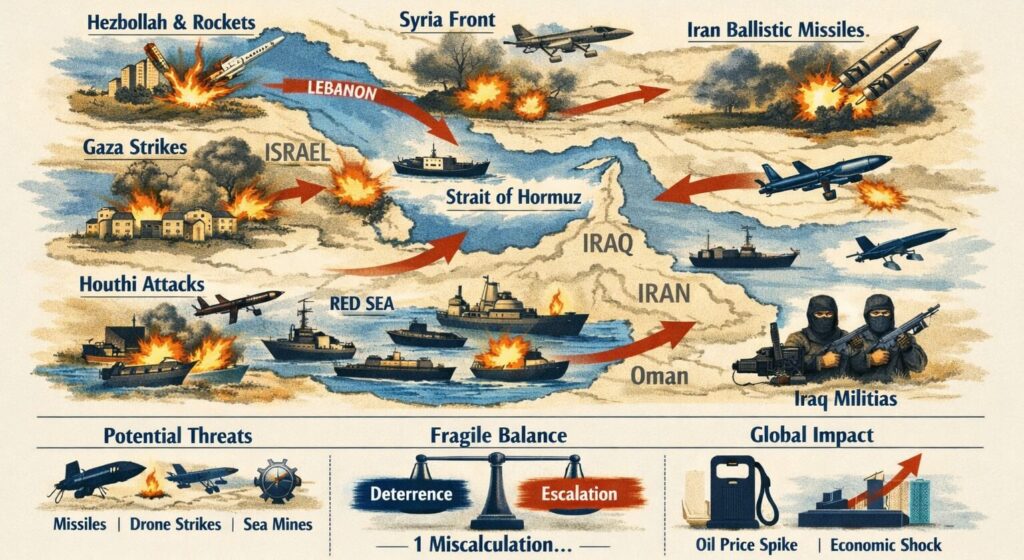
This scenario leads due to ongoing proxy expansions like Hezbollah exchanges and IRGC militia strikes already underway, requiring no Hormuz resolution for horizontal spread. Key triggers include uncontained militias ensnaring Gulf states, with primary consequences encompassing attacks on regional energy facilities, NATO cohesion strains, and Brent crude surging past $120 per barrel.
| The U.S. and Israel Factor |
| The U.S. Navy’s Fifth Fleet, based in Bahrain, remains the guarantor of free passage through Hormuz, but its presence also makes it a lightning rod for confrontation. Israel’s covert strikes and cyber operations against Iranian assets have added another layer of volatility, pulling the Gulf into the broader Israel–Iran shadow war. The “clash” is not just military — it’s psychological, with each side testing the other’s resolve in a narrow waterway that carries one‑fifth of the world’s oil. |
Secondary Pathway: U.S. Assault on Iranian Infrastructure (30%)
Trump’s explicit grid threat remains potent if the Hormuz deadline lapses, though tempered by Iranian hardening and global aversion to oil shocks from 20% of seaborne trade. Triggers center on failed compliance leading to strikes, yielding nationwide blackouts, reciprocal U.S. base hits within 30 minutes, and intensified global inflation.
Least Likely Pathway: Escalatory Impasse to Coerced Truce (25%)
This emerges only post-mutual devastation from blows like grid attacks or Hormuz mining, demanding exhaustion amid Iran’s Supreme Leader Mojtaba Khamenei’s vow: “The lever of closing the Strait of Hormuz must certainly continue to be used.” Triggers involve fatigue after strikes with consequences of forced de-escalation, potential reparations, and diplomacy flickering via Iranian terms but stalled without Russia/China mediation.
Economic and Geopolitical Fallout
Hormuz disruption risks propelling Brent crude beyond $120 per barrel and stagflation as 20% of global oil halts. Civilian tolls from blackouts and hospital failures compound refugee crises and alliance fractures, with Gulf neutrals trapped in crossfire and markets facing prolonged volatility.
“Ab nahi koi baat khatre ki, Ab sabhi ko sabhi se khatra hai”- Jaun Elia
(There is no longer a single identifiable threat, Now everyone is a danger to everyone.)

