

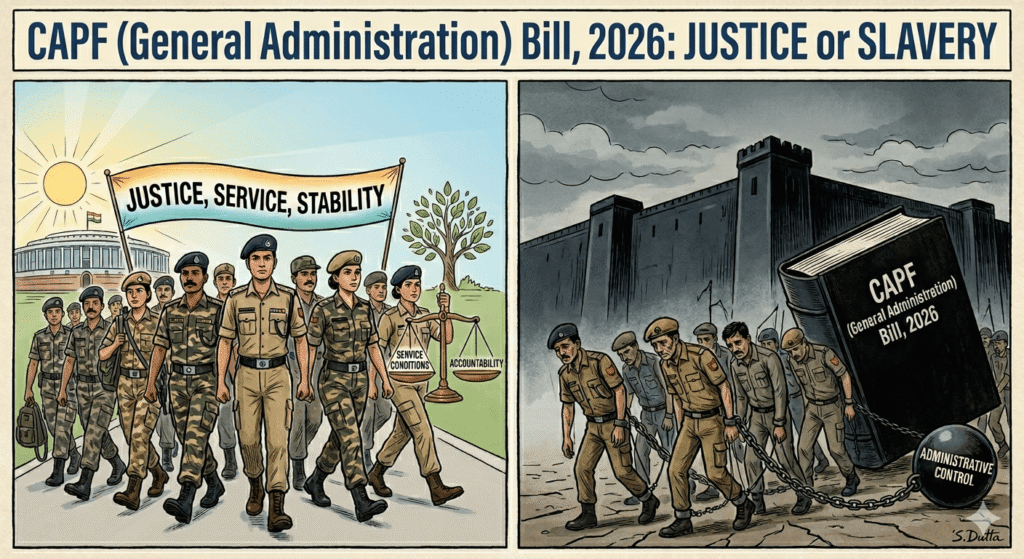
India’s democratic journey has never been defined merely by the transfer of power, but by the supremacy of justice. Whenever the system has faltered, the people have held on to the faith that, in the end, the final ray of justice would come from the Supreme Court of India. But today, a serious question stands before us: are we moving in a direction where justice itself is being systematically weakened?
The proposed CAPF (General Administration) Bill, 2026, related to the Central Armed Police Forces, does not appear to be merely an administrative change. It seems to be an attempt to affect the very soul of justice that was established by the Supreme Court after a long struggle. If rights and the balance secured through the Court are altered by legislative means, then this is not merely a policy change, but an assault on the very idea of justice.
This situation brings to mind the mythological episode of the abduction of Sita Mata—in other words, here “justice in the form of Sita” appears to be removed from its rightful place and brought once again under control. The question is: can such a thing be acceptable in a democracy?
History bears witness that whenever centralization was carried out in the name of “leadership” and “coordination,” the results were not always positive. During the difficult years of terrorism in Punjab, when order had collapsed in Srinagar, and during the tragedy of the Kashmiri Pandit exodus, failures of leadership and coordination forced the nation to pay a heavy price.
The period of Bihar’s so-called “Jungle Raj” became a symbol of administrative failure. At that time, the circumstances became so horrifying that even the trust of a family associated with the All India Services was shattered. This was not just an isolated incident, but a lasting stain on the system of governance.

And when the Central Bureau of Investigation was itself called a “caged parrot” by the Supreme Court, the issue then too was one of leadership and independence. If the same structural mindset is now being sought to be imposed upon the CAPFs, then it is naturally a matter of concern.
In contrast, the ground reality is that the CAPFs have played a decisive role in some of the country’s most difficult challenges. Whether it was the defence of Parliament during the 2001 Indian Parliament attack or standing up against terror in Mumbai during the 2008 Mumbai attacks, the officers and personnel of the CAPFs demonstrated leadership, courage, dedication, discipline, and unwavering devotion to the nation. Their contribution to preserving the country’s unity and internal security is not merely a matter of duty, but a living tradition of sacrifice.
But today, the issue is not only one of capability, but also of moral courage. Jatayu in the Ramayana teaches us precisely this—that to stand against injustice, one does not need numbers or power, but resolve.
In this context, the memory of Atal Bihari Vajpayee naturally comes to mind. He was a leader who never placed power above morality. He let a government fall for the sake of a single vote, but did not abandon principle. At a time when such steps are being discussed merely to establish administrative control and create a more “convenient structure,” this comparison becomes even more relevant.
Are we moving toward a situation where our own forces—those who have given their all in the defence of the nation—are to be confined within a limited and controlled framework? Is this in keeping with the spirit of freedom for which the country struggled?

This is not merely a question concerning the CAPFs. It is a question of the trust that a citizen places in the judiciary, the Constitution, and the system of governance. If the balance secured through the Court itself is altered, then where will the foundation of the democratic structure stand?
India’s history offers us both a warning and a direction. Governments come and go, but the nation and its soul endure. If decisions go against that soul, they affect not only the present, but the future as well.
Today, there is a need to pause and reflect, to understand the fundamental spirit of justice, and to ensure that we are not unknowingly moving along a path where control replaces freedom and order overshadows justice.
Ultimately, the question is this: is India moving in a direction where justice will remain secure, or toward one where it will once again have to struggle for survival?
And now, in conclusion, a humble yet firm appeal—

All justice-loving Indians are earnestly requested to strongly oppose any such “black law.” History bears witness that when injustice is not stopped in time, it gradually spreads through the whole of society and destroys the very roots of justice.
To raise one’s voice today is not merely an option, but a responsibility. Because if we remain silent today, tomorrow justice itself will fall silent.


CAPFs: 50+ YEARS OF IGNORED RECOMMENDATIONS (1970–2018)
1. L.P. SINGH (1970)
Secretary, MHA | 14 Oct 1970
Efficiency of force must come before IPS interests
CAPF officers must get fair promotion avenues
No reservation for IPS recommended
Deputation was only a temporary arrangement
Denial of promotion harms morale & effectiveness
2. K.F. RUSTAMJI
DG, BSF
Opposed fixed quota for IPS
Selection must be based on merit, not source
BSF had sufficient internal officers for leadership
Favoured home-grown leadership
3. V.G. KANETKAR (1966)
First DG, CRPF
CAPF officers were ready for higher ranks
Ignoring them for IPS/Army is unjustified
Internal officers had experience + seniority + capability
Their promotion claims cannot be ignored
4. 7th CENTRAL PAY COMMISSION (2015)
Chairman: Ashok Kumar Mathur | 19 Nov 2015
CAPF officers need career progression
Deputation posts must be reviewed
Senior posts should be open to CAPF officers
CAPF officers must be eligible for DG level posts
5. COMMITTEE ON ESTIMATES (2017–2018)
Chairman: Murali Manohar Joshi | March 2018
CAPF officers recruited via UPSC like IPS
Yet top posts held by IPS officers
Causes:
Demoralization
Reduced effectiveness
Found acute stagnation & frustration
Recommended:
Top posts for CAPF cadre officers
Regular cadre review
6. PARLIAMENTARY STANDING COMMITTEE REPORT 214 (2018)
Chairman: P. Chidambaram | 12 Dec 2018
CAPFs are mature forces (no need for deputation)
IPS deputation creates promotion bottlenecks
IPS join at senior levels (DIG/IG)
Recommended:
Max 25% deputation quota
No reservation for DG posts
Equal opportunity for CAPF officers
7. IIM AHMEDABAD REPORT (6th CPC STUDY)
Dr. Abhishek Mishra & Dr. Swati Mishra
Even after 14 years, officers face stagnation
Leads to:
Demotivation
Loss of experienced manpower
Recommended:
Time-bound promotions
My simple request to the honourable HM to kindly reconsider the decision taking into consideration the sacrifices of these young officers who have given their life and limbs safeguarding the integrity and sovereignty of the country at the cost of happiness and well being of their families Will we as citizens able to look into the eyes of Veernaris who sacrificed their Sindoor will be able to face the weeping fathers and wailing mothers and orphaned children of our warriors Will our conscious not prick us and our deeds haunt us We as veterans officers are feeling let down and helpless and defeated before our juniors after putting in 40 years of service Review this traversity of Justice to not regret irreparable damage to the morale and psyche of these young warriors the back bone of national internal and external security of Nation As soldier sanatani and rashtra bhakt I earnestly pray to remember the theory of Karma in Geeta life turns full circle very aggressively and painfully for all actions Lamhon nae khatta ki thi sadyion nae sazza payee hai Jai hind
Very rightly said. CAPF cadre officers saw a flicker of hope by securing a favourable verdict from Delhi High Court in spite of strong opposition of their own controlling ministry(MHA) which was further confirmed and reconfirmed by the Supreme Court by rejecting the Review petition of MHA. Now to nullify the verdict of the courts this bill is being brought by the MHA which is grave injustice to the 13000 officers of CAPFs. BJP leaders often claim to be from a party which is different from others and quote Shah Bano Bill brought by the Congress govt to nullify the verdict of Supreme Court to appease a particular community. Now their govt is bringing CAPFs bill to nullify the verdict of a well justified order of the Supreme Court to favour a particular class of officers. So how this govt is different from the then Congress govt?
In case PM/HM bring bill on CAPF General Administration 2026 in Parliament, it will be a gross injustice and step motherly behaviour. Factually, PM/HM are operating under bureaucratic terrorism and spoiling career of thousands of CAPF officers who shall be reduced to slaves and Indirectly, they are encouraging slavery which is unconstitutional. They are overruling SC judgement of May 2025 by bringing this Act for legislation. CAPF is amongest 54 OGAS and why Govt is ignoring 6 CAPF services and denying OGAS implied career progressions. Britishers were against giving coveted posts to Indians as they were firm believers that they can’t be impartial, so it is being proved.