

Few texts of Hindu civilisation have attracted as much criticism in the modern period as Manusmriti. For more than a century, it has frequently been cited as evidence of Hindu social evils and treated as a window into the nature of Hindu civilisation itself.
Yet such attribution is often both methodologically unsound and historically reductionist. It is methodologically unsound because neither the authenticity of many disputed verses nor their causal relationship to the social practices in question has been conclusively established. A text whose manuscript tradition bears clear evidence of interpolation cannot be treated as straightforward historical evidence until its earliest recoverable layer has been identified.
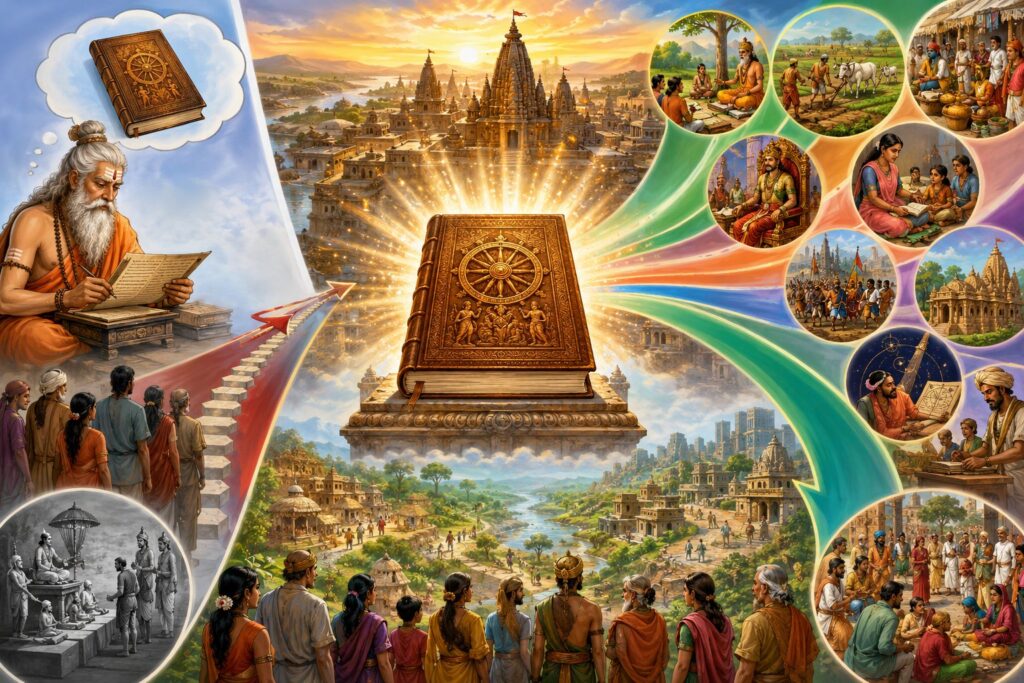
It is historically reductionist because social institutions emerge through complex interactions of political power, economic change, regional custom, religious movements, invasions, state formation, and countless other influences. To attribute centuries of social development to a single law code is to substitute a simplistic explanation for a far more complex reality. This is particularly problematic in the case of Manusmriti, whose authority had largely faded about a thousand years ago. The centuries of iconoclastic Islamic rule and colonial administration that followed disrupted Hindu civilisational institutions and fundamentally reshaped Hindu society.
A more fundamental question must therefore be asked: are we debating the original Manusmriti, or a text shaped by centuries of interpolation, redaction, and accretion? Until that question is addressed, neither criticism nor defence can claim full historical validity. The search for the historical Manusmriti is therefore not merely a textual exercise; it is essential to any serious reconstruction of Hindu social history.
The Revisionist Imperative
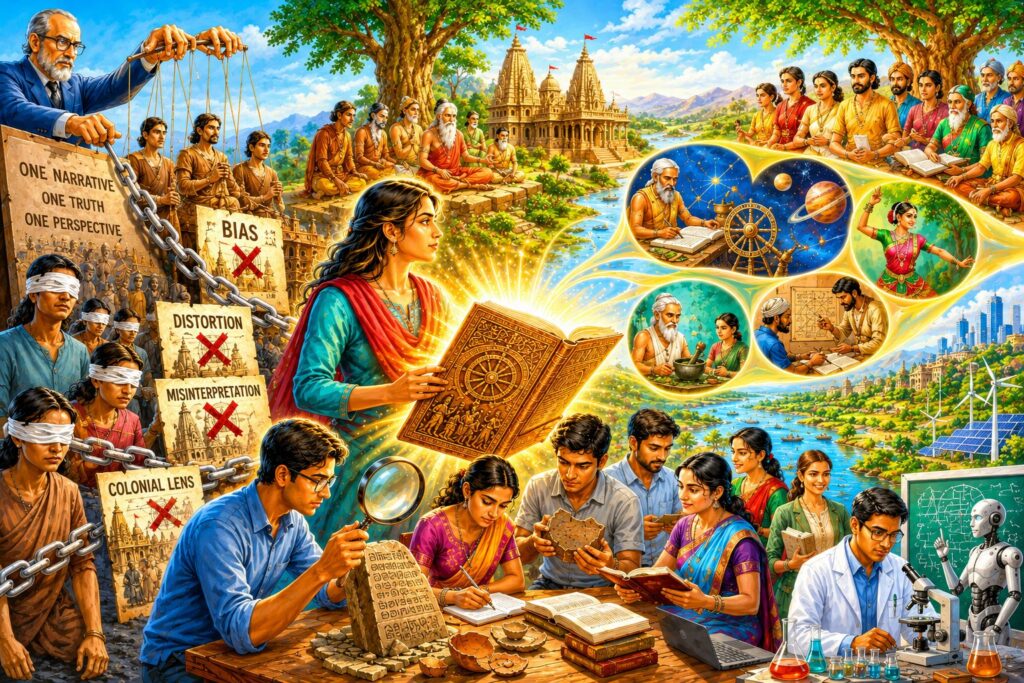
Revisionism is not the rewriting of history; it is the recovery of history. Every serious discipline advances by revisiting inherited conclusions in the light of better evidence and better methods. Science progresses by correcting old theories. History progresses by correcting old narratives.
The purpose of scholarship is not to preserve inherited assumptions but to discover truth. Whenever accepted interpretations rest upon weak evidence, ideological prejudice, or incomplete sources, revision becomes a scholarly duty.
The study of Hindu civilisation is no exception. Few civilisations possess a textual tradition as vast, ancient, and complex as Hindu civilisation. Reconstructing Hindu social history therefore requires rigorous textual criticism, historical analysis, and intellectual honesty.
The Wisdom of the Rishis
One of the remarkable achievements of the Hindu tradition was its early recognition that written texts are vulnerable to corruption. The ancient rishis understood that every act of copying creates opportunities for omission, addition, error, and manipulation. Over time, repeated transcription can transform a text.
To prevent such corruption from affecting the foundational sources of Sanatana Dharma, the Vedas were preserved through an extraordinarily rigorous oral tradition. The Vedas were transmitted through highly structured systems of memorisation and recitation designed to ensure exceptional textual fidelity.
The preservation system extended far beyond memorisation. Students learned to recite the text through intricate patterns and permutations that effectively functioned as a human error-correcting code. A misplaced syllable, altered accent, or incorrect tonal inflection would disrupt the recitational sequence, making corruption immediately detectable.
This system is virtually unparalleled in world history. It explains why the Vedas retained a remarkable degree of textual integrity while many later written works became vulnerable to alteration.
Vulnerability of Smriti Texts
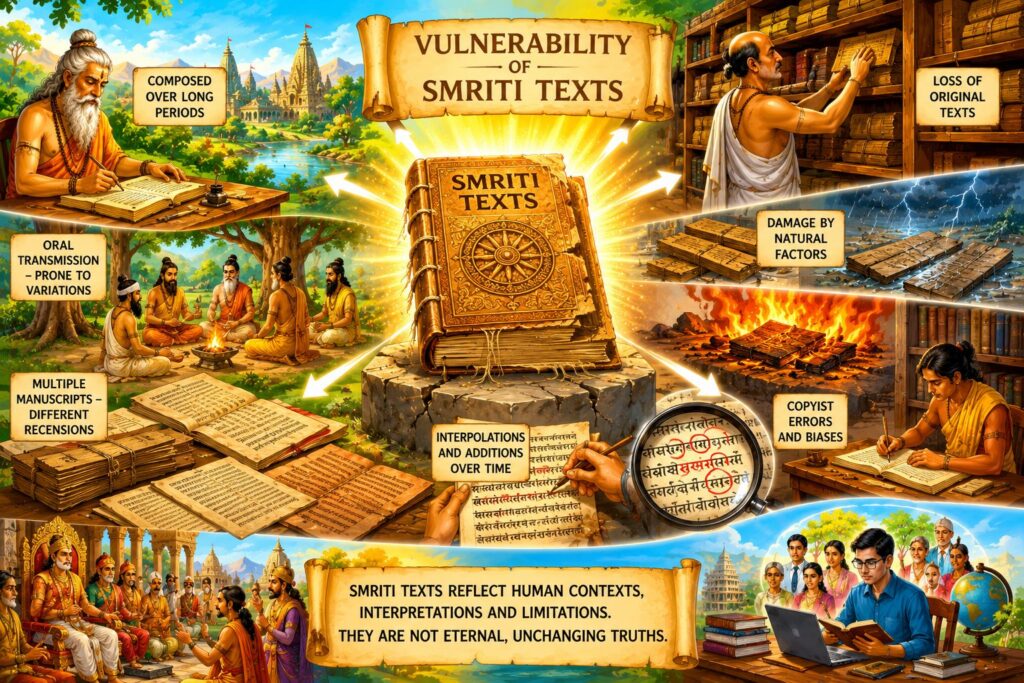
The situation was different for the vast body of post-Vedic literature. The Smriti corpus—including the Puranas, Itihasas, Dharmashastras, commentaries, and numerous other works—was transmitted largely through manuscripts and periodic recensions. These texts remain invaluable sources for understanding Hindu thought and society, but their mode of transmission exposed them to the cumulative effects of repeated copying, transmission, and occasional interpolation.
Dharmashastras, or law codes, occupied a unique position because they directly affected social organisation, inheritance, governance, religious duties, and customary practice. Such texts naturally attracted those seeking to legitimise contemporary arrangements and sectarian preferences by attributing them to ancient authority. The greater the authority of a text, the greater the temptation to alter it.
Why Manusmriti Matters
No Smriti enjoyed greater prestige than Manusmriti. For centuries it was regarded as one of the most authoritative statements of social and legal norms within Hindu society. Its prestige made it a powerful source of legitimacy. Precisely for that reason, it was also especially vulnerable to revision by later generations seeking to project their own preferences and assumptions under the authority of antiquity.
As one of the earliest and most influential Dharmasastra texts, Manusmriti became a standard reference for later legal literature. During the nineteenth century, when colonial scholarship was constructing influential narratives about ancient India, it often became the principal lens through which European scholars viewed Hindu society. Its prominence ensured that it would later become a focal point of ideological controversy.
Yet, as Patrick Olivelle has observed, despite the immense attention Manusmriti has received—including periodic public burnings and sustained political criticism—the study of the text itself has remained surprisingly neglected. More heat has often been generated than light.
The existence of interpolation within the Manusmriti tradition is not merely speculative. Scholars such as Georg Bühler, P. V. Kane, Robert Lingat, and Patrick Olivelle have documented significant variations among extant manuscripts and identified evidence of successive textual layers. Although they differ regarding the extent and chronology of particular interpolations, there is broad recognition that the received text is the product of a long process of transmission and redaction rather than the untouched preservation of a single original document.
Among modern scholars, Dr. Surendra Kumar undertook one of the most ambitious attempts to identify interpolations. In his Viśuddha Manusmriti, he applied textual and doctrinal criteria to distinguish authentic verses from later additions and concluded that approximately 1,471 of the 2,685 verses in the received text—about 55 per cent—are interpolations. His conclusions remain contested, and no scholarly consensus exists regarding the precise extent of interpolation. Nevertheless, his work represents one of the most detailed efforts to reconstruct an earlier form of the text.
The internal structure of the received text itself raises important questions. Of its 2,685 verses, approximately 1,034 are devoted to Brahmanas and 971 to matters relating to the king. Together, these two subjects account for nearly three-quarters of the entire work. Such a skewed distribution appears striking in a text that, from the outset, presents itself as a comprehensive law code for society as a whole, encompassing all four varnas and the intermediate groups. Whether this imbalance arose through interpolation, deletion, or other processes of textual transmission remains a matter for investigation. What is beyond dispute is that it compels a re-examination of whether the received text faithfully reflects the structure, scope, and priorities of the earliest Manusmriti.
Unlike the Vedas, Manusmriti belonged to the Dharmasastra tradition. It was not a foundational text of spiritual revelation but a law code concerned with regulating social life. Its provisions were therefore closely connected to the social conditions and institutional realities of particular periods. Critical examination of its textual history is not only legitimate but indispensable.
Today, Manusmriti no longer functions as a governing law code. Its significance is primarily historical. Yet precisely because it remains one of the most important sources for understanding Hindu social history, recovering its earliest attainable form remains an important scholarly task.
The Convergence of Opposites
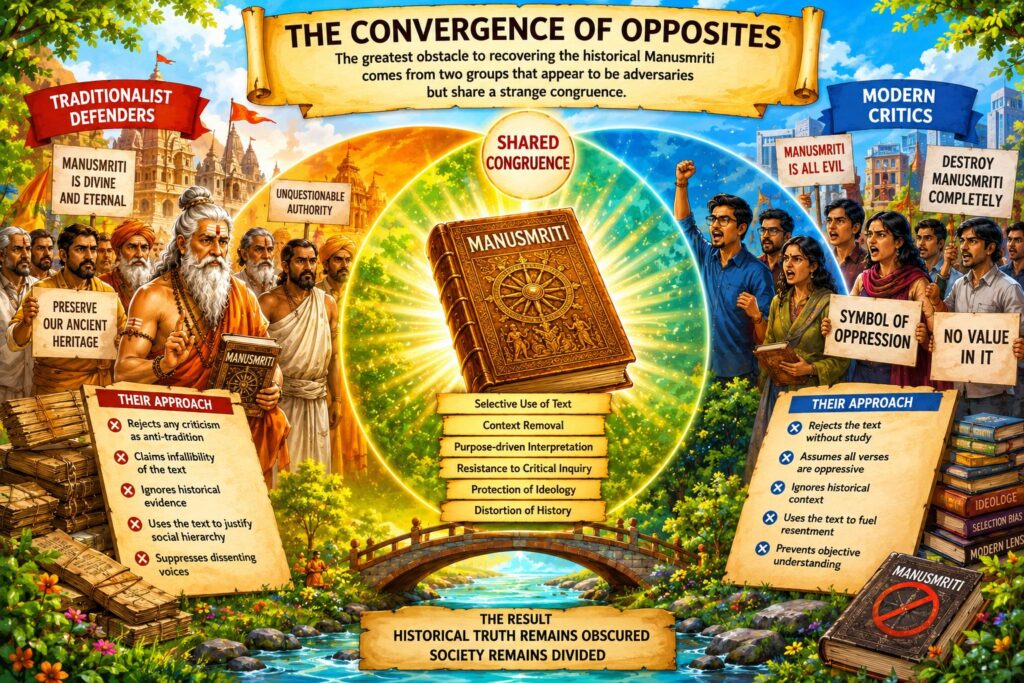
The greatest obstacle to recovering the historical Manusmriti comes from two groups that appear to be adversaries but share a strange congruence. The first consists of obscurantists who treat every verse of the received text as equally authentic and regard textual criticism as an assault on tradition. The second consists of anti-Hindu polemicists who elevate the most controversial passages into definitive statements about Hindu civilisation while disregarding questions of textual authenticity and textual history.
Despite their opposing conclusions, both treat the received Manusmriti as a fixed and homogeneous document. One venerates it; the other weaponises it. Neither asks the prior question on which scholarship depends: does the received text faithfully represent the earliest Manusmriti? Until original textual layers are distinguished from later accretions, interpretation remains speculative and historical judgment uncertain.
Restoration Before Interpretation
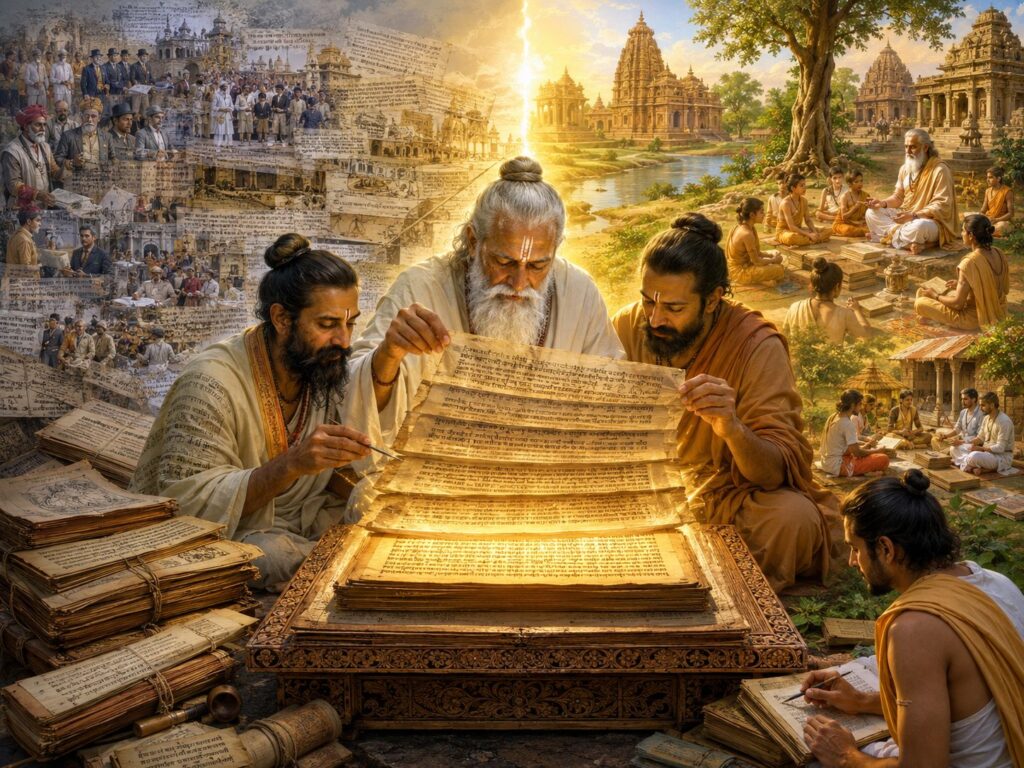
A civilisation cannot understand its past through layers of later interpolations. If interpolations are accepted as original, historians risk mistaking the social realities of later centuries for those of earlier ages. They risk confusing later interpolations with the beliefs of the civilisation itself. The result is not history but historical illusion.
This problem is especially acute in the case of Manusmriti because the text is frequently invoked to support sharply divergent narratives about Hindu civilisation. In either case, conclusions are of little value unless the authenticity of the underlying text has first been established.
The recovery of the earliest attainable Manusmriti is therefore not an antiquarian exercise. It is a civilisational necessity. The task requires comparative manuscript study, philological analysis, historical contextualisation, identification of anachronisms, and the reconstruction of original textual layers. Only after this work is undertaken can Manusmriti serve as a reliable source for reconstructing Hindu social history. While the original text may never be recoverable in its entirety, rigorous textual criticism can often distinguish earlier textual strata from later accretions with reasonable confidence.
Revisionism is not the rejection of tradition. It is the removal of the accretions that obscure tradition. Its purpose is to understand it properly.
The debate over Manusmriti is ultimately not a debate about a book but about method. A civilisation confident in itself does not fear scrutiny of its texts, nor does it confuse later interpolations with ancient wisdom. Equally, it does not reduce the complexities of centuries of social history to a single document whose own textual history remains contested. The choice before Hindu society is clear: it can continue to inherit narratives shaped by centuries of interpolation, as well as by colonial scholars, missionaries, Marxists, polemicists, and obscurantists, or it can undertake the harder task of recovering its own history from its own sources.
The first duty of scholarship is restoration. A text must be authenticated before it can be interpreted, and historical causation must be demonstrated before responsibility can be assigned. History must be recovered before it can be written. The reconstruction of Hindu social history therefore begins with the recovery of authentic sources, for only a restored text can yield a trustworthy history.


Sir, Kusos for writing a well researched article on one of the bedrock of Sanatan faith. I would like to supplement it with some conjectures that are worth visiting in this context:-
1) The entire basis of unravelling the context of this Dharmashastra rests on copy of book published during British Colonial rule in 19 th century.
2) Hindu kingdoms flourished in the country prior to British rule in Maratha confederacy, Vijaynagar empire and Rajputana.
3) Even earlier, Chinese traveller Hieun Tsang visited India near about Harsha’s reign and he took back a huge caravan of books. Currently at Gansu province’s Dunhuang caves. Their study can recreate priceless manuscripts lost in Taxila and Nalanda.