

Any serious analysis of India’s Military Industrial reform must engage directly with the Chinese model, since China has been the primary organising reference for Indian military modernisation. Following the 2015 reforms under Xi Jinping, the PLA reorganised from seven military regions into five theatre commands, explicitly designed around joint operations rather than service-specific structures. Alongside this, the Military-Civil Fusion strategy formalised the integration of China’s commercial technology sector — Huawei, DJI, Alibaba Cloud, Baidu, and hundreds of defence technology firms — into the military supply chain.
The implications are profound. China does not have a “DRDO equivalent” struggling to produce military technology in isolation from the commercial world and under the shadow of a colonial era bureaucracy and financial regulations. China has a system where leading commercial firms are simultaneously defence contractors, where civilian universities with cutting-edge AI programmes hold active PLA research contracts, and where the state’s industrial policy is explicitly shaped to produce technologies, semiconductors, quantum communication, hypersonic propulsion, AI that serve military as well as commercial objectives.
India’s answer to this cannot simply be structural mimicry. The political economy that drives China’s military-civil fusion a one-party state with legal instruments compelling commercial participation in defence work is neither desirable nor replicable in a democracy. But the principle is sound: the most capable talent and technology in a country must have a pathway into defence applications, and that pathway cannot involve a decade of bureaucratic clearance and a 40% pay cut.
India’s Technology Development Fund (TDF), the Innovations for Defence Excellence scheme, and the Defence Innovation Organisation are partial gestures toward this integration. What they lack is scale, speed, and a clear signal to the commercial technology sector that defence is a viable, predictable, and professionally rewarding market.
Budget, Bureaucracy, and the Valley of Death
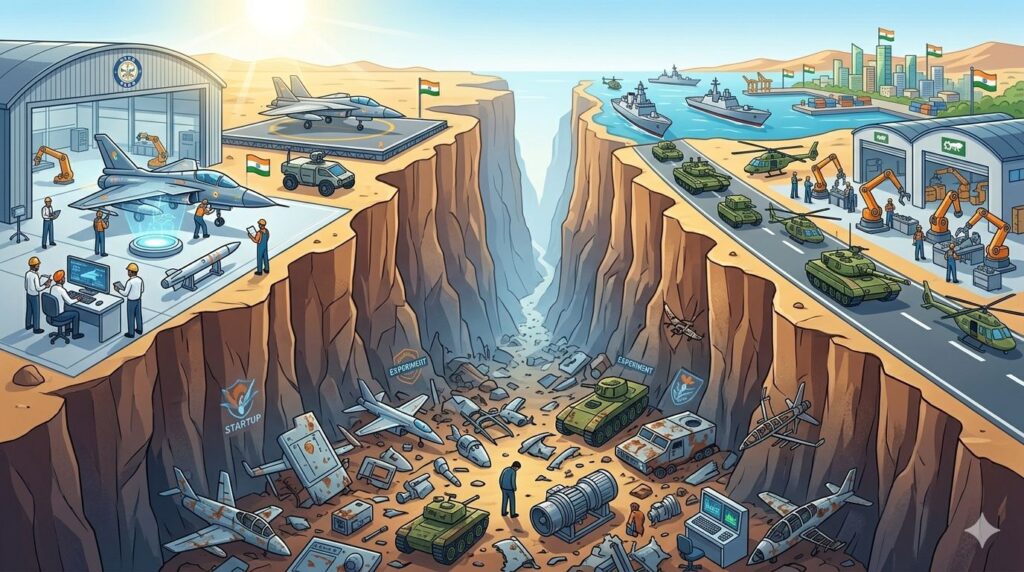
The “valley of death”, the gap between a successful prototype and a production contract is the graveyard of Indian defence startups.
A firm might win an iDEX grant, build a working prototype, pass Service trials, and then wait years for a production order that may never arrive because the Service has in the meantime imported a comparable product, or because the procurement file has stalled in financial concurrence, or because the product falls into a category with no clear acquisition pathway.
The Indian Ministry of Defence allocated a record ₹7.85 lakh crore (approximately USD $94 billion) for the 2026–2027 fiscal year. This marks a 15.19% increase from the previous year and accounts for roughly 15% of the total Union Budget. ₹1.39 lakh crore is earmarked specifically for capital acquisitions from domestic defence industries, driving the ‘Aatmanirbhar Bharat’ (Self-Reliant India) initiative.
But the effective utilisation of this reservation depends on whether domestic industry can supply products that meet Service requirements, and whether the procurement system can award contracts fast enough to sustain those firms. In this context, it is important to ensure that the provisions of these reservations are not exploited by foreign OEMs by entering into superficial collaborations with local firms and pushing locally assembled products as IDDM. This situation, among other drawbacks, perpetuates dependence on foreign OEMs for critical technologies.
The Atmanirbhar Bharat Abhiyan, launched in 2020, produced two positive instruments: the Positive Indigenisation Lists now running to four tranches covering over 500 items which prohibit import of specified items after a defined cutoff date, and the domestic procurement reservation. These lists have generated tangible pressure on the Services to work with domestic suppliers. But they have also exposed a secondary problem: the quality and reliability certification infrastructure for domestically produced defence items is under-scaled, and the testing ranges and environmental simulation facilities needed to qualify new products are heavily subscribed and often delayed.
A structural reform that has received insufficient attention is the separation of Research & Development from production readiness. The DRDO’s mandate conflates basic research, applied research, prototype development, and technology demonstration. Moving technology from demonstration to production requires a different set of competencies like manufacturing process engineering, supply chain development, production quality management, that DRDO was never designed to provide, not because of competence but because, by design or for any other reason, manufacturing was excluded from DRDO’s mandate. Since private sector industries, till 2001 were explicitly excluded for production of finished, ‘’ready to use” Defence products, the DRDO had the specified ordinance factory or DPSU under the control of the Department of Defence Production as the only option for getting its indigenously designed and developed products manufactured. The model adopted by ISRO for its commercial transfers, where a technology transfer agreement moves a proven design to a designated production agency, is a partial solution but has not been systematically applied to Defence technologies.
Lessons from Op Sindoor: Productive Use of Urgency
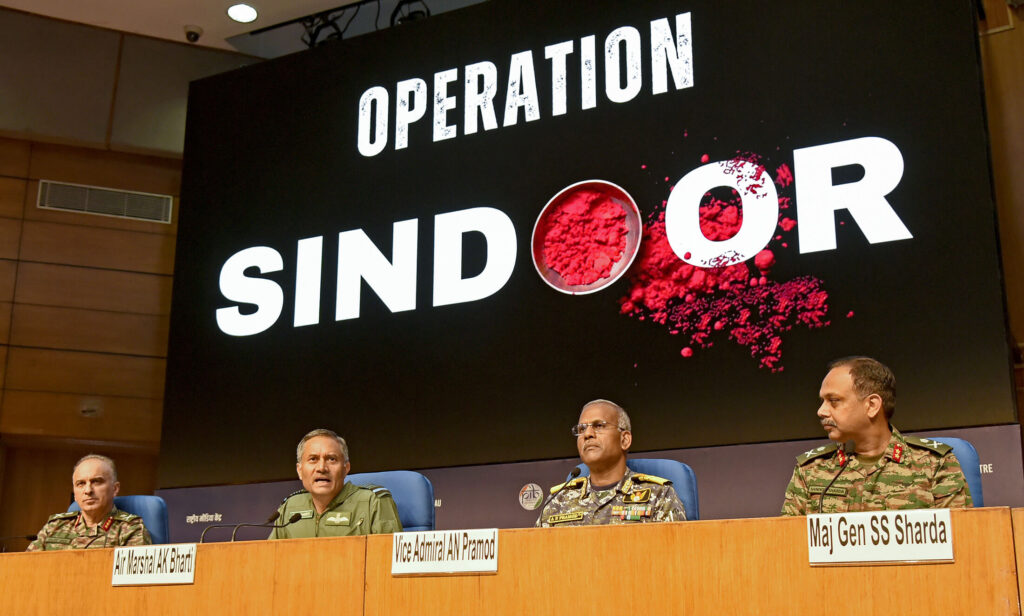
Operation Sindoor, in the weeks that followed, has become the subject of extensive after-action analysis within the defence establishment not only in terms of tactical lessons but in terms of what the operation revealed about the state of India’s indigenous technology base.
Several things appear to be clear. The integration of multiple platforms and sensors in a compressed operational timeline required software interoperability that, in several instances, had to be engineered rapidly at the operational level rather than being available as a designed-in feature. This is a systems integration problem, the consequence of a procurement history that bought platforms from different vendors, in different decades, without common data architecture. It is also a solvable problem, and the urgency generated by recent operations may finally provide the political impetus to fund a genuine defence data architecture programme.
The operation also demonstrated the value of systems that can be fielded rapidly. The shorter the time between a capability requirement being identified and a system being operationally available, the more useful the capability is. This argues for a sustained investment in modular, software-upgradeable platforms where the hardware changes infrequently but the software, mission algorithms, and sensors can be updated in the field on timescales of weeks or earlier rather than years.
India’s armed forces have historically been resistant to this model, preferring to specify complete requirements upfront and hold vendors to fixed performance parameters. This approach manages perceived financial risk well but performs poorly under conditions of rapid technological change. The shift to a spiral development model where successive incremental capability additions replace the single definitive variant is well established in US and Israeli procurement but has barely penetrated Indian defence acquisition culture.
The Human Capital Deficit

No reform of DRDO’s structures or iDEX’s funding mechanisms will produce the desired results without addressing the human capital pipeline. The scientists, engineers, and technologists who must execute India’s Defence R&D modernisation are, in many cases, choosing not to enter the Defence sector.
The reasons are well documented. Government pay scales for defence scientists, while nominally competitive at mid-career, do not match what a talented engineer can earn at a leading technology firm within five years of graduation. The work environment in DRDO laboratories, for all the genuine scientific accomplishment within it, is often characterized by bureaucratic overhead, limited publication freedom (given classification requirements), and slow promotion cycles. The career ceiling for entrepreneurially inclined scientists those who might, in the US context, leave a national laboratory to start a Defence technology startup and return to work alongside their former colleagues does not exist in the Indian context.
Building that human capital pipeline requires a set of connected interventions. First, a cadre of “cleared entrepreneurs”, scientists and engineers with active security clearances who can operate in both commercial and classified environments need to be created and supported. Second, the Indian Institutes of Technology and National Institutes of Technology, which produce the largest share of defence-relevant engineering talent, need dedicated defence technology research centres with funding, clearances, and direct project linkages to the armed services. Third, the salary and progression structures within DRDO need reform that political leadership has repeatedly promised and bureaucratic inertia has repeatedly deferred.
The Indian Space Research Organisation’s recent experience with talent is instructive. ISRO lost significant numbers of mid-career scientists to commercial aerospace firms as the private space sector grew and had to adapt its own culture and incentive structures to remain competitive. DRDO faces the same pressure from the growing defence startup ecosystem it has, paradoxically, helped create through iDEX.
ISRO’s organizational structure and operational autonomy have allowed it to bypass cumbersome red tape, empowering the agency to adapt quickly to changing scientific environments and scale its space programs efficiently, which has provided a distinct structural edge compared to DRDO.
A Framework for Reform: Five Structural Changes
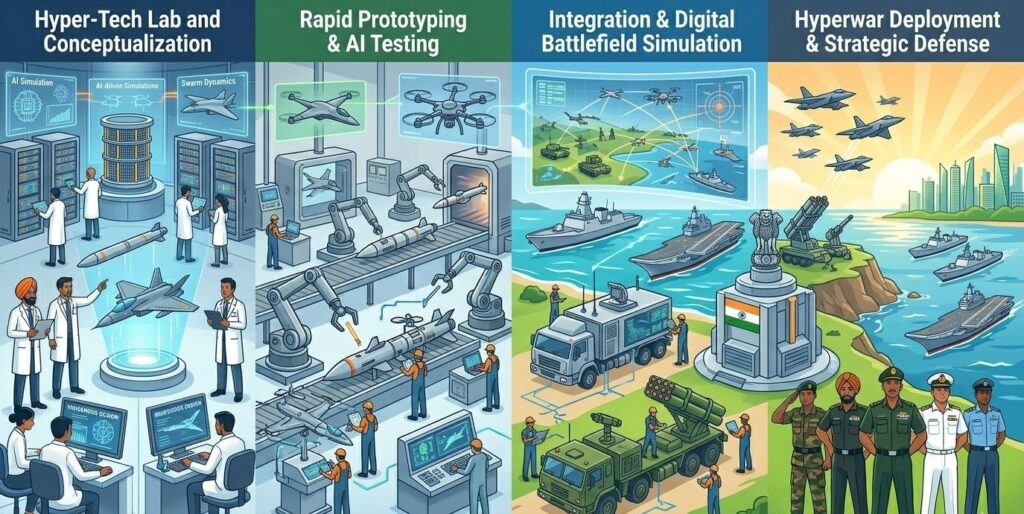
Drawing on the analysis above, five structural changes have the greatest potential to rewire India’s lab-to-lethality pipeline for the hyperwar era.
First: Separate Research and Development from Delivery. DRDO should be restructured so that basic and applied research functions are separated from prototype development, which should in turn be separated from production transfer and fieldability assurance. Each stage requires different organisational cultures, different partnerships, and different success metrics. A National Defence Research Foundation could manage the transition from research insight to programme-worthy concept, with iDEX-connected firms handling the prototype-to-production stage. Whether to bring about this separation by dismantling and reconstituting DRDO or by restructuring the DRDO, retaining advantages of keeping these separate functions under a larger umbrella but with adequate autonomy and freedom from shackles of bureaucracy, is a matter to be carefully examined. Nevertheless, DRDO will still have to be entrusted with work on certain niche futuristic technologies, as in case of several establishments in the USA. Air Force Research Laboratory AFRL and Naval Research Laboratory NRL are examples.
Second: Build a Defence Technology Clearinghouse. India currently has no single institution that tracks the state of indigenously available defence technologies, maps them against Service requirements, and actively brokers connections between suppliers and users. The Directorate General of Acquisition within the Ministry of Defence performs some of this function, but it is procurement-focused rather than technology-focused. A clearinghouse with real-time visibility into startup capabilities, DRDO technology readiness levels, and Service requirement gaps would dramatically reduce the information friction that drives the valley of death.
Third: Create Fast-Track Acquisition Pathways for Software and AI. The current DAP 2020 was designed primarily for hardware. Software systems — algorithms, data pipelines, AI models follow development cycles measured in months, not years, and their value degrades rapidly if procurement takes three years. A dedicated Software Acquisition Pathway, analogous to the US Department of Defense’s Software Acquisition Pathway established in 2020, would allow rapid iterative contracting for AI and cyber capabilities, with performance evaluated incrementally rather than against a fixed requirement specification.
Fourth: Scale the Defence Innovation Ecosystem Geographically. ** India’s defence technology innovation is heavily concentrated in Bengaluru, with secondary clusters in Hyderabad and Pune. Building innovation capacity in proximity to military commands in the eastern theatre context, in Guwahati and Siliguri; in the northern theatre context, adjacent to Leh and Chandigarh — would reduce the cultural and geographical distance between technology developers and operational users. Defence Technology Parks with cleared facilities, testing ranges, and Service liaison officers co-located with startup tenants would shorten the feedback loop between military requirement and technical response.
Fifth: Mandate Joint Operational Wargames That Drive R&D Requirements. The most effective way to align defence R&D priorities with operational reality is to run rigorous, joint wargames that systematically identify capability gaps and translate them into technology requirements. The US joint experimentation programme, run through US Joint Forces Command before its disbandment and continued through service-level experimentation, drove significant R&D investment by making concrete capabilities mattered in future operating environments. India’s Integrated Defence Staff has the mandate for this function but has been under-resourced. Elevating the Integrated Defence Staff’s role in wargame-driven requirements generation and directly linking those requirements to DRDO programme starts and iDEX challenge postings, would give the entire innovation system a sharper operational purpose. It goes without saying that all the reforms will remain ineffective unless the sluggish bureaucratic procurement process umbilically bound to ‘lowest tender’ syndrome is overhauled, bringing in purpose-oriented conscientiousness, trust and transparency.
Conclusion: The Clock Is Running

The phrase “lab to lethality” contains within it a tension that India’s defence establishment has not resolved: the laboratory values process, rigour, and publication; lethality demands speed, secrecy, and operational utility. The age of hyperwar does not eliminate this tension, it makes the cost of failing to manage it existential.
India’s position is not without assets. It has a large and growing base of engineering talent, a commercial technology sector of genuine global standing, a space programme with demonstrated dual-use capabilities, and a set of recent operational experiences from the Galwan Valley confrontation of 2020 to Operation Sindoor in 2025 that have injected urgency into strategic conversations that previously lacked it. The window in which reforms can be adopted before the capability gap with China becomes structurally irreversible is real but not unlimited.
The decisions made in the next five years about DRDO’s architecture and autonomy, scale and scope of iDEX’s and TDF, the defence AI ecosystem’s structure, and the human capital pipeline will determine whether India enters the next major conflict with systems that were designed for the fight it faces, or with systems designed for the fight its adversaries have already left behind. The laboratory must learn to speak the language of the battlefield. The battlefield must learn to be patient enough to let the laboratory finish its task.
What Operation Sindoor demonstrated, above all, is that when the two speak the same language, the results are not merely symbolic. They are decisive.
(Concluded)