

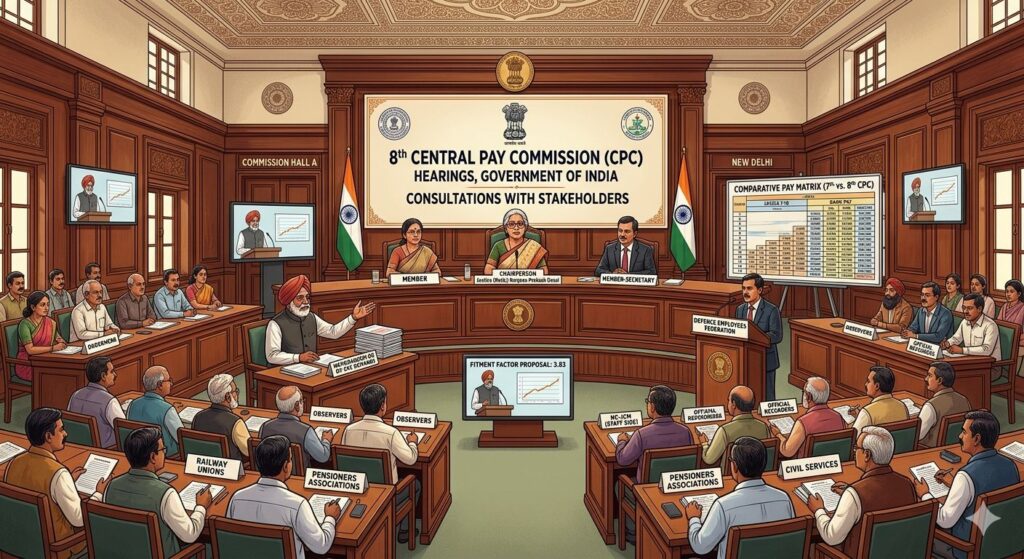
The hearings of the 8th Central Pay Commission (CPC) are currently underway. In a recent development, the Forum of Retired IPS Officers (FORIPSO) presented the following five long-standing disparities and anomalies regarding pension fixation and revision through a series of detailed PowerPoint slides:
- Pension Disparities: Seniors Receiving Less Than Juniors.
- Irrational Concordance Tables & Notional Pay Formula.
- Anomalies in the DG’s Pay Scale.
- Liberalisation of Enhanced Pension to Senior Pensioners.
- Commutation of Pension.
Except for the specific issue concerning the Director General of Police (DGP) pay scale, all other highlights are common across all services and ranks. Crucially, the recommendations in this presentation involve no additional fiscal burden on the Government; rather, they seek a fair, equitable, and logical rationalisation of existing frameworks.
Below is an exhaustive review of the core anomalies and the proposed corrective measures submitted to the 8th CPC for consideration.
Pension Disparities: Seniors Receiving Less Than Juniors
The Core Issue
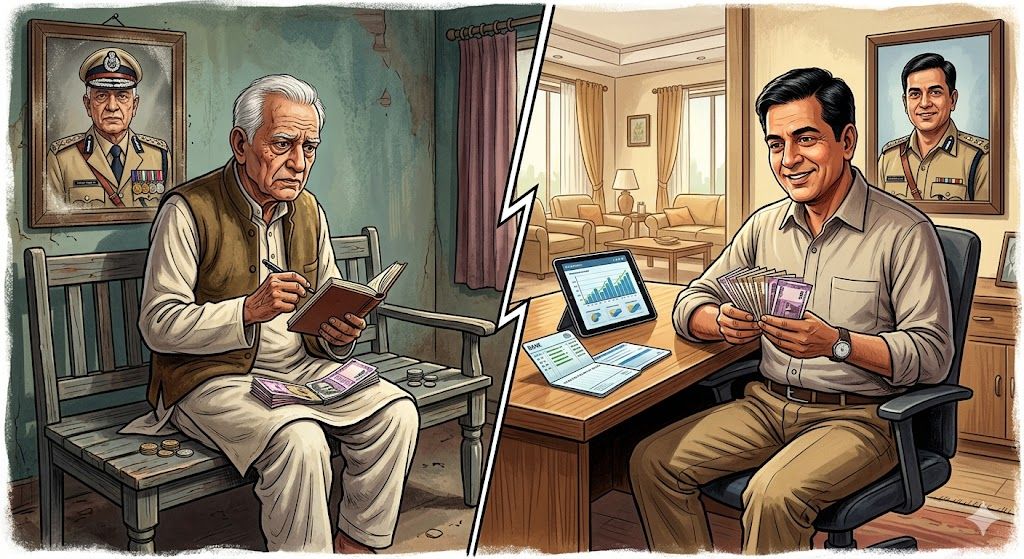
Overlapping pay scales currently cause senior retired officers to receive lower pension than their juniors. Because pension is calculated as 50% of the last pay drawn, a senior retiring at the bottom of a scale draws less than a junior/ feeder rank retiring at the top of his scale. This anomaly did not exist up to the 3rd CPC but was introduced during the 4th CPC and progressively worsened.
Recommended Fix
- Ensure that the pay scales of juniors do not overshoot those of their seniors.
- If an overlap is unavoidable, mandate that a senior’s pension shall not be less than the highest pension entitlement of a junior in the feeder rank.
Also Read: How Colonels and Brigadiers ended up with higher Pay and Pension than Generals
Historical Progression of Overlapping Pay Scales

3rd CPC (w.e.f. 01.01.1976)
No overlapping occurred; hence, no senior drew less than a junior.
| Rank | Pay Scale |
| IG (the then highest rank) | 2500-125-2750 |
| Addl. IG | 2250-125-2500 |
| DIG | 2000-125-2250 |
| SP (Selection Grade) | 1800 (fixed) |
| SP (Sr. Time Scale) | 1200-1700 |
4th CPC (w.e.f. 01.01.1986)
Overlapping was introduced for the ranks of IG and below.
| Rank | Scale | Remarks |
| DG | 7600-100-8000 | Except in DG & ADG ranks, IG and below retiring at the bottom of the scale received less than the highest pension of the junior feeder ranks because of overshooting of pay scales. |
| ADG | 7300-100-7600 | |
| IG | 5900-200-6700 | |
| DIG | 5100-150-6150 | |
| SP (Selection Grade) | 4500-150-5700 | |
| SP (J.A. Grade) | 3700-125-4700-150-5000 | |
| SP (Sr. Time Scale) | 3200-100-3700-125-4700 |
5th CPC (w.e.f. 01.01.1996)
Overlapping extended to all ranks except ADG.
| Rank | Scale | Minimum Pension | Maximum Pension | Remarks |
| DG | 24050-650-26000 | 12,025 | 13,000 | Except ADG, all other seniors retiring at the bottom of the scale received less than the highest pension of the junior feeder ranks. |
| ADG | 22400-525-24500 | 11,200 | 12,250 | |
| IG | 18400-500-22400 | 9,200 | 11,200 | |
| DIG | 16400-450-20000 | 8,200 | 10,000 | |
| SP (Selection Grade) | 14300-400-18300 | 7,150 | 9,150 | |
| SP (J.A. Grade) | 12000-375-16500 | 6,000 | 8,250 | |
| SP (Sr. Time Scale) | 10000-325-15200 | 5,000 | 7,600 |
6th CPC (w.e.f. 01.01.2006)
Pension overlaps expanded drastically across the board. For example, a pre-2006 retiree ADG could draw a pension of only ₹33,500, which fell short of a post-2006 ADG (₹39,500), an IG (₹38,500), a DIG (₹37,950), and even a Selection Grade SP (₹37,850) – who sits three levels below the ADG.
| Rank | Scale | Minimum Pension | Maximum Pension | Remarks |
| DG | 77765 – 80000 | 38,883 | 40,000 | All seniors retiring at the lower end of their pay scales ended up receiving pension lower than the highest pension of their junior feeder ranks, owing to the overshooting of pay scales. |
| ADG | 67000 – 79000 | 33,500 | 39,500 | |
| IG | Pay-Band-4: 37400-67000 + Grade Pay 10000 | 23,700 | 38,500 | |
| DIG | Pay-Band-4: 37400-67000 + Grade Pay 8900 | 23,150 | 37,950 | |
| SP (Selection Grade) | Pay-Band-4: 37400-67000 + Grade Pay 8700 | 23,050 | 37,850 | |
| SP (J.A. Grade) | Pay-Band-3: 15600-39100 + Grade Pay 7600 | 11,600 | 23,350 | |
| SP (Sr. Time Scale) | Pay-Band-3: 15600-39100 + Grade Pay 6600 | 11,100 | 22,850 |
7th CPC (w.e.f. 01.01.2016)
Pay scales were overstretched with extensive overlapping. A pre-2016 retiree DGP retiring at the bottom of the scale receives a pension of ₹1,02,700, which is less than a post-2016 retiree SP (Senior Time Scale) drawing ₹1,04,350 at the top of his scale – despite the SP being six ranks junior. This is not a hypothetical situation but a real one, supported by real time detailed data furnished to the 8th CPC by way of illustration.
| Rank | Pay Scale | No. of Increments | Minimum Pension | Maximum Pension |
| DG | 2,05,400 – 2,24,400 | 3 | 1,02,700 | 1,12,200 |
| ADG | 1,82,200 – 2,24,100 | 7 | 91,100 | 1,12,050 |
| IG | 1,44,200 – 2,18,200 | 14 | 72,100 | 1,09,100 |
| DIG | 1,31,100 – 2,16,600 | 17 | 65,550 | 1,08,300 |
| SP (Selection Grade) | 1,18,500 – 2,14,100 | 20 | 59,250 | 1,07,050 |
| SP (J.A. Grade) | 78,800 – 2,09,200 | 33 | 39,400 | 1,04,600 |
| SP (Sr. Time Scale) | 67,700 – 2,08,700 | 38 | 33,850 | 1,04,350 |
The Redundance of Excessive Increments
Historically, the number of increments for the DG rank was scaling down (4 increments in the 4th CPC, 3 in the 5th CPC, and 1 in the 6th CPC). The 7th CPC suddenly reversed this trend back to 3 increments without explanation.
The following table illustrates the redundance of granting unbridled increments, as an officer is often promoted long before utilising even a small portion of the prescribed increment range. Furthermore, assigning 33 and 38 increments to lower SP ranks translates to an impossible notional service length of 42 years, far exceeding any realistic service structure.
| Rank | Pay Scale | No. of Increments | Minimum Tenure in the Rank before Promotion* | Remarks |
| * | ||||
| DG | 2,05,400 – 2,24,400 | 3 | No further promotion | In the case of the lowest ranks, SP (Junior Administrative Grade) and SP (Senior Time Scale), the grant of 33 & 38 increments, respectively, translates into a notional service length of 42 years – considering that they had already completed the minimum qualifying service of 9 years and 4 years respectively. A 42-year service tenure is neither realistic nor aligned with the prevailing service structure. |
| ADG | 1,82,200 – 2,24,100 | 7 | 5 years | |
| IG | 1,44,200 – 2,18,200 | 14 | 7 Years | |
| DIG | 1,31,100 – 2,16,600 | 17 | 4 Years | |
| SP (Selection Grade) | 1,18,500 – 2,14,100 | 20 | 1 Year | |
| SP (J.A. Grade) | 78,800 – 2,09,200 | 33 | 4 Years | |
| SP (Sr. Time Scale) | 67,700 – 2,08,700 | 38 | 5 Years |
*Note: Minimum promotion tenures are drawn directly from official Government promotion guidelines:
| Sl. | Rank | Eligibility for Promotion on Completion of: |
| Senior Time Scale (STS) – Supdt. of Police (SP) | 4 years of service as ASP | |
| Junior Administrative Grade (JAG) SP | 9 years of service | |
| Selection Grade SP | 13 years of service | |
| Deputy Inspector General of Police (DIG) | 14 years of service | |
| Inspector General of Police (IGP) | 18 years of service | |
| Addl. Director General of Police (ADGP) | 25 years of service | |
| Director General of Police (DGP) | 30 years of service |
Impact: Inefficiency Rewarded
The unrestrained increments have led to a situation where officers in feeder ranks receive higher pension than their seniors who have not reached the top of the running pay scales. Except in rare cases of stagnation due to non-availability of higher posts, these continuous increments – particularly in the feeder ranks of IG and below – effectively reward inefficiency. An officer overlooked or superseded for promotion can end up drawing a higher pension than his seniors, who may be 4 to 6 ranks above him, despite the latter having earned promotions through merit, efficiency, and integrity. The elongated and overlapping pay scales thus have the unintended effect of benefiting less competent subordinates, otherwise ineligible for promotion, by allowing them to continue accruing increments indefinitely.
Legal Precedent and the “Next Below Rule”
Delhi High Court Order dated 20.03.2024 in WP(C) No. 8080/2016 & 6002/2016, UOI Vs. All India S-30 Pensioners’ Association, upheld by the Supreme Court on 04.10.2024 in SLP(C) No. 23558 of 2024. The same Judgement applies to WP(C) 7350/2015, UOI Vs. FORIPSO. A crux of the Order is given below:-
- Pension Fixation at the Corresponding Level:- The pension of pre-2006 and earlier retirees is to be fixed at the corresponding level of the revised scale and not at the minimum of the revised scale, meaning thereby the increments last earned will be given equivalent weightage in the revised scale.
- DGs not to draw less Pension than ADGs, etc:-Retired DGs (Scale-32) shall not receive a pension lower than that of retired ADGs (Scale-30). In other words, the minimum pension of pre-2006 retiree DGs shall not be less than ₹39,500, which is the maximum permissible pension of post-2006 retiree ADGs. Similarly, ADGs shall not draw less pension than IGs, IGs not less than DIGs, and DIGs not less than SPs, ensuring a consistent and logical pension hierarchy across all levels.
- The ratio settled and the settled law of Next Below Rule imply the 7th CPC scales should logically be designed as follows:
| Rank | 7th CPC Scale | Pension Not to be Less than: |
| DG | 2,05,400 – 2,24,400 | 1,12,050 (ADG’s highest pension) |
| ADG | 1,82,200 – 2,24,100 | 1,09,100 (IG’s highest pension) |
| IG | 1,44,200 – 2,18,200 | 1,08,300 (DIG’s highest pension) |
| DIG | 1,31,100 – 2,16,600 | 1,04,350 (SP’s highest pension) |
| SP | 67,700 – 2,08,700 | – |
- Irrational Concordance Tables & Notional Pay Formula
The Core Issue
Under Clauses 17.41 and 17.42, the 7th CPC recommended that past retirees receive full weightage for earned increments (a principle subsequently upheld by the Supreme Court as cited earlier). While the Government accepted this, a subsequent implementation committee declared it unfeasible and introduced the alternative mechanisms of “Notional Pay” and “Concordance Tables” (OM No. 38/37/2016-P&PW(A) dated 6th July 2017).
However, the Department of Expenditure prepared 58 Concordance Tables that arbitrarily “bunched” multiple pay stages together, effectively deleting the benefits of most of the past earned increments. This anomaly is illustrated below with Concordance Table No. 56, applicable to DGs:
Concordance Table No. 56 for DGs
Scale of Pay/ Pay in the Pay Band & Grade Pay at the time of retirement:
| From 01.01.1986 to 31.12.1995 | 7600-100-8000 |
| From 01.01.1996 to 31.12.2005 | 24050-650-26000 |
| From 01.01.2006 to 31.12.2015 | 75500-3%-80000 |
| Corresponding level w.e.f. 1.1.2016 | Level 16 (205400-224400) |
| 4th CPC: Basic Pay From 01.01.1986 to 31.12.1995 | 5th CPC: Basic Pay From 01.01.1996 to 31.12.2005 | 6th CPC: Basic Pay From 01.01.2006 to 31.12.2015 | Pay range for pensioners retired during 01.01.2006 to 31.12.2015 | Notional Pay as on 01.01.2016 | Revised Pension/ Enhanced Family pension (if applicable) w.e.f. 01.01.2016 | Revised Family pension w.e.f. 01.01.2016 | |
| Minimum | Maximum | ||||||
| 7600 | 24050 | 77765 | – | 79920 | 205400 | 102700 | 61620 |
| 7700 | 24050 | 77765 | – | 79920 | 205400 | 102700 | 61620 |
| 7800 | 24050 | 77765 | – | 79920 | 205400 | 102700 | 61620 |
| 7900 | 24700 | 80000 | 79930 | 80000 | 211600 | 105800 | 63480 |
| 8000 | 24700 | 80000 | 79930 | 80000 | 211600 | 105800 | 63480 |
| 25350 | 80000 | 79930 | 80000 | 211600 | 105800 | 63480 | |
| 26000 | 80000 | 79930 | 80000 | 211600 | 105800 | 63480 | |
Specific Distortions:
- 4th CPC Retirees: Earned increments (0, 1, and 2) were all bundled together at the absolute bottom of the 7th CPC scale (₹2,05,400), wiping out their incremental history. Stages with 3 and 4 increments were clumped together, allowing only a single increment benefit.
- 5th CPC Retirees: The top three stages – representing 1, 2, and 3 increments respectively – were compressed into a single stage (Notional Pay of ₹2,11,600), discarding earned differences.
- 6th CPC Retirees: Retirees at the peak of the pre-revised scale (₹80,000) were fixed just one step above the bottom of the new scale (₹2,11,600) instead of the top.
The Right Fix: Rational Concordance Tables
To honour actual past increments, the tables must be restructured by mapping advancements from the top of the scale downward, rather than forcing everyone into the bottom register.
Rational Table No. 56 (4th CPC Retirees)
| 4th CPC: Basic Pay From 01.01.1986 to 31.12.1995 | Rational Notional Pay as on 01.01.2016 | Rational Revised Pension w.e.f. 01.01.2016 | Rational Revised Family pension w.e.f. 01.01.2016 |
| 7600 | 205400 | 102700 | 61620 |
| 7700 | 211600 | 105800 | 63480 |
| 7800 | 217900 | 108950 | 65370 |
| 7900 | 224400 | 112200 | 67320 |
| 8000 | 224400 | 112200 | 67320 |
Rational Table No. 56 (5th CPC Retirees)
| 5th CPC: Basic Pay From 01.01.1996 to 31.12.2005 | Rational Notional Pay as on 01.01.2016 | Rational Revised Pension w.e.f. 01.01.2016 | Rational Revised Family pension w.e.f. 01.01.2016 |
| 24050 | 205400 | 102700 | 61620 |
| 24700 | 211600 | 105800 | 63480 |
| 25350 | 217900 | 108950 | 65370 |
| 26000 | 224400 | 112200 | 67320 |
Rational Table No. 56 (6th CPC Retirees)
| 6th CPC: Basic Pay From 01.01.2006 to 31.12.2015 | Rational Notional Pay as on 01.01.2016 | Rational Revised Pension w.e.f. 01.01.2016 | Rational Revised Family pension w.e.f. 01.01.2016 |
| 77765 | 217900 | 108950 | 65370 |
| 80000 | 224400 | 112200 | 67320 |
Recommended Action:
- The 8th CPC may reiterate the recommendation of the 7th CPC and extend the benefit of all past increments in the revised pay scale.
- Given the variation in the number of increments across successive CPCs, the revised pension should be computed by counting increments from the top of the scale downward, rather than from the bottom upward.
- It must be ensured that the revised pension of a senior rank is not lower than the maximum pension admissible to any of the lower ranks.
- Anomalies in the DG’s Pay Scale
The Core Issue
The 7th CPC split the uniform rank of Director General into two separate classes: the Apex Scale (₹2,25,000) for select positions and an inferior running HAG+ scale (₹2,05,400 – ₹2,24,400) for others. This layout fragments a singular rank whose officers hold completely interchangeable posts.
Furthermore, when State Governments assign an officer as an “Acting DGP (HoPF)“, the Apex Scale is frequently placed in abeyance, depriving senior officers of their rightful dues.
Recommended Action
Restore rank uniformity by granting the Apex Pay Scale to all DGs across the board. This correction carries minimal financial implications for the exchequer.
Institutional Justification
- DG is the highest rank in the IPS, beyond which there is no further promotion. Although the Apex Pay sanctioned for DGP (HoPF) is one step higher than that of other DGs, the two positions are interchangeable, without any formal promotion process or disciplinary procedure for demotion.
- DGP (Head of Police Force – HoPF) is not a promotional post, but merely a selection from among officers of the same rank (DGs). It is essentially a re-designation of one DG post with a higher pay scale (Apex Scale), keeping in view the stature and responsibilities attached to the position.
- The DGP (Head of Police Force – HoPF) has no supervisory or legislative authority over other cadre DGs. It is significant that neither the IPS (Pay) Rules, nor the IPS (Fixation of Cadre Strength) Regulations, nor any MHA document (including the Profile of the IPS and Cadre Strength Statement published on the MHA website) indicates any inter-se superiority among officers holding the rank of DG.
- IPS officers rise to the rank of DG through merit and a proven record of performance, not merely by seniority or any time bound pattern. Officers with undistinguished service records do not reach this level.
- Interchangeability: Substantive positions are shifted between DG posts without demotion or promotion protocols. Under MHA Order No. 16011/11/2016-IPS.II dated 08.03.2018, an officer transferred out of the HoPF post retains Apex Pay protection. Thus, having multiple DGs drawing Apex Pay simultaneously is already a legally recognised reality.
- The “Acting DGP” Arbitrariness: The concept of an “Acting DGP” emerged as a loophole to bypass the Supreme Court’s mandate in Prakash Singh & Ors. vs. UOI (2006), which restricted political interference by requiring a UPSC-vetted three-name panel. Appointing junior officers on an “acting” basis bypasses seniority, leaving senior DGs unfairly penalised without cause.
- Legal Protections: The Next Below Rule (NBR) stipulates that seniors cannot be bypassed without formal disciplinary proceedings. This framework is reinforced by plethora of Court rulings, including the Delhi High Court Order (28.02.2013) in State of Bihar Vs. J.K. Khanna, upheld by the Supreme Court on 03.05.2013, alongside the landmark D.S. Nakara vs. UOI (1983) ruling.
- Liberalisation of Additional Pension to Senior Pensioners
The Core Issue
Currently, additional age-related pension increments only begin at 80 years of age. However, life expectancy data for India sits at an average of 70.82 years, meaning the vast majority of pensioners pass away before ever unlocking these benefits.
Unlike active staff, pensioners do not get annual increments to cushion lifestyle inflation, and aging brings exponentially higher healthcare expenses.
| Age of Pensioner | Additional Quantum of Pension |
| From 80 years to < 85 years | 20% of basic pension |
| From 85 years to < 90 years | 30% of basic pension |
| From 90 years to < 95 years | 40% of basic pension |
| From 95 years to < 100 years | 50% of basic pension |
| 100 years or more | 100% of basic pension |
Proposed Alternatives
1st Alternative: Smooth Annual Trajectory
Instead of forcing a 20-year wait for a 20% bump, implement a steady 1% annual increment from the date of retirement up to age 80. Post-80, distribute the remaining tiers proportionally inside each five-year slab.
| Age of Pensioner | Current Additional Pension | Proposed Additional Pension |
| From 60 yrs to < 80 yrs | Nil | 1% p.a. (20% divided by 20 years) |
| From 80 yrs to < 85 yrs | 20% of basic pension | 20% + 2% p.a. (10% divided by 5 years) |
| From 85 yrs to < 90 yrs | 30% of basic pension | 30% + 2% p.a. (10% divided by 5 years) |
| From 90 yrs to < 95 yrs | 40% of basic pension | 40% + 2% p.a. (10% divided by 5 years) |
| From 95 yrs to < 100 yrs | 50% of basic pension | 50% + 10% p.a. (50% divided by 5 years) |
| 100 years or more | 100% of basic pension | 100% of basic pension |
2nd Alternative: Entry Tiers starting at Age 65
Introduce the entry tier starting at age 65 rather than 80, climbing by 5% every five years.
| Age of Pensioner | Current Additional Pension | Proposed Additional Pension |
| From 65 years to < 70 years | Nil | 5% of basic pension |
| From 70 years to < 75 years | Nil | 10% of basic pension |
| From 75 years to < 80 years | Nil | 15% of basic pension |
| Above 80 years | Annual increments as proposed in the 1st alternative. | |
Legislative and State Precedents
This second alternative has strong structural backing. The Department-Related Parliamentary Standing Committee on Personnel, Public Grievances, Law and Justice recommended exactly this 65-year layout in Para 3.28 of Report No. 110 (presented to Parliament on 10.12.2021).
Several states have already successfully adopted decentralized models:
- Punjab: Sanctioned an old-age allowance model stretching back to 1989. It was expanded to the All-India Services (AIS) via Letter No. 3/13/90-2FPIII/6037 dated 12.07.1990 and liberalized on 22.12.2011. Punjab maintains a 5% edge over central limits across all tiers.
- Himachal Pradesh: Extended a matching 5% scaling “Pension Allowance” starting at age 65 to State and AIS pensioners via multiple orders spanning 2014 to 2022.
- Andhra Pradesh (2019): Initiated additional relief starting at 10% for the 70–75 age group.
- Madhya Pradesh (2010): Enacted specialized rules for Judicial Officers under Article 309 providing up to 20% additional pension by age 75.
- Rajasthan (2024): Amended its Civil Services Rules to award 5% at age 70 and 10% at age 75.
Comparative Table: Current Centre vs. State Frameworks
| Age Band | Central Govt | Punjab | Himachal Pradesh | Andhra Pradesh | Madhya Pradesh | Rajasthan |
| 65 to < 70 | Nil | 5% | 5% | Nil | Nil | Nil |
| 70 to < 75 | Nil | 10% | 10% | 10% | 10% | 5% |
| 75 to < 80 | Nil | 15% | 15% | 15% | 20% | 10% |
| 80 to < 85 | 20% | 25% | 20% | 20% | 30% | 20% |
| 85 to < 90 | 30% | 35% | 30% | 25% | 40% | 30% |
| 90 to < 95 | 40% | 45% | 40% | 30% | 50% (up to <100) | 40% |
| 95 to < 100 | 50% | 55% | 50% | 35% | 50% | 50% |
| 100+ | 100% | 100% | 100% | 50% | 100% | 100% |
- Commutation of Pension
- Rule 10-A of the CCS (Commutation of Pension) Rules, 1981 mandates uniform restoration of commuted pension after 15 years, irrespective of the actual period required for recovery of the commuted amount and irrespective of the age at which the pension is commuted. In practice, the principal amount of commuted pension is fully recovered much earlier than 15 years, and continued deductions up to 15 years result in substantial excess recovery from pensioners. This amounts to immoral enrichment of the State at the cost of senior citizens.
- There appears to be a misapplication of para 9 of the oft-quoted 1987 Judgment of the Supreme Court in the Common Cause case in WP No. 3958-61 dated 19.12.1986. The 15-year restoration period indicated by the Court was based on the commutation factors prevailing at that time, when the recovery period was approximately 12 years, plus a 2-year equitable buffer. However, after revision of the Commutation Table in 2008 (w.e.f. 02.09.2008), the recovery period has drastically reduced to 8.194 years (at age 60). Therefore, logical application of the same ratio/principle would imply a restoration period of 10.2 years (8.194 + 2), not 15 years.
- Rule 10-A also treats unequals as equals by applying a uniform 15-year recovery period to all pensioners, regardless of the age at which they commute their pension. For example, a person commuting pension at age 65 has a recovery factor of 7.591 years, whereas a person commuting at age 60 has a recovery factor of 8.194 years, yet both are subjected to the same 15-year deduction period. This results in greater excess recovery from those who commute at higher ages.
- It is also incorrect to assume that pensioners are able to earn significant returns on the commuted amount. In many cases, the commuted amount is used for medical treatment, family obligations, repayment of loans, or house construction. With prevailing interest rates in the range of 6–7% (all taxable) and inflation reducing real returns, the assumption that pensioners financially benefit from commutation is factually unsupported. It in no way justifies 15 years of deduction.
- It is relevant to note that the 5th Central Pay Commission at para 136.12 of Part-VI (page 1819 to 1824) of Volume-III of its report recommended a recovery period of 12 years. The Government did not accept the recommendation, without assigning any reasons. The 6th Central Pay Commission recommended that the issue be revisited after revision of the Commutation Table. Although the Commutation Table was revised in 2008, the recovery period was not reduced.
- The present issue is not with the Commutation Table, but with the fixed 15-year recovery period, which has become excessive and inequitable after the revision of commutation factors in 2008.
Recommended Fix
- The restoration period for commuted pension should be rationalised by aligning it with the actual recovery period indicated in the Commutation Table (2008), along with a reasonable equitable buffer as originally envisaged by the Supreme Court
- Restoration of commuted pension may be allowed after completion of the actual recovery period, based on the commutation factor applicable at the age of commutation, together with an additional buffer of two years towards recovery of interest. Since the current recovery period is approximately 8.194 years at the age of 60, the restoration period may be rationalised to 10.2 years (8.194 + 2), in place of the existing uniform period of 15 years.
- This would ensure fairness, prevent excess recovery, and remove the anomaly of a uniform 15-year recovery period for all pensioners irrespective of age. This would be in line with the 1987 ruling of the Supreme Court.
Conclusion
The arguments and tables presented above highlight systemic contradictions within the pension framework. Overlapping pay scales penalise meritorious promotions, unscientific concordance tables wipe out earned increments, and outdated recovery windows result in excess deductions from senior citizens.
FORIPSO’s submission to the 8th Central Pay Commission offers clear, legally backed solutions to these anomalies, ensuring a fair and equitable retirement framework for all civil servants without added fiscal strain on the government.


Very well analysed. Thank You, Mr Khanna for these projections before the 8CPC. These shall certainly help all the AIS retirees.