


Dolphins are one of the ocean’s most intelligent, playful, social and human-friendly creatures. Dolphins belong to the Delphinidae family, which comprises around 37 recognized species – ranging from the small Maui’s dolphin (about 1.7 meters long) to the large orca or killer whale (up to nearly 10 meters long)— found in oceans, seas, estuaries, and rivers worldwide. They are known for streamlined bodies, prominent dorsal fins, and long beaks with conical teeth.
Dolphins live in complex societies, commonly known as pods. These groups can sometimes merge into “superpods” numbering in the thousands, especially when food is abundant.
Dolphins live in water but they are not fish. They are mammals. Unlike fish, dolphins:
- Are warm-blooded creatures. They maintain a constant body temperature irrespective of the surrounding water. The biggest advantage of being warm-blooded is that it makes dolphins less prone to infections and other health conditions that affect cold-blooded species.
- Breathe air through their lungs and need to periodically come to the surface to replenish their air supply, unlike fish which can breathe underwater through their gills.
- Give birth to live young and nurse them with milk, unlike most fish which lay eggs.
- Have a thick layer of insulating blubber beneath their skin for warmth, which fish do not have.
- Possess body hair, especially visible at birth, which fish lack.
- Move their tails up and down to propel themselves, whereas fish swim by moving tails side to side.
- Have skeletal and physiological traits like four-chambered hearts and ear bones characteristic of mammals.
These adaptations make dolphins fundamentally different from fish but superbly adapted for aquatic life. For instance, dolphins have a greater capacity for oxygen storage in their lungs, blood, and muscles and can exchange 80% of the air in their lungs with each breath, while humans are only capable of exchanging 17%. This ensures a more efficient use of the oxygen in their bodies and allows them to stay under-water for longer period of time.

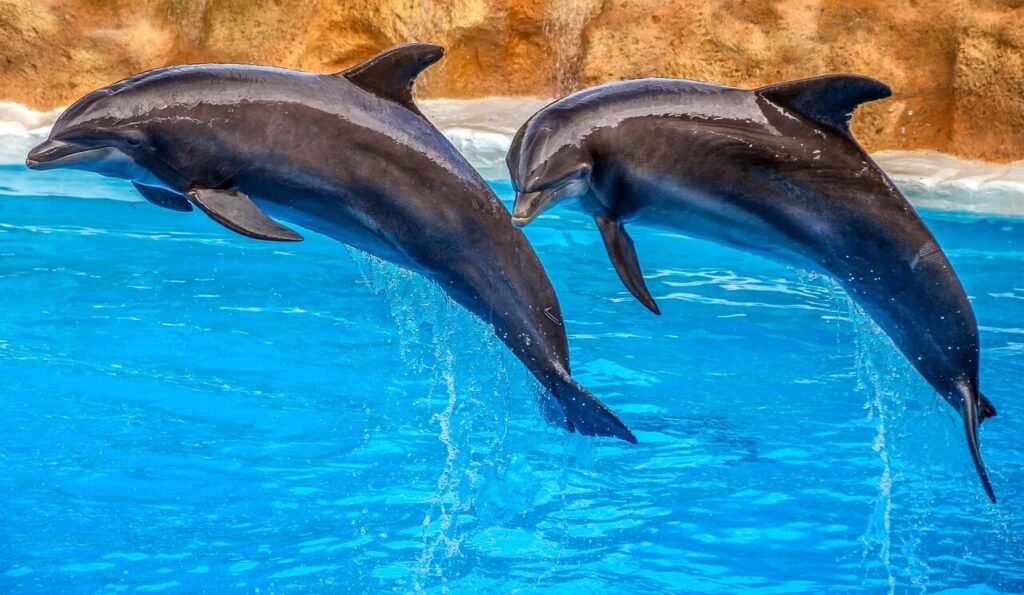
Dolphins have a torpedo-shaped body that reduces drag and allows them to swim swiftly and gracefully through the water, reaching speeds of up to 37 mph (60 km/h) in short bursts. They have a thick layer of blubber under their smooth, rubbery skin, which provides insulation in cold waters, buoyancy, and energy reserves. Their skin continuously sheds and renews to maintain hydrodynamic efficiency. A prominent dorsal fin on their back stabilizes their swimming and helps with balance. Each dolphin’s dorsal fin is unique in shape and markings, useful for identification. The powerful tail fins (flukes) move vertically, unlike fish tails that move side to side, enabling efficient propulsion and graceful leaps out of the water. Dolphins have conical teeth (usually 80-100) designed to grip slippery prey like fish and squid. They swallow their prey whole and have a multi-chambered stomach to aid digestion. Their skin contains specialized nerve endings that provide touch and pressure sensitivity, helping them sense movements and navigate their environment. Dolphins have exceptional hearing both in air and underwater, essential for echolocation and communication. Dolphins breathe through a blowhole, positioned on top of their heads, which allows efficient air exchange at the surface.
Dolphins navigate and hunt using sound waves and echoes, with remarkable precision in murky water or darkness. They demonstrate problem-solving skills, self-awareness (mirror recognition), learning, cultural transmission, and communication using diverse vocalizations. Dolphins often interact with humans and engage in playful behaviours like leaping, surfing waves, and playing with objects. These physical and cognitive adaptations make dolphins exceptionally well-suited for marine life and enable their characteristic friendly, social nature that often extends to humans.
Unique features of dolphins

There are several key features, which make dolphins uniquely human-friendly among wild animals:
Communication and recognition
Dolphins are good communicators. Dolphins rely on —whistles, clicks, squeaks—and nonverbal cues, such as touching, leaping, and synchronous swimming, to communicate with pod mates and, occasionally with human beings. They communicate using a rich variety of vocalizations and body language to establish and maintain social bonds. Dolphins can make squeaks, buzzes, whistles, clicks, and a wide array of noises. These whistles can be heard by others of the species from miles away. These signature whistles can help them recognize each other. Studies suggest they can learn to respond to human cues and vocalizations. Communication within dolphin pods is remarkably sophisticated, relying on unique signature whistles that function like names, enabling individuals to identify and call each other across vast distances.
Advanced intelligence
Another key attribute of dolphins is their advanced intelligence, which sets them apart from most other marine species and places them among the most cognitively capable animals on Earth. Research suggests that their large brains, high emotional intelligence, and problem-solving abilities make them keen observers of other intelligent beings—including people. Their brains are not only large relative to body size but also highly complex, with specialized regions that support problem-solving, social bonding, and communication. Dolphins can recognize themselves in mirrors, a rare trait shared with only a few other species. Dolphins are quick learners capable of understanding symbolic languages, following multi-step instructions, and imitating behaviours from humans or other animals. Their intelligence shines not only in individual capabilities but also in their strong social structures, where cooperative hunting strategies, role-playing, and collective defence against predators illustrate a level of teamwork and cultural transmission that rivals primates.
Large, complex brains
Dolphins have some of the largest brains relative to body size in the animal kingdom. Their neocortex, responsible for reasoning, perception, and social interaction, is highly developed. Dolphins have demonstrated self-recognition in mirrors (an indicator of self-awareness) and are capable of advanced problem-solving, imitation, and innovative play.
Social structure and empathy
Dolphins are altruistic and empathetic: they care for sick or injured pod members, assist one another during births, and have even aided other marine species or humans in distress. Their playful behavior—jumping, surfing waves, tossing fish—serves not only as exercise or practice for hunting, but also as a means of bonding within the group and with humans.
Learning and culture
Some dolphin populations have developed unique “cultural” behaviours, such as tool use (using sponges to protect their snouts while foraging) and passing down hunting strategies through generations—behaviours once considered exclusive to humans and primates. Pods in Shark Bay, Australia, have learned to “beach” themselves intentionally to catch fish, a skill learned by calf dolphins through observation.
Social structure and bonds
Within their pods, dolphins form bonds that can last decades, especially between mothers and calves, and among males who form cooperative alliances. These bonds are maintained through physical contact, synchronized swimming, vocalizations, and social play. The same behaviors that nurture connections within their pods may motivate dolphins to seek similar interactions with humans, who represent novel social partners.
Curiosity and playfulness
Dolphins are naturally curious and playful animals. Their social bonds encourage playful behavior that strengthens relationships, and they often extend this playfulness to humans, approaching boats, swimmers, and divers. This curiosity is supported by their high intelligence and emotional responsiveness, making them keen observers and learners of human behaviour.
Empathy and altruism
Dolphins show empathy towards pod members by aiding sick or injured individuals, nursing calves, and coordinating when threatened. These empathetic tendencies may sometimes extend to humans, explaining reports of dolphins helping swimmers in distress. Their socially driven altruism highlights how social bonds underpin their friendly interactions not only among themselves but also toward people.
Tourism and conservation
The friendliness of dolphins has fostered a global ecotourism industry, attracting millions to destinations like Hawaii, the Bahamas, and the Canary Islands. These interactions have inspired public support for marine conservation, though they must be carefully managed to ensure dolphins are not disturbed or put at risk.
Dolphin-assisted therapy
Therapy programs involving dolphins have proliferated in recent decades, based on claims that interaction with these animals can benefit people, especially children with autism or physical disabilities. While the true therapeutic value is debated, the positive emotional and psychological impact of swimming with dolphins is widely reported.
How many dolphin species are there?

There are dozens of species of dolphins and each has their own unique habitats, appearance, and behaviour. Many dolphins are grey in colour, some species have various patterns of black and white, and a few are even pink. These include:
Bottlenose Dolphin (Tursiops truncatus)
Perhaps the most famous and widespread, bottlenose dolphins are frequently the stars of marine parks and documentaries. Known for their intelligence, adaptability, and playfulness, they often seek out contact with humans both in the wild and in captivity.
Pacific White-Sided Dolphin (Lagenorhynchus obliquidens)
These strikingly marked dolphins are considered among the most gregarious. Found in the cool waters of the North Pacific, they approach boats, leap alongside swimmers, and interact with other species—often forming large pods that display acrobatic behaviors.
Spinner Dolphin (Stenella longirostris)
Named for their energetic leaps and spins, spinner dolphins are commonly seen in tropical regions. These dolphins travel in large, cohesive groups and often swim near the surface, mingling with boats and human observers.
Pink Amazon River Dolphin (Inia geoffrensis)
While less likely to approach humans due to their shy, freshwater habitat, these dolphins are beloved in South American folklore. Their striking coloration and occasional appearances near river communities have earned them a special appreciation among people who share the Amazon basin.
Common Dolphin (Delphinus delphis)
These dolphins are renowned for their fast swimming, frequent bow-riding, and playful nature. They often engage with whale-watching tours and fishing boats, making them a regular sight off many temperate and tropical coasts.
Dolphins – ambassadors for the sea

Dolphins are sentinels of ocean health, when their populations decline, it signals that marine ecosystems are faltering. Like many marine animals, they face growing threats: overfishing, pollution (especially plastic waste and toxic chemicals), noise from ships, and habitat loss. Efforts to protect dolphins can have far-reaching benefits for entire ecosystems—from the reduction of bycatch in fisheries to broader marine protection legislation. In caring for dolphins, we are caring for the seas on which our own species depends.
Why are dolphins under threat?
Dolphins face many threats around the globe. Dolphins are often drown in nets intended for tuna, shrimp, or other fish. By some estimates, hundreds of thousands of dolphins die annually as collateral damage in industrial fishing operations. “Dolphin-safe tuna” labels are helpful, but enforcement is inconsistent and often unreliable in international waters.
Noise Pollution: Dolphins rely on echolocation to navigate and hunt. The proliferation of ship traffic, seismic blasting for oil exploration, and military sonar disrupts this delicate system. Loud underwater noise disorients, stresses, and sometimes kills cetaceans outright. What for humans is an invisible externality of modern life becomes a matter of life and death for dolphins.
Ocean Contamination: Dolphins accumulate toxic chemicals like mercury and PCBs in their bodies due to bioaccumulation. This not only threatens dolphin populations but also poses indirect health risks for coastal communities that consume seafood contaminated through the same food web.
Climate Change: Warming oceans disrupt dolphin prey availability and migration patterns. Melting ice and ocean acidification further alter marine ecosystems, destabilizing the environments dolphins rely upon. There is also evidence that climate-induced extreme weather threatens certain populations of river dolphins, which already survive under precarious conditions.
Direct Slaughter and Exploitation: The infamous dolphin hunts in places like Taiji, Japan, or drive hunts elsewhere, where dolphins are corralled and killed en masse, have sparked international outrage. Yet they persist, rationalized as cultural traditions or economic necessities. The continued endurance of such hunts underscores how cultural reverence has limits in the face of industrial and market pressures.
Conclusion

Dolphins are more than curiosities of nature. They are intelligent, social, and self-aware beings who embody both our admiration and our failures as custodians of the planet. Their plight reveals systemic flaws—from industrial overreach to the corruption of culture in the name of profit. Their survival, however, could tell a different story: that humanity, at a moment of ecological crisis, chose to expand its circle of concern and reshape its relationship with the natural world.