
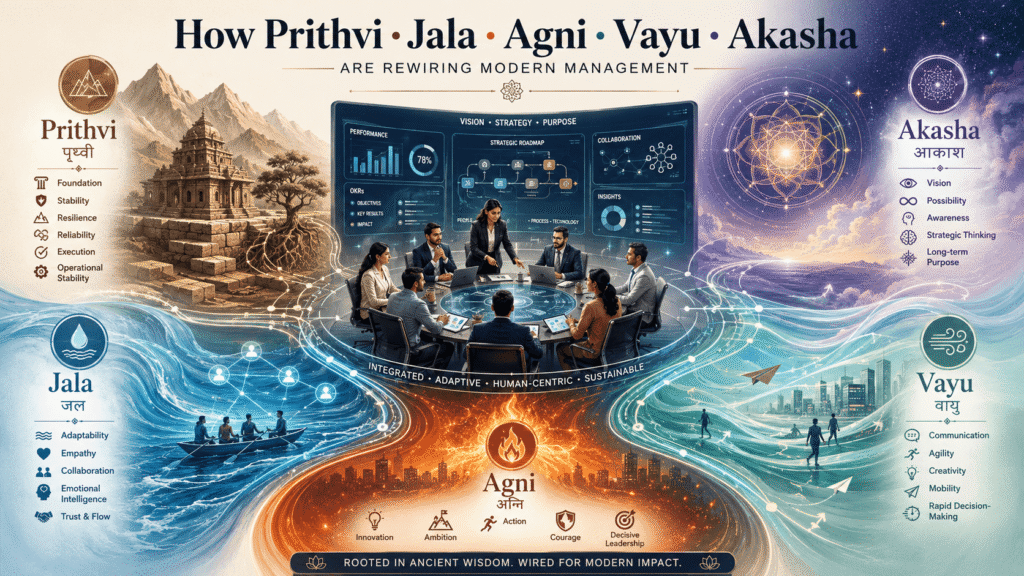
“Pancha” means five, “maha” means great, and “bhuta” refers to elemental constituents. Together, Panchamahabhuta describes the five great elements that form the basis of existence.
The espresso machine at Cafe Aromas in Hiranandani Powai, Mumbai was hiss-crying, but it wasn’t as loud as the buzzword fatigue at the table next to me.
I watched an earnest management consultant sketch “The Four Pillars of Leadership” Purpose, Presence, Performance, and Partnership—onto a napkin for a group of wide-eyed youngsters. I checked my notebook: that was the seventh “proprietary framework” I had encountered this year. By the time our coffee arrived, my companion—the Chief Strategy Officer of a mid-cap auto-component firm—leaned in and whispered the quiet part out loud.
I’ve stopped reading the management books,” he admitted. “It’s the same wine in different bottles. Ten years later, and nothing has actually moved.

He isn’t just cynical; he’s right. The statistics back him up with sobering clarity. McKinsey’s long-running research, refreshed as recently as 2023, confirms that roughly 70% of organizational transformations fail to meet their objectives. Meanwhile, the average tenure of an S&P 500 company has plummeted from 67 years in the 1920s to just 21 years today. We have more business schools, more consultants, and more “thought leadership” per square mile than at any point in human history, yet the half-life of a successful enterprise is collapsing.
Something is wrong with the wine, the bottles, or both.
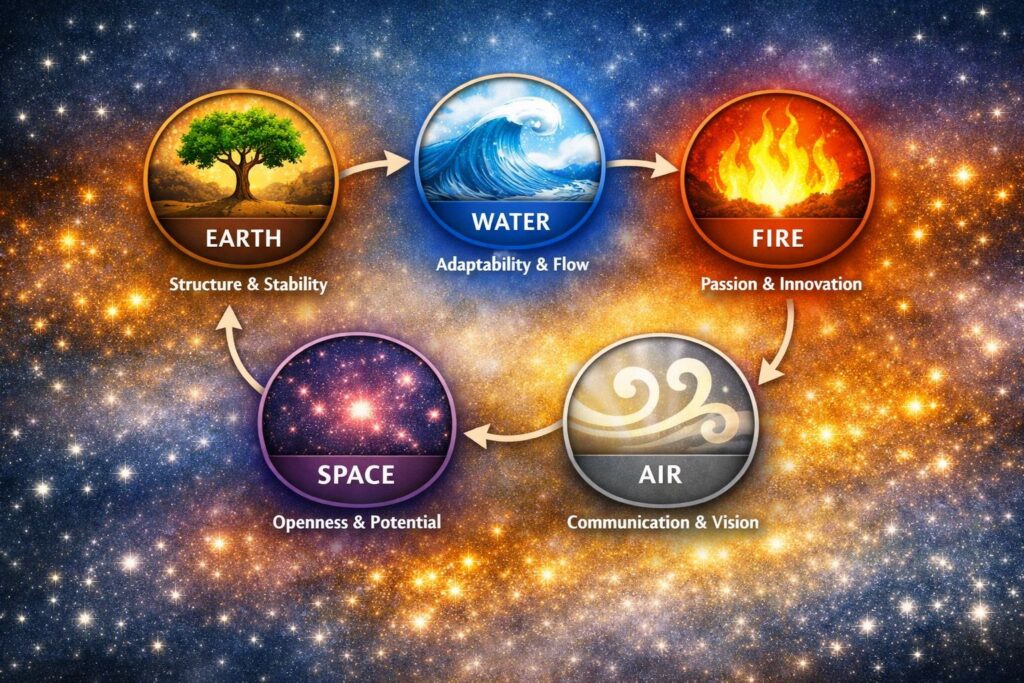
Which is what bringing me, with a necessary dose of skepticism, to the Panchamahabhuta—the five great elements of classical Indian thought. Earth, Water, Fire, Air, and Ether. Or, in the resonance of the original Sanskrit: Prithvi, Jala, Agni, Vayu, and Akasha.
Here is a well-known Sanskrit verse on the Panchamahabhuta:
पृथिव्यप्तेजो वायुराकाशश्चेति पञ्चभूतानि ।
एतैः सर्वं जगदेतत् संजातं धार्यते लीयते च ॥
Transliteration:
*Prithivy-ap-tejo vayur-ākāśaś cheti pañcha bhūtāni |
Etaiḥ sarvaṁ jagadetat sañjātaṁ dhāryate līyate cha |*
Meaning:
Earth, water, fire, air, and space are the five elements. From these, the entire universe is born, sustained, and finally dissolves.
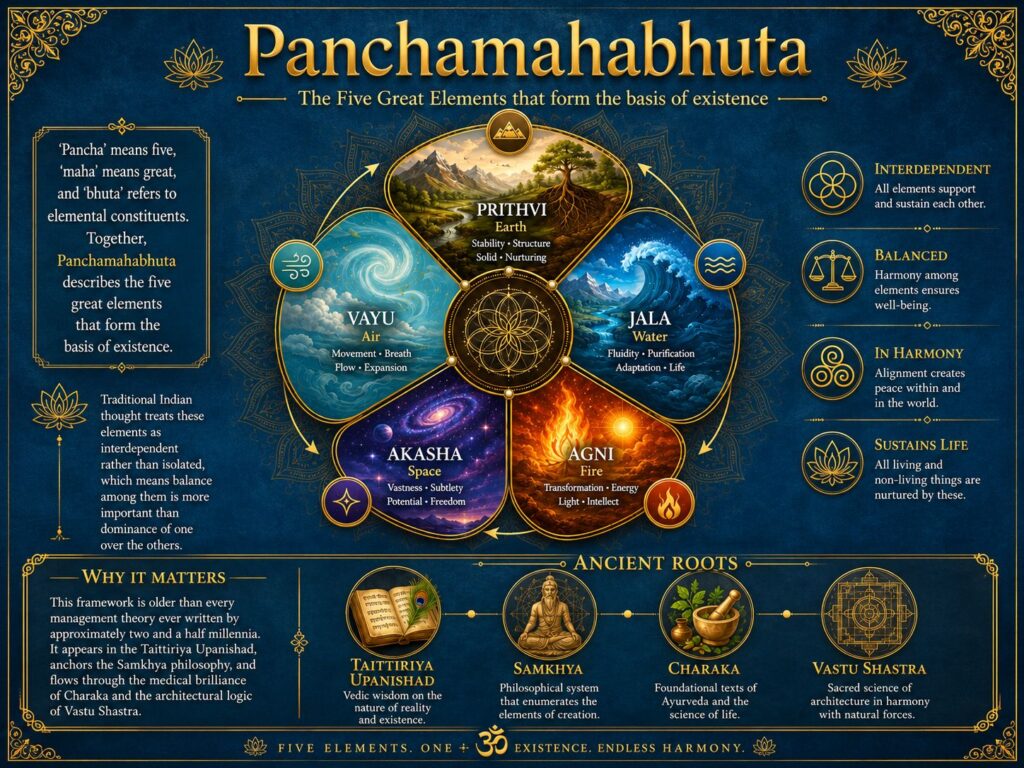
Traditional Indian thought treats these elements as interdependent rather than isolated, which means balance among them is more important than dominance of one over the others.
This framework is older than every management theory ever written by approximately two and a half millennia. It appears in the Taittiriya Upanishad, anchors the Samkhya philosophy, and flows through the medical brilliance of Charaka and the architectural logic of Vastu Shastra. Strip away the ritual scaffolding, and you are left with an extraordinarily disciplined system designed to ask one question: What is everything made of, and how do these constituent things relate to each other?
That is not a mystical question. It is the oldest strategic question in the world.
Before We Proceed: A Necessary Clearing of the Air
Let me be direct about what this article is not. It is not an invitation to install meditation rooms next to the server farm and declare your company “spiritually aligned.” It is not a pitch for Ayurvedic leadership retreats in Rishikesh, though I have attended one and the food was excellent. It is not the latest attempt to drape ancient wisdom over contemporary anxiety and sell it as disruption.
The Panchamahabhuta is a systems framework—one of the most complete descriptions of how any complex, living system organizes, sustains, grows, and decays. When Indian companies—some of the most quietly resilient enterprises on the planet—operate in alignment with these principles (often without naming them), they are not being mystical. They are being precise.
The question I want to put to the boardroom table is this: what if the West has been building organizations using an incomplete operating manual, and what if India has been sitting on a more comprehensive one for three thousand years?
Let us examine the evidence, element by element.
Prithvi — Earth
The Foundation That Cannot Be Faked

In classical thought, Prithvi is the element of solidity, stability, structure, and patience. It is not inert; the earth gives form to everything that grows. It is the non-negotiable substrate.
In organizational terms, Prithvi is the question your company almost never honestly asks: What are we actually built on? Not what the vision statement says. Not what the investor deck claims. What is the actual, tested, structural reality of this organization?
The most famous example in contemporary Indian business sits in Jamshedpur, and it has been sitting there since 1907. Tata Steel—part of the Tata Group, India’s largest and most respected conglomerate—has survived colonial rule, Partition, two World Wars, the License Raj, liberalization, the 2008 financial crisis, and the acquisition of Corus Steel in what many called a hubristic overpayment. It has outlasted every management trend, every McKinsey wave, and every disruption narrative.
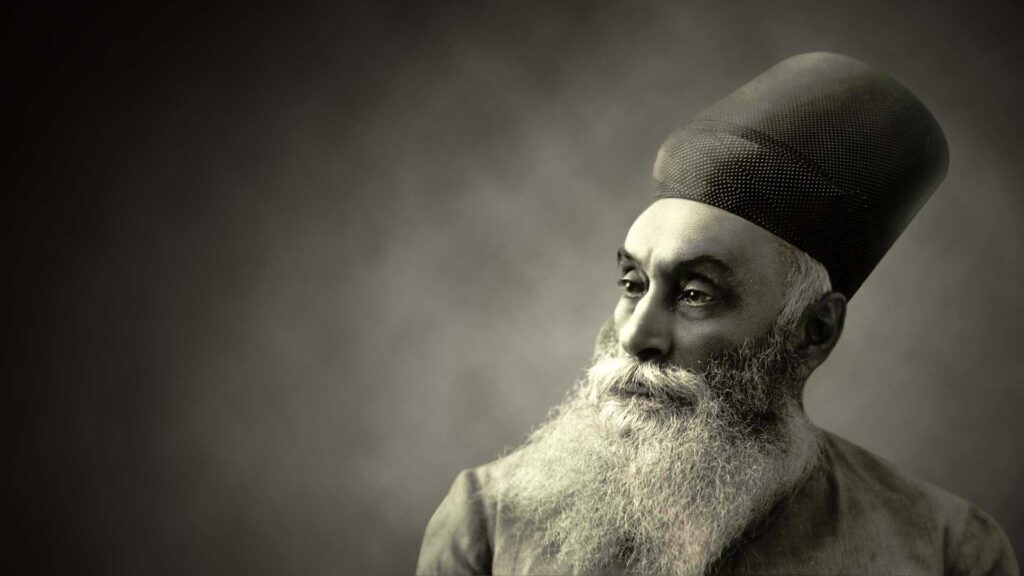
Why? Because its foundation—Prithvi—was built with unusual intentionality. J.N. Tata did not just build a steel plant; he built a town. Housing, hospitals, schools, and parks came before the factory was profitable. This is not philanthropy as brand management. It is earth-logic: you cannot build a durable structure on sand.
The Tata Group’s value system is not a marketing tagline. It is the sedimented result of decisions made over more than a century.

Compare this to the collapse of Infrastructure Leasing & Financial Services Limited (IL&FS) in 2018, which nearly triggered a systemic credit crisis in India. IL&FS was not brought down by bad strategy. It was brought down by the complete erosion of its Prithvi—its governance structure had become hollow, its disclosed financials a fiction, its “diversified” portfolio a house of paper. The earth had gone, and the structure came down with a speed that shocked even its most seasoned creditors.
The lesson for Western organizations is perhaps uncomfortable: many Silicon Valley darlings have been built on what engineers would recognize as technical debt—rapid scaling on foundations that were never load-tested. The 2019 “implosion” of WeWork refers to the spectacular collapse of its planned Initial Public Offering (IPO), where the company’s valuation plummeted from $47 billion to under $10 billion in just six weeks. WeWork’s 2019 implosion was not a business model failure; it was a Prithvi failure.
Prithvi demands patience. The earth principle does not reward urgency; it rewards depth. In a world of quarterly earnings calls and eighteen-month CEO tenures, that is a genuinely radical proposition.
Jala—Water
The Intelligence of Flow

Water has no preferred shape. Pour it into any vessel, and it assumes that vessel’s form without losing its essential nature. Apply heat, and it becomes vapor; apply cold, and it becomes ice—but in each state, it remains itself. Water finds the lowest point not because it is weak, but because that is where it is most needed.
In organizational life, Jala is the intelligence of adaptation—the capacity to flow through constraint, to assume the shape that circumstances require, and to remain essentially coherent through all of it.
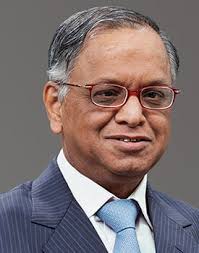
No Indian company embodies this more spectacularly than Infosys. When N.R. Narayana Murthy and his six co-founders started the company in 1981 with ₹10,000 in seed capital—money contributed by their wives—the Indian technology sector did not exist. They were not disrupting anything because there was nothing to disrupt. They were flowing into an empty space. Through the License Raj, when getting a simple computer imported took years of governmental negotiation, they adapted. When liberalization arrived in 1991, they adapted faster than almost anyone.

The real test of Jala came later. When Infosys’s original model—people-intensive, arbitrage-based outsourcing—began showing structural stress as automation advanced, the company’s response was instructive. It did not double down on what had worked. It reconfigured. New leadership, new service lines, aggressive acquisition of design and digital capabilities. The water was finding new channels.
The Bhagavad Gita offers a precise instruction Yogastha kuru karmani act a verse from the Bhagavad Gita (2.48) where Lord Krishna advises Arjuna to “perform your duty (karmāṇi) being established in yoga (yogasthaḥ), abandoning attachment (saṅgaṁ tyaktvā) to success or failure”. It promotes acting with total presence and inner calmness (equanimity), without being anxious about results from a state of equanimity, not from attachment to a fixed outcome. The best strategies are not rigid plans; they are refined orientations that can flex without fracturing.
The lesson that India can offer the world here is the cultural comfort with ambiguity as a feature, not a bug. Indian managers have been navigating regulatory ambiguity, infrastructural uncertainty, and market unpredictability for generations. This has not made them worse strategists; it has made them more fluid.
Agni Fire
The Transformative Imperative

Fire is the most discussed element in management literature, even when it goes by other names. Vision, Passion, Drive, Disruption. But classical Indian thought is more careful about fire than the average startup pitch deck. The Agni of the Vedic tradition is the sacred fire—tended, directed, and purposeful. It is not the wildfire; it is the hearth. Agni is the element of digestion, of metabolism, of turning raw material into nourishment.
The Mahindra Group began as a steel trading company in 1945. Today, it operates in automotive, aerospace, information technology, financial services, hospitality, and agribusiness. By any conventional Western business school analysis, this diversification should be a disaster—the conglomerate discount, as theorized in financial literature, suggests that diverse businesses create less value than focused ones. And yet Mahindra consistently defies it.

Because Mahindra’s diversification is metabolic, not acquisitive. Each new business vertical is Agni-powered in a specific way: it is entered when the group’s core capabilities can be genuinely transferred. The fire is not set randomly. It is lit in prepared places.

Dr. Verghese Kurien—the man who built Amul and made India the world’s largest milk producer through Operation Flood—was not a dairy man by training. He was a mechanical engineer who was posted to Anand, Gujarat against his will and chose, out of principled stubbornness, to stay. His Agni was not passion in the motivational-poster sense; it was a fierce, directed commitment to a specific transformation: converting the most exploited producers in India—smallholder dairy farmers—into the owners of their own supply chain.
Amul is not merely a brand. It is a structural transformation of an entire sector’s power structure. The fire Kurien lit was not about profit maximization.
The message to Silicon Valley is pointed: Agni is not the same as disruption theater. The most durable transformations in Indian business were not fueled by press releases and funding rounds; they were fueled by a specific, directed commitment to changing something real. The fire has to be tended, not just started.
Vayu – Air
The Connective Tissue of Communication

Air is invisible. You cannot hold it, see it, or own it. And yet remove it for three minutes, and the most sophisticated organism on earth is finished. In organizational life, Vayu is everything that moves between people: communication, culture, trust, the informal networks that carry information faster than any formal reporting structure ever could.
The organization that best exemplifies Vayu-intelligence in Indian business is not a corporation at all. It is the hawala network—one of the most efficient, low-cost, trust-based financial transfer systems in human history. The hawala system, which predates modern banking by centuries, moves money across continents based entirely on reputation and relationship. There are no contracts in the legal sense, no enforcement mechanisms beyond the social, and yet the system’s reliability has historically matched or exceeded formal banking channels. The air—the network of trust and communication is the entire infrastructure.
The Vayu principle is what makes India’s family-business conglomerates—the Birlas, the Bajajs, the Godrejs—more durable than their Western equivalents. The Godrej family has been managing a family enterprise since 1897, across five generations, through Partition, liberalization, and digitization. How? By investing obsessively in the quality of the air—the communication norms, the family governance protocols, the shared understanding of what the enterprise exists to do.
The Ambani split is a study in what happens when the air goes bad. Dhirubhai was the sole carrier of the connective tissue. When he died, the air network died with him.
For Western companies navigating remote and hybrid work, the Vayu lesson is existential. According to Gallup’s State of the Global Workplace: 2024 Report, the findings confirm that only 23% of employees worldwide are engaged at work, with 62% not engaged and 15% actively disengaged.

This persistent low engagement—amounting to roughly 77% of the workforce not being fully invested—is highlighted as a critical driver of lost productivity, estimated to cost the global economy $8.9 trillion, or 9% of global GDP, this is fundamentally a Vayu crisis. Organizations that managed communication through the forced proximity of offices found, when that proximity was removed, that they had been mistaking physical co-location for cultural coherence. The report suggests that high-engagement organizations (which often reach more than 70% engagement) succeed by focusing on purpose, trust, and clear communication rather than just physical presence.
Sridhar Vembu is the primary founder and CEO of Zoho Corporation, which he co-founded as AdventNet in 1996. Along with his siblings and friends, Vembu built the company into a global SaaS(software as a service) leader, focusing on affordable, cloud-based business tools while fostering rural development in India.
The result is an organization whose communication culture is extraordinarily intentional, because it could never rely on the coffee-machine conversations that substitute for culture in most urban offices. The air was deliberately engineered. The software company, whose revenue exceeded $1 billion, continues to grow robustly—not despite its distributed rural structure, but because of the communication discipline that structure demanded.
Akasha – Ether
The Space That Makes Everything Else Possible

Akasha is the most difficult element to write about and the most important one to understand. It is not space in the sense of physical emptiness. Akasha is the medium through which everything else moves—the substrate that gives the other four elements room to exist. In Samkhya philosophy, Akasha is associated with Shabda—sound, vibration, the possibility of resonance. It is the element of purpose before purpose was a management concept. In essence, “purpose before purpose” is about focusing on the fundamental contribution a business makes to society as its primary driver, with profitability serving as the measurement of that value, rather than the purpose itself.
Akasha represents the honest, behavioral answer to a question most companies evade: Why do we exist beyond profit? It is not a mission statement or a brand promise; it is the raw, tested reality of an organization’s purpose.”

The most powerful demonstration of Akasha in Indian business history is the Tata Group’s response to the November 2008 Mumbai attacks. The Taj Mahal Palace Hotel was one of the primary targets of the coordinated attacks that killed 174 people over four days. During those four days, the hotel staff’s behavior defied every rational model of human self-interest. Staff members formed human shields. They guided guests to safety while remaining exposed themselves. A housekeeper who had already evacuated returned to the building to help guests she had spotted from outside. Twelve hotel employees died.
This behavior was not mandated by any crisis protocol. It was the behavioral expression of a culture whose Akasha had been filled so completely that it overrode the survival instinct.
Harvard Business School professor Rohit Deshpandé studied this response in detail and concluded that the Taj’s staff behavior could not be explained by conventional organizational psychology. It could only be explained by culture and specifically by a culture whose purpose-space had been filled so completely and over such a long period that it had become structurally load-bearing.

Akasha is also what separates the Patanjali story from a simple business narrative. Baba Ramdev’s Patanjali Ayurved grew from nothing to revenues of over ₹30,000 crore in less than a decade. Patanjali succeeded because it filled a purpose-space that had been left empty by every other major FMCG company: the space of cultural self-respect. Hindustan Unilever—which has operated in India since 1933—found itself briefly on the defensive against an organization with no marketing sophistication at all, simply because the challenger had a more compelling answer to the Akasha question.
For Western management, Akasha is what Simon Sinek approximated with “Start with Why”—but Sinek’s formulation remains at the level of strategic communication. Akasha goes deeper. It is not about what you tell the market about your purpose; it is about whether the purpose is so deeply encoded into the organization’s DNA that it shows up in behavior under maximum stress.
The Five Elements as a Unified System: The Real Insight

The most important aspect of the Panchamahabhuta is what I have not yet said: the elements are not independent. They are a system.
In classical thought, each element arises from the one before it. From Akasha comes Vayu; from Vayu comes Agni; from Agni comes Jala; from Jala comes Prithvi. The sequence is not arbitrary—it describes a hierarchy of dependency. The material world (Prithvi) is downstream of purpose (Akasha). Stability is downstream of communication, which is downstream of transformation, which is downstream of adaptability, which is downstream of purpose.
This has a devastating implication for organizations that try to fix Prithvi problems—structural instability, governance failures, execution breakdowns—without addressing the upstream elements. You cannot build a durable structure without clear communication (Vayu). You cannot sustain clear communication without transformative purpose (Agni). You cannot keep that fire alive without adaptive intelligence (Jala). And you cannot develop adaptive intelligence without a deep, tested answer to why you exist (Akasha).
Most organizational transformation programs work in the wrong direction. They attack the Prithvi—the org chart, the KPIs, the process redesign—while leaving the Akasha unexamined. This is precisely why McKinsey’s 70% failure rate persists regardless of the sophistication of the intervention. You are adjusting the furniture in a house whose foundations are uncertain.
The Jio disruption of 2016 illustrates the integrated system at work. Mukesh Ambani’s second act was not primarily a technology story. It was an Akasha decision: bringing digital access to every Indian at price points that made it possible for the least privileged to participate. This Akasha decision shaped the Vayu. The Vayu shaped the Agni—the transformation of an oil company into a technology and consumer company. The Agni shaped the Jala. And all of this eventually restructured the Prithvi. The five elements worked together, in sequence, as a system.
What the West Can Learn, and What It Must Unlearn
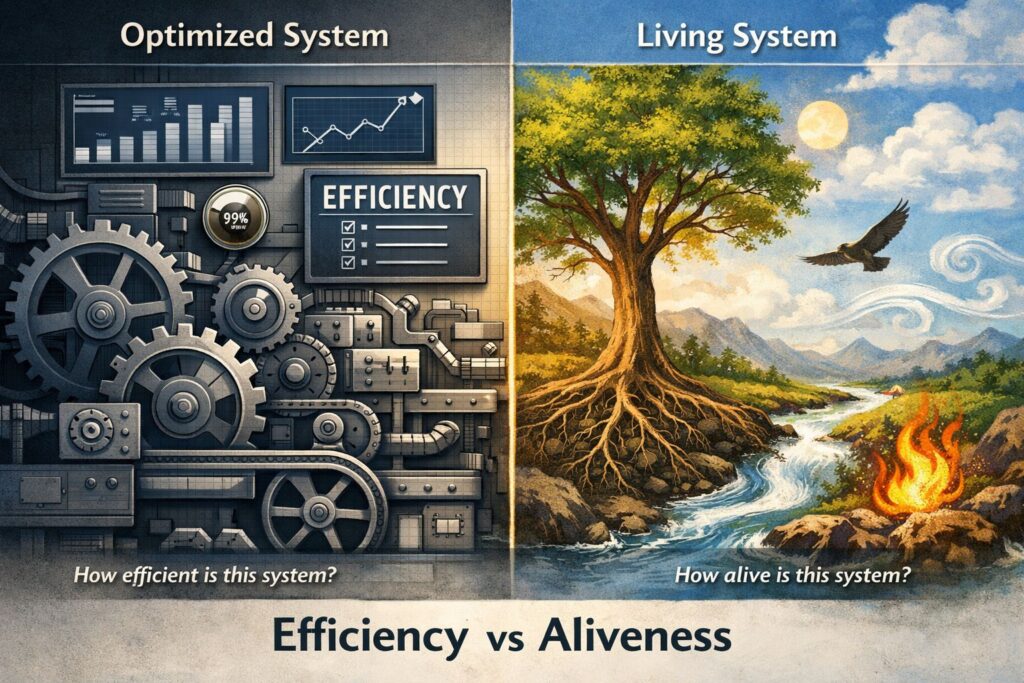
The honest assessment is this: Western management theory is extraordinarily good at optimizing systems that already work. It is poorly equipped to understand why systems persist through conditions that optimization models predict should destroy them. The Panchamahabhuta offers a different analytical register—one that asks not “how efficient is this system?” but how alive is this system?
A living system is not the same as an efficient one. Living systems carry redundancy, slack, and apparent irrationality that, under stress, turns out to be essential structural integrity. The great Indian family conglomerates—impure, diversified, slow-moving by Silicon Valley standards—have survived conditions that would have destroyed a leaner, more rationally organized firm.
The lesson is not that India does everything right. It does not. Indian organizations suffer chronically from Vayu failures—communication is often indirect to the point of dysfunction, hierarchy suppresses information flow, and the cultural aversion to delivering bad news creates catastrophic feedback failures. The Akasha is often invoked but rarely examined: many Indian companies hide mediocre governance behind a veneer of purpose.
The lesson is that the Panchamahabhuta asks better questions than most dominant frameworks in contemporary management literature.
On August 19, 2019, the Business Roundtable released a “Statement on the Purpose of a Corporation,” signed by 181 CEOs, committing to lead their companies for the benefit of all stakeholders—customers, employees, suppliers, communities, and shareholders. This marked a significant shift away from “shareholder primacy,” pledging to invest in employees, protect the environment, and deal ethically with suppliers. This was presented as a revolutionary reorientation of American capitalism.
In the Taittiriya Upanishad, which predates this announcement by approximately twenty-four centuries, the highest human purpose is described not as accumulation but as dharma—the righteous, relational, contextually appropriate fulfillment of one’s role in an interdependent system. The Business Roundtable was not being revolutionary. It was, haltingly and imprecisely, rediscovering something.
A Framework for Application: Reading Your Organization Through the Five Elements
If you are a leader or strategist reading this with more than merely academic interest, here is a diagnostic orientation—not a consultants’ template, but a set of genuinely uncomfortable questions to sit with.
On Prithvi (structural earth): If your CEO resigned tomorrow and all the management consultants left the building, what would remain? Is there a documented, lived, behaviorally-reinforced governance structure, or is the stability of our organization a function of particular individuals? Can the organization hold its shape under load?
On Jala (adaptive water): What is the last significant thing your organization abandoned because the context had changed—not because it was failing, but because it was no longer the most nourishing path forward? Organizations that cannot practice intelligent abandonment are losing their Jala.
On Agni (transformative fire): What is your organization currently digesting? Agni is not about launching new initiatives; it is about metabolizing change. What difficult transformation are you actually committed to completing, as opposed to announcing?
On Vayu (communicative air): What do your frontline employees know about the organization’s strategic direction, and how did they learn it? What does the quality of that information tell you about the health of the invisible network through which everything important actually travels?
On Akasha (foundational ether): Under maximum stress—during a crisis, a scandal, a market collapse—what does your organization’s actual behavior reveal about the purpose it has chosen, as opposed to the purpose it has declared? The Taj’s staff answered this question on 26 November 2008. When will yours be tested, and what will the answer be?
Coda: Back at Cafe Aromas
I told the Chief Strategy Officer about the Panchamahabhuta over our second coffee. He listened with the carefully maintained skepticism of a man who has sat through too many offsite presentations.
When I finished, he was quiet for a moment.
“So, what you’re saying,” he said, “is that most organizations fail because they’re trying to fix the visible problems—the structure, the numbers, the org chart—without asking whether the invisible stuff is intact.”
“The invisible stuff,” I agreed, “being the purpose, the trust, the communication, the will to actually transform, and the structural integrity to hold it all together.”
He nodded slowly. “That’s not ancient wisdom,” he said. “That’s just accurate.”
Which is, I think, precisely the point. The Panchamahabhuta is not ancient wisdom in the sense of wisdom that has aged. It is ancient wisdom in the sense of wisdom that has been continuously verified—by the enterprises that embodied it without knowing its name, and by the organizations that ignored it and paid the price.
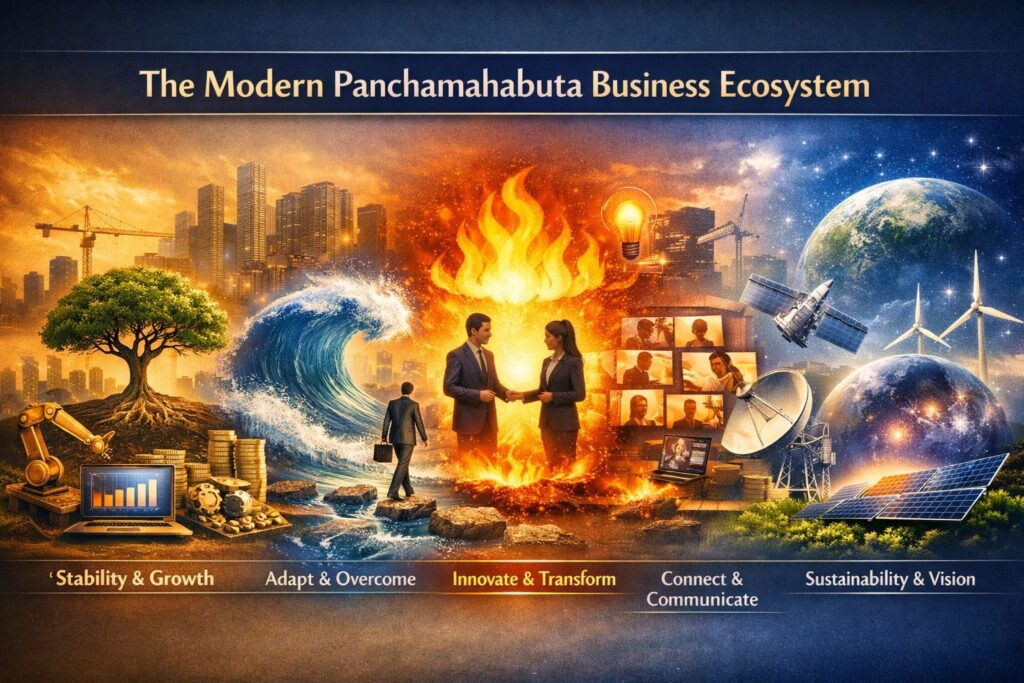
Panchamahabhuta is ancient, but its business relevance is unmistakably modern. In a world of disruption, employee expectations, and sustainability demands, companies need more than efficiency. They need balance. They need systems that can think, move, transform, nurture, and endure. The five elements provide a rich framework for understanding that challenge.
For Indian companies, Panchamahabhuta offers a way to modernize without losing cultural depth. For multinational companies, it offers a way to globalize without becoming mechanized. For both, it offers a reminder that the best enterprises are not merely productive—they are balanced, humane, and resilient.
The Elemental Enterprise is therefore not a return to the past. It is a wiser way to move into the future.
Holding everything together.