

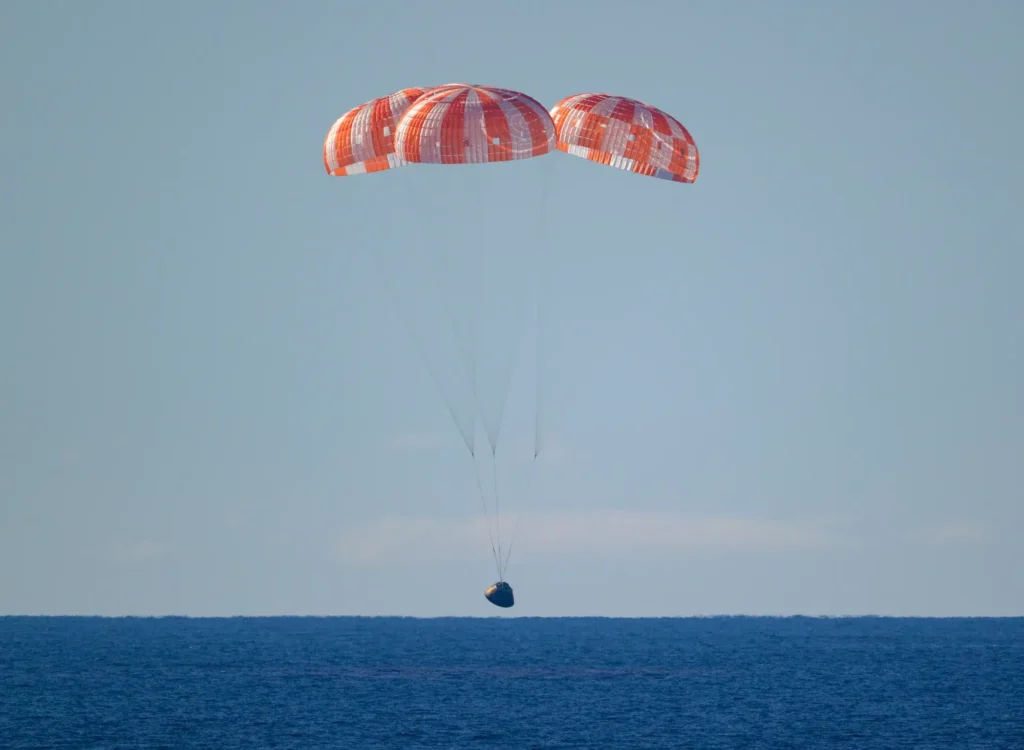
In the morning at 0537 IST on 11 April 2026, the Orion crew module of the Artemis II mission successfully splashed down in the Pacific Ocean off the coast of San Diego, California. This flawless return of the mission which was flyby mission to Moon represents a major achievement for NASA, It could also be viewed as a broader global milestone, marking the revival of human lunar exploration after more than five decades.
Artemis II was a technically complex mission undertaken by the National Aeronautics and Space Administration (NASA) particularly due to the involvement of astronauts, which significantly increased the mission’s operational and safety requirements. This mission was launched using the Space Launch System (SLS) launcher. This vehicle had carried NASA’s Orion spacecraft, which is a next-generation crew module designed to transport four astronauts to lunar orbit and further.
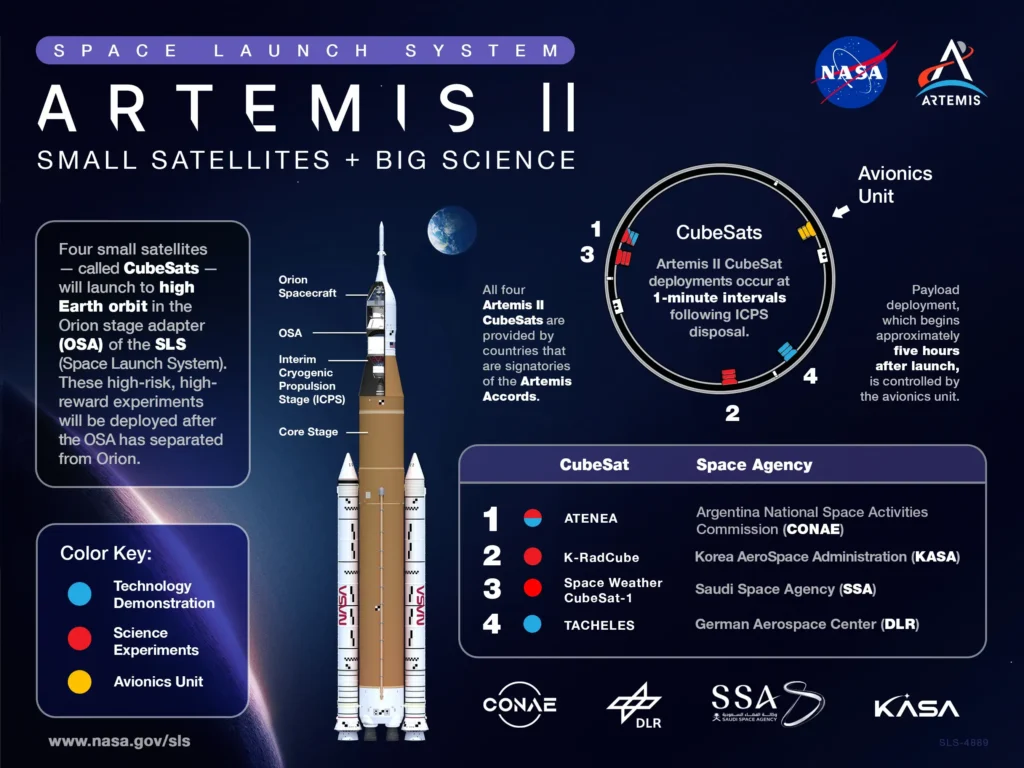
It was equipped with advanced life-support systems, radiation shielding, and a heat shield capable of withstanding re-entry into Earth’s atmosphere, while the European Service Module was providing power and propulsion. On April 1, 2026, after reaching Earth orbit, the rocket had placed Orion into a highly elliptical orbit, where it remained for a day and all systems were checked for their functionality. Subsequently, the round-trip journey to and from the Moon took approximately eight days of time.
During this lunar flyby mission, the crew of Artemis II set a new record for the farthest distance travelled by humans from Earth. It reached a distance of 406,771 km, surpassing the previous record held by Apollo 13, which reached about 400,171 km on April 14, 1970.
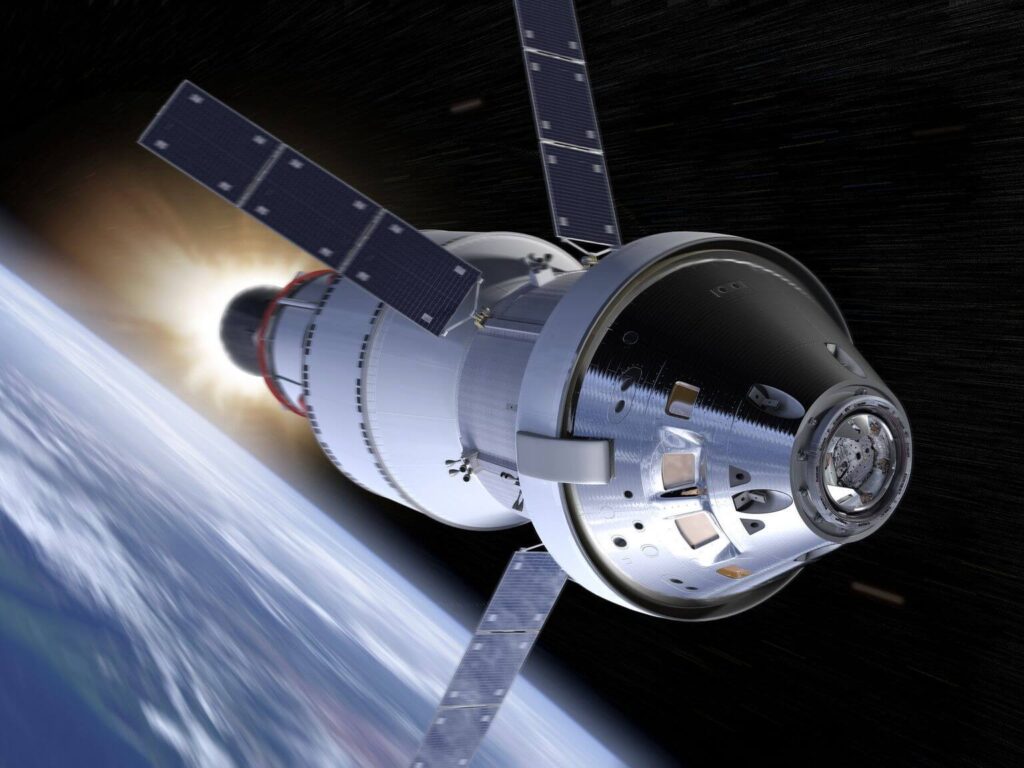
In this mission, the crew conducted a close lunar flyby at an altitude of approximately 6,545 km above the surface of the Moon, enabling astronauts to observe the Moon’s far side and witness an Earthrise. They also observed a total solar eclipse. Throughout this period when the craft was in the close vicinity of Moon, the crew rigorously tested Orion’s life-support, navigation, and propulsion systems, and successfully managed an expected 40-minute communications blackout while passing behind the Moon.
The riskiest phase of Artemis II was the high-speed hypersonic re-entry through Earth’s atmosphere. At this point, the spacecraft did experience extreme heating (temperatures were possibly around 2700°C) and intense aerodynamic forces as Orion decelerated from speeds of around 11 km/s (over Mach 30, means 30 times the speed of sound). The surrounding air had ionized into plasma, causing a communications blackout and leaving the crew temporarily cut off from Earth during the most critical moments. Physically, astronauts did endure strong vibrations and high g-forces. Artemis II’s higher velocities make this phase particularly challenging and risky.

NASA had used a modified skip re-entry profile for Artemis II. In this case the spacecraft uses aerodynamic lift and not a purely ballistic descent. This helps in slowing down more gradually and reduces stress on the crew.
Scientists at NASA were closely monitoring the re-entry mainly for judging the performance of Orion’s heat shield, which has been designed to withstand temperatures exceeding 3,000°C. Earlier during Artemis I mission (2022), which was an unmanned mission there were some issues related to the thermal/heat shield and unexpected wear was observed on the AVCOAT (Ablative Coating) heat shield. AVCOAT heat shield is made from silica and phenolic fibers. NASA had decided not to make any changes in the heat shield, but had decided a more conservative re-entry profile to reduce any risks. (https://stories.uq.edu.au/contact-magazine/artemis-return/index.html)
The achievements of the Artemis II mission mark a major step forward for the US Moon programme. This mission successfully validated the Orion spacecraft’s Environmental Control and Life Support System (ECLSS) with astronauts on board, validating that the cabin environment can safely sustain human life during extended deep-space travel. Astronauts also captured rare firsthand views and imagery of the Moon’s far side. This information would have much utility in planning future missions.
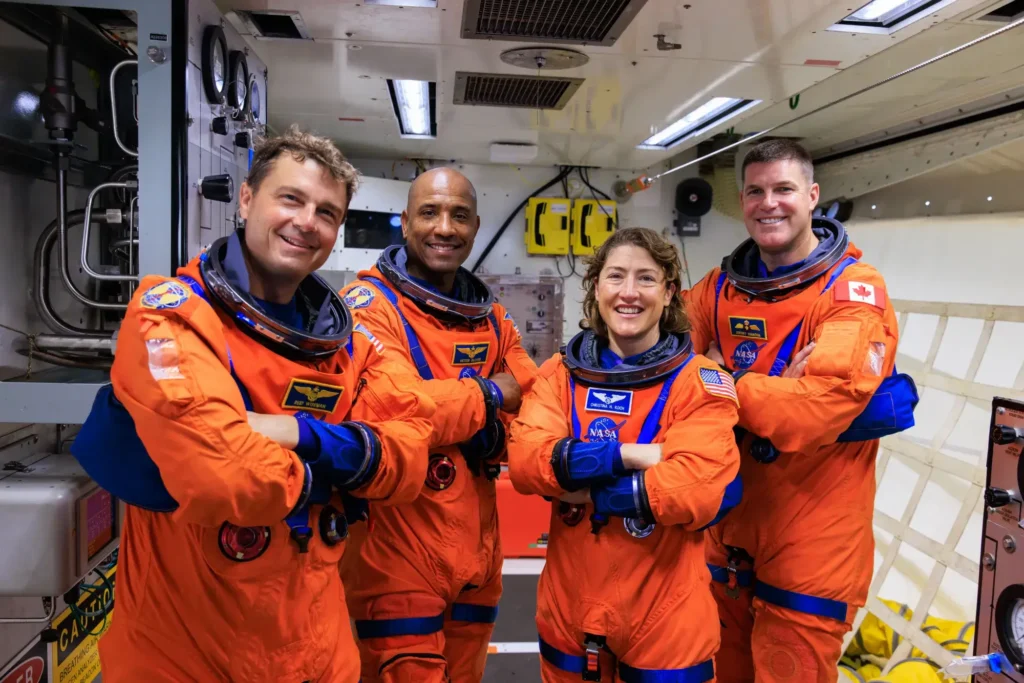
A communication milestone was achieved when the crew conducted the first spacecraft-to-spacecraft call with the International Space Station (ISS). The overall performance of various sub-assemblies of the launcher systems and spacecraft would give NASA a major boost in planning future missions. An advanced laser communication system is known to have successfully transmitted high-definition video and data back to Earth, demonstrating faster and more efficient deep-space communication. In addition, the mission helped validate crew operations, navigation systems, and mission timelines in real conditions beyond LEO.
There is growing discussion that the Artemis II mission signals a revival of a modern-day space race. In recent times, the Moon has re-emerged as a critical arena for demonstrating county’s technological might. While Artemis II is framed as an international collaborative effort under the Artemis programme, major space powers like Russia and China are not part of it.
Overall, the safe journey and strong spacecraft performance of Artemis II have reinforced plans for upcoming, longer-duration missions, including preparations for human lunar surface landings in the near future. Artemis IV is expected to undertake a human landing on the Moon by 2028.