


In India, the Central Armed Police Forces (CAPFs)—CRPF, BSF, CISF, ITBP, SSB and the Assam Rifles—share one common defining feature: they all function under the Ministry of Home Affairs (MHA). Together, they form the country’s “in-between” forces, repeatedly deployed for border patrolling, internal security, counterterrorism, anti-Naxal operations, enabling free and fair elections, riot control and crisis management.
Comparable forces exist across the world, but their institutional design differ sharply. In some countries, they operate as a professional “third pillar” between the army and the police. In others, similar responsibilities are handled by powerful civilian federal agencies. And in some systems, these forces remain under tight political control—used more as instruments of the state than as independent, professionally-led institutions.
Also Read: Why Is MHA reluctant to loosen its grip over CAPFs?
Broadly speaking, there are three models behind this:
1) The European Gendarmerie Model: Military Status, Civilian Policing, Dual Accountability

Europe’s classic answer to the “mid-spectrum force” is the gendarmerie: a force with military character doing civil policing—typically with clear legal identity and a dual relationship with interior and defence establishments.
France: a military force, attached to the Interior Ministry for internal security

France’s National Gendarmerie is a textbook example of the hybrid: it remains part of the armed forces but has been formally attached to the Interior Ministry for its internal security missions. It handles policing across most of the national territory—especially smaller towns and rural areas—while also retaining military missions.
What this enables in practice is internal security without the optics of “calling in the army.” During nationwide protest waves or infrastructure disruptions, the state can deploy nationally organised, disciplined units that are trained for public order and can be moved rapidly across regions—while still operating within a policing framework rather than a warfighting one.
Italy: The Carabinieri as a full armed-forces branch—yet a national police force

Italy’s Carabinieri lean even more militarised: since 2000 they have been separated from the Army and recognised as the fourth branch of the Italian Armed Forces, while also functioning as a nationwide police force. For military tasks they report through defence channels; for public order and internal security, they operate under interior coordination.
This structure helped Italy build a force that can fight organised crime and terrorism at home while also deploying abroad for peacekeeping, training missions, and protection duties—using a single institutional culture that blends police craft with military discipline.
Spain: the Guardia Civil—explicitly dual-ministry by design

Spain’s Guardia Civil is also “military in nature” and operates under the authority of both the Interior Ministry and the Defence Ministry (with defence authority becoming dominant in wartime or military missions).
The big European takeaway: these forces get a clear charter: military status is not treated as a loophole, and civilian policing is not treated as a downgrade. The hybrid identity is acknowledged, structured, and regulated—rather than left ambiguous.
2) The North American Model: Civilian Federal agencies with serious power
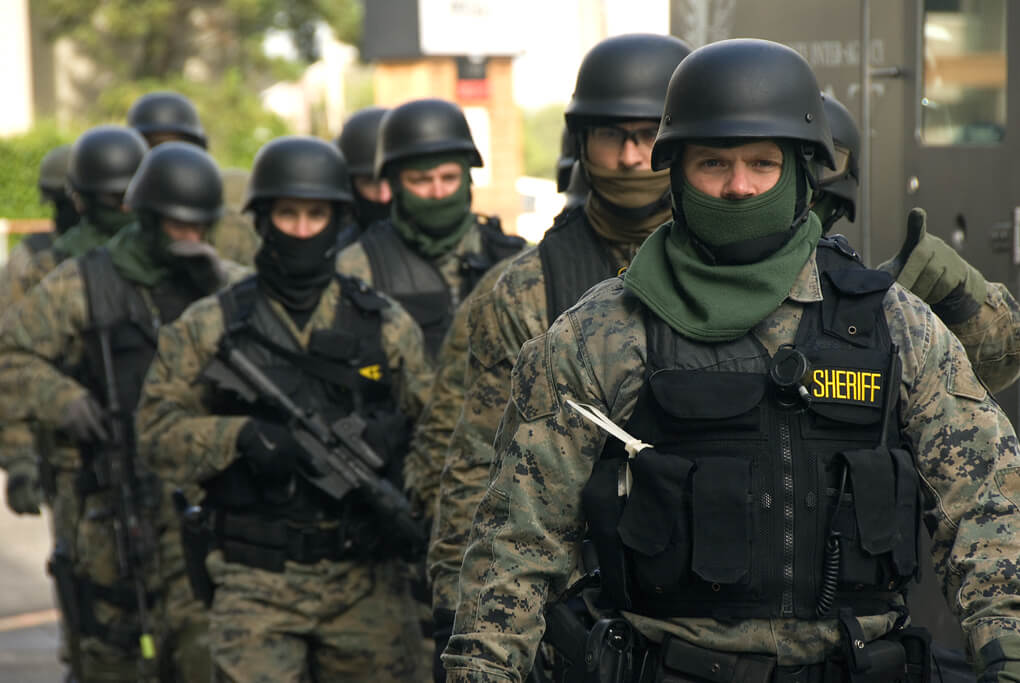
Some democracies deliberately keep “CAPF-type” functions fully civilian—but still build large, heavily armed federal institutions with nationwide reach.
United States: Customs and Border Protection (CBP) -a large civilian border-security force

In the United States, the closest parallel to a CAPF-style border role is the U.S. Customs and Border Protection (CBP), which operates under the Department of Homeland Security. CBP says it has over 60,000 employees, making it one of the largest law-enforcement agencies in the world.
Its identity is clear: CBP is civilian law enforcement, not a military force. The friction appears when its responsibilities expand faster than oversight and accountability. Recent reporting has pointed to controversies over Border Patrol operations well away from the border, and the civil-liberties concerns that arise when a border-trained force is deployed in dense urban settings.
Canada: the RCMP – federal police plus “contract policing”

Canada’s model is a different kind of hybrid. The Royal Canadian Mounted Police (RCMP) is the national police service, but it also provides contract policing—serving as the local/provincial police in most provinces and territories (except Ontario and Quebec) and in more than 150 municipalities. This is done through formal agreements with clear cost-sharing arrangements.
What strengthens this model is the stress on civilian oversight. The Civilian Review and Complaints Commission (CRCC) is an independent body created by Parliament to ensure public complaints about RCMP conduct are reviewed fairly and impartially.
The North American takeaway is simple: you can keep these forces civilian—but then legitimacy depends heavily on strong oversight, accessible complaint systems, transparency, and rigorous rights-focused training, because the powers involved are still enormous.
3) The Hard-Control Model: Paramilitary forces as centralized political–military instruments

A third approach treats CAPF-like forces not as independent, professional institutions, but as tools kept tightly under the control of the country’s top political leadership. In this model, such forces are often placed under military command or directly aligned to the ruling party, so they can be mobilised quickly to protect the regime and manage internal threats—with limited operational autonomy and weaker public oversight.
China: People’s Armed Police under Central Military Commission control

China’s People’s Armed Police (PAP) is a large paramilitary force used for internal security, counter-terror operations, riot control, and broader “stability maintenance” tasks. A major shift came with the 2017–18 reform cycle: multiple analyses from U.S.-linked military research and professional institutions note that, by 2018, the PAP was brought fully under the Central Military Commission (CMC)—moving away from the older dual-command arrangement and centralising authority at the top.
The logic is straightforward. The priority is tight central control, command cohesion, and regime stability. Oversight, therefore, is largely internal and political—not independent and civilian in the way many democracies design accountability for powerful security forces.
Pakistan: Rangers—nominally “Interior”, structurally military-shaped

Pakistan’s Rangers reflect a hard-control variant: a paramilitary force used for border duties and internal security that sits on paper under the Ministry of Interior, including for border-control functions.
But structurally, it remains heavily military-shaped—multiple sources note that while the Rangers fall under Interior Ministry authority, they are commanded by military officers (often on secondment from the Army).
Human Rights Watch has also described the Rangers as a paramilitary force operating alongside the Army in internal deployments, underscoring how closely such forces can be used in support of state security objectives.
Karachi is often cited as the signature case. HRCP-referenced reporting shows the scale of lethal violence in the early 2010s—over 3,000 killings in 2012 and 2013, followed by 2,909 killings in 2014—illustrating why extraordinary security operations gained political momentum.
After that, HRCP-based reporting also points to declines in 2015 across key indicators such as targeted attacks and overall murders, even as “encounter” and due-process concerns remained part of the public debate.
The trade-off is consistent in this model: when a military-shaped force becomes the default answer to civilian policing breakdown, rights and accountability tensions predictably intensify—because the mandate expands fast, but independent civilian oversight often does not.
Three questions these models bring into focus:

First: What is the force—legally?
Europe often defines gendarmeries as military-status police forces. North America typically defines border and federal policing as civilian agencies. Hard-control systems fold paramilitaries into a party–military chain. That legal identity shapes everything that follows—training, culture, use-of-force norms, and accountability.
Second: Who controls careers?
In more “institutional” models, promotion ladders are built and defended from within—whether the force is military-status (gendarmeries) or civilian (RCMP/CBP). But when senior command and promotions are shaped mainly by an outside dominant service, the force’s professional identity weakens and dependence grows.
Third: Does “control” mainly oversight—or mainly dominance?
Canada shows that strong coercive powers can coexist with formal civilian complaints review. The U.S. shows how expanding roles can trigger civil-liberties battles when oversight is seen as insufficient. China shows the other extreme—where “control” means vertical political command, not independent accountability.
Conclusion: lessons learnt

The international models show three clear lessons: first, define the force’s legal identity and mandate so there is no confusion about roles, powers, and accountability; second, let the organisation “own” its careers so leadership grows from within and professionalism is rewarded, not blocked; and third, balance operational control with independent oversight so authority is trusted, not feared.
If India absorbs these lessons, the CAPFs can evolve from being seen as deployable instruments into self-led institutions—stronger in morale, fairer in progression, and more credible in the eyes of both the ranks and the citizen.