


Since the days of the Cold War, a standard tactic of the West has been to use its influential media and academia to build up and propagate fake narratives against its opponents—basically to discredit their political ideologies, their leaders, their body-politic, their science and technology and their intellectual achievements in general. Because most of the people in the English-understanding world (which includes this country also) have been, since the colonial era, acculturated and conditioned into treating anything published in the Western media and academia as the gospel truth, the narratives have traditionally been punching way above their weight and have been accorded a position that they don’t really deserve. However, they are actually not as clever as they pretend to be and the narratives fall apart under a rigorous examination.
The latest in this endless slander series is an article in the British newspaper ‘The Economist’ (Jan. 28) titled “Xi Jinping is immensely powerful. Why can’t he stamp out corruption?”. Since the article is pay-walled, I will first give a summary of the article before shredding it.
How the Western Media’s stupidity betrayed their Ulterior Motives
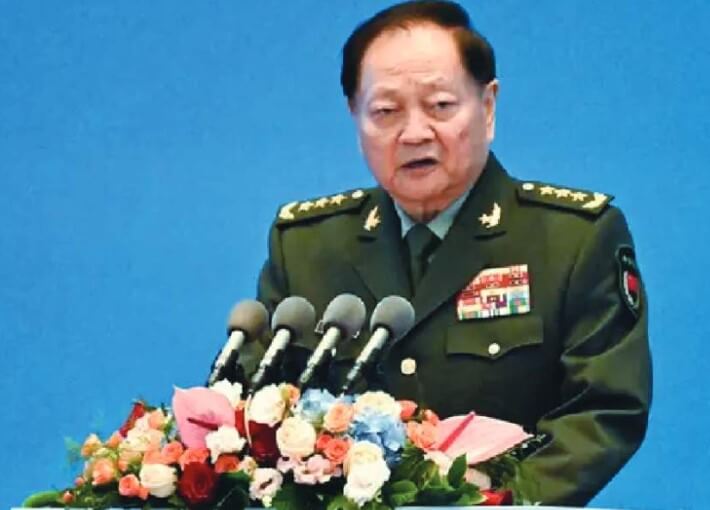
The immediate provocation of the article is the recent (Jan. 24) action by Jinping against Liu Zhenli a top general of the PLA. Chinese President Xi Jinping initiated a dramatic shake-up of the People’s Liberation Army (PLA) high command by placing General Zhang Youxia—the senior vice chairman of the Central Military Commission (CMC) and a previously trusted ally—under investigation for “serious disciplinary violations”. Zhang was reportedly accused of creating a “political clique” within the military to challenge Xi’s authority.
However, the West betrayed its ulterior motives as well as collective intellectual bankruptcy when the Wall Street Journal reported that a high-level briefing had accused Zhang of leaking core technical data on China’s nuclear weapons program to the United States. This is plain and simple bullshit.
The fact is that China is believed to have perfected the design of its advanced, miniaturized thermonuclear warheads, suitable for modern, solid-fuel missiles like the DF-31 and DF-41, by the mid-1990s, concluding its active nuclear test program in 1996. These warheads are comparable to the famous American miniaturized warheads W87 (for Minuteman III ICBMs) and W88 (for Trident II SLBMs) developed by the Los Alamos National Laboratory (LANL). Readers will be enlightened to note that back in 1999, Dr. Wen Ho Lee, a Taiwanese American nuclear physicist at LANL, was accused of being a spy for China, leading to a high-profile investigation that eventually collapsed due to lack of evidence, prompting a rare judicial apology and significant legal reforms. Incidentally, at that time also, it was the Western media, the New York Times that had alleged that China had stolen nuclear secrets from Los Alamos, Dr. Lee was fired and subsequently arrested on 59 counts of mishandling classified information.
The development of thermonuclear weapons is so old now and has reached such a level of perfection with the USA, Russia, China, England and France that there is hardly anything to be gained by spying. Design secrets of thermonuclear weapons are the most closely guarded secrets in the whole world and they are so detailed that they cannot be ‘leaked’ deliberately or inadvertently in a casual meeting, telephonic talk, email, or even hundreds of pen drives. Hence, even a remote hint of passing on China’s thermonuclear weapons’ design secrets is pure, unadulterated bullshit.
It is utterly pathetic that the Western media could not concoct a more credible story.
Summary of ‘The Economist’ Article Ridiculing Xi Jinping
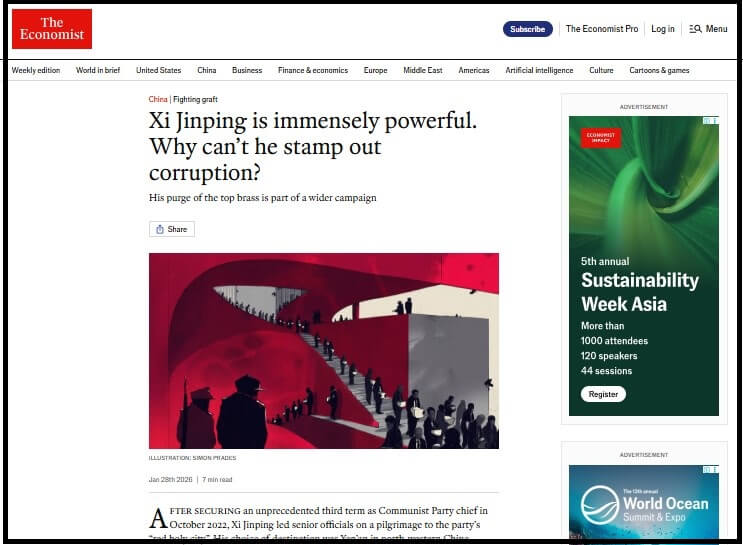
The very sub-headline or ‘deck’ of the article is a dead giveaway of their intentions. It says “His purge of the top brass is part of a wider campaign’. It only means that they are imputing ulterior motives to his actions.
While I will rebut their specific weaknesses separately, the article broadly accuses him of committing Stalin-like excesses in pursuit of absolute power:
“Xi Jinping’s October 2022 Yan’an pilgrimage evokes Mao’s wartime base and “rectification” campaign, which purged 15,000 of 40,000 revolutionaries via torture and executions. Xi promotes this “Yan’an spirit” for ideological purity, rejecting corruption and hedonism, without endorsing Mao’s violence. His 2012 anti-graft “self-revolution” has jailed thousands, punished millions, and curbed street-level corruption. Yet 2025 saw record probes (over 1 million, up 15% from 2024, 60% from 2023) and 983,000 punishments—the highest under Xi—despite his past “victory” claims.
PLA and Military Purges: The PLA fosters graft through loyalty networks, secrecy, and procurement booms. Recent targets include top generals like Zhang Youxia for alleged post-buying (e.g., aiding ex-minister Li Shangfu for bribes). Dozens purged, per think-tanks like MERICS, as early reforms failed amid rampant bribery.
Civilian Corruption Surge: Promotion-selling hits civilians as fire officials convicted for paying kickbacks on contracts/code violations. Xi targets lower ranks, netting businesspeople/NGOs; monthly bribery punishments hit 7,271 (April–Sept 2025) vs. 586 a decade ago. Most offenders persisted post-Xi.
Harsher Measures, Persistent Risks: Penalties toughened as 70%+ get prison/expulsion (vs. 30% in 2014); 46% more uncharged detentions with torture/solitary. Five entrepreneurs suicided in custody (April–July 2025).
Drivers of Corruption: Spending in chips/biotech/military; peer pressure; “small-circle politics” via implicit gifts signaling trust.
Xi sees corruption as existential, like Soviet collapse trigger. Ignoring backlash over deaths/detentions, he vows more “bone-scraping” to boost party prestige.
The Sleight of Hand
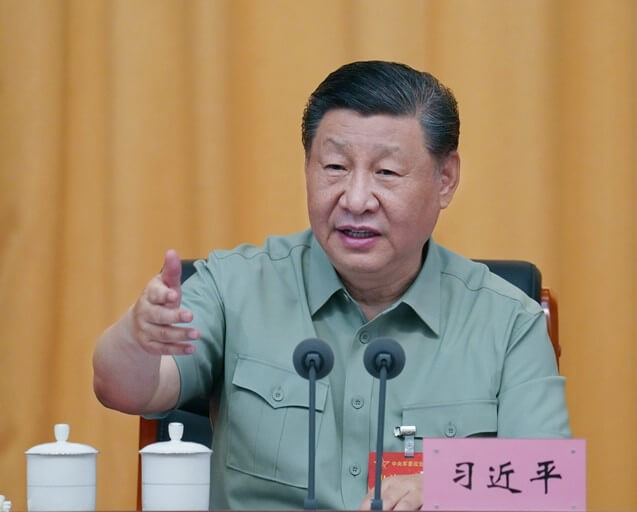
The article opens with Xi’s visit to Yan’an, immediately invoking Mao’s rectification campaign and its brutal excesses. This is a classic guilt by geography manoeuvre. Yan’an ceases to be a historical site with multiple layers of meaning and becomes instead a psychological inkblot onto which the author projects paranoia, purges, and latent bloodlust.
Notice the sleight of hand. Xi explicitly invokes Yan’an as a symbol of discipline, endurance, and political direction. The article concedes that he is not calling for Mao style bloodletting—then spends the next several paragraphs reminding the reader, in lurid detail, of Mao era torture and executions. This is not argument; it is atmosphere building. The logical link is never made explicit because it does not exist. Yan’an is simply there to plant a mood: beware, history may repeat itself.
This is Cold War bullshit recycled. When Khrushchev spoke of Lenin, Western commentators heard Stalin. When Soviet leaders invoked the Great Patriotic War, Western editorials muttered about tanks in Prague. Symbols are stripped of local meaning and repurposed for foreign consumption.
The Myth of the “Tattered High Command”

The claim that purging corrupt generals has left China with a “tattered high command” is perhaps the laziest trope in the piece. It rests on an almost childlike view of how modern militaries function, as though armies depend critically on a handful of irreplaceable men.
Historically, this argument collapses completely under simple scrutiny. In Stalin’s purge of the Red Army (1937–1938) was a devastating pre-WWII crackdown in which nearly 35,000 officers were discharged and thousands executed, including top-tier command. Yet, the Red Army still adapted, learned, produced great military leaders who came up from the ranks below those purged and ultimately defeated the Wehrmacht, the mighty German war-fighting machine.
More importantly, the article quietly assumes what it must prove: that the purged generals were primarily victims of political paranoia rather than participants in corruption. This assumption is smuggled in without evidence, and then treated as self-evident. You are never asked to consider the opposite possibility—that a professionalising military benefits from removing officers who monetised rank and procurement.
How can the size of Budget be related to Corruption?
We then encounter the argument that increased military budgets and procurement necessarily “open up opportunities for graft.” This is presented as almost axiomatic—except, curiously, when discussing NATO militaries.
The United States defence budget dwarfs that of China, involves far more private contractors, and operates within a revolving door that would make any Marxist weep with vindication. Yet Western reporting rarely treats budget expansion per se as evidence of systemic rot. The logic is selectively activated.
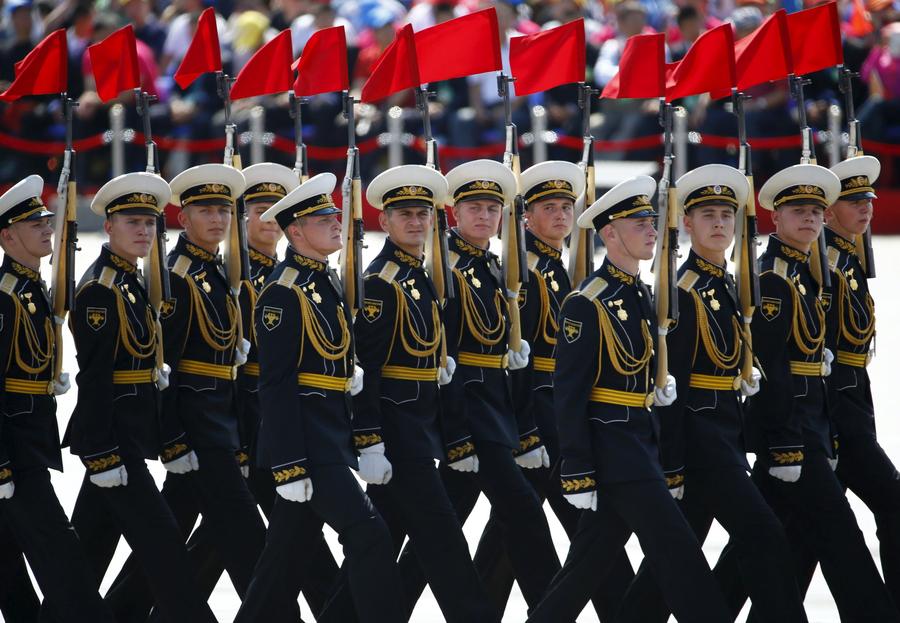
Moreover, the claim ignores China’s unusually high degree of self-reliance in defence matters. As I had shown in an earlier article ‘Guns and diplomacy: what does China’s grand military parade really mean’, every single piece of military equipment on display in the Sept. 3, 2025 Victory Day parade was indigenous and NOT IMPORTED, as many other nations habitually do.
Procurement corruption is not impossible, but the simplistic equation—more money equals more corruption—would, if applied consistently, produce devastating conclusions about Western defence establishments. The article does not dare apply its own logic universally.
Maliciously projecting Vigilance as Failure
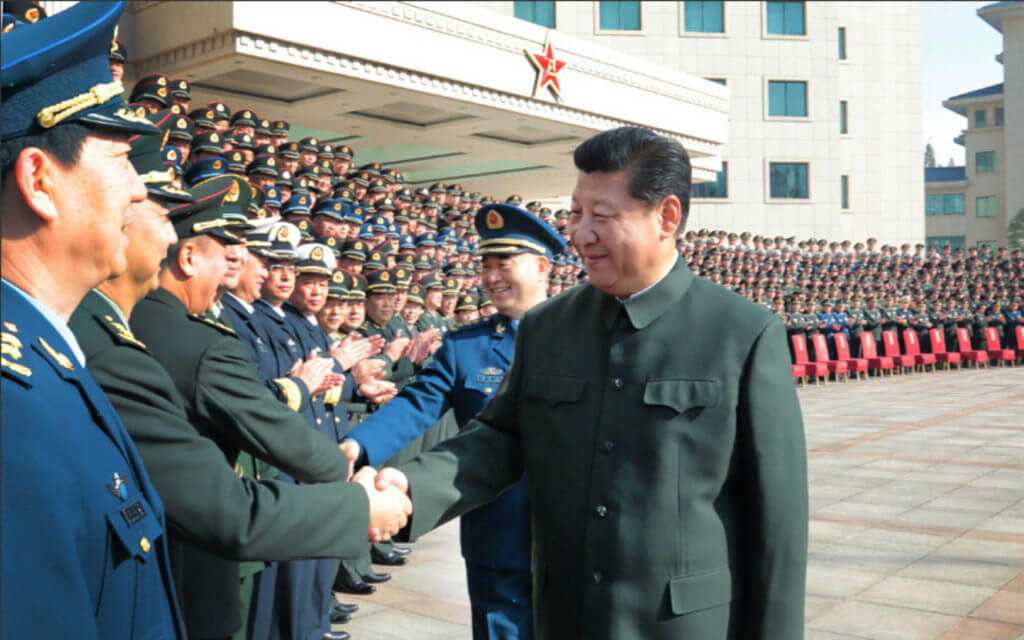
We are then told, with heavy implication, that investigating over one million people in 2025 somehow indicts Xi’s anti-corruption drive. This is outrageous. In most other contexts, increased enforcement is read as increased seriousness. Here it is reframed as proof of futility.
This is a classic narrative trap. If investigations are few, the leadership is derided as complacent or complicit. If investigations are many, then they allege that corruption must be rampant and uncontrollable. Heads, Xi loses; tails, Xi also loses.
No serious attempt is made to distinguish between types of cases, levels of severity, or changes in reporting thresholds. The article treats all investigations as equivalent moral data points, collapsing everything from minor disciplinary breaches to grand corruption into a single ominous mass. It is statistical theatre, not analysis.
The Sheer Outrageousness of ‘Promotions for Sale’
The most serious accusation—that ranks and promotions in the PLA are “routinely up for sale”—rests on a remarkably thin evidentiary base. We are told that unnamed officers were “briefed” about allegations, relayed via the Wall Street Journal, and amplified by a Berlin think tank.
This is hearsay layered upon hearsay, presented with declarative confidence. No documents are cited. No judicial findings are referenced. The claim is simply asserted, then echoed, until repetition masquerades as proof.
Worse, the internal logic is dubious. The suggestion that a senior general effectively “bought” the promotion of a defence minister reverses the normal direction of power. In peacetime hierarchies especially, ministers shape careers; they are not typically clients of subordinates. The article waves this away, trusting that the reader’s unfamiliarity with Chinese command structures will do the rest.
From Generals to Fire Chiefs, how the West stretched the Stupid Comparison
One of the article’s most revealing moves is the seamless slide from alleged corruption at the apex of the PLA to petty graft in municipal fire departments. This is rhetorical bait and switch.
Local level corruption exists everywhere. A fire chief in Beihai selling positions tells us precisely one thing: that a fire chief in Beihai sold positions. It does not establish that the Chinese state is systemically corrupt at the top any more than a crooked zoning officer in New Jersey proves that the Pentagon is for sale.
The article relies on proximity rather than causality. By placing these anecdotes adjacent to one another, it encourages the reader to intuit a pattern that is never demonstrated.
The Psychology of Forced Absurdity

The weakest passages are psychological speculations dressed up as sociological insight. We are told that officials accept bribes out of fear—fear that refusing cash will mark them as informants. This is not supported by evidence; it is asserted because it sounds exotic and sinister.
In reality, corrupt networks do not operate on gift giving paranoia. They operate on mutual assured exposure, contractual kickbacks, and institutionalised rent seeking. The idea that cadres reluctantly accept envelopes to avoid social awkwardness is almost comic. It infantilises corruption while mystifying it.
Similarly, the notion that accepting a bottle of liquor is a subtle trust signal, without which serious corruption cannot proceed, reduces complex patronage systems to a caricature fit for a lifestyle column. It is so infantile that it does not even enrage me; it makes me sad for their stupidity.
Projecting Ideology as Pathology
Finally, Xi’s insistence that corruption is an existential threat is portrayed as obsession bordering on paranoia, with obligatory references to the Soviet collapse. This, too, has a Cold War pedigree. When Western leaders speak of systemic risk, they are prudent. When non Western leaders do the same, they are alleged to be haunted by ghosts.
The Soviet Union did, in fact, collapse in part because its party lost internal discipline and legitimacy. To treat this as a delusion rather than a historical lesson is ideological, not analytical.
The Western Circus of Narrative Gymnastics

Ever since the Bolshevik Revolution, you can instantly recognize the Western Narrative Gymnastics that begins with a pilgrimage, preferably to a place heavy with symbolism; it then segues into a moral fable; and it ends with a warning that the strongman at the centre of the story is walking a dark, familiar path. The names change—Stalin, Mao, Castro, Putin, and now Xi Jinping—but the structure remains comfortingly intact.
Unfortunately, the narrative framing is so aggressive that logic itself becomes collateral damage. Statistics are marshalled without context, anecdotes are elevated into systemic claims, and mutually contradictory arguments are stacked atop one another with breezy confidence. The end result is not analysis but insinuation: the lay reader who is not as much endowed with critical faculty as this author, is made to feel that something is rotten at the core of the Chinese state, even if no single paragraph quite proves it.
Xi Jinping’s anti-corruption drive may succeed or fail; that is an empirical question. But this article does neither the reader nor reality any service by replacing analysis with atmosphere and logic with lineage based suspicion.
Oh, how badly the West falters in its Deceit
The article repeatedly implies:
- If corruption exists, it means Xi has failed.
- If corruption is uncovered, it means Xi has failed.
- If corruption is punished, it means Xi is paranoid.
- If corruption is not punished, it means Xi is complicit.
This is a closed epistemic loop. No possible outcome can falsify the author’s thesis. In logic, this is indistinguishable from conspiracy theories. It is not journalism; it is falsifiable storytelling.
The article constantly slides between: 2012 (Xi comes to power); “Seven years ago”; “Last year”; “Between April and September”; and “Ten years earlier”. But it never asks the only relevant comparative question: Compared to what China would look like without this campaign, what has changed? Instead, it implicitly compares China to an imaginary corruption-free baseline that has never existed anywhere—including in the West. This is a classic ahistorical comparison: China is judged against a moral ideal, not against empirical peers.
When Western systems uncover corruption:
- It proves “institutional strength”
- It shows “independent oversight”
- It reflects “rule of law working”
When China uncovers corruption:
- It proves “systemic rot”
- It shows “fear and coercion”
- It reflects “authoritarian decay”
Same phenomenon, opposite moral valence. This is not analysis; it is ideological color-coding.
The article never seriously asks:
- What incentives does Xi have to fabricate corruption?
- What does he gain by destabilising elite networks?
- Why would an authoritarian consolidate power by angering every major patronage group simultaneously?
This omission is telling. Real political analysis revolves around incentives. Propaganda avoids them. In reality, elite-level anti-corruption is one of the most dangerous policies a leader can pursue. That alone should make blanket cynicism implausible.
Much of the article relies on:
- Anonymous briefings
- Think-tank phrasing (“suggests that…”, “indicates that…”)
- Psychological speculation (“fearful officials”, “small-circle politics”)
This is soft evidence used to support hard conclusions.
The Yan’an opening is not incidental. It activates what might be called Western historical muscle memory:
Discipline means Purge
Ideology means Terror
Rectification means Violence
This reflex was trained during the Cold War and has never been unlearned. The irony is sharp: the same Western media that now treats Stalin as a necessary evil against Hitler cannot resist using him as a cudgel against any contemporary non-Western leader who asserts state authority.
In the 1930s–50s, Western media used exactly identical moves:
- Military purges = incompetence
- Internal discipline = paranoia
- Ideological language = insanity
- Anti-corruption = factional warfare
Yet post-hoc history complicated every one of those claims.
The point is not that Xi = Stalin. The point is that Western media keeps recycling the same interpretive machinery regardless of context. It is a factory process.
What we are left with is not a serious engagement with China’s anti corruption campaign but a morality play recycled from an earlier era. Xi Jinping is cast simultaneously as ruthless ‘purger’ and ineffective enforcer, as omnipotent autocrat and embattled paranoiac. The contradictions are not resolved because they are not meant to be.