



For centuries, death has been medicine’s hard stop—an irreversible line crossed when the heart ceases and the brain flatlines. But Dr. Sam Parnia, director of critical care research at NYU Langone Health, is dismantling that certainty. Over three decades of studying near-death experiences and advanced resuscitation, Parnia’s team has uncovered evidence that the human brain can flicker back to life not mere minutes, but potentially hours—even days—after clinical death. In one documented case from their trials, a patient showed restored brain waves and lucid recall of events after over an hour without a heartbeat. This isn’t science fiction; it’s data from controlled studies challenging the very timeline of dying.
Parnia’s work, detailed in projects like the AWARE-II study, reveals that brain activity doesn’t vanish instantly upon cardiac arrest. EEG readings from resuscitated patients capture surges of gamma waves—hallmarks of heightened consciousness—long after oxygen deprivation should have caused permanent damage. Traditional resuscitation windows hover around 20-30 minutes before brain cells begin inexorable decay. Yet Parnia’s patients have defied this, regaining memory and awareness of their surroundings during periods of clinical lifelessness. He posits that death is a process, not a binary switch, with cellular repair mechanisms possibly active for far longer than we assumed. Imagine the implications: protocols extended from minutes to hours could salvage lives in operating rooms, battlefields, or disaster zones.
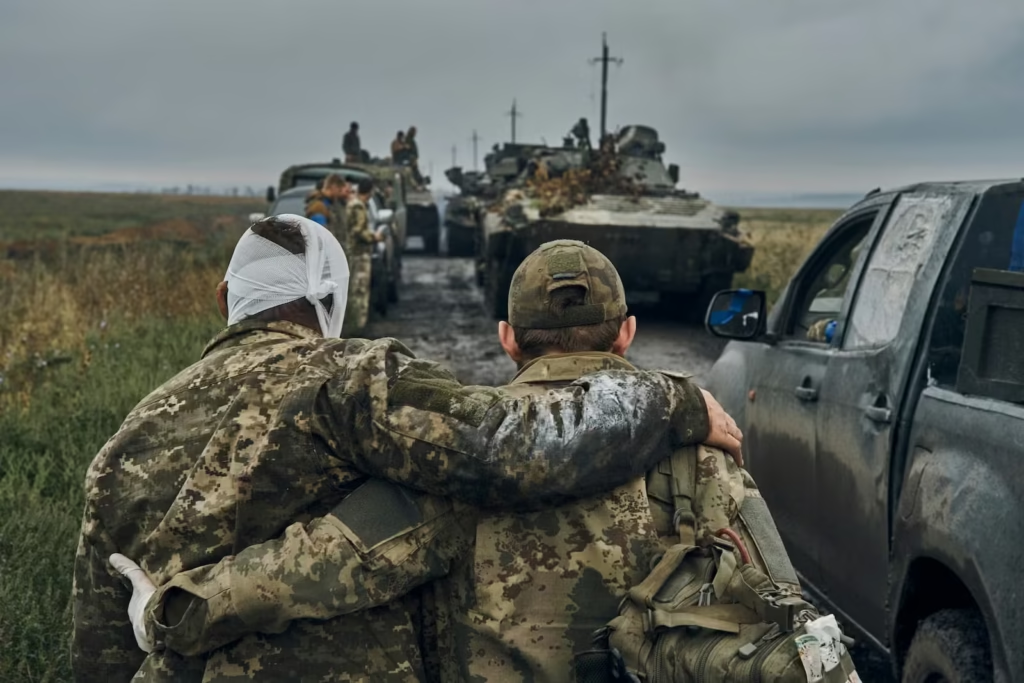
In military contexts, where every second counts, this research demands urgent attention. Indian armed forces, pushing boundaries in high-altitude warfare along the LAC or naval operations in the Indian Ocean, face scenarios where medevac delays doom casualties. Current field protocols prioritize rapid evacuation within the “golden hour,” but Parnia’s findings suggest we could buy far more time. Equipping forward operating bases with advanced ECMO (extracorporeal membrane oxygenation) machines—already tested in his NYU trials—might revive soldiers clinically dead from hemorrhagic shock or blast injuries. The U.S. DARPA has explored similar “biostasis” tech for wounded warriors; India, with its Atmanirbhar push in defense R&D, should accelerate indigenous versions. Picture DRDO labs adapting underwater robotics expertise to portable resuscitators, preserving brain function amid prolonged extractions from submarine incidents or rugged terrains.
Critics warn of ethical minefields: prolonging a potentially vegetative state, resource strains on ICUs, or blurred lines between life and organ donation. Parnia counters that informed consent and quality-of-life metrics can guide this, much like we’ve navigated ventilators in COVID wards. Policymakers must act—funding trials through ICMR or tri-services medical corps, training paramedics in extended CPR, and integrating AI-monitored EEGs for real-time brain scans. India’s defense budget, ballooning to counter regional threats, allocates too little to such frontier medicine.
Parnia’s revelations force a reckoning: death may be more negotiable than we thought. By embracing this science, militaries and healthcare systems worldwide—not least India’s—can turn the impossible into protocol. The question isn’t if we’ll revive the clinically dead tomorrow, but how soon we start.