

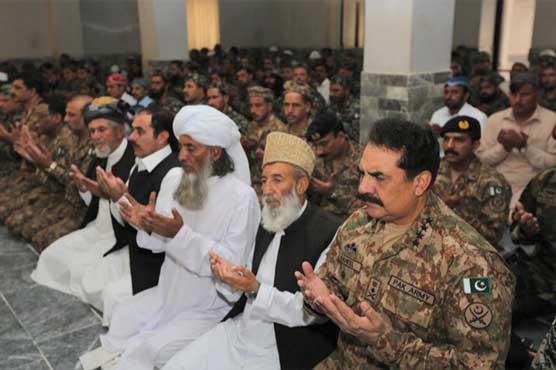
In October 1998 Qazi Husain Ahmed, the Emir (Chief) of the Jamaat-e-Islami said that the Pakistan generals are not Corps Commanders but ‘Crore Commanders’ (pun intended). This was the first time someone dared to say such a thing about the Pakistan army top brass that too openly in public. Previously, this was something everyone knew but only uttered in hushed tone – that too behind closed doors.
Pakistan Military is the biggest business conglomerate, most powerful banker, largest landowner and most influential opinion leader that runs the state, society and economy.
Fertiliser, cement, oil, banks, housing, shipping, telecom, food— anything, just name it, and the chances are that the Pakistan Army already dominates or has a stake in it.

- Pakistan military is the biggest player in the petroleum and gas sector
- Pakistan Army is the biggest contractor for Pakistan’s Space and Upper Atmosphere Research Commission of Pakistan
- Fauji Foundation based in Rawalpindi is the largest business conglomerate in Pakistan
- Askari Bank is among the top 5 banking institutions in the country
- Fauji Fertiliser is the most profitable company on the Pakistan Stock Exchange
- Mari Petroleum and FFC are the most profitable firms that dominate their sectors
- Askari Aviation Services (Pvt) Ltd under the Army Welfare Trust is a leading Pakistani aviation company
- National Logistics Corporation (NLC) a Pakistan Army venture controls much of Pakistan’s freight and logistics, often competing directly with private operators.
- More than a dozen PSUs including Water and Power Development Authority (WAPDA), National Logistics Cell (NLC), the Frontier Works Organization (FWO) and the Special Communications Organization (SCO) are totally controlled by the Pakistan Army.
Also Read: Soldiers or salesmen: why Pakistan army minds its own business

Almost 50% of the high-ranking retired Pakistan Army/Navy and Air Force Generals and Corps Commanders are directly accommodated in these organizations while another 30% are adjusted in foreign service or bureaucracy. Even the remaining 20% are inducted as advisors to provincial governments, absorbed into various projects or public sector undertakings. As a result, Pakistan is a country where the army gets rich and generals become billionaires while people starve. This has given rise to the notion “Poor Nation, Rich Army.”
A number of times both serving and retired military officers—have been involved in scandals. Everyone knew what happened and who was involved, but no one said it openly – in public, and the case was closed, unless the officers involved had fallen out of favour or the scandal couldn’t be brushed under the carpet. It is hardly surprising that:

- Former Army Chief Gen. Ashfaq Parvez Kayani who for many years was the most powerful figure in the country was grilled for favouritism in the Defence Housing Authority (DHA)’s DHA Valley project which was classified by the National Accountability Bureau (NAB) as among Pakistan’s “50 mega land scams.”
- Former Army Chief General Qamar Javed Bajwa, his wife Aisha Amjad and daughter-in-law Mahan Zabir reportedly acquired so much wealth and property during his tenure that their net worth grew to billions of Pakistani rupees within a few years.
- Former Director general of the Inter-Services Public Relations (ISPR) and Special Advisor to the Prime Minister (SAPM) on Information and Broadcasting Gen Asim Saleem Bajwa and his family established a “business empire” worth tens of millions of dollars, including 133 restaurants in four countries
- The Pandora Papers revealed that over 700 Pakistanis, including relatives of former military officials, held offshore accounts and shell companies.
Military’s involvement in business – worldwide

The involvement of militaries in business is a complex issue that has its own merits and demerits. While on one hand it leads to financial freedom for equipment, training, and welfare and on the other hand it also raises concerns about transparency, and accountability.
But then, Pakistan is not the only country where the military is involved in business. All over the world, a number of armies fund, own and manage private businesses which were initially started for welfare of soldiers, but overtime developed into powerful commercials entities.
Egypt – The military as a builder and broker

The Egyptian military is perhaps the closest parallel to Pakistan. It produces everything from bottled water and pasta to refrigerators and television sets. Egypt presents a classic example of what happens when Army Generals become businessmen. Like Pakistan, Egypt’s military tries to camouflage its commercial endeavours as essential for nation‑building and public welfare but in reality, no government can ignore its economic clout. The Egyptian military dominates the economy as well as the civilian politics by virtue of the fact that it controls over 20–40% of the country’s trade and commerce.
The military has two faces – both as “builder and broker”. Its reach extends far beyond barracks and battlefields. On one hand it runs factories, farms, construction companies, and consumer goods enterprises besides dominating the construction of highways, housing, and other big infrastructure projects. On the other, it elbows out private enterprise, distorts markets, and exercises authoritarian control. Civilian leaders find themselves dependent on military‑run projects, while entrepreneurs struggle to compete against an institution with privileged access to land, capital, and contracts.
The military’s double role as “defender and developer” makes it both a stakeholder in national security and a gatekeeper of economic opportunity. The net result is that the Egyptian military today not only dominates the economy but also reshapes the politics by deciding who will run the government and how.
Turkey: Corporatized welfare mechanism for soldiers

Turkey offers one of the most unique examples of how a military has corporatized welfare into a full‑fledged business empire. The Turkish Armed Forces established the OYAK Group (Ordu Yardımlaşma Kurumu) in 1961 as a pension fund for soldiers. OYAK collects contributions from serving officers and reinvests them into profitable ventures, effectively turning soldier pensions into capital for large‑scale business operations.
It is now one of Turkey’s largest and one of the most professionally managed business group with stakes in cement, finance, insurance, automobiles (including a joint venture with Renault), logistics, chemicals, and food industries. It is legally autonomous and operates more like a specialist corporate entity than as a military puppet organisation.
The objective behind the creation of OYAK was to set up a corporatized pension system to ensure that military personnel enjoy financial stability even after retirement. This was the rationale behind privileged access to contracts and markets, even though such advantages distort competition. This has not only allowed it to become a corporate giant but also allowed backdoor entry for the military to exert its influence in economy and politics.
Myanmar: The military as merchant

In Myanmar, the Tatmadaw has developed into one of the most entrenched military business empires in the world. Though the Tatmadaw, was formally founded on 27 March 1945 during World War II, its growth trajectory began in the 1990s, when international sanctions and economic isolation forced the military to be financially self‑reliant. To sustain itself independently of civilian governments, the Tatmadaw created two wings: Myanmar Economic Holdings Limited (MEHL) and Myanmar Economic Corporation (MEC). The justification behind this was that these ventures were essential for nation building and self‑reliance as the profits generated will be ploughed back to finance welfare schemes and to provide pensions, healthcare, and financial stability to soldiers and their families.

Today the Myanmar Economic Holdings Limited and Myanmar Economic Corporation have become dominant players in the national economy controlling mining, jade and gem trade, banking, telecommunications, transport, construction, and consumer goods sectors. This allows the military to sustain itself even when international pressure seeks to weaken its grip, making it politically untouchable. This model demonstrates how military commerce, when unchecked, can transform an armed force into a parallel state, one that commands not only the battlefield but also the marketplace.
These conglomerates are managed by serving and retired officers who are given privileged access to all kinds of natural and manmade resources. By managing MEHL and MEC, Myanmar’s military has entrenched itself as both merchant and political broker, ensuring that its economic dominance reinforces its authoritarian grip on the country.
In reality, Tatmadaw’s business empire is opaque and deeply tied to corruption. Tatmadaw’s profits are directly siphoned to the military’s coffers, bypassing civilian oversight – paving the way for the army’s political dominance, funding repression and promoting authoritarian rule. This makes it a textbook case of how military commerce can lead to authoritarianism and corruption in the name of welfare.
Sudan: mines fund militias

Republic of Sudan’s military is deeply entrenched in the country’s economy. The Sudanese Armed Forces (SAF) and Rapid Support Forces (RSF) – a paramilitary force control over 250 companies in gold mining, oil infrastructure, agriculture, trade taxation, and manufacturing business especially in Darfur and other conflict zones. Sudan’s Military Industry Corporation (MIC) produces weapons, ammunition, and military equipment. The revenue generated from these networks is used to sustain war, consolidate political power, finance clandestine operations, enrich elites, and undermine civilian governance often bypassing state institutions.
Indonesia: TNI’s ‘undercover’ empire

The Indonesian military (Tentara Nasional Indonesia, TNI) is a powerful economic actor and almost inseparable part of the country’s economy. Military-linked foundations and cooperatives run transport companies, plantations, mining ventures, construction firms and have significant presence in logging, mining, transport, arms procurement and security related businesses. Kickbacks and inflated contracts are common in arms purchases, often involving foreign suppliers.
United States: Lobbying, contracts, and the Pentagon’s golden triangle

The United States with an annual defence budget exceeding $800 billion, has the world’s largest arms industry dominated by firms like Lockheed Martin, Boeing, Northrop Grumman, and Raytheon. The United States military business is dominated by the military–industrial complex — a term coined by President Dwight Eisenhower in 1961, to describe the symbiotic relationship between the Pentagon, Congress, military and private defence contractors. However, unlike Sudan, Indonesia, or Egypt, the United States military itself does not directly run commercial businesses. The Department of Defence (DoD) awards contracts, but the military does not own or operate these companies.

The military does run non-commercial support services like commissaries, gas stations, exchanges, housing, healthcare and retail outlets. These are technically government-run retail operations, not private businesses. But these are welfare-oriented, not profit-driven businesses for serving military personnel, their families, and retirees. For instance, grocery stores operated by the Defence Commissary Agency (DeCA) offer food and household goods at discounted prices to service members and their families. Similarly, some bases have retail stores run by the Army & Air Force Exchange Service (AAFES), Navy Exchange (NEX), and Marine Corps Exchange (MCX). They function almost like any other department store and sell clothing, electronics, and appliances. But the profits are reinvested into morale, welfare, and recreation (MWR) programs including gyms, bowling alleys, golf courses, theatres, and restaurants designed to improve quality of life of military personnel and their families.
China: Profit-making is no longer the military’s business

In the 1980s and 90s, the Chinese People’s Liberation Army (PLA) ran over 20,000 businesses ranging from hotels and factories to transport and consumer goods. But in the 1998 President Jiang Zemin ordered the PLA to divest from commercial ventures, transferring most businesses to civilian ministries or privatizing them. The logic behind this move was that profit‑making undermined professionalism and created conflicts of interest. The justification for reform was that the military’s core mission was defence, not commerce, and that professionalism required disentangling soldiers from profit. The PLA today focuses on defence, while state‑owned enterprises handle industries once controlled by the military. China’s case illustrates how political will can dismantle military business empires and restore focus on defence, offering a rare example of successful reform.
Conclusion: Business as Usual

When not engaged in battle, the Pakistan Army is occupied with another front — business. The paradox of a struggling nation whose military thrives as a wealthy corporate actor raises pressing questions about governance, accountability, and the health of democracy. For Pakistan, the central dilemma is whether its army will continue to straddle the dual roles of soldier and entrepreneur, or whether reform will re‑establish a clear boundary between defence and commerce. Until that line is redrawn, the military will remain not only the guardian of the state but also one of its most influential business magnates.