

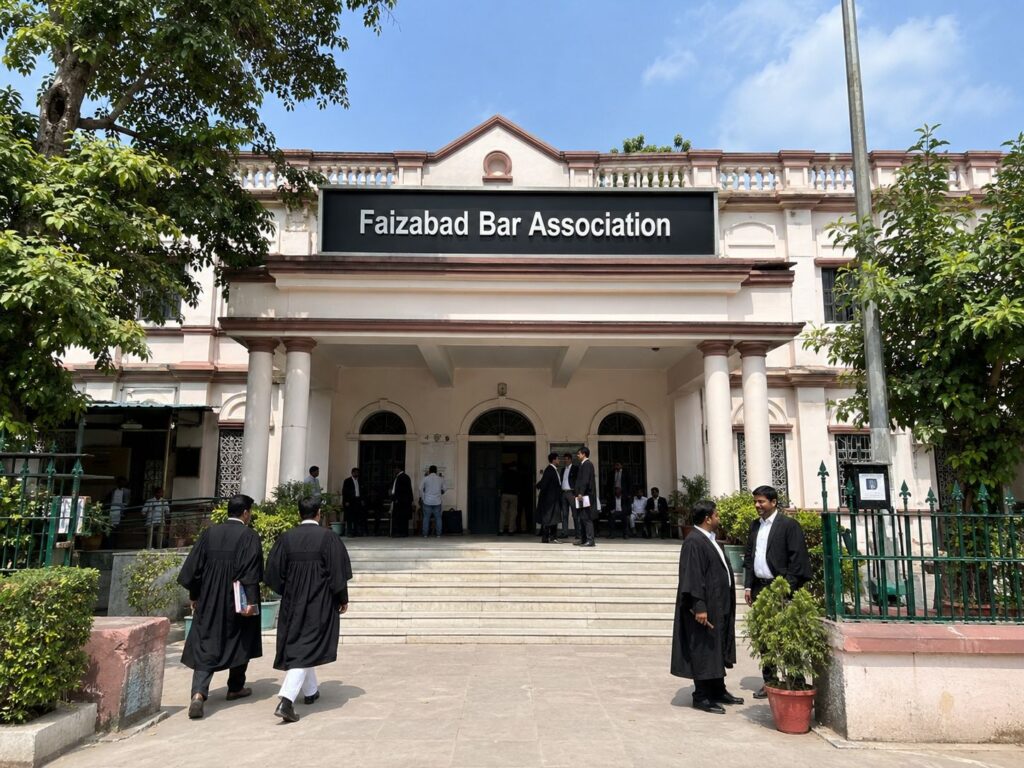
Recently the Faizabad Bar Association — a professional body of lawyers in the Faizabad district (now officially Ayodhya) which plays a central role in legal proceedings and advocacy in the region resolved that none of its members will defend the eight accused persons arrested in the alleged Ram Mandir donation embezzlement case.
The decision was taken at the association’s general body meeting following the recent arrests.
According to the resolution, any advocate who appears on behalf of the accused could face a Rs 5 lakh penalty. Reports also state that lawyers warned of further action, including seeking cancellation of membership, against those violating the resolution.

This resolution is wholly illegal in view of the judgment of the Supreme Court in A.S. Mohammed Rafi vs State of Tamil Nadu (2010), in which the Court observed:
“Before parting with this case, we would like to comment upon a matter of great legal and constitutional importance which has caused us deep distress in this case. It appears that the Bar Association of Coimbatore passed a resolution that no member of the Coimbatore Bar will defend the accused policemen in the criminal case against them in this case.
Several Bar Associations all over India, whether High Court Bar Associations or District Court Bar Associations, have passed resolutions that they will not defend a particular person or persons in a particular criminal case. Sometimes there are clashes between policemen and lawyers, and the Bar Association passes a resolution that no one will defend the policemen in the criminal case in court. Similarly, sometimes the Bar Association passes a resolution that they will not defend a person who is alleged to be a terrorist or a person accused of a brutal or heinous crime or involved in a rape case.
In our opinion, such resolutions are wholly illegal, against all traditions of the Bar, and against professional ethics. Every person, however wicked, depraved, vile, degenerate, perverted, loathsome, execrable, vicious or repulsive he may be regarded by society, has a right to be defended in a court of law, and correspondingly it is the duty of the lawyer to defend him.”
Historical and Constitutional Importance of the Right to Counsel
The Court then cited several historical examples.
When the great revolutionary writer Thomas Paine was jailed and tried for treason in England in 1792 for writing his famous pamphlet The Rights of Man in defence of the French Revolution, the great advocate Thomas Erskine (1750–1823) was briefed to defend him. Erskine was, at that time, the Attorney General for the Prince of Wales, and he was warned that if he accepted the brief, he would be dismissed from office. Undeterred, Erskine accepted the brief and was dismissed from office.
However, his immortal words in this connection stand out as a shining light even today:
“From the moment that any advocate can be permitted to say that he will or will not stand between the Crown and the subject arraigned in court where he daily sits to practice, from that moment the liberties of England are at an end…”
Indian lawyers have followed this great tradition. The revolutionaries in Bengal during British rule were defended by our lawyers; the Indian communists were defended in the Meerut Conspiracy Case; Razakars of Hyderabad were defended by our lawyers; Sheikh Abdullah and his co-accused were defended by them; and so were some of the alleged assassins of Mahatma Gandhi and Indira Gandhi. In recent times, Dr Binayak Sen has also been defended.
No Indian lawyer of repute has ever shirked responsibility on the ground that it would make him unpopular or that it was personally dangerous for him to do so. It was in this great tradition that the eminent Bombay High Court lawyer Bhulabhai Desai defended the accused in the INA trials in the Red Fort at Delhi (November 1945–May 1946).
However, disturbing news is now coming from several parts of the country where Bar Associations are refusing to defend certain accused persons.
The Sixth Amendment to the US Constitution states:
“In all criminal prosecutions the accused shall enjoy the right… to have the assistance of counsel for his defence.”
In Powell vs Alabama (1932), the US Supreme Court held that the right to counsel is an essential component of a fair trial and due process.
The Court observed:
“The right to be heard would be, in many cases, of little avail if it did not comprehend the right to be heard by counsel.”
Professional Ethics and the Duty of Lawyers
We may also refer to the legendary American lawyer Clarence Darrow (1857–1930), who strongly believed that every accused person, no matter how wicked, loathsome, vile or repulsive he may be regarded by society, has the right to be defended in court.
Most lawyers in America refused to accept the briefs of such apparently wicked and loathsome persons, but Clarence Darrow accepted them because he firmly believed that every person has the right to be defended in court and that it is correspondingly the duty of the lawyer to defend.

At the Nuremberg trials, the Nazi war criminals responsible for killing millions of people were nevertheless defended by lawyers. The same happened in the trial of Adolf Eichmann, one of the architects of the Holocaust.
We may also refer to the fictional American lawyer Atticus Finch in Harper Lee’s famous novel To Kill a Mockingbird. Despite threats of violence and social ostracism, Atticus Finch courageously defended a black man falsely charged with raping a white woman because he believed that everyone has a right to be defended.
The following words of Atticus Finch will ring throughout history:
“Courage is not a man with a gun in his hand. It is knowing you are licked before you begin, but you begin anyway and you see it through no matter what. You rarely win, but sometimes you do.”
In our own country, Article 22(1) of the Constitution states:
“No person who is arrested shall be detained in custody without being informed, as soon as may be, of the grounds for such arrest nor shall he be denied the right to consult, and to be defended by, a legal practitioner of his choice.”
Chapter II of the Rules framed by the Bar Council of India, relating to Standards of Professional Conduct and Etiquette, states:
“An advocate is bound to accept any brief in the Courts or Tribunals or before any other authorities in or before which he proposes to practice at a fee consistent with his standing at the Bar and the nature of the case. Special circumstances may justify his refusal to accept a particular brief.”
Professional ethics require that a lawyer cannot refuse a brief, provided a client is willing to pay his fee and the lawyer is not otherwise engaged.
Hence, the action of any Bar Association in passing a resolution that none of its members will appear for a particular accused—whether on the ground that he is a policeman, a suspected terrorist, a rapist, or a mass murderer—is against all norms of the Constitution, the statute, and professional ethics.
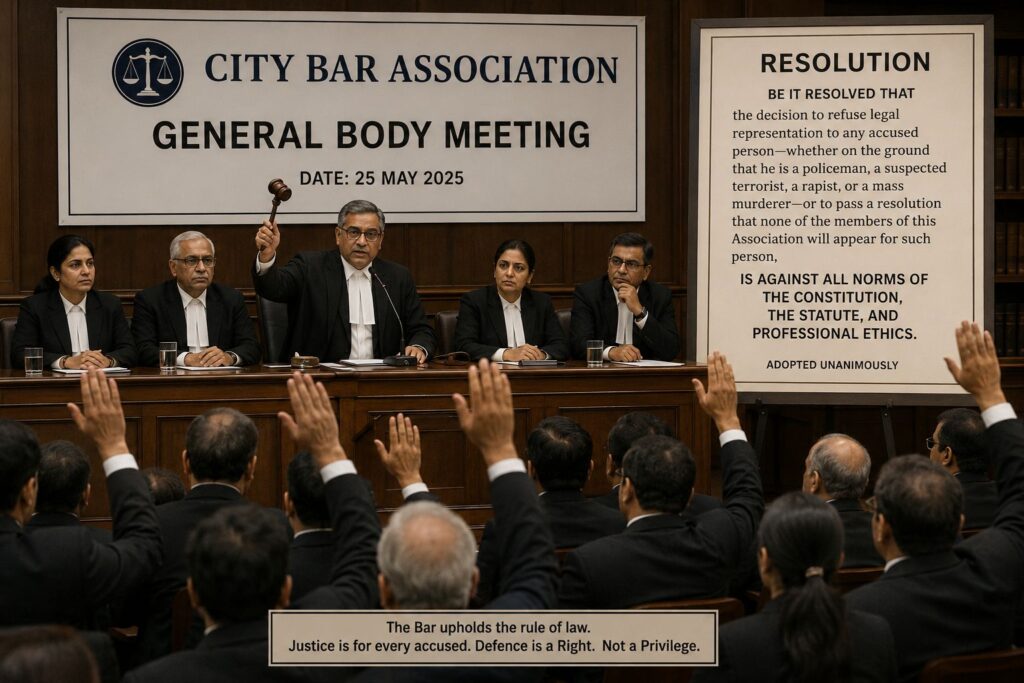
It is against the great traditions of the Bar, which has always stood up for defending persons accused of a crime. Such a resolution is, in fact, a disgrace to the legal community.
The Supreme Court declared that all such resolutions of Bar Associations in India are null and void and that right-minded lawyers should ignore and defy such resolutions if they want democracy and the rule of law to be upheld in this country.
In view of this clear and detailed exposition of the law, the Faizabad Bar Association would be well advised to withdraw its illegal and contemptuous resolution. The members of the Faizabad Bar should ignore it, treating it as null and void and as disgraceful to their profession.