

The Supreme Court has recently upheld the dismissal of a Christian army officer Samuel Kamalesan for refusing to take part in religious rituals of his troops as per regimental traditions in spite of having been ordered to do so. In its cryptic order, the Supreme Court found no ground to interfere with an earlier order of the Delhi High Court.
Reasoning of the Delhi High Court
The Delhi High Court had essentially emphasized the Armed Forces’ secular ethos—personnel of all faiths united by uniform, nation before self/religion—while respecting individual beliefs (per Regulations paras 332, 1385). However, Commanding Officers (COs) bear heightened responsibility to lead by example, prioritizing unit cohesion, morale, and unflinching command over personal preferences, especially in combat. Article 33 allows restricting rights for discipline; the Army Act does so, making religious parades military duties. The petitioner’s refusal to fully participate (entering sanctum, rituals) was disobedience to lawful superior commands (Section 41, Army Act), not merely religious freedom—potentially demoralizing troops, violating military ethos.
Arguments in Support of the Officer
Arguments in support of the officer were led by a lawyer whose point was published by The Hindu as an editorial titled ‘The Kamalesan Case and its Simple Lesson’. His main contentions are:
- The court’s stance sends an unintended message that conscience-based objections are unwelcome or punishable.
- Minorities may perceive that faith-based disagreements will not be accommodated.
- Intent does not matter as much as message, and the message here is exclusionary.
- Democracies face collisions between values; the question is not which value wins, but how to accommodate both.
- True strength lies not in blind uniformity, but in flexibility that respects individual rights while sustaining institutional cohesion.
- The judiciary missed an opportunity to uphold constitutional tolerance.
- The Kamalesan case stands as a warning: institutions must find ways to respect plurality of faiths while maintaining order.
- A simple accommodation could have turned a divisive case into an exemplar of Indian constitutional values—unity without forced uniformity.
Arguments against the Officer
Arguments against the officer were led by a retired army officer who wrote an article titled ‘An officer or a believer? What I learnt about faith and duty in 40 years in the Indian Army’. His main contentions are:
- Regimental mandirs, gurdwaras, churches, and sarv dharm sthals are not religious imposition mechanisms.
- They serve as symbols of regimental identity, morale, and unity, reinforcing fraternity rather than promoting any faith.
- In uniform, one does not discard faith but internalises it—it becomes personal, quiet, and dignified.
- The officer’s duty is not to judge rituals but to stand with his soldiers, physically and symbolically.
- Presence during collective religious rituals is a sign of leadership, solidarity, and shared identity.
- Religion in the Army is not worship, but a medium of bonding.
The Explosion of Stupidity on Social Media

In between the two, the social media literally exploded with pure, unadulterated bullshit, mainly from the retired and serving fauji community without an ounce of knowledge about the legal or socio-cultural complexity of the issue. Some of the gems of epic stupidity are given here for your enlightenment about the level of intellectual development in the country—without comments, of course, because commenting on them would waste space and divert from the central thesis of this article:
- You are an outsider and you do not know anything about the army and hence you have no right to comment on the issue. We know better. Stay out of the army.
- Practitioners know better than purists.
- The religion of your troops becomes your religion. That’s how it has always been. That’s how it will always remain.
- When conscience meets duty, solders have to stick to duty. No silver medals in Army. Kill or be killed.
- Positioning himself as some sort of martyr to his cause must be important to him for his future career options, perhaps as a hard-line evangelist. Could be lucrative.
- Looks like this guy was a cry baby. All of us have done these things when staying in lines—part of game.
- Any person who keeps such religious beliefs/faiths is a fundamentalist and needs to be treated with caution.
- Soldiering isn’t a clerical job—the other side wants to kill you before you can kill them.
- Regimental grooming, sleep deprivation, etc. are part of training and they sustained us during ops & exercises.
- More than Kamalesan, the SSB which selected him needs to answer few questions. How did this rotten apple enter the organisation?
NUANCES, WHICH PEOPLE FAILED TO UNDERSTAND

Religion must not come in the Way of One’s Job
Religion is a personal thing; a matter of personal belief. It has absolutely no place in any job, whether government or private. When you are discharging your duties, you must leave your religion at your home. Otherwise, find another job.
Ideally, it should be made very clear to anybody joining any job that, while the employer, whether government or a private person, respects your religion, please keep your religion and your religious practices at home for your private time.
That religion cannot be allowed to have any interference in job can be understood from a simple example. Suppose a Muslim man is employed as a security guard in jewellery showroom entrusted with protecting the property. Would any employer, whether Hindu or Muslim, tolerate that the guard abandons his duty place and goes off to offer namaz leaving the showroom unprotected? Similarly, can a Hindu security guard abandon his duty place to perform say, Trikaal Sandhya?
The legal issue is that the ‘mutually-agreed upon service conditions’ necessarily entail that the guard shall not leave his duty place for anything and the employee has to abide by that or leave the job—as simple as that. If he has to answer the call of nature, he shall inform the store manager so that for that period, he may make some other arrangement. He cannot disappear for half an hour on the pretext that he was constipated and was straining on the loo.
Can a Muslim soldier, in the midst of a battle, stop fighting and offer namaz? Aurangzeb did so during the Kandahar campaign of Shahjahan. Abdul Aziz, the son of Nazar Mohammed, himself witnessed that one day when a fierce battle was raging, the hour of the zuhr namaz arrived. To the utter astonishment of everybody around him, Aurangzeb spread his carpet on the blood-soaked ground, knelt down and calmly said his prayers, completely oblivious of the clash of arms and the cries of the warriors and the wounded around. Noted historian B. P. Saksena states that he was then without armour and shield. Saksena adds that the Bukhara army gazed on the scene with wonder, and Abdul Aziz, in generous admiration, stopped the fight, crying: “To fight with such a man is to court one’s own destruction.”
But, Aurangzeb was a prince. He was not employed by anybody and did not take orders from anybody. The position of modern-day employees is different.
Historical Reality of the Role of Religion in Wars

Unfortunately, such ideal conditions do not exist. Historically, armies across the world have been fighting in the name of religion and it is a historical fact that soldiers did derive extra inspiration when religious fervour was invoked. You see, soldiers for most part of history have been unlike the Red Army of the Soviet Union or the People’s Liberation Army of China where ideology was the motivating factor and not religion. They could, at least for the sake of argument, be regarded perfect soldiers, fighting ‘mechanically’ because fight they must without the ‘stimulation’ of religion.
Little more than a century after the Prophet, the swords of the Islamic armies rapidly swept over the ancient world. Truly inspired by the newly found religious zeal, they easily trampled over most of the opposition. It needs no elaboration that Islamic armies throughout the course of history and across the world fought in the name of their religion and for religious merit. The most popular battle cries of the soldiers were: Allahu Akbar, and Deen! Deen! (The Faith! The Faith!). Akbar introduced the battle cry of Ya Muin (O Helper) also.
Western armies were also known to and fight in the name of religion. Besides the well-known Crusades, they fought several wars against people of other religions in the name of religion. These include The Reconquista (8th-15th century when Christian kingdoms in Spain fought to reclaim territories from Muslim rule in the Iberian Peninsula); Spanish conquests in North Africa (1090-91 when Christian Spanish forces fought against Muslim Berber Almohad conquerors); Cromwell’s conquest of Ireland (1649-1653 when Protestant English Parliamentarian forces fought against Catholic Irish Confederates and Royalists, involving massacres like the Siege of Drogheda); and numerous other wars amongst various sects of Christianity.

Religion was indeed invoked to instil greater fighting spirit in the soldiers. In Shakespeare’s Henry V, the King rallies his soldiers before the Battle of Agincourt thus “Once more unto the breach, dear friends, once more; or close the wall up with our English dead… Follow your spirit, and upon this charge; Cry ‘God for Harry, England, and Saint George!” Here Harry is Henry V himself. He is calling for divine protection for their king, their country, and their patron saint. Saint George is the patron saint of England and is venerated for his courage and Christian martyrdom.
Historically, when Hindu armies fought the Muslim invaders, they did raise the battle cry of ‘Har Har Mahadev’. Indian soldiers are therefore no different from the rest of the world and they cannot be blamed if religion still inspires them. We have to live with that.
Where Post-Independent Indian Army failed
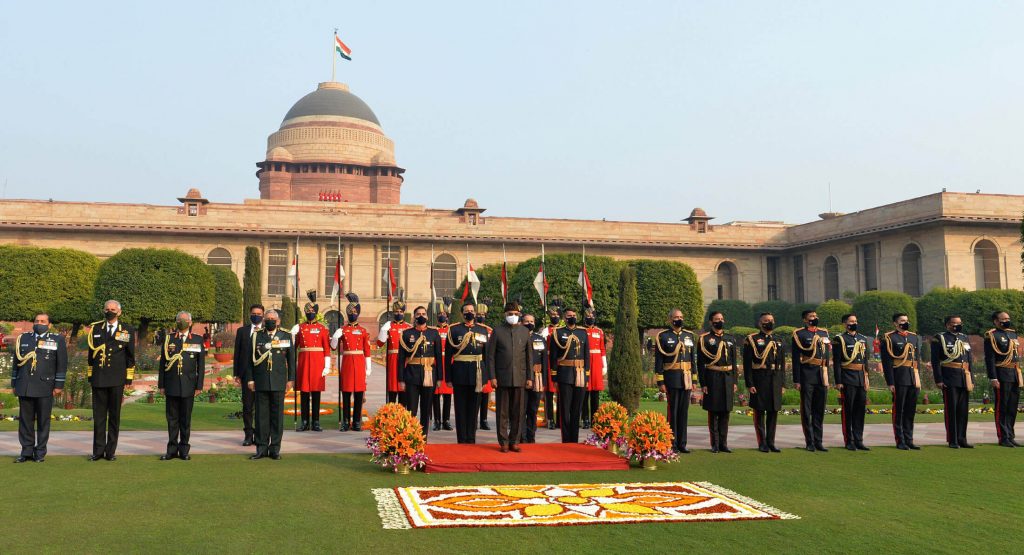
After independence, ideally, India could have and should have reorganized its armies into a ‘national and truly secular’ structure shedding the historical, colonial relics of many of the regiments (though not all, such as the Grenadiers) based on ethnicity, caste, region and religion, and having battle cries that are based largely on religion—a product of British ethnographic engineering. These regiments were stabilised around identity markers—caste, religion, region, language, and even battle cries of religious origin—believed to produce cohesion and fighting spirit.
The logical problem goes like this. If the colonial system of regiments works well, we should have amplified it further. In that case, why did we create say, the Grenadiers, Guards, and Mechanised Infantry etc. and why don’t we dispense with them. If regiments like the Grenadiers are working fine, why don’t we dispense with the colonial system? If all-India regiments are the normatively desirable and functionally adequate model, why retain—and even emotionally glorify—the Sikh Regiment, Jat Regiment, Gorkhas, Dogras, Rajputs, Marathas, etc. If the system does not work satisfactorily, why are they not dispensing with the regiments that follow this?
Logically, it does not make any sense to continue with a hotchpotch of colonial relics and modernity. The current reality—a hybrid system—is neither ideologically clean nor logically coherent. It represents a freeze-frame of history, not an outcome of deliberate design—a halfway house that tries to emotionally draw on pre-modern identities while proclaiming modern secular professionalism.
However, we cannot help if nobody since independence has had the intellectual mettle or political courage to do that or ‘stamp out’ religion, caste, ethnicity, region etc. from the army. This means that, for the foreseeable future, we have no option but to live with the ‘imperfect’ structure that we have. Our soldiers are not going to become Red Army or PLA soldiers.
Having thus accepted our fate and the fact that our system would continue to permit the troops to indulge in their religious practices even when living in army/paramilitary/police camps, we must now examine what can be done by way of ‘compromises’ or via media to live with the imperfection, or what ought to have been done in situations like that involving Kamalesan.
What the Colonial Era British Officers used to do?

John Masters was a British officer who served in the 4th Prince of Wales’s Own Gurkha Rifles in the 1930s on the North-West Frontier. In Bugles and a Tiger he gives a vivid, half-amused, half-horrified description of the annual Dashain (Dashera) festival celebrations in the Gurkha battalion lines. During Dashain, the most important festival for Hindu Gurkhas, each company sacrificed a young male buffalo or large goat to Devi Durga/Kali. The regimental colour (the Queen’s Truncheon in the case of Gurkha regiments) was also “fed” blood in their tradition.
The ritual that shocked and horrified young British officers was the requirement that the commanding officer or a designated officer personally decapitate the animal with a single stroke of the kukri. If the officer failed (that is, needed two or more strokes), it was considered an extremely bad omen for the coming year and a deep humiliation. The Gurkhas would have lost confidence both in his manliness and leadership. They would have thought that the officer did not care about their beliefs.
Viewed logically and scientifically, the Gurkhas could be argued to have been irrational. But the British did not have the luxury of having ‘rational’ soldiers. They had to do with whoever they had got and ensure that the troops retained their trust in them. Masters writes that hundreds, of British officers who privately considered themselves devout Christians spent nights secretly practising decapitating coconuts, rolled up beddings, and the like with oversized knives so that, once a year, they could publicly behead a buffalo in front of a thousand cheering Gurkhas and keep their reputation for courage intact.
Christianity is the only major Abrahamic religion that has completely and permanently abandoned ritualistic animal sacrifice. The rejection is not peripheral—it lies at the very core of Christian theology and is articulated in the Old Testament (Psalm 51:16–17; Hosea 6:6; Isaiah 1:11; and Jeremiah 7:21–23) and New Testament (Hebrews 7–10 and 1 Cor 5:7). Note that while religiosity was very high in the colonial British army in India—yet they did not mind ‘obliging’ the men they commanded.
What Kamalesan should have done?

Kamalesan’s folly was that he took the matter too literally. Standing in an ‘aarti’ and waving the ‘lamp-laden thali’ before the idol does not ‘convert’ him to Hinduism or hurt his core religious beliefs of Christianity. It is like this. Suppose al Qaeda or ISIS terrorists kidnap someone. They might force him at gunpoint to recite the Kalima. Under duress, he might. That act under threat does not really make a Muslim out of him. Belief is an internal thing. That cannot be forced. At first opportunity, he would revert to his original religion. By taking part in ‘aarti’ even as a drama if he wished so, would not have compromised his religious integrity. After all, hundreds of Muslim/Christian girl actors play roles of Hindu girls in films; get married on-screen according to Hindu rituals and sport sindoor—that does not compromise their personal religion. If his doing the ritual mechanically without any faith (that is, essentially acting) would have made his troops happier and boosted their morale, so be it.
Let us look at it another way. A subordinate of an officer might be getting his daughter of just 18 years who has not done even high school, married off. May be he had his own compulsions of family, his ‘biradari’, or social customs, etc. whatever. May be the groom is 15-20 years older than the girl. It is also possible that hefty dowry was also paid secretly. But, if such a subordinate invited his officer to attend the marriage, it would ‘hurt’ him if the officer refused to attend because in his ‘progressive’ views, the marriage was being performed under a ‘retrogressive’ social system. The subordinate would interpret it as a class bias issue—the officer declining his invitation because he was of a different ‘class’.
Why his ‘obliging’ was Important?
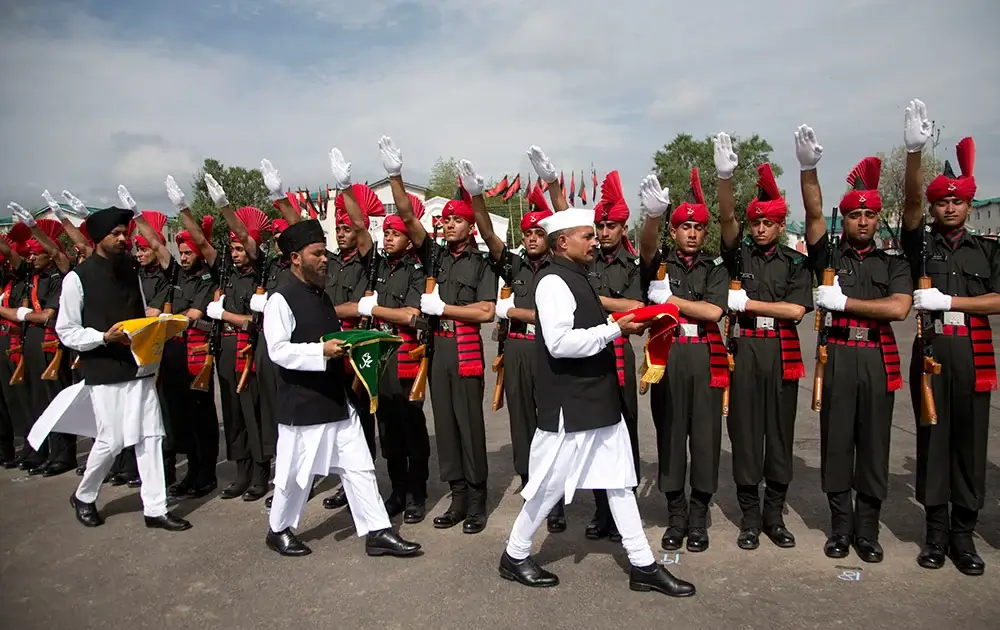
You see, officers are not supposed to be on a mission of reforming the society or making everybody under their command a perfectly rational being. Theirs is a very small circle and they must ensure that the circle remains cohesive. The courts delivered a correct judgment but laid emphasis on discipline. Discipline, though important, was secondary.
The core issue is that you are leading humans and not robots. You have to respect their human sentiments and human frailties. If, for reasons beyond your control, you are obliged to work with them, you have to take them along not by the lash but by securing their willing and enthusiastic cooperation. Respecting their traditions is thus part of this duty because it builds camaraderie. In that sense, it was a professional requirement nay duty.
You cannot discharge this duty in a half-hearted manner, which betrays your real feelings. By refusal to perform the ‘aarti’, he made appear that not only did he not believe in their practices, he would be rendered ‘spiritually impure’ if he obliged them by taking part. In other words, he placed his personal religious beliefs over a professional requirement vital for securing the trust and cooperation of the troops. Effectively, it can be argued that he ‘alienated’ himself from them and thus cut at the very roots of camaraderie so very essential for optimal performance of men in combat. An officer is expected to have a human bond with his men, not just a rank-based command relationship. He failed in that fundamental duty.

The simple fact is, one does not have to believe in others’ religions to take part in their activities as a mark of fellowship or respect. If troops or officers of one faith take part in the festivities of other religions (such as Holi, Diwali, Eid or Christmas), it just an expression of their belonging together—it has nothing to do with what they believe in the depths of their mind.
Even the judgment in the “Jehovah’s Witnesses case” (Bijoe Emmanuel v. State of Kerala 1986) ruled that the school children belonging to the Jehovah’s Witnesses faith must stand up respectfully during the National Anthem even if their religious beliefs prevented them from singing it—moreover, no legal provision obligates anyone to sing the National Anthem. The court held the students’ expulsion unconstitutional but insisted upon standing as a mark of respect. By an extension, so is the case here. He could have taken part mechanically.
In this case, it is just incidental that the officer was Christian. The same arguments would have applied even if he were a die-hard atheist. If the entire campus is lit up for Diwali, it would look very odd and disheartening to the fellow men if someone were to say that he is an atheist and hence he would keep his house in darkness.
In terms of Ramifications, why this Case was critical?

Because, had Kamalesan succeeded, it could have had disastrous consequences for discipline in the army and paramilitary forces that follow similar traditions. As per media reports, in October 2012, the Indian army had issued an order that instead of ‘good morning/afternoon’ army personnel would greet each other with ‘Jai Hind’. It was also ordered that all outdoor events (e.g., parades, ceremonies, training exercises) culminate with “Bharat Mata Ki Jai” shouted thrice, followed by the applicable regimental battle cry. The order aimed to standardize greetings and foster national pride and unity across the Army, reinforcing a secular, patriotic identity.
Personnel of certain religions might summarily refuse to raise Bharat Mata ki Jai/Jai Hind arguing that they all have Hindu religious overtones and it goes against their faith. In BMKJ, there is unstated deification of Bharat mata, which goes against the basic tenets of monotheistic religions regarding ‘The God’ only worthy of being hailed. That would create unnecessary complications. Thankfully, the SC judgment has pre-empted that possibility.