

Life is full of surprises. Unexpected turn of events do happen. One such experience was my association with the Right to Education (RTE) Act 2009 – one of the most significant legislations in independent India. It gave a major boost to school education and raised India’s status as a progressive nation championing education after a long wait. It received domestic and international acclaim as an innovative public policy initiative. Yet, it took six decades after independence. Looking back, it baffles me how RTE was almost given up and picked up at the last moment in an unexpected chain of events in which I played a pivotal role. My role began as a reluctant onlooker and ended as the most passionate champion of RTE.
From 2000 to 2007 my postings in the Government of India were in industrial development, as were many of my earlier postings in Bihar. I expected my last posting also to be in the industry sector. My promotion to Secretary to the Government of India came in 2007 after three years as Additional/Special Secretary in the Ministry of Steel. Contrary to my expectations, in November 2007 I was posted as Secretary, School Education & Literacy. I accepted the order like a disciplined civil servant and moved the next day from Udyog Bhavan to Shastri Bhavan in New Delhi.
After joining the Ministry of Human Resource Development (now Education), I immediately tried to understand the challenges of my new assignment. Among other tasks, one appeared crucial: to prepare the bill for the Right of Children to Free and Compulsory Education. It was in a state of uncertainty. The Hon’ble Supreme Court and Parliament had directed the State to enact a law making RTE a fundamental right of every child. Yet, five years after the constitutional amendment, there was no meaningful progress.
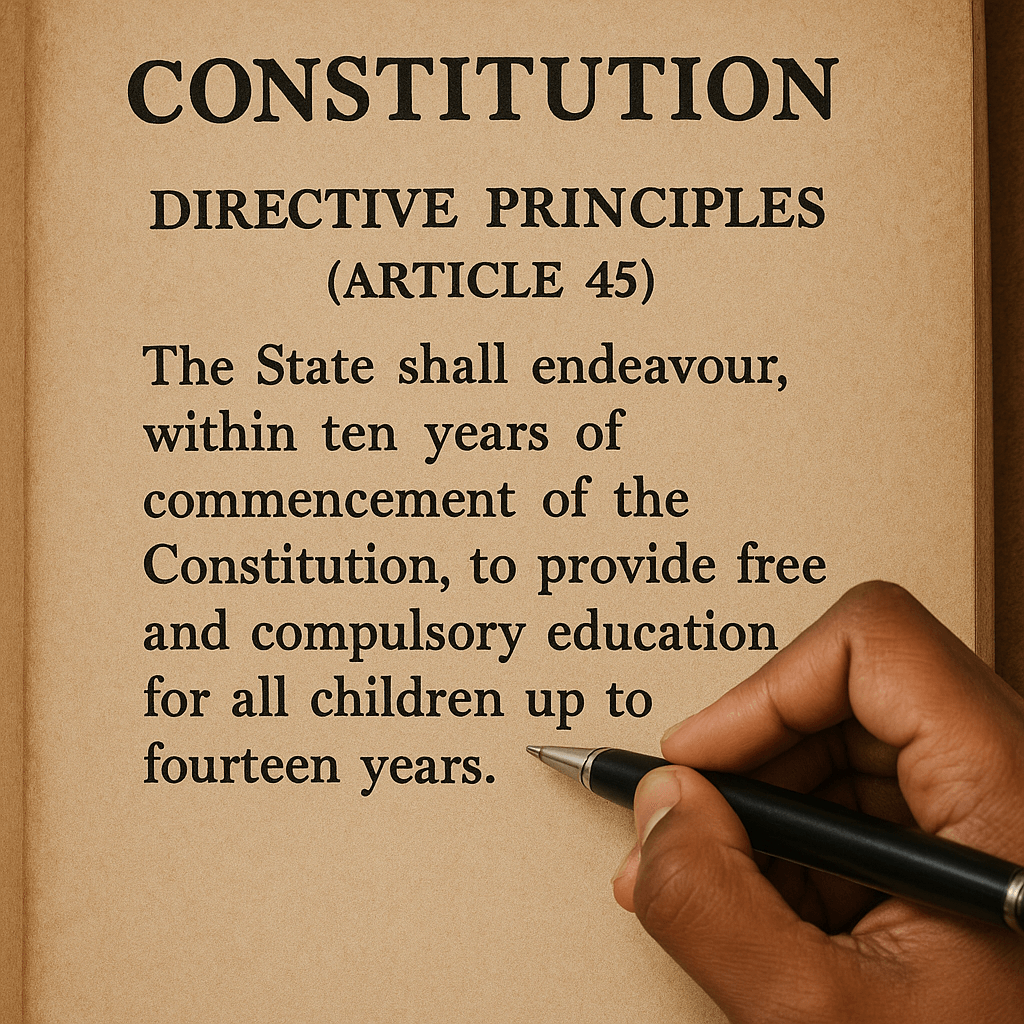
The Constitution, in the Directive Principles (Article 45), directed that the State shall endeavour, within ten years of commencement of the Constitution, to provide free and compulsory education for all children up to fourteen years. Even after more than three decades, this was not implemented. In a landmark judgement in 1993 (Unnikrishnan vs State of Andhra Pradesh), the Hon’ble Supreme Court held that the right to education is implicit in the right to life under Article 21 and that every child has a right to free education until the age of 14, thereafter subject to the economic capacity of the State.
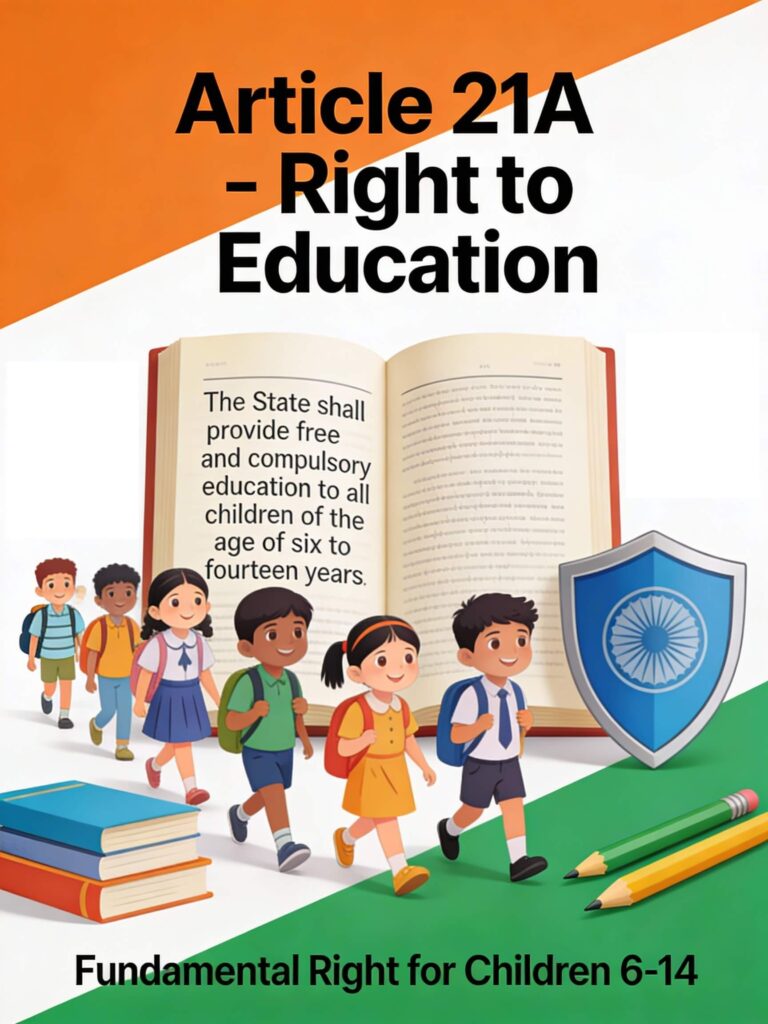
Consequent to this judgement, the Constitution was amended by the 86th Amendment in 2002, inserting Article 21A in the Fundamental Rights, stating that the State shall provide free and compulsory education to all children aged 6 to 14 years in such manner as the State may by law determine, which shall come into force on a date to be notified. After this, the issue before the Government of India was if, how, and when to introduce the RTE Bill in Parliament. By 2007, this had still not been done.
Soon after joining as Secretary, I tried to understand the implications of such legislation and discussed it with different wings of the government. Initially, I faced a Hamletian dilemma: to be or not to be. I had personal reservations based on my experience in Bihar. As Secretary, Education in the Government of Bihar, I had inherited over 200 contempt cases pending before the Hon’ble High Court, requiring my personal appearance almost daily for past violations of court orders. My predecessor was often mocked in the local press for this. I wondered whether RTE could lead to similar contempt cases nationwide against the Secretary, Government of India, for failures in implementation. This made me disinterested initially. However, I was clear that personal choices should not influence matters of duty.
In Shastri Bhavan, I studied the files in detail. A High-Power Committee (HPC) had been constituted to review the RTE Bill, examine the financial commitments, and assess the resource position of the government. The HPC had met many times. Its strong view was that RTE would involve huge expenditure—around ₹2 lakh crores over seven years—which was not feasible, particularly amid the global financial crisis. The prevailing view was to go back to Parliament and seek to annul the constitutional amendment.
Personally, I felt relieved. Without RTE, there would be no risk of contempt cases. This was my first reaction. But events soon changed my mindset from a reluctant onlooker to a staunch supporter.
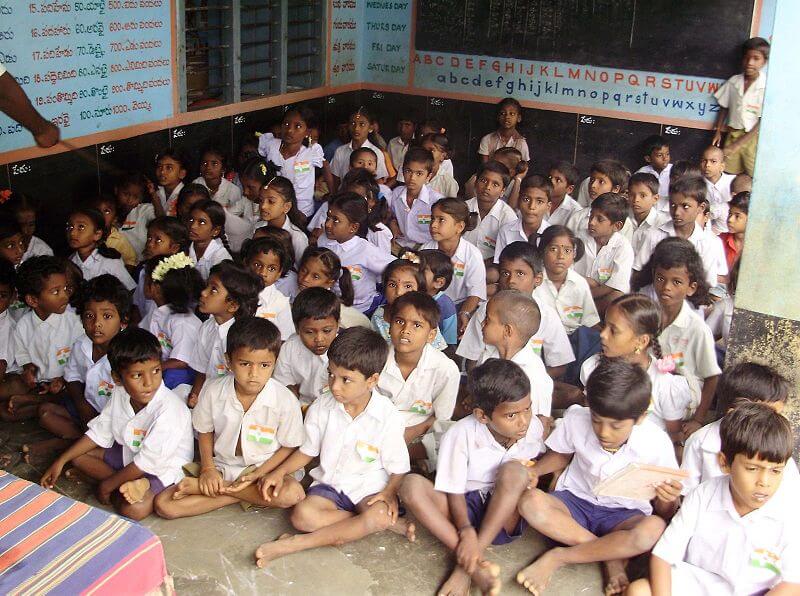
The eastern states—Odisha, West Bengal, Bihar, and Jharkhand—were the most educationally backward. NCERT and NUEPA reports ranked them lowest on educational indices. My ministry had to focus on these states. During a visit to Odisha, the Director of Education arranged a visit to my hometown Baripada in Mayurbhanj, one of the lowest ranked districts in the index of education.
My visit included my old school, Sarat Chandra Vidyapith. I was overjoyed to return, and the headmaster gave me a warm welcome and requested my comments in the Visitors’ Book. But the school was in very bad shape. When I had joined in 1963, it was a modest new school, yet I managed to secure a position among the top ten in the state Board. Now, after four decades, I saw no improvement: no proper infrastructure, hardly any laboratory or library, little had changed since my school days. There was no money, no grants, nothing, even after sixty years of independence.
The headmaster and teachers explained there was very little funding to improve the school. I wrote from the heart in the Visitors’ Book: I was happy to visit my school after forty years; but sad and shocked that the condition of the school had not improved in four decades. On the flight back from Bhubaneswar to Delhi, I reflected: why are Indian schools in such poor condition? What does the future hold? Who is responsible? What should be done?
By the time I reached my chamber in Shastri Bhavan, I felt remorse and guilt that the government had not done enough for education despite promises and rhetoric. I asked myself if I could do something. I became convinced that we had a golden opportunity to make the Right to Education a fundamental right for every child for eight years of free and compulsory education. We had to provide the investment which the schools needed and enforce norms, standards, and quality as provided in the RTE Bill. That was the way to begin building a new India. But how to move in that direction when the mood at higher levels was against committing such huge investments? India was spending barely 2% of GDP on education that time against the recommended 6%, far below many nations.
The fateful day of the HPC meeting arrived. The Hon’ble Prime Minister chaired it, with top dignitaries present. I was the only civil servant and felt out of place. As the meeting progressed, everyone felt that implementing RTE would be too costly and could not be financed. It became clear that the Bill would be dropped and Article 21A re-amended. I almost prepared to pack my papers. Then, unexpectedly, the PM turned to me: “Mr Secretary, what is your point of view?”
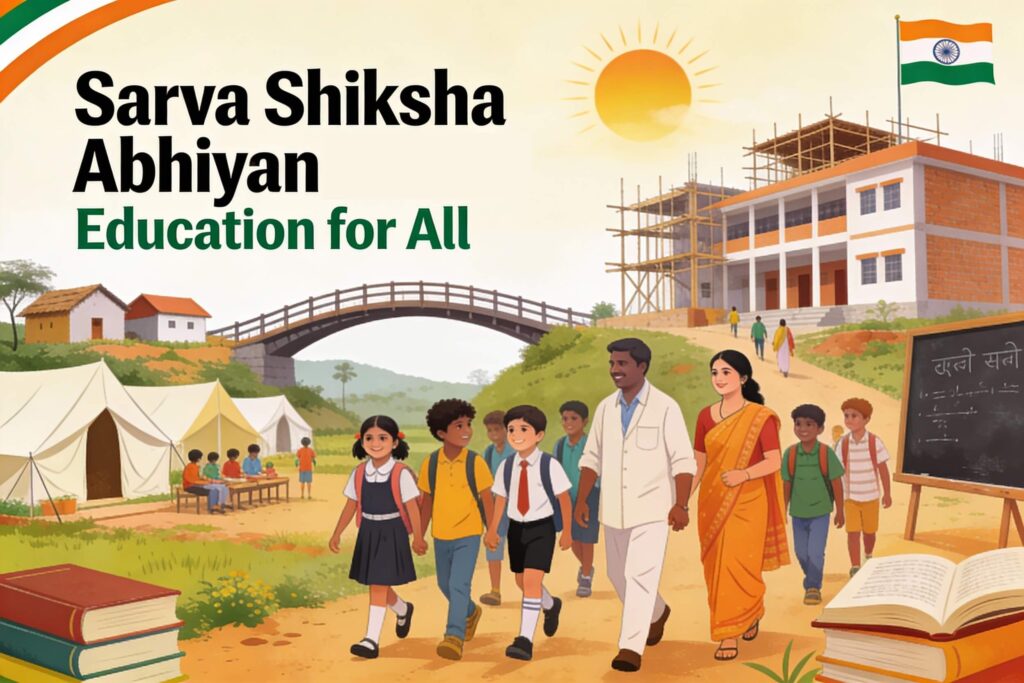
I was nervous. An inner voice told me this was a moment of history. Speak short and straight, from the heart. I said: “Sir, we have been saying that funds are not available. India signed the Education for All declaration of the United Nations and introduced Sarva Shiksha Abhiyan in 2000 for universalising elementary education. Since then, the central government has been providing substantial funds year-after-year. The budget has grown from ₹40 crore in 2000 to ₹13,000 crore in 2007. I feel we will continue to provide substantial funds for universal coverage. But we will not be able to enforce norms, standards, infrastructure, and quality without the RTE Act. I strongly recommend that RTE be made an Act.”
Nobody expected this stand. The PM was satisfied and said, “Yes, let us have RTE Act.” There was pin-drop silence. He asked me to sit with PMO officials to work out details. It was the first positive step—from rejection to hope of revival.
The next few weeks I spent running around, finalising the RTE Bill through inter-ministerial consultations and seeking concurrence. Reservations persisted: resource crunch and Centre–State issues. If the Centre passed the RTE Act, it would have to bear the financial burden. Some suggested that states enact their own laws, which would defeat the purpose. One IAS colleague, working with a powerful functionary, even suggested a central law for just one state. I explained to him the futility of his suggestion and politely asked him to drop such ideas.
There were still reservations from the fund givers! I eventually proposed some innovative solutions. One, the Centre would estimate the RTE budget annually in consultation with the States. Two, expenditure would be shared 65% by the Centre and 35% by states. Three, the Centre would provide grants-in-aid to states by mutual consultation. Four, the Central Government would refer to the Finance Commission under Article 280(3)(d) to examine the need for additional resources for states to meet their share under the Act. For the first time, the Finance Commission could be requested to earmark funds specifically for RTE. This formula found favour and was accepted in the final Bill.
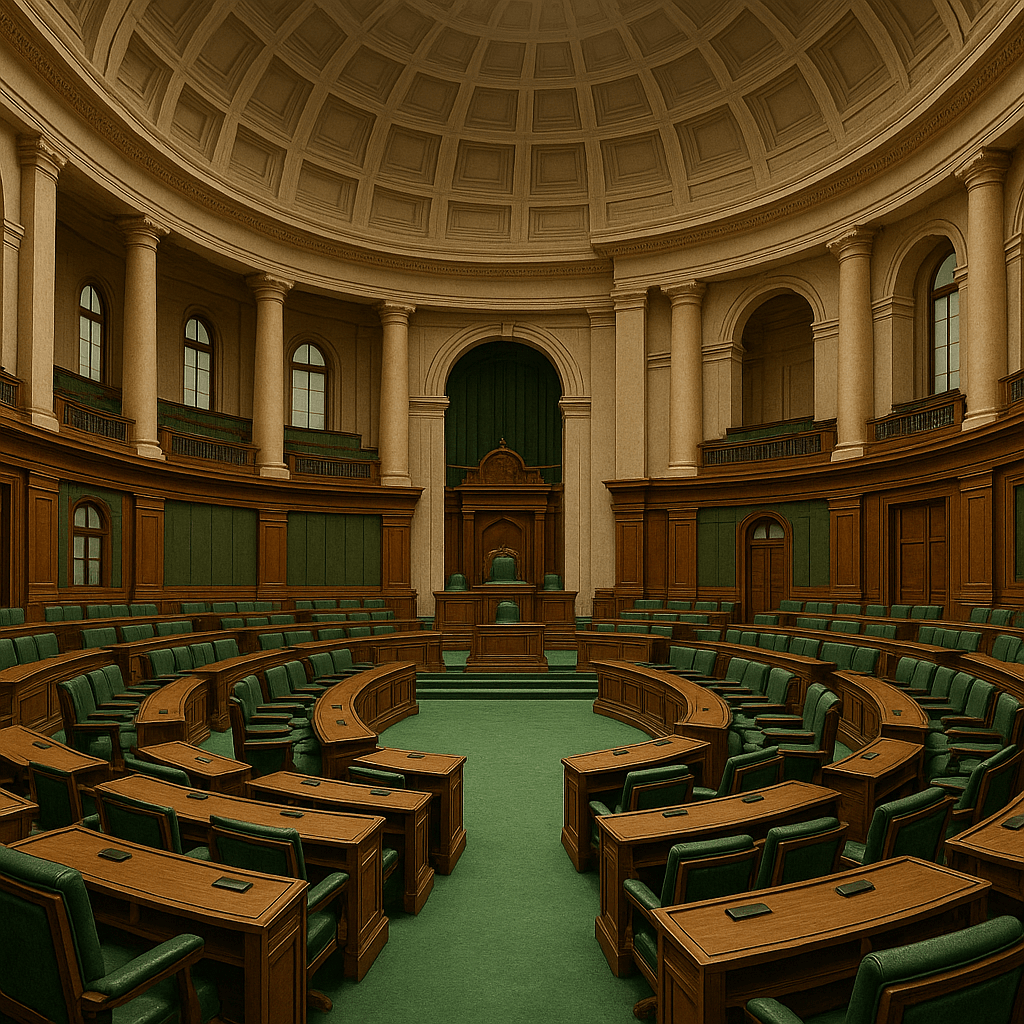
Two months before my superannuation, I managed to clear the Bill through my Ministry, the Union Cabinet and into Parliament. I met the Chairman of the Parliamentary Standing Committee on Education and convinced him of the need for the Act. The Bill was introduced in Parliament in the second week of December 2008, just a month before my retirement. In due course it was approved.
During this period, I had to run through the corridors of power in search of support. Generally, there was little eagerness except in the PMO. The Prime Minister stood like a rock and encouraged me throughout. Some self-opinionated civil servants, however, made derisive remarks, advising me to forget RTE and focus on pension papers as I had less than a year to retire. I assured them that both tasks were being pursued simultaneously.
The national press grew interested. At a press briefing, a correspondent asked, “Mr Secretary, you plan to spend nearly ₹2 lakh crores over seven years on RTE. Don’t you think this grand plan is too costly for India?” It was unnerving, but again my inner voice advised brevity. I replied, “If you think education is costly for India, all I can say is that illiteracy will be costlier for India.” The press liked the reply and gave strong support to the RTE Bill.
When the Bill was introduced in Parliament, it was widely welcomed. The Economic Times editorial of 12 December 2008 hailed it as a profound step and said the authors of the Bill should be declared national treasures.
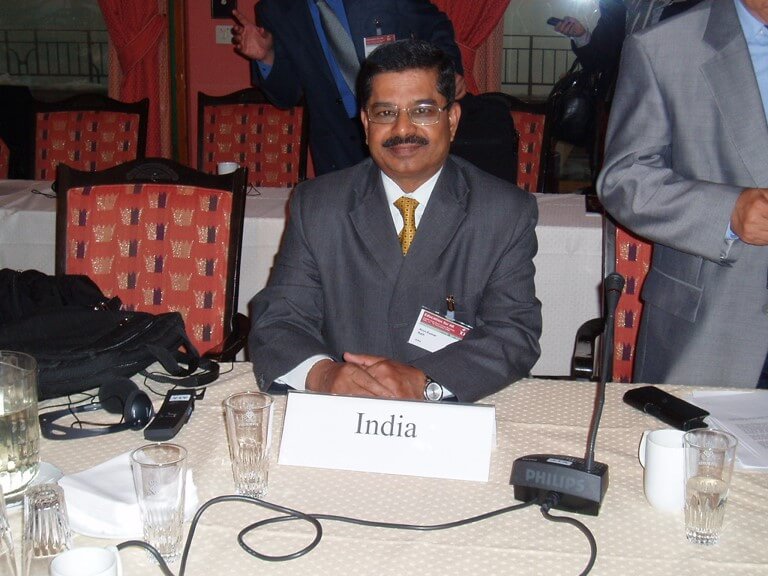
Around the same time, the UNESCO Conference on Education for All in Oslo (December 16–18, 2008) reviewed global progress of the goals of EFA. While many countries were cutting education budgets due to the global financial crisis, I informed the Conference that India was increasing its education investment, had introduced the RTE Bill, and was universalising the national mid-day meal scheme for about 200 million school children to improve enrolment and reduce dropouts. This was greeted with applause. The Conference felt that by making education a legal right and enhancing investment, India could rise from a poor to a developed country.
I revisited my school in 2015 as Chief Guest and again in 2018 for the Alumni Meet, after the enactment of RTE. I was amazed by the transformation: improved infrastructure, smart classrooms, laboratory, library, trained teachers, and mid-day meals.

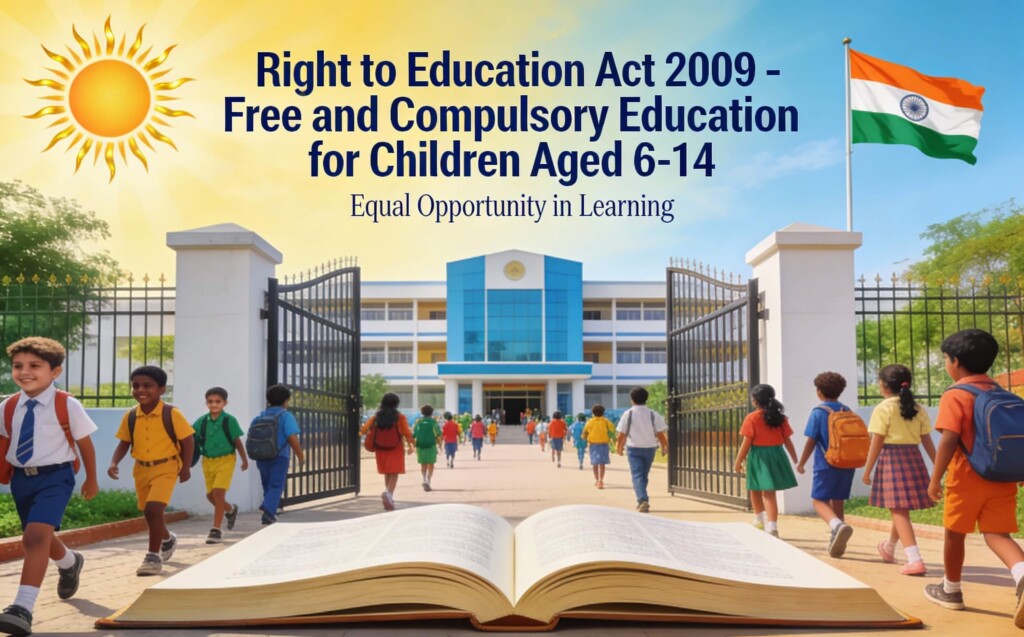
RTE became an Act after approval by Parliament on 4 August 2009. India became the 135th country to make elementary education a fundamental right when the Act came into force on 1 April 2010, granting every child eight years of free and compulsory education. The National Education Policy 2020 later lauded RTE, noting India’s remarkable strides towards near-universal elementary enrolment. Based on RTE’s success, is imperative to increase universal schooling from 8 years to 15 years for the children, by adding three years of pre-school and four years of secondary schooling to strengthen school education.
Looking back, I am amazed that such an epoch-making Bill was almost dropped in 2008. It was my destiny to be transformed from a reluctant onlooker into an ardent activist for RTE. It remains a matter of great satisfaction that I could finalise the draft Bill and steer it through the complex web of government machinery in the corridors of power. It is one of my most memorable achievements